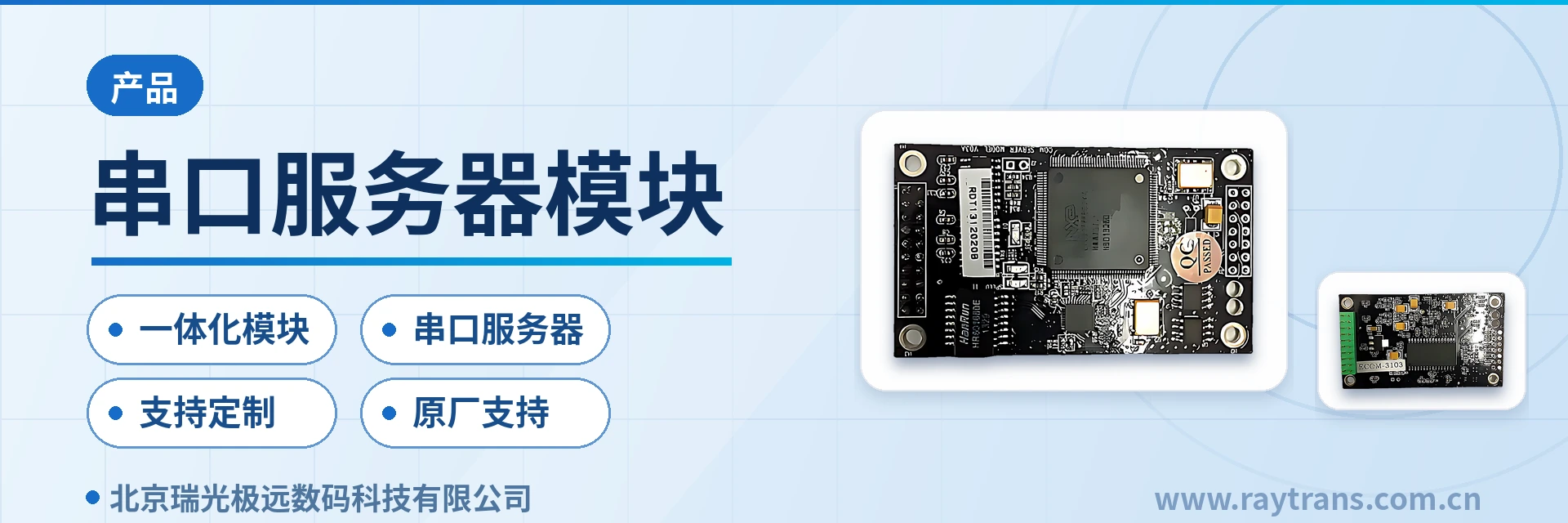
Serial Port Server Module
RS485 RS232 to Ethernet Integrated Plug-in Card Virtual Serial Port No Software Modification Required
Serial port server module. Beijing Ruiguang Jiyuan Digital Technology Co., Ltd. provides technical specifications, selection recommendations, networking approaches and supporting application solutions for this product, with support for customized development and on-site technical support.
The serial port server module is an integrated module developed by Beijing Ruiguang Jiyuan Digital Technology Co., Ltd. It converts data from serial devices such as RS232, RS485, and RS422 directly into Ethernet packets, giving serial devices like telecontrol equipment, PLCs, instruments, and sensors—which could originally only support local short-range communication—the ability to access IP networks. The module integrates serial-to-Ethernet conversion, protocol encapsulation, and remote maintenance into one unit. As a compact bridge converter, it performs well in product showcases for industrial sites. Among its functions, RS485-to-Ethernet and RS232-to-Ethernet conversion are particularly practical. It supports customized development and on-site technical support, making it suitable for scenarios such as industrial automation private networks, unattended sites in electric power and rail transit, and remote data acquisition in the field. As a professional optical multiplexer manufacturer, Raytrans also offers serial-to-Ethernet modules that can be integrated into smart mining communication solutions to meet networking requirements in harsh environments.
Key Specifications at a Glance: Serial port type · RS232/RS485/RS422 and other formats (the manufacturer's technical documentation shall prevail) · Uplink interface · Ethernet · Form factor · Integrated module (card-based) · Data mode · Bidirectional transparent transmission between serial port and TCP/IP · Customization · Customized development supported · Service · Original manufacturer support and on-site technical support
What Is a Serial Port Server Module? Working Principle of a Serial-to-Ethernet Module
The task of a serial-to-Ethernet module is to interface two completely different communication methods: the serial side is an asynchronous data stream measured in bytes without network addresses, while the Ethernet side consists of packet data measured in messages with source and destination addresses. The serial port server module establishes internal receive and transmit buffers, encapsulates the bytes received from the serial port into TCP or UDP packets according to rules and sends them to the network side, and at the same time parses and restores the packets received from the network side into a serial byte stream for the serial device. The serial device still faces the same serial port, while the host faces a network port. In actual product showcases, such modules are also often called bridge converters, playing the role of bridging between the serial port and the network.
The electrical standard on the serial side determines how wiring is done on site. The electrical characteristics of RS-232 follow TIA/EIA-232 (consistent with ITU-T V.28 and V.24 recommendations). It is a point-to-point interface, and the cable length specified by the standard generally does not exceed 15 m, making it suitable for short-distance connections next to equipment. RS-485 follows TIA/EIA-485 and uses a differential two-wire system, allowing multiple slave stations to be connected to the same bus, with a transmission distance of up to about 1200 m at low rates, making it suitable for measurement and acquisition buses. RS-422 is a four-wire full-duplex differential interface, used in applications requiring independent bidirectional transmission and reception. For this reason, RS485-to-Ethernet and RS232-to-Ethernet conversion have become the two most common serial networking methods on site.
On the network side, Telnet and RFC2217 (Telnet Com Port Control Option) are commonly used to complete remote serial parameter negotiation. The host can also map a remote serial port to a local COM port through virtual serial port software, so that existing configuration and monitoring software can call it in the original serial manner. The serial port server module incorporates these capabilities into a single module, eliminating the need to install a separate box-type serial port server on site.
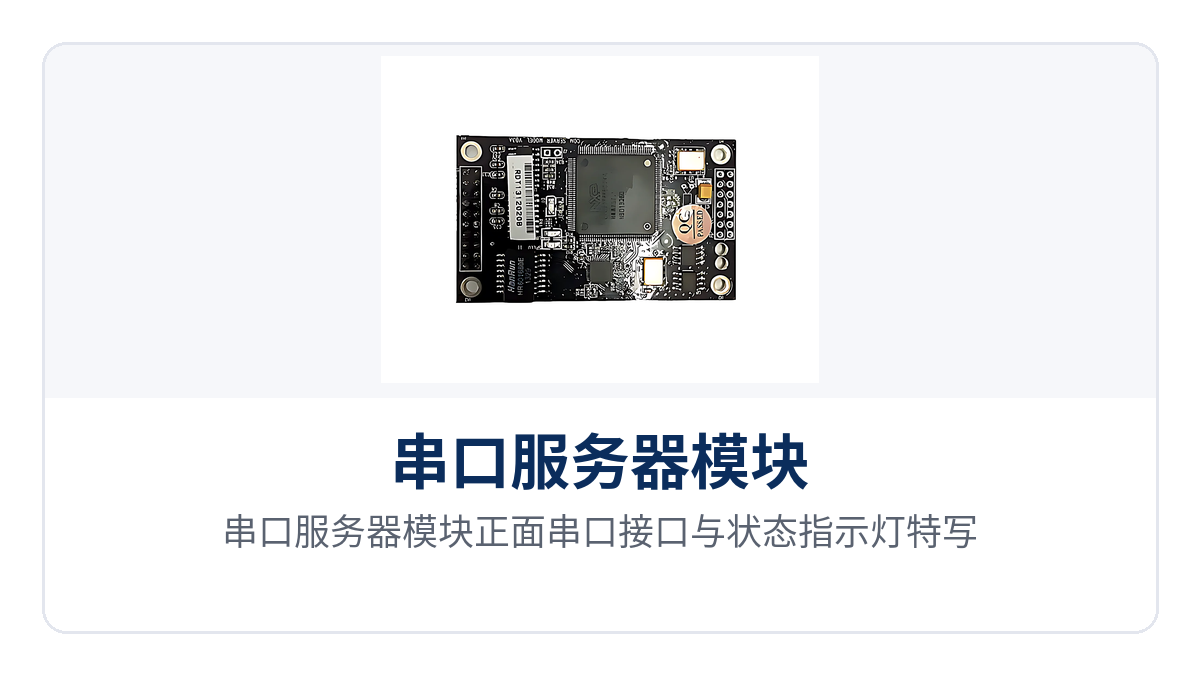
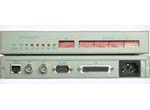
Figure 1: Close-up of the serial port interfaces and status indicator LEDs on the front panel of the serial port server module
Core Functions and Performance Specifications of the Serial Port Server Module
The integrated multi-function serial port server module supports customized development and on-site technical support, integrating serial access, protocol encapsulation, network access, and remote maintenance into a single module. The table below lists the functions and performance specifications of the serial port server module. Product-specific parameters are subject to the manufacturer's technical documentation.
Function | Description |
|---|---|
Serial-to-Ethernet transparent transmission | Bidirectional conversion between RS232/RS485/RS422 serial data and TCP/IP packets; the serial-side byte stream corresponds one-to-one with network-side packets, with no data termination or rewriting |
Integrated multi-function design | Serial access, protocol encapsulation, network access, and remote maintenance are integrated into a single module, requiring only one card slot on site |
Network protocol access | Supports TCP and UDP bearers; on the serial side, Telnet and the RFC2217 serial port control option can be used for remote parameter negotiation |
Virtual serial port | The host maps a remote serial port as a virtual serial port, and existing configuration and monitoring software can call it as a local COM port without rewriting the software |
Modular embedding | Installed as a module/plug-in card in the card slot of equipment enclosures, sharing the rack and power supply with transmission and access equipment, reducing standalone devices in the cabinet |
Customized development | The number of serial channels, interface format, and protocol software are customized per project, with development, commissioning, and on-site technical support provided by the original manufacturer |
Item | Parameter/Specification | Description/Applicable Conditions |
|---|---|---|
Serial interface standard | RS232/RS485/RS422 and other formats | RS-232 follows TIA/EIA-232 and ITU-T V.28/V.24; RS-485/RS-422 follows TIA/EIA-485. The specific format is subject to the manufacturer's technical documentation |
Serial rate | not yet recorded in the knowledge base | The serial rate depends on the format and cable length, and is subject to the manufacturer's technical documentation and commercial confirmation |
Number of serial channels | not yet recorded in the knowledge base | The number of channels is a product-specific parameter and can be customized per project, subject to the manufacturer's technical documentation |
Uplink network interface | Ethernet interface | The standard follows IEEE 802.3; the interface rate and type are subject to the manufacturer's technical documentation |
Network protocols | TCP, UDP, Telnet, RFC2217, etc. | RFC2217 is the Telnet Com Port Control Option, used for remote serial parameter negotiation |
Power supply and power consumption | not yet recorded in the knowledge base | The module form factor usually shares the power supply with the enclosure, subject to the manufacturer's technical documentation |
Operating environment | not yet recorded in the knowledge base | For unattended sites, on-site temperature and protection requirements shall be submitted, subject to the manufacturer's technical documentation |
Installation form | Integrated module (card-based) | Suitable for unattended cabinets in industrial private networks and card-based equipment enclosures |
Management and maintenance | not yet recorded in the knowledge base | The network management method and self-recovery mechanism are subject to the manufacturer's technical documentation and commercial confirmation |
How to Select a Serial Port Server Module?
To select a serial port server module, first check the number and interface format of the serial port devices on site, then the chassis and installation conditions, and finally confirm the protocol software and after-sales support. Only when all three match should price be discussed. As an optical multiplexer manufacturer, Beijing Ruiguang Jiyuan (Raytrans) provides technical specification-based selection and networking solutions from the factory. The following tables can be checked item by item according to the project, and also help form a complete smart mining communication solution.
Selection Dimension | Basis for Judgment | Description/Applicable Conditions |
|---|---|---|
Serial port format | RS-232 point-to-point interface, RS-485/RS-422 multi-point bus interface | The format determines the interface circuit form, whether terminating resistors are required, and the wiring topology |
Number of serial ports | Determined by the number of serial port devices to be networked on site | The number of channels is a product-specific parameter; not yet recorded in the knowledge base, and the manufacturer's technical documentation shall prevail |
Installation form | Plug-in card embedded in an existing equipment chassis, or installed independently nearby | The modular form fits unattended cabinets and shares the rack and power supply with the equipment |
Networks and protocols | Virtual serial port, Modbus RTU to Modbus TCP, TCP/UDP working modes | The scope of software development must be explained to the manufacturer during the selection stage |
Environment and power supply | Equipment room temperature, power supply mode, grounding and protection requirements | Not yet recorded in the knowledge base; the manufacturer's technical documentation and commercial confirmation shall prevail |
Customization and after-sales | Whether customized development and on-site support are required | Supports customized development, factory support and on-site technical support |
What is easily overlooked during selection is the matching relationship between serial port rate and cable length: an RS-485 bus is more stable at long distances and low rates, and blindly increasing the baud rate will raise the bit error rate (BER); RS-232 also needs to be re-evaluated when its wiring exceeds the standard length. On the protocol side, confirm in advance whether the upper-layer software accesses via a virtual serial port or directly via a TCP port, as the two differ in implementation and commissioning methods.
Typical Application Scenarios
Industrial automation private network: connecting on-site serial port devices to the industrial Ethernet
In an industrial automation private network, PLCs, weighing instruments, electricity meters and temperature controllers mostly have only RS-232 or RS-485 interfaces and are scattered at both ends of the production line. Connect the serial ports of these devices to a serial-to-Ethernet module, and connect the module uplink to an industrial switch; the workshop host and the MES system can then access each device by IP address, without separate cabling from every device to the control room computer. In such product showcase scenarios, the common requirements for an industrial serial port server are bus-type RS485-to-Ethernet multi-point access and small-data, long-cycle polling; installing the module nearby according to the bus topology can significantly shorten on-site cabling. If the on-site protocol is Modbus RTU, data can be provided on the network side in Modbus TCP mode; the RS232-to-Ethernet conversion method and register mapping must be confirmed before implementation.
Unattended sites in electric power and rail transit: telecontrol and monitoring serial port data backhaul
Telecontrol, protection and monitoring devices at electric power substations and rail transit sites output operating data through serial ports. Such sites are usually unattended, with only a small amount of optical cable or data channels leading to the superior center. The serial-to-Ethernet module is installed in card slot form into an optical multiplexer or integrated access device, converting serial port data into Ethernet directly at the remote end and backhauling it to the center over the existing transmission channel, so that no additional serial port aggregation is needed at the central end. This networking approach merges serial port networking capability and transmission equipment into the same chassis, reducing the number of devices and points of failure in the cabinet, and also facilitates unified parameter verification and commissioning by the manufacturer.
Field and remote data acquisition: uploading serial port data from unattended sites to the platform
Hydrological, meteorological, pipeline and oil and gas field acquisition points are distributed in mountains and remote areas, where power supply and maintenance conditions are limited, and serial port collectors and sensors need to send data to a remote platform. The serial-to-Ethernet module is installed with the acquisition cabinet and, together with wireless or wired backhaul channels, converts serial port data into IP packets and sends them to the platform; the modular design allows the number of serial ports to be adjusted on site simply by replacing the module, without replacing the unit. When selecting for field scenarios, temperature, power supply and lightning protection grounding conditions should be submitted to the manufacturer for confirmation; product-specific temperature and power supply indicators are not yet recorded in the knowledge base, and the manufacturer's technical documentation shall prevail.
How is a serial port server module networked and deployed?
There are mainly three networking approaches for serial port server modules. The point-to-point approach is simple in structure: one serial port device connects to one module, the module uplink connects to a switch or router, and the host accesses the serial port by IP plus port number. The multi-serial-port aggregation approach suits scattered acquisition points: modules at multiple sites connect to different ports of the same switch, and the central software distinguishes devices by IP and port, without additional central-end aggregation equipment. The same-chassis networking approach installs the module in card form into a card-based device, so that serial ports are converted directly into Ethernet at the remote end and backhauled over the existing transmission channel, with no serial port aggregation needed at the central side.
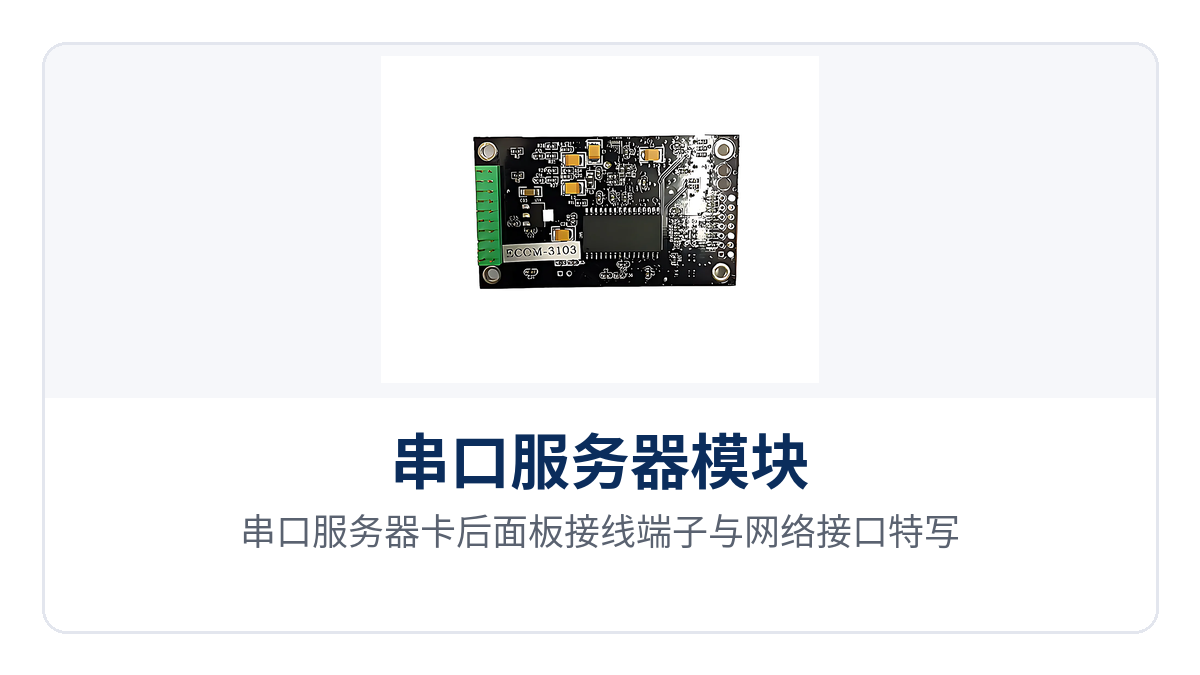
Figure 2: Close-up of the rear panel wiring terminals and network interface of the serial port server card
Several points are worth implementing in advance during deployment: wiring and grounding shall be carried out according to on-site specifications; terminating resistors shall be added as required at both ends of the RS-485 bus, and excessively long branches shall be avoided; cable length and serial port rate shall match, and long lines running at low speed are more stable; IP address and port planning shall be confirmed with the network management party before construction to avoid conflicts with existing network segments; for unattended sites, network management alarms are recommended so that link interruption or device power failure can be detected in time. For product parameters involving power supply mode, temperature range and ingress protection (IP) rating, not yet recorded in the knowledge base; the manufacturer's technical documentation and commercial confirmation shall prevail.