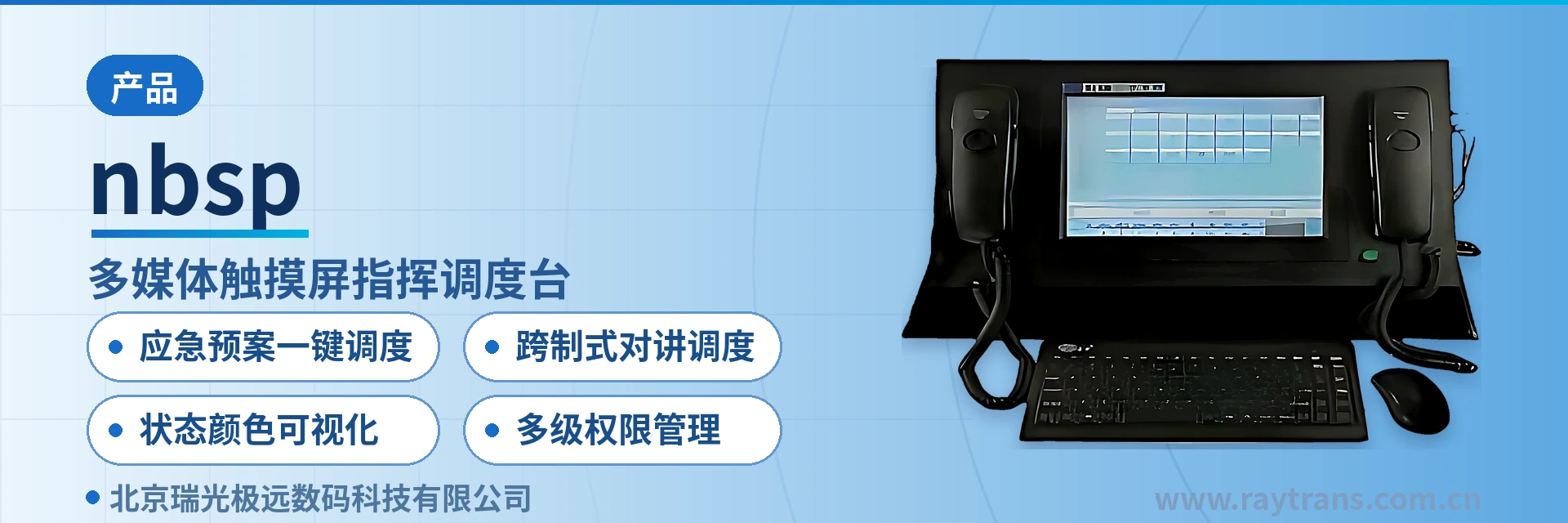
Multimedia Touchscreen Command Dispatch Console
One-touch pre-defined plan linkage, broadcast, conference, SMS; single console unified control of digital and analog, cross-band intercom, graphical
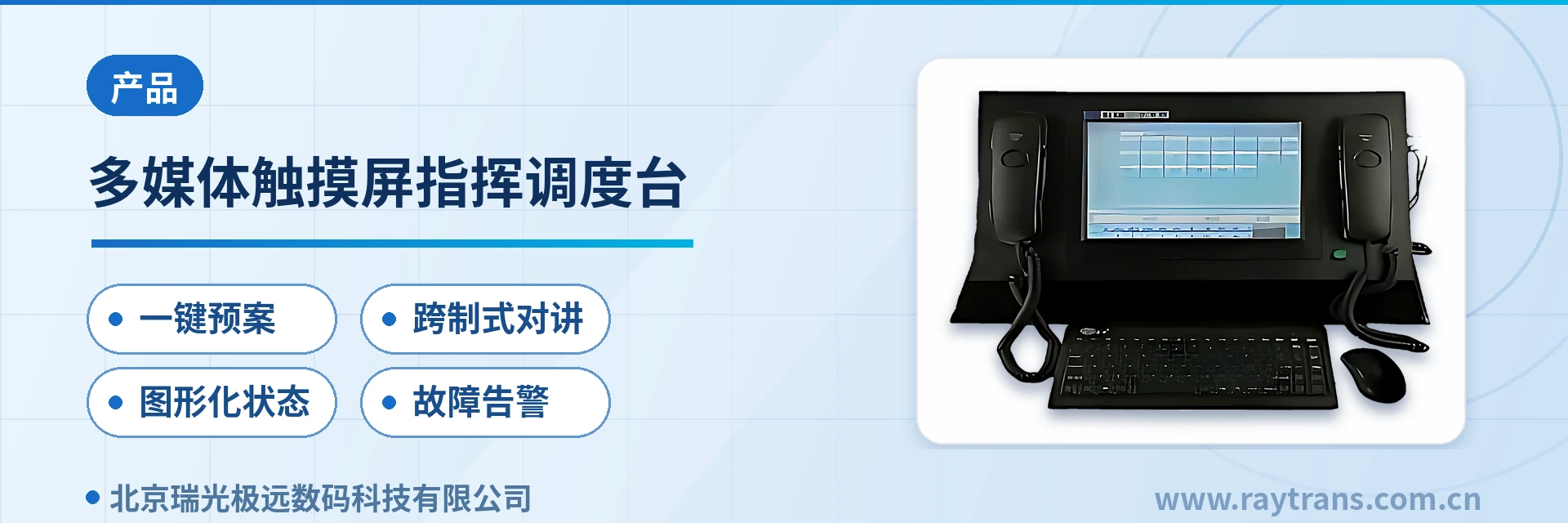
The Multimedia Touchscreen Command Dispatch Console consists of an industrial-grade, fully visualized, digital high-definition LCD touchscreen and two dispatching exchanges; it has built-in multimedia communication command and dispatch control software and registers over an IP network to connect to the integrated multimedia communication dispatch host for overall command and dispatch control of the communication system, and is the core management and control device of the communication dispatch system; the multimedia communication command and dispatch control management interface uses a graphical mode to display terminal device types (IP phones, intercoms, mobile phones, cameras, etc.) in real time, and uses corresponding colors to display current device status (idle, ringing, in call, etc.) in real time; the system implements
The Cross-Format Intercom Command Dispatch Console is the core management and control device of the audio and video dispatching system developed by Beijing Ruiguang Jiyuan Digital Technology Co., Ltd. It consists of an industrial-grade full-view, digital high-definition LCD touchscreen and two dispatching exchanges. The device has built-in multimedia communication command and dispatch control software and registers with the integrated multimedia communication dispatch host over an IP network to exercise overall command and dispatch control over the communication system. It is a key dispatch console device in the converged communication command and dispatch system.
The Cross-Format Intercom Command Dispatch Console aggregates wired and wireless terminals such as IP telephones, intercoms, mobile phones and cameras onto a single graphical product showcase command map, presenting idle, ringing and talking states by terminal type in different colors. The dispatcher can complete calls, transfers, conferences and broadcasts by clicking on the map, without memorizing phone numbers or switching back and forth between multiple systems. The operation is simple and efficient, fully demonstrating the cross-format intercom dispatch capability of the multimedia dispatching exchange.
Key Specifications at a Glance: industrial-grade full-view LCD touchscreen · two dispatching exchanges · registration with the integrated multimedia communication dispatch host over an IP network · graphical real-time display of terminal types and states · unified dispatching of digital/analog cross-band intercoms · plan buttons linking broadcast, conference and SMS
What kind of device is the Cross-Format Intercom Command Dispatch Console?
The Cross-Format Intercom Command Dispatch Console is a communication dispatch control device that uses an industrial-grade LCD touchscreen as its operating interface and two dispatching exchanges as its core processing units, deployed in emergency command centers, public security and firefighting operation rooms, energy and chemical centralized control centers, and industrial park security duty rooms. The two dispatching exchanges handle dispatch control processing, while the industrial-grade LCD touchscreen provides graphical operation and terminal status presentation.
The device has built-in multimedia communication command and dispatch control software and registers with the integrated multimedia communication dispatch host over an IP network; voice channel setup and conference resources are provided on the dispatch host side. When the number of terminals increases, it is sufficient to expand the access capacity on the main unit side, while the operating interface and scheduling method of the dispatch console remain unchanged.
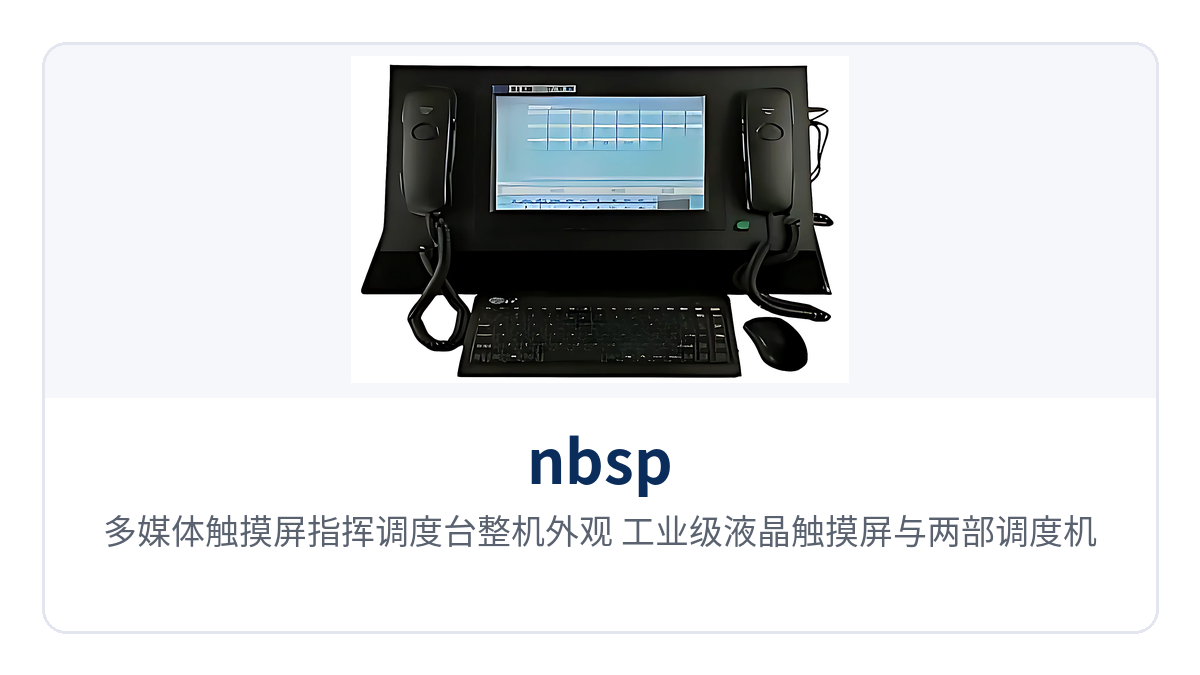
Figure 1: Overall appearance of the Multimedia Touchscreen Command Dispatch Console, an operating surface composed of an industrial-grade LCD touchscreen and two dispatching exchanges
How does one-touch dispatching of a pre-defined plan compress the handling process into a single click?
One-touch dispatching of a pre-defined plan is the capability of pre-solidifying emergency handling processes into interface buttons that execute on a single click when an incident occurs. The dispatch console supports communication emergency plan management, allowing plans for flood control, drought relief, explosion and fire to be pre-edited according to the operating environment, binding the three actions of broadcast, conference and SMS to the same button.
When an incident occurs, the dispatcher clicks the corresponding plan button, and the system automatically executes the configured communication dispatching work: automatically broadcasting the alarm through sound reinforcement, automatically initiating a conference with the responsible persons, and automatically sending incident short messages (SMS). The plan button triggers broadcast alarm, conference and SMS linkage dispatching in one touch, compressing the previous handling process of dialing item by item and notifying one by one into a single click.
Broadcast alarm: automatically plays warning voice over sound reinforcement to the designated area; the audio source can be an internal sound file, an external audio source or a TTS file.
Conference convening: automatically initiates a conference with the responsible persons, and members join the conference according to the list pre-set in the plan.
SMS notification: automatically sends incident short messages (SMS) to responsible persons, delivered simultaneously to internal terminals and external mobile network phones.
Cross-format intercom dispatch: how does a single device uniformly dispatch digital/analog intercoms of different formats across frequency bands?
Cross-format intercom dispatch brings intercoms of different frequency bands, different models and different formats (digital/analog) into the same dispatch interface, with the dispatcher controlling talk rights uniformly. The intercom terminals carried by firefighting, public security, armed police, electric power inspection and industrial park security personnel often come from different manufacturers and operate on different frequency bands, making it difficult for them to join each other's networks and communicate when each forms its own network.
A single device can uniformly dispatch digital/analog intercoms of different formats across frequency bands, with talk rights controlled through the dispatch software interface. The commander can directly specify the speaking order and perform barge-in announcement at any time, without changing devices on site or adding a separate conversion gateway, so on-site communication is no longer split into several isolated networks that cannot communicate with each other.
The states of intercom terminals are presented on the dispatch map with icons and colors just like wired terminals, and are uniformly incorporated into call, group call, talkgroup call and conference. Cross-format intercom dispatch lets one dispatch console manage the wireless terminals of multiple teams at the same time, so command intent no longer relies on relaying one terminal at a time.
How does the graphical interface display idle, ringing and talking states of terminals in real time by color?
Status color visualization is the basic working mode of this interface: the management interface graphically displays terminal device types (IP telephones, intercoms, mobile phones, cameras, etc.) in real time, and uses corresponding colors to display current device status (idle, ringing, talking, etc.) in real time. Terminal types and states are readable on the same map at the same time, without querying each terminal individually.
The graphical interface displays idle/ringing/talking states of terminals in real time by color, so the duty operator can tell at a glance which terminals are available, which are talking and which incoming calls have not yet been answered. The monitoring function also displays missed calls, unregistered terminals and incoming call queuing, and presents communication failure alarms and fault logs in a centralized way, so troubleshooting no longer requires switching back and forth between multiple systems.
How does multi-level permission management separate the dispatch rights of different duty job roles?
Multi-level permission management separates the operating scope of different job roles through group management, account management and hierarchical collaborative dispatching. System management provides four configuration items: group management, account management, multi-level permission management and hotline management. Dispatcher accounts are assigned to corresponding groups and granted dispatchable terminal scope by level.
The dispatching requirements of day-shift duty, night-shift duty and holiday duty are not the same. Service policies for nights and holidays can be set separately to adjust ringing and transfer rules. Daily dispatching and emergency handling can therefore run under the same account system with separated rights, and misoperations by low-permission accounts will not affect key dispatching links.
What functions does this dispatch console provide?
The functions of this dispatch console cover basic calls, dispatching, broadcast, trunking intercom, conference, SMS, electronic fax, emergency plans, monitoring and system management, with service policies additionally set according to duty periods. The function items and their descriptions are listed in the table below for item-by-item comparison against your organization's handling processes.
Function | Description |
|---|---|
Basic functions | Click-to-call, call transfer, call forwarding, call park, call pickup, call grabbing, hold/resume, do not disturb (DND), blocking |
Service policies | Service policy settings for nights and holidays, adjusting ringing and transfer rules according to duty periods |
Dispatch functions | Single click, barge-in, forced release, call pickup, monitoring, talk disable, manual/automatic transfer, group call, talkgroup call, conference, dynamic grouping, hierarchical collaborative dispatching |
Broadcast functions | Instant broadcast, scheduled broadcast, announcement, ambient monitoring; the audio source can be an internal sound file, an external audio source or a TTS file |
Trunking intercom | Dispatch intercoms of different frequency bands, different models and different formats (digital/analog), with talk rights controlled through the dispatch software interface |
Conference functions | Conference convening, conference reservation, conference member identity authentication, multiple conference groups, conference process monitoring |
SMS functions | Send short messages (SMS) to internal IP telephones, WiFi telephones, multimedia terminals and GPS terminals, and also to external mobile network phones |
Electronic fax | Import fax files for batch sending; after receiving a fax, save the image and automatically send it to a designated mailbox |
Emergency plans | Pre-edit plans according to operating environments such as flood control, drought relief, explosion and fire; when an incident occurs, click the button to initiate the pre-defined dispatching work |
Monitoring functions | Display of missed calls, unregistered terminals and incoming call queuing; communication failure alarm and fault log management |
System management | Group management, account management, multi-level permission management, hotline management |
What are the key specifications?
Specifications such as device composition, access mode, dispatchable terminals and status display are listed item by item in the table below according to the product documentation. When selecting, you can check them item by item against your organization's existing intercom formats, terminal types and number of duty job roles, and include the configuration items for interfacing with the integrated multimedia communication dispatch host in the checklist.
Item | Parameter/Specification | Description/Applicable Conditions |
|---|---|---|
Equipment composition | Industrial-grade LCD touchscreen + two dispatching exchanges | The touchscreen handles graphical operation, and the two dispatching exchanges perform dispatch control processing |
Display mode | Industrial-grade all-round visible, digital high-definition LCD touchscreen | The graphical user interface (GUI) displays terminal types and status in real time |
Built-in software | Multimedia communication command and dispatch control software | Carries services such as dispatching, public address (PA), intercom, conferencing, short message service (SMS), fax, pre-defined plans and monitoring |
Access mode | IP network registration | Connects to the integrated multimedia communication dispatch host, which provides voice channels and conference resources on the main unit side |
Dispatchable terminals | IP telephones, WiFi telephones, intercoms, mobile phones, cameras, multimedia terminals, GPS terminals | Unified dispatching of wired and wireless terminals |
Status display | Idle, ringing and in-call states distinguished by corresponding colors | Presented by terminal type and refreshed in real time |
Intercom format | Digital/analog, different frequency bands, different models | Unified talk right control through the dispatch software interface |
Broadcast audio source | Internal sound files, external audio sources, TTS files | Supports instant broadcast and scheduled broadcast |
Permission configuration | Group management, account management, multi-level permission management, hotline management | Dispatch scope divided by job role and duty level |
Dimensions, weight, power supply, operating environment | Not yet recorded in the knowledge base | Subject to product documentation and commercial confirmation |
Indicators such as the dimensions, weight, power supply mode and operating environment of the equipment are not yet recorded in the knowledge base. As the core management and control equipment of the converged communication command and dispatch system, it is recommended to refer to the product documentation and commercial confirmation before purchase, and to calculate uniformly together with the access capacity on the main unit side.
What differentiated value does it offer compared with a conventional dispatch console?
Differentiation Point | Specific manifestation |
|---|---|
One-touch dispatching of pre-defined plans | The plan button triggers linked dispatching of PA announcements, conferences and SMS with one touch |
Cross-format intercom dispatch | A single unit can uniformly dispatch digital/analog intercoms of different formats across frequency bands |
Visualized status colors | The GUI displays terminal idle/ringing/in-call status in real time by color |
Multi-level permission management | Group management, account management and multi-level permission management work with hierarchical collaborative dispatching to divide authority by job role |
Typical application scenarios
Emergency command and flood control and drought relief
Flood, drought and emergency incident handling require simultaneous visibility of telephones, intercoms, mobile phones and video on one interface. The cross-format intercom command dispatch console brings rescue team intercoms, duty room IP telephones, manager mobile phones and video surveillance into the same dispatch view, completing one-touch calls, group calls and conference convening with a single click, without relaying instructions between multiple systems, and audio and video dispatching information is presented synchronously.
The plan button links PA announcements, manager conferences and incident short messages (SMS) into one automatic flow, so that instruction issuance and personnel assembly advance in parallel. Missed calls, unregistered terminals and communication failure alarms are centrally indicated during handling, and afterwards the fault log can be used for traceback, meeting the recording requirements of long-duration duty during flood control and drought relief.
Public security, firefighting and armed police operations
Multi-format intercoms, video transmission and telephones commonly found at operation sites need unified dispatching at the same command seat. A single multimedia dispatching exchange can uniformly dispatch digital/analog intercoms of different formats across frequency bands, and the commander issues instructions directly through talk right control without temporarily deploying conversion gateways, so on-site communication is not fragmented by different formats.
The GUI presents participating units by group on the dispatch view, with colors distinguishing idle, ringing and in-call states, so who is online and who is in a call is visible at a glance. Hierarchical collaborative dispatching organizes dispatch relationships by command level, and with barge-in, forced release, monitoring and talk disable, superior commanders can intervene in on-site calls immediately, achieving efficient command and dispatch.
Energy, chemical and industrial park security
Between centralized control stations, process areas and tank farms, there are often wired dispatch telephones, explosion-proof intercoms and video surveillance at the same time. The cross-format intercom command dispatch console incorporates these terminals into the same interface, so the inspection team in the explosion-proof area can talk directly with the central duty room, and announcement and ambient monitoring are used for PA notification in process areas and on-site sound verification.
Multi-level permission management divides accounts and groups by job role, with separate authorization for daily inspection dispatching and emergency linkage. Electronic fax can distribute notices in batches, and SMS can be sent synchronously to internal terminals and external mobile network phones, so patrol posts, gatehouses and the surveillance center of industrial park security handle incidents collaboratively within the same converged communication command and dispatch system.