IDM MCC6000A Dual-Host Dual-System Server
1U dual main board
In some small converged communication systems, the system needs to support both Linux and Windows environments to meet application and service deployment requirements, and only medium computing performance is required. If a high-performance server is purchased, a virtual machine environment must be installed to implement a dual-system environment, which reduces server utilization efficiency; moreover, such servers are often large in size and unsuitable for portable field use. Therefore, a compact dual-system server that can accommodate two computer main boards is required.
What Is a Dual-Host Dual-System Server
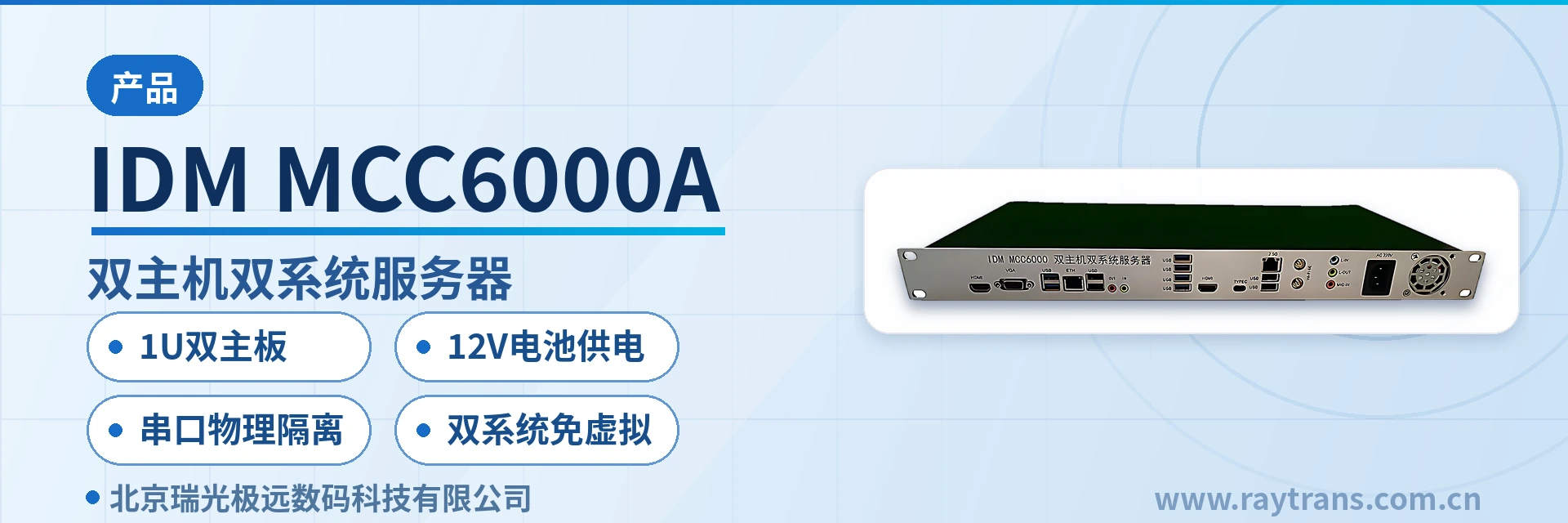
The dual-host dual-system server IDM MCC6000A is a dual-system server developed by Beijing Ruiguang Jiyuan Digital Technology Co., Ltd., featuring two computer main boards built into a 19-inch 1U chassis. It is used in small converged communication, triple-play and emergency command systems to simultaneously host two application environments, Linux and Windows, allowing both systems to run in parallel within a single device. In a small converged dispatching system, the SIP softswitch system usually runs on Linux, while the command and dispatch server usually runs on Windows; if a high-performance server with a virtual machine were used instead to achieve dual systems, server efficiency would be reduced and the overall unit would be too bulky for portable field use. MCC6000A resolves this contradiction by installing two independent main boards in a single 1U chassis, physically isolating Linux and Windows at the hardware layer and running them in parallel, providing a compact dual-system hosting platform for converged communication command and dispatch systems.
Key specifications at a glance: 19-inch 1U chassis · 1U dual main boards built in · Linux and Windows physically isolated and running in parallel · 12V battery power supply · Linux main board with Intel 610 chipset · Windows main board with Intel 13th Gen I7 13700F
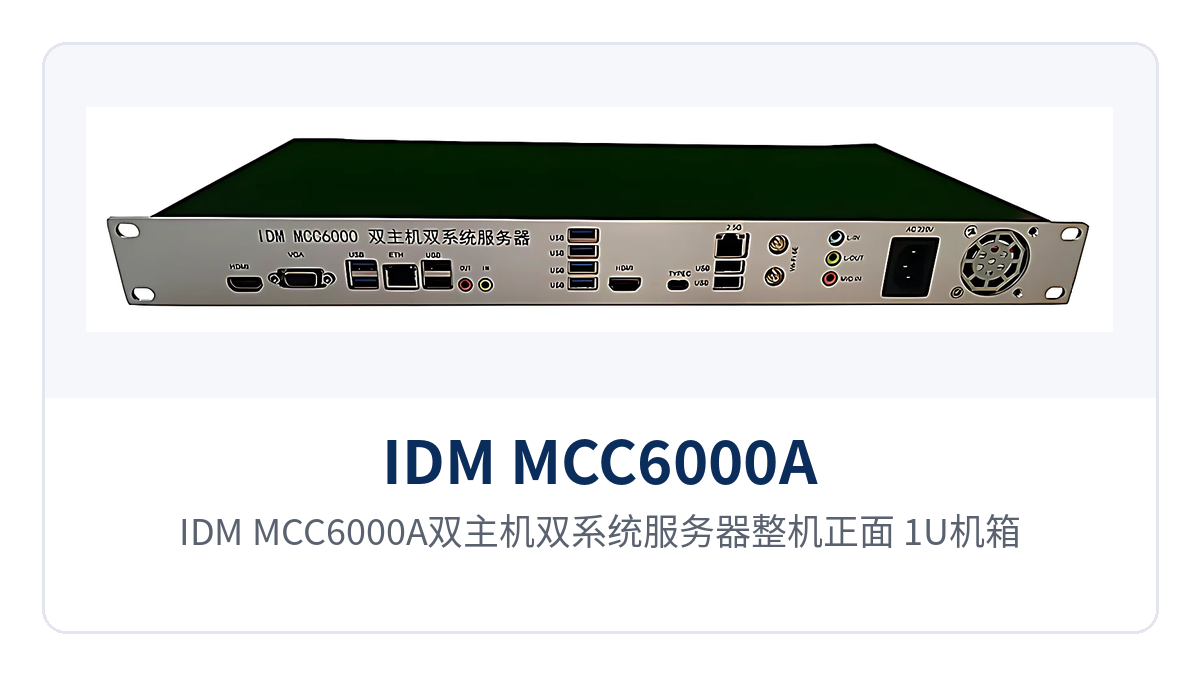
Figure 1: Front view of the IDM MCC6000A dual-host dual-system server — close-up of the 1U chassis and the internal dual main board structure
How Linux and Windows Physical Isolation Achieves Dual Systems Without Virtualization
Linux and Windows physical isolation is implemented by installing two independent computer main boards in a 1U chassis, each hosting one of the two operating systems, Linux and Windows. The two main boards are physically non-nested, each with its own power supply and operation, in a dual-system deployment without virtualization. There is no nested virtual machine environment, and the utilization efficiency of the computer main board computing resources is higher than that of a virtualization solution. The Linux side is used to install the SIP softswitch server, IoT server, audio and video server and user application server; deploying such services on Linux reduces virus infection, enhances security and avoids copyright disputes. The Windows side is used to install user software such as the operating terminal, with an interface and interaction style that are flexible and highly adaptable, making it easy for command and dispatch personnel to get started quickly.
The two physically isolated servers achieve service intercommunication through serial ports and voice interfaces, a key design that ensures overall system collaboration without breaking isolation. Commands of the converged dispatching system are exchanged with the softswitch server through serial ports, and internal and external network voice services are transmitted through voice interfaces. No IP network connection is established between the two systems, thus eliminating direct IP network connections through serial port physical isolation. This design makes MCC6000A particularly suitable for converged dispatching and emergency command scenarios that require the two systems to work together while also requiring physical isolation of the two networks, so that security need not come at the expense of deployment convenience, and services such as audio and video dispatching and product showcase run stably, each fulfilling its own role across the two systems.
Differentiated Value of the Dual-Host Dual-System Server
Differentiated Selling Point | Value to the User |
|---|---|
19-inch 1U with dual main boards built in, dual-system physical isolation, no virtual machine nesting | A single 1U device hosts both Linux and Windows systems, with security at the hardware layer and higher computing resource utilization efficiency than a virtualization solution |
12V power supply can be battery-driven, and the 1U size suits field and vehicle-mounted portable use | Free from dependence on equipment rooms and mains power, it can be relocated and deployed with command vehicles and portable cases, and is easy to transport and install |
The two systems intercommunicate through serial ports and voice interfaces, eliminating direct IP network connections | While the two systems stay coordinated, the transmission method blocks the security penetration risk caused by IP network mutual access |
Core Technical Specifications
The dual main board configuration, chassis and power supply parameters of MCC6000A are shown in the table below, and can serve as a design basis for dual-system deployment in small converged communication systems.
Item | Parameter/Specification | Description/Applicable Conditions |
|---|---|---|
Chassis structure | 19-inch 1U chassis with dual computer main boards built in | Hosts both Linux and Windows systems, with no nested virtual environment |
Power supply mode | 12V power supply, battery power available | Convenient for field and vehicle-mounted use, suitable for portable system deployment |
Linux system main board | Intel 610 chipset | CPU optional 12th Gen I3 (4-core 2.0GHz-2.8GHz); I3/I5/I7 selectable as required |
Linux memory and hard disk | 16G DDR4 dual-channel memory, 1TB SSD | Capacities configured as required |
Linux external interfaces | Gigabit RJ45 network port, HDMI output | Hosts the SIP softswitch, IoT, audio and video and user application servers |
Windows system main board | Intel 13th Gen I7 13700F, 16 cores 24 threads | 32G DDR4 memory, 4TB SATA hard disk, HDMI and DP video output, 7.1-channel 5-hole audio interface |
Windows network interfaces | 1× 2.5G Ethernet electrical interface, 1× RJ45 gigabit network port | Also equipped with 2× USB3.2, 2× USB2.0, 3.5mm audio input and output |
Main board configuration mode | Computer main boards flexibly configured according to user requirements | CPU, memory and hard disk capacity are all adjustable according to application scale |
The functions listed in the table below can be used directly as a functional comparison for dual-system server selection, and also apply to equipment comparison and selection for converged communication command and dispatch systems.
Function | Description |
|---|---|
1U dual main board and dual system | Two computer main boards are installed in a 19-inch 1U chassis, running Linux and Windows simultaneously |
Physically isolated Linux and Windows | The two main boards are isolated at the hardware layer and run in parallel; the dual systems require no virtual nesting and achieve high resource utilization efficiency |
Intercommunication between serial ports and voice interfaces | Dispatch orders are intercommunicated through serial ports, and internal and external network voice is transmitted through voice interfaces, eliminating IP network interconnection |
12 V battery-powered portable operation | 12 V power supply can use batteries; the small 1U size and light weight suit field and vehicle-mounted portable deployment |
Windows operating terminal interface | Suitable for installing user software such as dispatch operating terminals, with a flexible and highly adaptable interface |
Flexible main board configuration as required | CPU options include I3/I5/I7, and memory and hard disk capacity are configured according to application requirements |
How to Choose a Converged Dispatching Dual-System Server
When choosing a converged dispatching dual-system server, check three points first: whether the dual systems are physically isolated at the hardware layer, whether the power supply mode suits the deployment environment, and how the two systems intercommunicate. Physical isolation determines the security level. The MCC6000A uses dual main boards running in parallel instead of virtual machine nesting, building security at the hardware layer. The power supply mode determines whether the server can be taken into field and vehicle-mounted scenarios; the 12 V power supply, which can be battery-driven, lets a portable converged communication device work independently of an equipment room. The intercommunication mode determines whether isolation and collaboration can be achieved at the same time. The MCC6000A conveys dispatch orders through serial ports and transmits internal and external network voice through voice interfaces, eliminating direct IP network connections and avoiding leaving penetrable openings on isolated networks.
For small systems, the MCC6000A can replace the practice of deploying multiple servers separately with a single device: Linux handles services such as SIP softswitch, IoT and audio and video, while Windows handles the dispatch operating terminal, with both systems housed in the same 1U chassis. Compared with deploying multiple standalone servers or adding isolation gateways between networks, the dual-host dual-system server is better suited in size, weight, power supply and cost to scenarios such as military and industrial and mining enterprises that build independent networks according to network isolation requirements, and it also reduces the use of isolation gateways. As a command and dispatch system manufacturer, Raytrans (Beijing Ruiguang Jiyuan Digital Technology Co., Ltd.) uses the MCC6000A to provide dual-system server support for emergency command systems, converged dispatching and audio and video dispatching services, so that product showcase and command and dispatch applications can be efficiently implemented on the same platform.
Typical Application Scenarios
Military and National Defense Private Networks: One Portable Server Under Dual-Network Isolation
Military and national defense private network sites often need to run SIP softswitch services on the Linux side and a command and dispatch server on the Windows side at the same time, with the two systems connected to different independently isolated networks. The MCC6000A carries both systems in parallel within one device through 1U dual-main-board physical isolation. Dispatch orders are intercommunicated through serial ports, and internal and external network voice is transmitted through voice interfaces, eliminating direct IP network connections and enhancing overall security. The 12 V power supply, together with batteries, allows relocation and deployment with command vehicles and portable cases, independent of equipment rooms and mains power, making it easy to quickly set up a converged dispatching platform in the field and meet various on-site service requirements such as audio and video dispatching and product showcase.
Multiple Isolated Networks in Industrial and Mining Enterprises: Multi-System Hosting That Reduces Isolation Gateways
Industrial and mining enterprises usually have multiple mutually independent isolated networks, and the traditional approach relies on isolation gateways to forward data between networks. The MCC6000A uses one dual-host dual-system server to host services that need to run on different operating systems: the Linux system runs the SIP softswitch and IoT audio and video server, while the Windows system runs the dispatch operating terminal. Each system runs independently within its own isolated network, reducing the purchase and maintenance of isolation gateways. Main board configuration allows flexible selection of CPU and memory capacity according to application scale, so that enterprises with moderate computing needs do not have to buy over-specified servers to build their own converged communication command and dispatch system.
Emergency Command and Portable Communications: 12 V Battery-Powered Deployment in the Field and on Vehicles
At emergency command, field operations and temporary handling sites, communication servers often cannot rely on a fixed equipment room for power. The MCC6000A uses a 12 V power supply and supports battery power. With its small 1U size and light weight, it is easy to maintain and convenient to transport and install, suitable for embedding into portable converged communication systems and vehicle-mounted cabinets. The field and vehicle-mounted portable dual-system server can be driven directly by a vehicle battery or portable power source, centrally hosting servers that need to run on different operating systems. It provides a server carrier for on-site implementation of emergency command, three-network convergence and IoT audio and video systems, and also provides reliable converged dispatching support for the rapid deployment of emergency command systems.
Conclusion
The dual-host dual-system server IDM MCC6000A houses dual main boards in a 19-inch 1U chassis to achieve physically isolated parallel operation of Linux and Windows. The dual systems require no virtualization or virtual machine nesting. The 12 V power supply with battery power suits field and vehicle-mounted portable use, and intercommunication between serial ports and voice interfaces eliminates direct IP network connections. It is the dual-system server choice that balances security and portability for converged dispatching platforms, three-network converged communications, IoT audio and video, and emergency command systems. To confirm main board configuration, power supply solutions and pricing information, please contact Beijing Ruiguang Jiyuan Digital Technology Co., Ltd.