Multimedia Dispatching Access Transmission Equipment
, 2×STM-1, 4 physically isolated Ethernet interfaces, N×E1 bonding
The MSAP-CP is a PBX/IPPBX-based converged communications device developed and designed by Beijing Ruiguang Jiyuan. It is meticulously built for telecom carriers, government, industry, and large and medium-sized enterprise users, and is powerful in function. The product is designed with advanced digital integrated circuits, a highly integrated optimized structure, SDH/PDH optical transmission technology, and PBX/IPPBX communications technology. It can be deployed on the enterprise side or in a carrier equipment room, providing users with an integrated audio and video convergence solution.
The 2-channel STM-1 multi-service access transmission equipment is a multimedia dispatching access transmission device developed by Beijing Ruiguang Jiyuan Digital Technology Co., Ltd. It brings together SDH, PDH, PCM and IP access capabilities in a single chassis, so that one device can complete the access and uplink of remote voice, data and video services, providing integrated bearer for audio and video dispatching and converged dispatching. With IDM MSAP-CP as the dispatching and switching core and designed on PBX/IPPBX converged communication technology, the equipment can be deployed in an enterprise-side equipment room or a carrier equipment room, providing an audio-video integrated access solution for electric power private networks, public security/military private networks, and the equipment rooms of telecom carriers and industry customers. It is widely used in service scenarios such as product showcase, multimedia dispatching exchange and dispatch console, and is also one of Raytrans's representative models as an SDH equipment manufacturer in the private network communication field.
Key Specifications at a Glance: 2-channel STM-1 optical access · 4 isolated Ethernet ports · N×E1 bundling · 6 user slots · dual optical port ring network · 128×128 VC-12 cross-connect
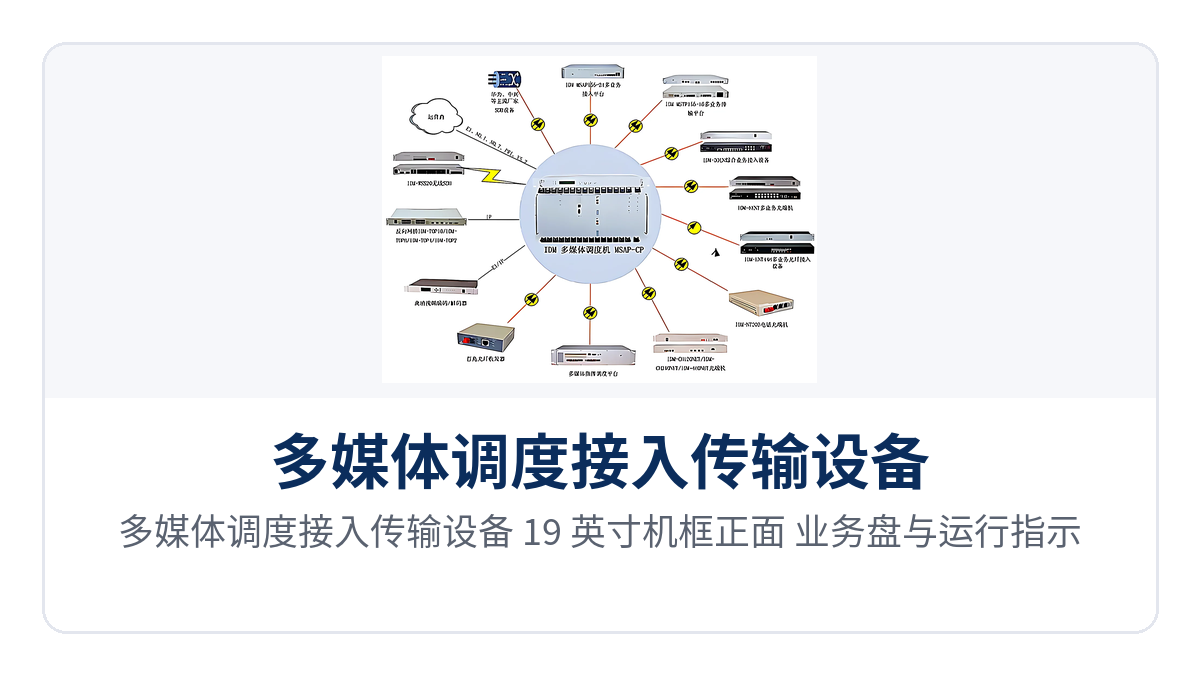
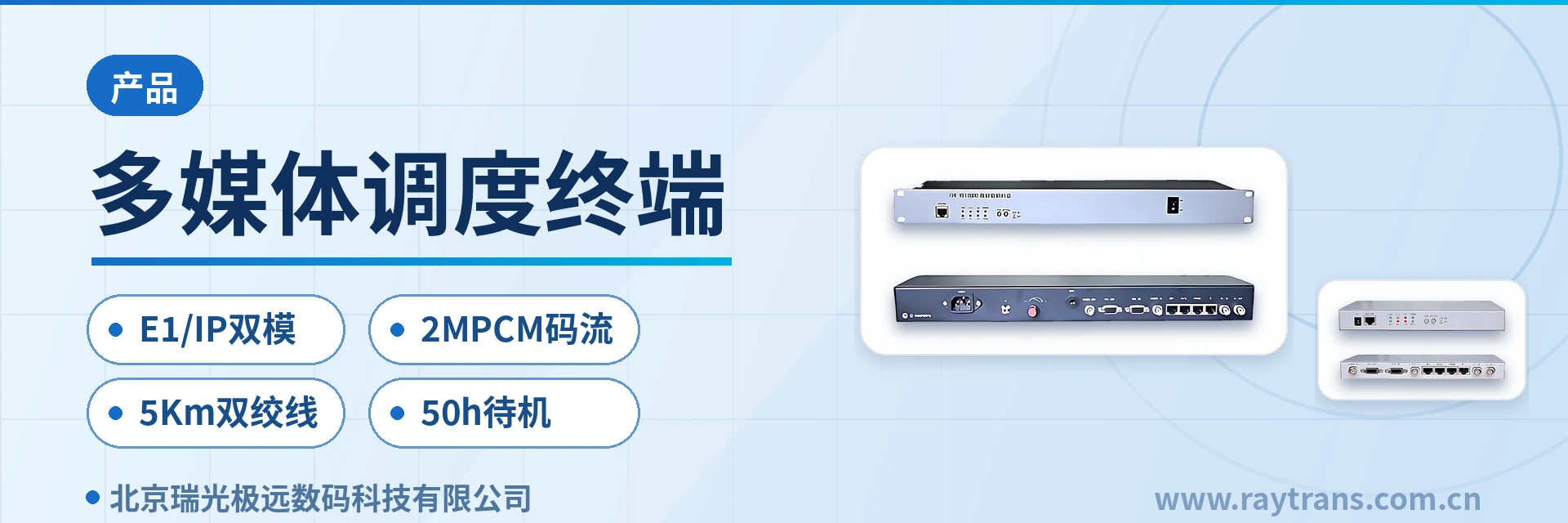
Figure 1: Front view of the 19-inch chassis of the multimedia dispatching access transmission equipment, with service cards and operating indicator LEDs
What access means does the 2-channel STM-1 multi-service access transmission equipment integrate
This type of equipment concentrates into one chassis the access work that used to require multiple devices. IDM MSAP-CP integrates access means such as SDH optical fiber transmission, E1 access, various 64K Z interfaces, IP communication and various wireless communications, providing multimedia communication services such as video, audio, fax and data, and demonstrating strong integration capability in scenarios such as audio and video dispatching and product showcase.
On the voice side, it is compatible with both the traditional telephone network and the IP telephone network. The system adopts a modular design and board assembly, integrates the E1 trunk access of a traditional TDM PBX switch and the functions of analog extension users, supports various signaling modes such as PRI, NO.1, NO.7 and SIP/H.323, and can connect to the traditional PSTN network and carriers' VOIP softswitch platform, providing a reliable voice switching foundation for converged communication and converged dispatching.
The multi-bus structure allows digital trunks, IP trunks and analog trunks to coexist. IDM MSAP-CP implements the three trunk modes based on the multi-bus system of the Telecom BUS, IP bus and ST-BUS, can connect to multiple touchscreen integrated dispatch consoles, and supports seamless connection with servers such as voice recording/voice mail, network management, fax, SMS and email sending and receiving, recording/video recording, GIS, and GPS/GPRS. As the core access platform of a multimedia dispatching exchange, the equipment can work together with the dispatch console and is widely applicable to application environments with high requirements for converged dispatching, such as military emergency communications vehicle solutions and smart mining communication solutions.
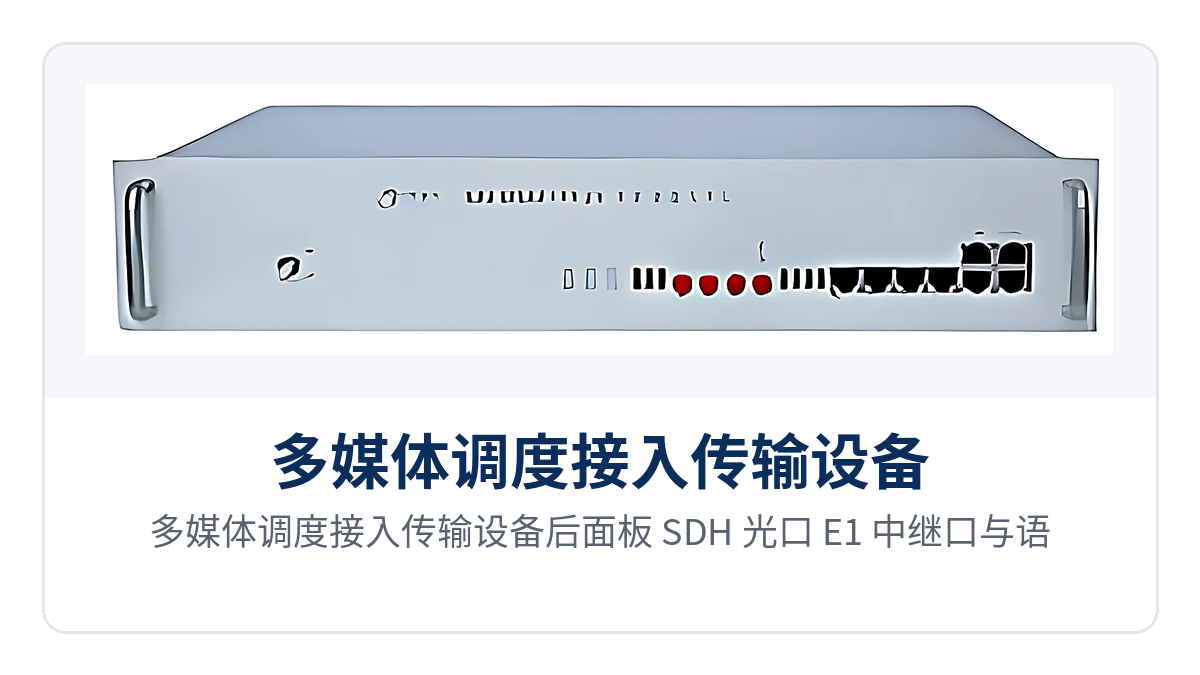
Figure 2: Close-up of the SDH optical ports, E1 trunk ports and voice interfaces on the rear panel of the multimedia dispatching access transmission equipment
Function and Performance Specifications
Function | Description |
|---|---|
Multi-format converged access | Integrates access means such as SDH optical fiber transmission, E1 access, various 64K Z interfaces, IP communication and various wireless communications, providing multimedia communication services such as video, audio, fax and data |
PBX/IPPBX converged switching | Designed on PBX/IPPBX converged communication technology, integrates the E1 trunk access of a traditional TDM PBX switch and the functions of analog extension users, realizing secure and efficient enterprise internal audio and video converged communication |
Multi-signaling support | Supports various signaling modes such as PRI, NO.1, NO.7 and SIP/H.323, and can connect to the traditional PSTN network and carriers' VOIP softswitch platform |
Multi-bus trunking | Based on the multi-bus system of the Telecom BUS, IP bus and ST-BUS, implements digital trunk, IP trunk and analog trunk modes |
Slot mixed insertion | Provides 6 user slots, which can be inserted with PDH service cards, E1 service cards and 64K service cards |
Physically isolated Ethernet | Can provide 4 physically isolated Ethernet interfaces, and can realize arbitrary allocation of N×E1 (N=1~63) bandwidth bundling |
Dual optical port ring network | The main unit provides SDH interfaces with dual optical ports or dual electrical ports, facilitating the formation of a chain network or a redundant ring structure |
Monitoring and alarm | Panel indicator LEDs can display specific alarm states, and the equipment can output alarm information, providing F (100Base-T) and f (RS232) network management interfaces |
Interfacing with servers and dispatch consoles | Can connect to multiple touchscreen integrated dispatch consoles, and supports seamless connection with servers such as voice recording/voice mail, network management, fax, SMS and email sending and receiving, recording/video recording, GIS, and GPS/GPRS |
Microwave extension | IDM WS20 consists of an IDU, an ODU and an antenna, supports conversion from STM-1 optical signals to 2.4G, 5.8G/15G microwave signals, and provides 1 or 2 STM-1 optical ports |
Item | Parameter/Specification | Description/Applicable Conditions |
|---|---|---|
Optical interface | 2-channel STM-1 optical access | The main unit provides dual optical port or dual electrical port SDH interfaces, facilitating chain network or redundant ring structures |
Cross-connect capacity | 128×128 VC-12 | Cross-connection capability of the IDM MSTP155-16, with ITU-T G.813 standard network element timing and path protection functions |
Ethernet | 4 physically isolated Ethernet interfaces, N×E1 (N=1~63) bandwidth bundling with arbitrary allocation | Each Ethernet interface is isolated from the others, and bandwidth is bundled and allocated according to service requirements |
Data channel | 2-channel n×64K (n=0-31) V.35/V.11 channels | Provided by the IDM MSAP155-24, used for synchronous data services |
User slot | 6 user slots | Can accommodate PDH service cards, E1 service cards, and 64K service cards |
Service slot | 3 service slots | Provided by the IDM MSTP155-16, can accommodate E1 service cards, FXS/FXO cards, V.24/V.35 cards, Ethernet expansion cards, video cards, and universal service cards |
Clock mode | Local crystal oscillator clock, line-extracted clock, external clock 2MBIT/2MHZ | To meet the clock requirements of various application environments |
Chassis structure | 19-inch standard 2U chassis / 19-inch 1U chassis | Corresponding to the IDM MSAP155-24 and IDM MSTP155-16 respectively, for ease of installation |
Power supply | DC -48V and AC 220V dual mutual-backup power supplies | The IDM MSAP155-24 has dual mutual-backup power supplies; the IDM MSTP155-16 offers DC-48V and AC220V power supply options |
Networking approach | Point-to-point, chain, ring | Can also be jointly networked with a centralized IDM MSAP-CP or centralized MSTP system |
Network management interface | F (100Base-T) and f (RS232) | Complete network management functions, capable of displaying and outputting alarm information |
Intercommunication capability | Can interconnect with the STM-1 optical interface of any standard SDH/MSTP equipment | The IDM MSTP155-16 can serve as an add-drop multiplexer or terminal multiplexer |
Microwave interface | STM-1 to 2.4G, 5.8G/15G microwave signal conversion, 1 or 2 STM-1 optical ports | IDM WS20, suitable for environments where optical fiber is difficult to deploy |
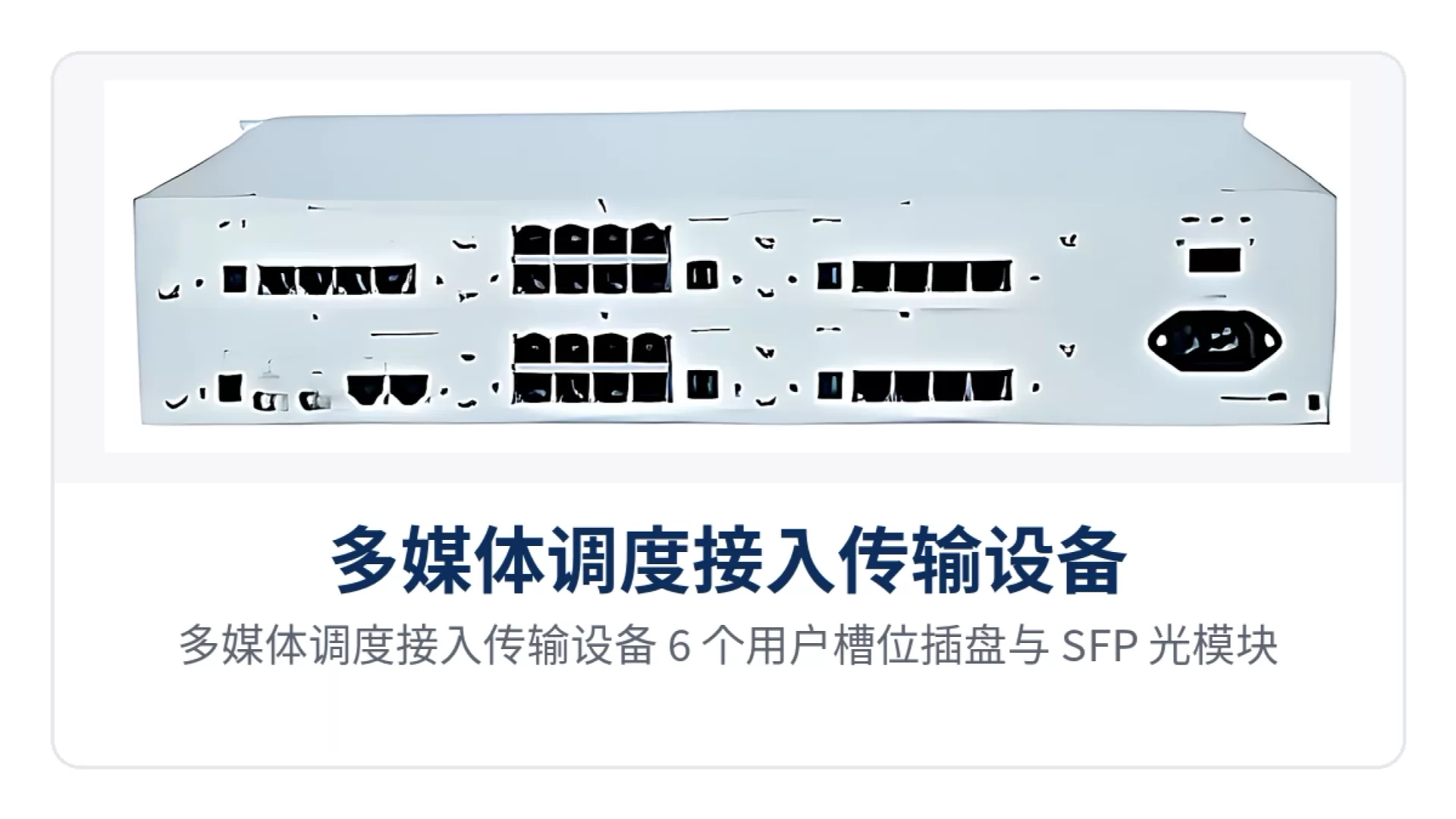
Figure 3: Close-up of the 6 user slots, SFP optical modules, and service card interfaces of the multimedia dispatching access transmission equipment
How to Allocate Bandwidth for 4 Physically Isolated Ethernet Interfaces and N×E1 Bundling
4 physically isolated Ethernet interfaces solve the problem of different service networks on the same device not interfering with one another. The device can provide 4 physically isolated Ethernet interfaces, which are independent of each other. Traffic or a failure on any one interface will not affect the other interfaces. Therefore, services with different security levels, such as surveillance, office, and video, can share one device without having to lay a separate network for each. This is particularly practical for services that require network isolation, such as product showcase and audio and video dispatching.
N×E1 bundling allows bandwidth to scale according to service requirements. The device supports N×E1 (N=1~63) bandwidth bundling with arbitrary allocation. The required bandwidth on the service side determines how many E1 links are bundled into one channel. For capacity expansion, simply increase the number of bundled E1 links, without replacing the unit or rewiring. This flexible bandwidth allocation method enables converged communication and converged dispatching services to scale on demand on the same platform.
Data services and voice services can run in parallel within the same chassis. In addition to Ethernet channels, the IDM MSAP155-24 also provides 2-channel n×64K (n=0-31) V.35/V.11 channels, suitable for carrying synchronous data. These channels, along with E1 and Ethernet services, are allocated by slot within the chassis without contention. As a professional SDH equipment manufacturer, Raytrans offers multimedia dispatching exchanges and dispatch consoles that can flexibly adapt to various converged dispatching application scenarios, such as military emergency communications vehicle solutions and smart mining communication solutions.
How to Choose Between Dual Optical Port Ring Networking and Point-to-Point or Chain Networking
Dual optical port ring networking is used to improve the reliability of audio and video dispatching transmission links. The main unit provides dual optical port or dual electrical port SDH interfaces, facilitating chain network or redundant ring structures. When any segment of optical cable on the ring is interrupted, services can be rerouted in the other direction without interrupting the sites.
The networking approach is determined by site distribution and switchover requirements. The device supports point-to-point, chain, and ring networking approaches, and can also be jointly networked with a centralized IDM MSAP-CP: use chain when sites are arranged in a line along a railway, highway, or pipeline; use ring when sites require fast self-healing; use point-to-point when the service volume between two sites is not large.
Branch equipment also supports the three networking approaches. The IDM MSTP155-16 can also serve as an add-drop multiplexer or terminal multiplexer for building point-to-point and point-to-multipoint chain and ring transmission networks. It can interconnect with the STM-1 optical interface of any standard SDH/MSTP equipment, making it easy to add sites to an existing SDH network.
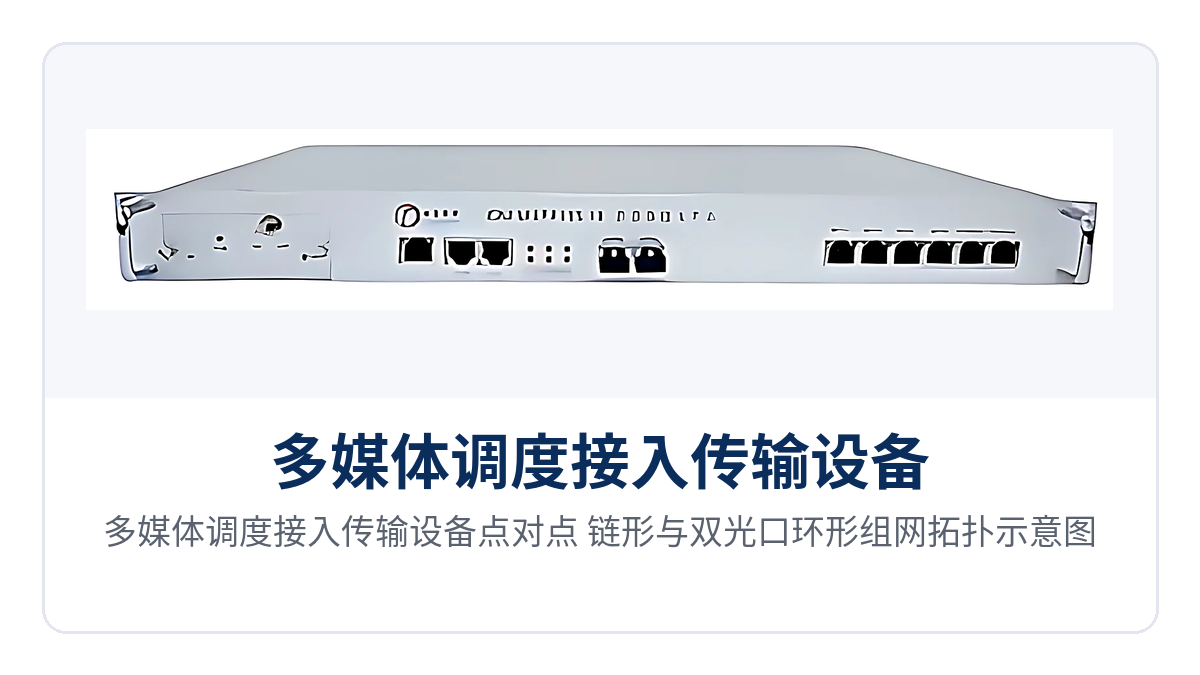
Figure 4: Schematic diagram of point-to-point, chain, and dual optical port ring networking topologies for the multimedia dispatching access transmission equipment
How to Connect Sites Without Optical Fiber: IDM WS20 Microwave Extension
For sites where optical cable cannot reach temporarily, use microwave to extend the STM-1 channel. The IDM WS20 consists of an IDU, an ODU, and an antenna. It supports conversion from STM-1 optical signals to 2.4G, 5.8G/15G microwave signals and provides 1 or 2 STM-1 optical ports, suitable for environments where optical fiber is difficult to deploy. For scenarios with high excavation and cabling costs, such as power transmission lines, mountainous area substations, and field training sites, switching to microwave can shorten the enable time.
The microwave segment and the optical transmission segment are connected by the same type of interface. Both sides of the microwave link interface with standard STM-1 optical interfaces. Therefore, the microwave extension segment and the preceding SDH optical transmission segment can be connected into one channel in terms of service configuration and network management. Voice, data, and video services can be routed through the microwave without changing service configurations.
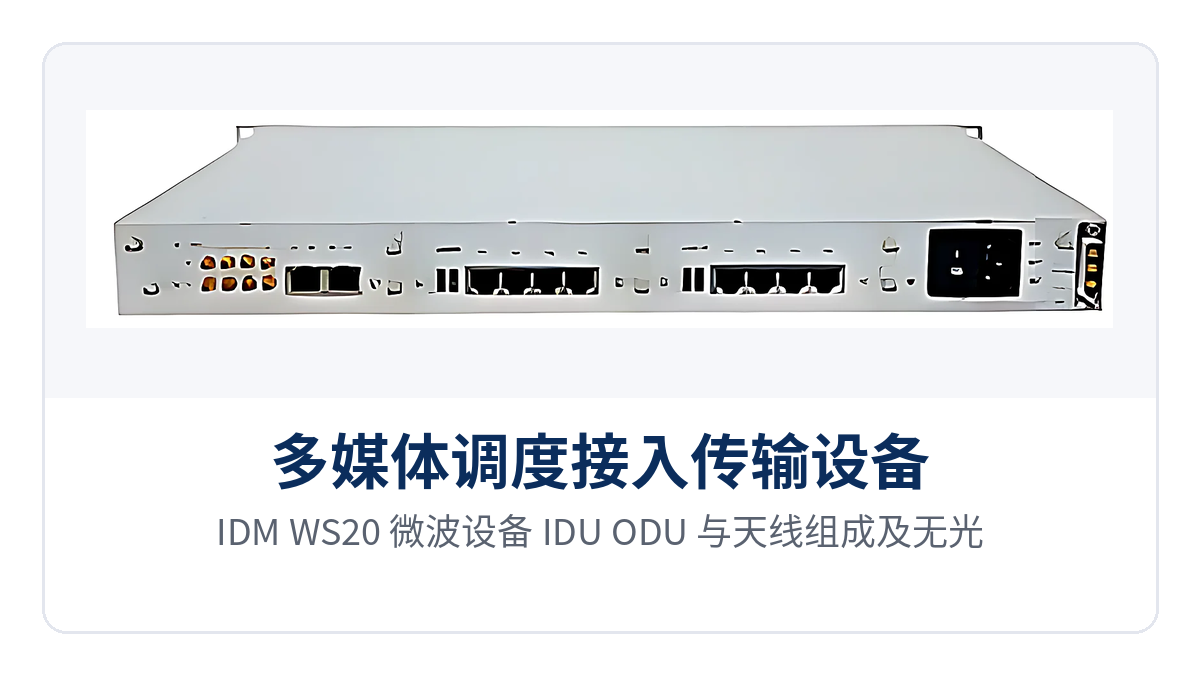
Figure 5: IDM WS20 microwave equipment IDU, ODU, and antenna composition and site extension without optical fiber
How They Are Used in Electric Power, Public Security and Military, and Carrier Equipment Rooms
Electric Power Private Network: Remote Multi-Service Access at Substations
Substations in electric power private networks are scattered in suburbs and mountainous areas, with many sites and diverse service types. Use 2-channel STM-1 optical access to send the E1 protection channels, telephone, and data services of a substation to the main station together. 4 physically isolated Ethernet interfaces carry services of different security levels, such as surveillance, office, and video, with physical isolation between channels. For sections where optical cable routing is tight, use dual optical port ring networking to form a ring. For sites not covered by optical cable, use IDM WS20 microwave extension. One device completes the access of one substation.
Public Security/Military Private Networks: Rapid Networking in the Field and Fiber-Free Environments
Field training and temporary command posts often have no existing optical fiber. In this case, IDM WS20 can use 1~2 STM-1 optical ports to set up transmission channels over 2.4G, 5.8G/15G microwave links, with such devices connected at both sides to terminate voice, data and video services; point-to-point and chain networking support re-erection of sites after they move with the mission, and the site does not depend on fixed pipelines.
Telecom Carriers and Industry Customer Equipment Rooms: Private Network Access Through One Device
The equipment room side cares about whether there are enough slots and whether services can be mixed. The device provides 6 user slots and can be inserted with PDH service cards, E1 service cards and 64K service cards, supporting access of voice and data services such as PDH, E1, FXO/FXS, V.24/V.28/V.35, EM, hotline phone, magneto telephone, X.50, X.58 and 10M/100M Ethernet; with N×E1 bundling and 4-channel isolated Ethernet, one device can collect various leased-line services on the user side and upload them to the backbone network.
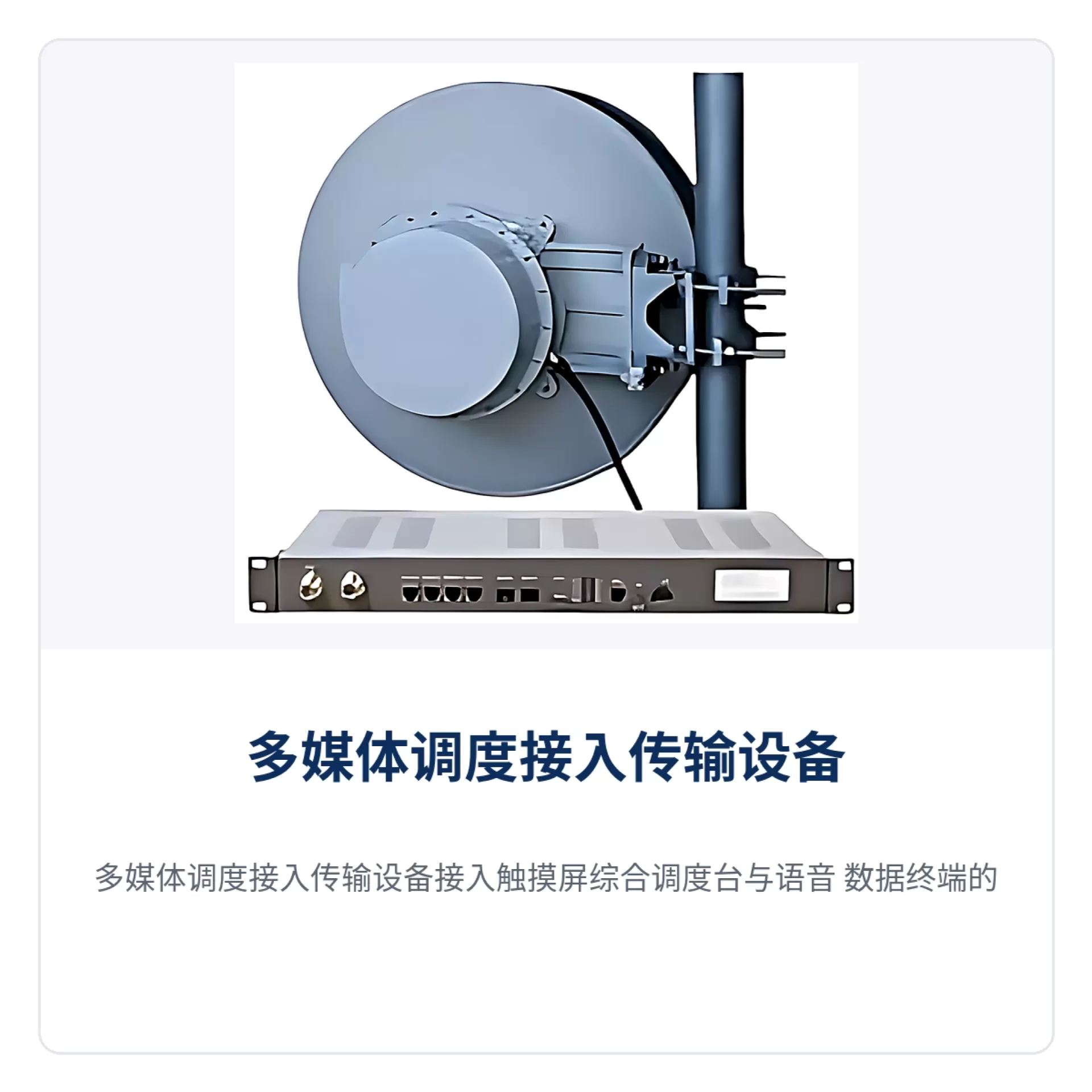
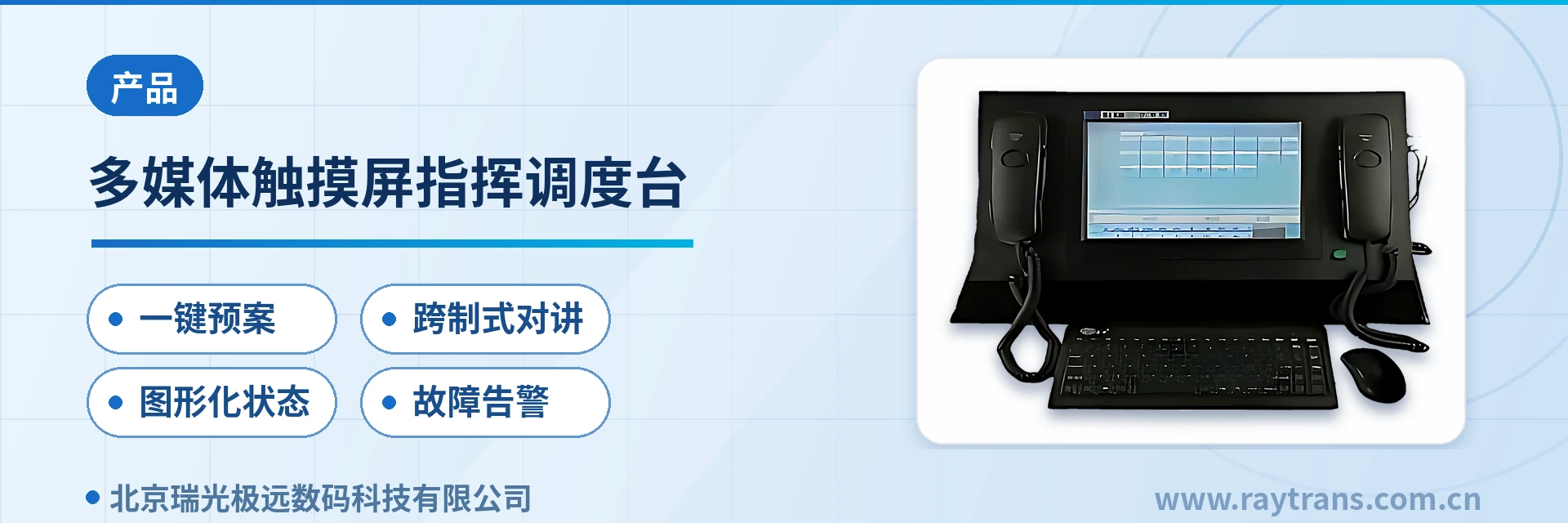
Figure 6: Application diagram of a multimedia dispatching access transmission device connected to a touchscreen integrated dispatch console and voice and data terminals
How to Select a Multi-Service Access Transmission Device
Selection starts with the number of optical interfaces and the networking approach. The main unit provides SDH interfaces with dual optical ports or dual electrical ports, making it easy to form a chain network or a redundant ring structure. Scenarios requiring ring network protection should choose the dual optical port configuration; when sites are arranged only in a chain, the single optical port configuration is sufficient.
Then consider capacity, cross-connect capability and interfacing requirements. The IDM MSTP155-16 has a cross-connect capacity of 128×128 VC-12, features ITU-T G.813 standard network element timing, VC-12 cross-connection and path protection functions, and can interconnect with the STM-1 optical interface of any standard SDH/MSTP equipment, making it suitable for equipment rooms that need both multi-service access and access to existing transmission networks.
In addition, consider service slots, clock and power supply. The IDM MSTP155-16 provides 3 service slots and can be inserted with E1 service cards, FXS/FXO cards, V.24/V.35 cards, Ethernet expansion cards, video cards and universal service cards, for flexible configuration as required; multiple clock modes include local crystal oscillator clock, line-extracted clock and external clock 2MBIT/2MHZ, meeting the clock requirements of various application environments. For power supply, the IDM MSAP155-24 uses DC -48V and AC 220V dual mutual-backup power supplies, while the IDM MSTP155-16 offers DC-48V and AC220V power supply options.