Industrial Telephone Optical Multiplexer
2-channel telephone and 2 groups of Fast Ethernet carried over a single fiber · Sensitivity better than 36dBm · 15
>-
The industrial telephone optical multiplexer is integrated multi-function optical fiber transmission equipment developed by Beijing Ruiguang Jiyuan Digital Technology Co., Ltd. As a representative telephone optical multiplexer product of the professional optical multiplexer manufacturer Ruiguang Jiyuan (Raytrans), the device extends voice and data services to user areas at the remote end, and is used for telephone and data access in military and armed police private networks, electric power and rail transit private networks and unattended field sites. In government private network optical fiber communication solutions, military emergency communications vehicle solutions and electric power and rail transit private network telephone access solutions, this multi-service optical multiplexer plays an important role. The device carries telephone and Ethernet services over the same optical fiber, with a receiver sensitivity better than -36dBm so that calls are still maintained over weak optical links; its power supply mode is DC5 or AC 220V, with an overall power consumption of 15W, adapting to industrial sites with differing power supply conditions. For more product showcase information, follow the official channels of Ruiguang Jiyuan (Raytrans).
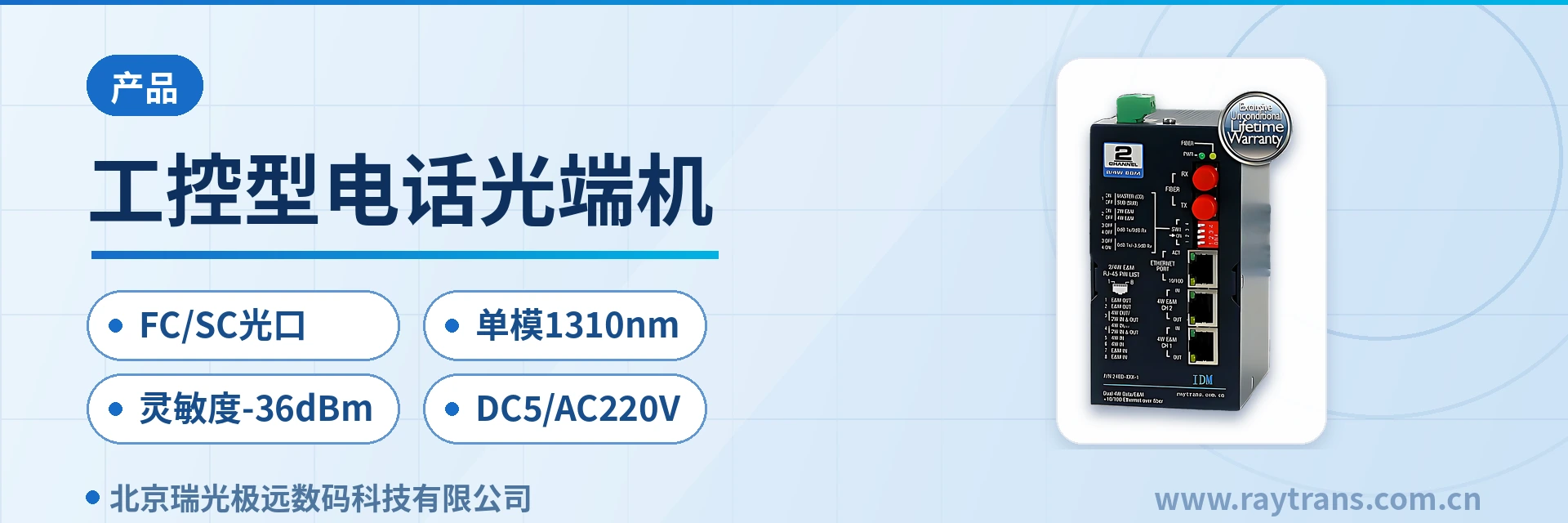
Key specifications at a glance: 2-channel telephone interfaces · 2 groups of shared 100M Ethernet · FC/SC optical port · single-mode 1310nm · sensitivity -36dBm · DC5/AC220V dual power supply · overall power consumption 15W
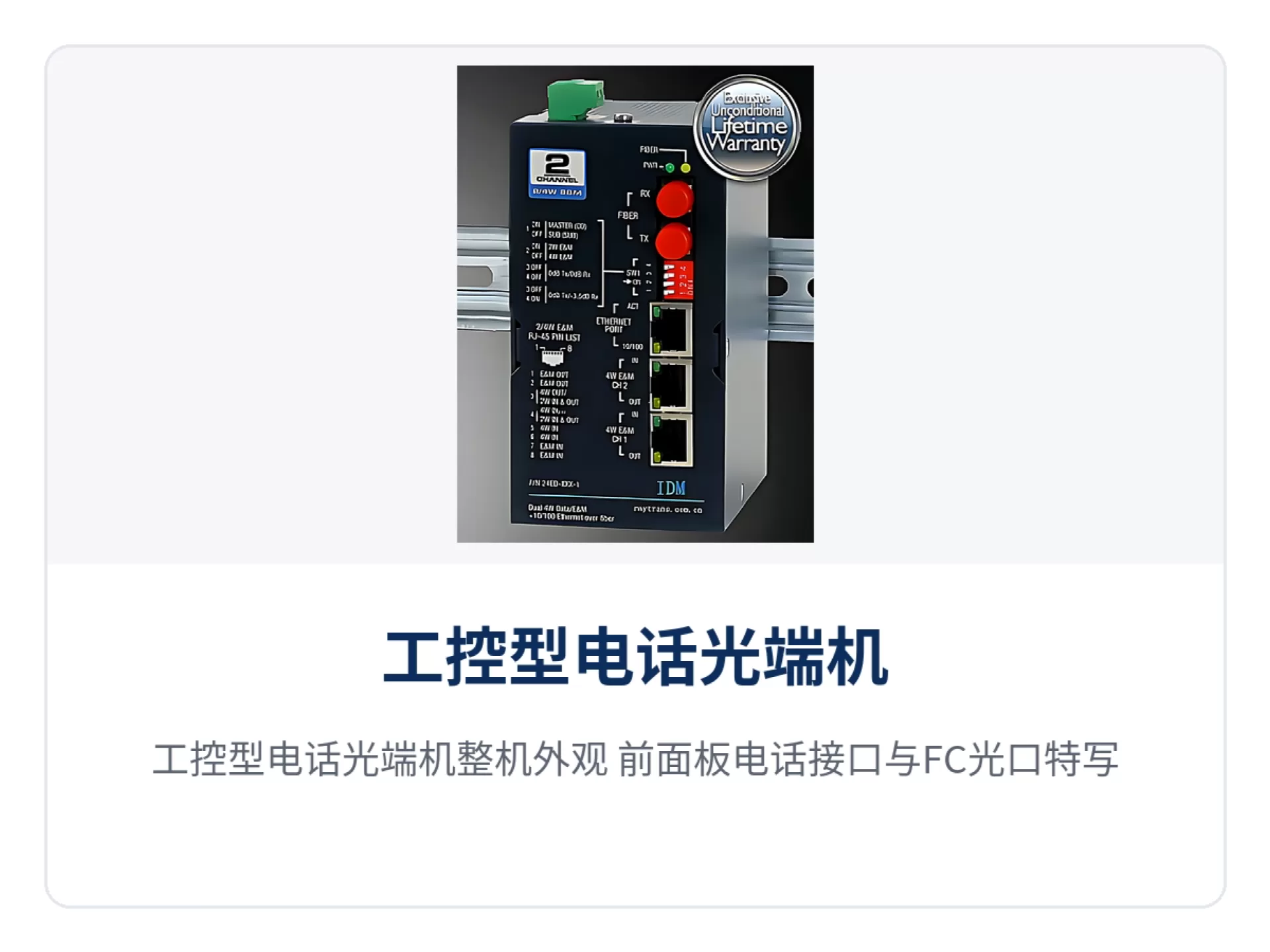
Figure 1: Overall appearance of the industrial telephone optical multiplexer, close-up of the telephone interfaces and FC optical port on the front panel
What kind of device is the industrial telephone optical multiplexer?
The industrial telephone optical multiplexer is optical fiber transmission access equipment between the central office switching network and remote-end telephones, used in pairs: the near end multiplexes the telephone and Ethernet services on the switch side onto a single optical fiber, and the remote end restores the services into telephone interfaces and Ethernet interfaces that can connect to telephones. As an industrial product of the professional optical multiplexer manufacturer Ruiguang Jiyuan (Raytrans), this telephone optical multiplexer adopts an integrated multi-function design, integrating the optical transceiver, multiplexing and interface circuits into an enclosure measuring 124×64×99mm, replacing remote small offices and cross-boundary line extension, and resolving the limitations of twisted pair in terms of bandwidth and transmission distance.
In terms of working principle, analog voice channels are first digitized by A-law compression encoding in ITU G.711 and multiplexed together with Ethernet data onto the optical channel for transmission, then undergo decoding at the remote end and are restored to 300Hz~3400Hz analog voice. The whole link carries services as optical signals, with electrical isolation between the transmitter and the receiver, so call quality in strong electromagnetic environments such as electric power and rail transit is more stable than with copper cable solutions.
What functions does the industrial telephone optical multiplexer provide?
| Function | Description |
|---|---|
| Telephone Service Access | Provides 2 ordinary telephone interfaces with caller ID support, connecting remote-end telephones to the central office switching network |
| Ethernet Data Channel | Provides 2 groups of shared 100M Ethernet channels; the 2 groups of Ethernet interfaces can be arbitrarily divided into VLANs |
| Single-Fiber and Dual-Fiber Optical Transmission | Provides 1 dual-fiber (single-fiber) optical channel for optical fiber transmission, multiplexing telephone and data onto a single optical fiber |
| Loop Power Feeding | Loop current 25mA/channel, providing power feeding for legacy analog telephones and industrial telephones |
| Voice Compression | Uses A-law compression in ITU G.711, with an audio range of 300Hz~3400Hz |
| Alarm Indication | The front panel provides comprehensive alarm indication, making it easy to judge the optical path and service status on site |
| Integrated Multi-Function Design | The telephone, Ethernet and alarm function set is integrated in one device, reducing the number of devices on site and the wiring workload |
Industrial Telephone Optical Multiplexer Technical Specifications
Optical Interface Parameters
| Item | Parameter/Specification | Description/Applicable Conditions |
|---|---|---|
| Interface Type | FC (SC, etc. can be customized) | FC/SC optical ports, with SC, FC and other types optional as required for the project |
| Fiber Mode | Single-mode (multi-mode optional) | Single-mode 1310nm is the default configuration; multi-mode is optional and selected according to the on-site optical cable |
| Optical Fiber Rate | 155bps±50ppm | 155bps precise clock, with the optical rate deviation controlled within ±50ppm |
| Wavelength | 1310nm | Single-mode 1310nm window |
| Transmit Optical Power | -2~-11dBm | Optical power output by the transmitter |
| Receiver Sensitivity | Better than -36dBm | The lower limit of optical power that can be received normally; calls can still be made over weak optical links |
Telephone Interface Parameters
| Item | Parameter/Specification | Description/Applicable Conditions |
|---|---|---|
| Telephone Interface | 2 ordinary telephone interfaces | Supports caller ID; loop current 25mA/channel |
| Audio Range | 300Hz~3400Hz | Standard voice frequency band |
| Impedance | Three-element complex impedance 200Ω+560Ω//0.1μF | Matches the subscriber interfaces of analog telephones and switches |
| Compression | A-law in ITU G.711 | Voice digitization encoding method |
Ethernet, Power Supply and Environmental Parameters
| Item | Parameter/Specification | Description/Applicable Conditions |
|---|---|---|
| Ethernet Channel | 2 groups of shared 100M Ethernet channels | The 2 groups of interfaces can be arbitrarily divided into VLANs |
| Power Supply Mode | DC5 or AC 220V | Power supply access from AC mains in the equipment room and from a direct current source on site are both supported |
| Overall Power Consumption | 15W | Power consumption of the unit during operation |
| Operating Temperature | 0℃~+50℃ | Ambient temperature of the operating environment |
| Humidity | 95%, non-condensing | Operating environment humidity |
| Product Dimensions | 124×64×99 mm | Length × depth × height |
What is the differentiated value of the industrial telephone optical multiplexer?
The differentiated value of the industrial telephone optical multiplexer is concentrated in three verifiable aspects: link optical power margin, optical rate clock accuracy and telephone power feeding compatibility, which are also the indicators usually considered when a private network telephone optical multiplexer is selected. Ruiguang Jiyuan (Raytrans) discloses these three verifiable parameters in its product showcase, so that engineering parties can make a direct comparison during selection.
| Differentiation Point | Practical significance for customers |
|---|---|
| Receiver sensitivity better than -36dBm | Stable calls even over weak optical links: the optical power margin is sufficient, so optical fiber attenuation, splice point and connector losses will not easily consume the call margin |
| 155bps±50ppm optical rate | Accurate clock for long-distance private network transmission: the optical rate deviation is controlled within ±50ppm, giving better assurance of clock accuracy on long-distance links |
| 25mA/channel loop current | Power feeding compatible with legacy industrial telephones: the loop current provides power feeding for legacy analog telephones and industrial telephones, so telephones already in use need not be replaced during private network upgrades |
How far can a telephone optical multiplexer transmit?
How far a telephone optical multiplexer can transmit depends on the optical power budget of the link, not on a fixed distance figure. The industrial telephone optical multiplexer has a transmit optical power of -2 to -11dBm and a receiver sensitivity better than -36dBm; subtracting the two gives an available optical power margin of about 25 to 34dB, and this margin is used to offset the attenuation of the optical fiber itself as well as splice point and connector losses.
When deploying over single-mode 1310nm fiber, the calculation must be carried out section by section according to the actual optical cable length, the attenuation per kilometer and the splice loss, with an aging and maintenance margin reserved; a weak-light long-distance telephone optical multiplexer can support private network links of tens of kilometers when sufficient optical power margin is reserved. The specific distance is subject to the calculation result based on the on-site optical cable parameters, and the optical cable type and optical module type must be matched before a decision is made.
Which industry scenarios is the industrial telephone optical multiplexer suitable for?
Military and Armed Police Private Networks
The military and armed police private networks have scattered sites and long link distances, and often only a single optical cable is available between the duty room, the sentry post and the peripheral points. The industrial telephone optical multiplexer multiplexes 2 telephone channels and 2 groups of shared 100M Ethernet onto a single optical fiber, so private network telephones and the data of IT terminals can travel over the same link; a receiver sensitivity better than -36dBm allows the link to maintain calls even under weak-light conditions, and dual DC5 or AC 220V power supply allows forward sites with different power supply conditions to draw power directly. The unit measures 124×64×99mm and can be installed in a cabinet or a site box, making it suitable for private network sites that require long-term attendance and a good fit for the deployment needs of military emergency communications vehicle solutions.
Electric Power and Rail Transit Private Networks
Substations, distribution rooms and platforms along the line have strong electromagnetic environments, where copper cable voice links are easily disturbed and noise can be introduced by ground potential differences. The industrial telephone optical multiplexer uses optical fiber as the transmission medium, with electrical isolation between the transmitter and the receiver, so voice travels over the optical path free from electromagnetic interference; the loop current of 25mA/channel can provide power feeding for legacy analog telephones and industrial telephones already in use on site, so telephones need not be replaced during dispatch telephone upgrades. With an overall power consumption of 15W and an operating temperature of 0 °C to +50 °C, it suits the normal-temperature operating environment of equipment rooms and platform cabinets, and is a common access device in electric power and rail transit private network telephone access solutions.
Unattended Sites in the Field
Unattended sites such as field pumping stations, oil pipeline valve chambers, and water conservancy and mining sites usually have no personnel on duty, the distance from the site to the center is long and power supply conditions differ. The industrial telephone optical multiplexer supports both DC5 and AC 220V power supply modes, can directly use the direct current power source available at the site, and its overall power consumption of 15W puts little pressure on solar power and storage battery supply; a single optical fiber can backhaul 2 telephone channels and 2 groups of shared 100M Ethernet channels to the center, and the front panel alarm indication makes it easy for O&M personnel to judge the link status and reduces on-site inspection frequency. In multi-service optical multiplexer and government private network optical fiber communication solution contexts, such sites often also use devices of the same series to complete the integrated backhaul of telephone and data.