IDM STM1
IDM STM1
The basic function of the IDM STM-1/GE is to demultiplex Ethernet frames from the GE port (using information carried by the Ethernet frames themselves, such as MAC addresses and VLAN TAGs), encapsulate the different streams of Ethernet frames into GFP frames (forming EoS signals), and then map the GFP frames into different VCGs (each VCG can contain 1 to 63 VC12 channels);
1 Overview:
The IDM STM-1/GE is an aggregation-type EOS device supporting GFP encapsulation. It can aggregate up to 63 EOS signals into GE/FE ports.
The basic function of the IDM STM-1/GE is to demultiplex Ethernet frames from the GE port (using information carried by the Ethernet frames themselves, such as MAC addresses and VLAN TAGs), encapsulate the different streams of Ethernet frames into GFP frames (forming EoS signals), and then map the GFP frames into different VCGs (each VCG can contain 1 to 63 VC12 channels). In the reverse direction, it demaps the VC12 signals from the STM-1 signal, extracts the Ethernet data according to the VCG demapping, aggregates it to the GE port, and adds different tags (such as VLAN TAGs) to the streams from different VCGs at the GE egress.
The IDM STM-1/GE is typically deployed at the central office (CO) end to implement aggregation functions. It can be networked with remote EOS devices to enable long-distance transmission of Ethernet data over TDM networks.
2 Product Features:
- Provides 2 STM-1 interfaces, operating in SDH ring or chain topologies, supporting 1+1 low-order path protection mode;
- Provides 1 optical and 1 electrical Gigabit Ethernet interface plus 2 Fast Ethernet interfaces, supporting full-duplex/half-duplex, auto-negotiation, flow control, and MDI/MDIX;
- SDH clock supports master clock and slave clock modes; in slave clock mode, automatic switching of the clock source is supported;
- Supports ITU-T compliant VCAT, LCAS, and GFP:
• VCAT complies with ITU-T G.7043 standard: Ethernet frames are transmitted to VCG using byte-interleaved transmission;
• LCAS complies with ITU-T G.7042 standard: Supports automatic identification of VC12 link sequence; supports automatic link establishment and teardown of VC12 links;
• GFP complies with ITU-T G.7041 and G.8040 standards: Supports FCS configuration for GFP frames. - Can aggregate data from remote devices into the corresponding GE/FE ports according to VLAN ID configuration; the data from remote devices must be tagged frames; and VLAN IDs between remote devices must not overlap;
- Supports rich Ethernet switching and management functions:
• Supports link aggregation on front-panel switching ports.
• Supports switching port mirroring management.
• Supports bandwidth limiting on switching port egress and ingress.
• Supports MAC address table management, with a table depth of 8K.
• Supports storm suppression on switching ports.
• Supports QoS functionality.
• Supports maximum frame size of 2048 bytes. - Supports Automatic Laser Shutdown (ALS) function on STM-1 and GE optical ports;
- Supports rich fault diagnosis functions: VCG loopback detection and switching port loopback detection;
- Supports 2 in-band management modes for remote devices, including: in-band management of remote devices based on GFP frames, and a management channel based on a management VLAN;
- Provides Console and SNMP network management interfaces, supports online software upgrade, and is easy to maintain;
- Supports rich network management functions, including: configuration management, topology management, resource management, alarm management, performance management, maintenance functions, system management, and security management;
- Dual power supply redundancy design, total power consumption <30W, stable and reliable operation.
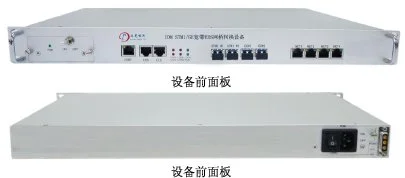
- Adopts standard 19-inch 1U chassis with dual power supply redundancy design.
3 Typical Applications
3.1 Point-to-Point Application
In point-to-point applications, two ends are interconnected via STM-1 optical directions to achieve point-to-point interworking of GE and FE services. The application is shown in Figure 1 below.
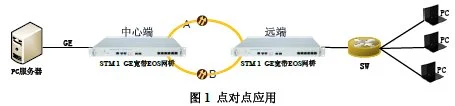
This device provides a GE optical port that can be directly connected to a Media Converter to enable Gigabit Ethernet service access for remote areas. The application is shown in Figure 2 below.
3.2 Used with Media Converter
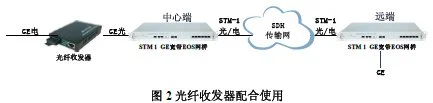
3.3 Multi-Direction Tree Topology
This device provides 2 STM-1 optical ports, which can correspond to 2 directions respectively, connecting to 2 remote bridge devices to provide GE and FE service access respectively. The application is shown in Figure 3 below.
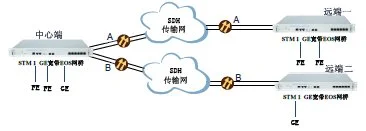
Figure 3 Multi-Direction Tree Topology Application
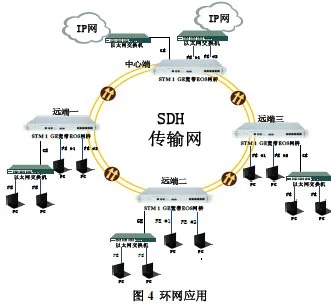
3.4 Ring Network Application
In the ring network access mode, the STM-1/GE can be deployed in the central equipment room of key customers or the corresponding carrier's equipment room. By utilizing VLAN functions (port VLAN and 802.1Q VLAN), the VLAN IDs of the entire private network can be uniformly planned, enabling secure isolation of different network nodes and even different types of services. The STM-1/GE is deployed at user branch nodes to complete access for each branch node, providing optional 2M~N*2M bandwidth data services for each branch user.
FAQs
What is the working principle and function of a media converter?
The rapid advancement of informatization has led to growing demand for multimedia communications such as data, voice…
View answer