E1
E1
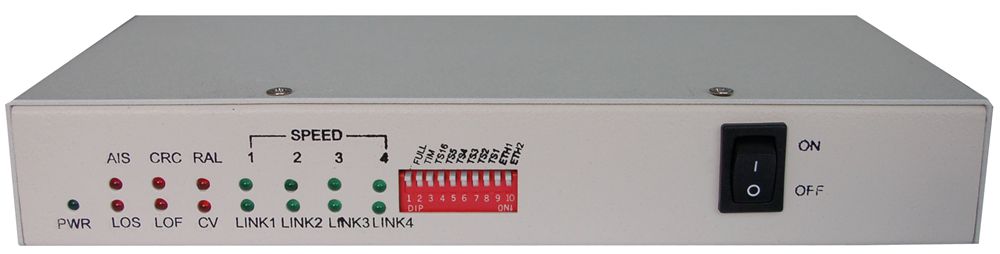
The TRX E1/V.24 Interface Converter completes the conversion between a transparent E1 transmission channel and a V.24 interface. It is widely used in data communication equipment and is suitable for use over fiber optics, microwave, DDN private networks, or other 2M channels, enabling V.24
Overview:
The TRX E1/V.24 Interface Converter completes the conversion between a transparent E1 transmission channel and the V.24 interface. It is widely used in data communication equipment and is suitable for extending the working distance of devices with V.24 interfaces over fiber, microwave, DDN private networks, or other 2M channels. It is widely applied in remote interconnection of surveillance data, image processing, video conferencing, and other equipment.
Main Features:
V.24 (RS232) Synchronous: 64K or 128K Asynchronous: 300~115200bps
E1 channel supports CRC-4 and non-CRC-4 error checking modes;
Maximum transmission line bandwidth is 7.68Mbps, supporting high-quality image surveillance systems;
Automatically detects the number and delay of E1 lines upon reset and automatically selects the available E1;
Allows up to 8ms delay difference among 4 E1 lines; this device is the optimal choice in DDN networks where delay is difficult to determine;
Real-time monitoring of E1 interface status; automatically cuts off lines with LOS or AIS at both ends, and automatically reconnects when the line recovers;
Complete line alarm indication output, providing LOS, AIS, and E1 delay exceeding 8ms alarm outputs;
E1 line loopback function for convenient E1 channel performance testing;
Technical Specifications:
V.24 Interface
1) Synchronous interface rate: 64K, 128K, 256K, 512K, 1024K, or 2048kbps selectable
2) Asynchronous interface rate: auto-adaptive
3) Interface mode: DTE or DCE selectable
E1 Interface
1) Standard: Compliant with ITU-T G.703, G.704, G.823 recommendations
2) The V.24 interface rate can fully occupy the 2048K bandwidth on the E1 line
3) E1 line loopback function
4) Interface type: Unbalanced (75Ω) BNC interface [or balanced (120Ω) RJ-45 interface]
5) Line coding: HDB3 connection mode DCE
Clock Mode: G.703 recovered clock, internal clock, external clock
Clock Mode: Master clock (DCE), user clock (DTE), line clock (DCE) modes selectable; phase adjustment function ensures seamless connection with various devices
Dimensions: 170mm (L) × 150mm (W) × 37mm (H)
Power Supply: AC 220V (DC -48V optional)
Other Specifications:
Input Voltage AC220V or DC-48V Power Consumption <5W
Operating Temperature –5°C to 50°C Storage Temperature –25°C to +55°C Relative Humidity –25°C to +55°C
Operating Environment 10% to 95% Atmospheric Pressure 70kPa to 106kPa
Free from corrosive and solvent gases, dust-free, and no strong magnetic field interference
FAQs
What is the working principle and function of a media converter?
The rapid advancement of informatization has led to growing demand for multimedia communications such as data, voice…
View answer