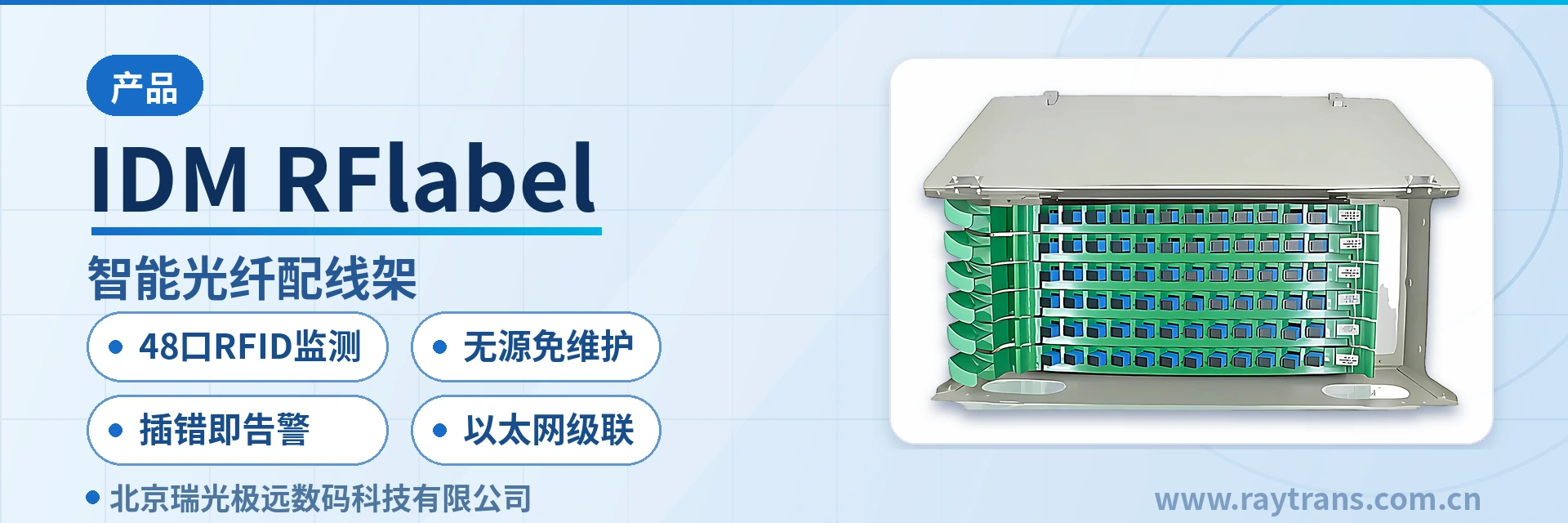
IDM-RFlabel Intelligent Optical Fiber Distribution Frame
48-port port-by-port RFID monitoring, red light alarm on misinsertion, tri-color LEDs eliminate record checking
The IDM-RFlabel intelligent optical fiber distribution frame is typically used for the management of equipment room ODF optical fiber distribution frames. It usually works with the equipment room cable database. RFID tags are affixed to the ends of optical cable distribution frames in the equipment room, and the devices and port numbers connected to each cable and optical cable are recorded in the database. RFID monitoring antennas are affixed to each corresponding port on the ODF distribution frame. If a fiber optic cable or cable head insertion is detected, the database is checked to see whether it is the required line; if not, an alarm is triggered. Each port is equipped with a corresponding indicator LED: red indicates an error, green indicates normal, and off indicates no connection.
IDM-RFlabel Intelligent Optical Fiber Distribution Frame (RFID Optical Fiber Distribution Frame) is an equipment room ODF intelligent patching device developed by Beijing Ruiguang Jiyuan Digital Technology Co., Ltd. It consists of a 48-port optical fiber distribution rack, passive RFID electronic tags, port monitoring antennas, and tri-color port indicator LEDs, and works with the equipment room cable database. As a professional intelligent distribution frame manufacturer, Raytrans applies this highly integrated product at the bridge converter level to automatic acquisition, comparison, and security alarms for the connection status of optical cable and cable ports, replacing manual paper labels and spreadsheets as the identification management method. For electric power and rail transit private network equipment rooms, national defense and classified unattended equipment rooms, and telecommunications and data center ODF O&M scenarios, it turns the port status of distribution frames that previously relied on manual inspection into queryable, alarm-capable, and traceable data, providing an efficient and reliable product showcase solution for electric power private network equipment room patching management.
Key specifications at a glance: 48 optical fiber ports (FC/SC flexibly configurable) · RFID 13.56MHz passive tags (compliant with ISO-14443A, NFC compatible) · collector interfaces ≥4 · splice trays ≥4 · Ethernet cascading for multi-rack management · MQTT/MCP protocol interfacing with the equipment room operation and maintenance intelligent agent
What Kind of Device Is an RFID Optical Fiber Distribution Frame? Basic Principles of ODF Intelligence
An RFID optical fiber distribution frame is an intelligent patching device built on a traditional ODF optical fiber distribution frame. It uses RFID identification and electronic tags to replace paper records, turning the connection status of distribution frame ports into queryable and alarm-capable data. A traditional ODF only performs the physical functions of optical cable fixation, splicing, and termination. What is plugged into a port and whether it is plugged correctly can only be checked by comparing label paper and records, which is costly in manual verification and easily leaves monitoring blind spots.
ODF port monitoring is completed in four steps: RFID tags are affixed to the ends of the optical cable distribution frame, and the device and port number connected to each cable or optical cable are recorded in the database; an RFID monitoring antenna is affixed to each corresponding port on the ODF distribution frame; after a fiber optic cable or cable head insertion is detected at a port, the system retrieves the line information that the port should have from the database for comparison; if the comparison does not match, an alarm is triggered. Each port is also equipped with an indicator LED for on-site indication: red means error, green means normal, and off means no insertion.
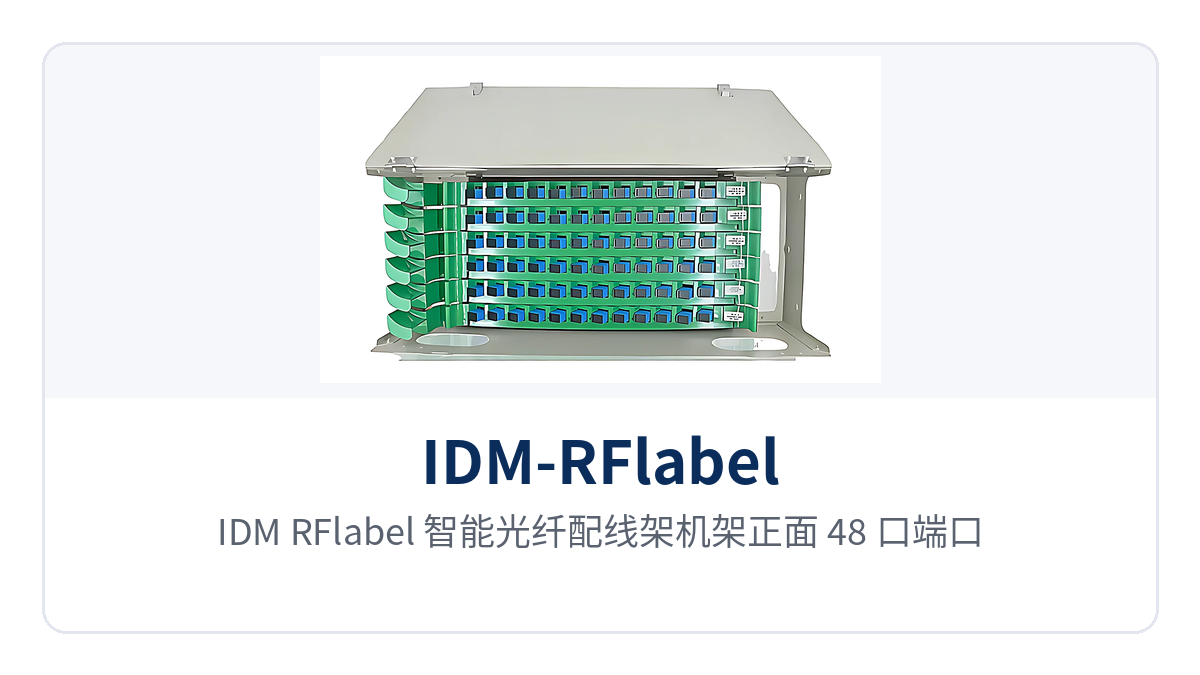
Figure 1: Front of the IDM-RFlabel intelligent optical fiber distribution frame rack with a 48-port array and tri-color port indicator LEDs
The IDM-RFlabel intelligent optical fiber distribution frame adopts an integrated multi-function design, concentrating patching and termination, RFID identification, port monitoring, status alarms, and network management capabilities in the same rack. The equipment room does not need to add an independent identification main unit or alarm box beyond the original distribution frame, reducing cabinet space usage and secondary cabling, and also reducing equipment stacking and points of failure in private network equipment rooms.
How Does 48-Port RFID Monitoring Trigger an Alarm Immediately When a Port Is Plugged Incorrectly?
The implementation of 48-port RFID monitoring is one-to-one guarding of each port: the rack provides 48 optical fiber ports, with the number of FC or SC ports flexibly configurable, and each port is equipped with a set of RFID monitoring antennas and a tri-color indicator LED. Once a fiber optic cable or cable head is inserted into a port, the antenna reads the tag at the end and compares it with the expected record in the equipment room cable database. The database records the device and port number corresponding to that port. A mismatch means a wrong insertion, a crossed insertion, or a wrong line change. The system immediately issues an alarm and lights the red indicator LED of that port.
The point at which a problem is discovered is thus advanced from "the next inspection" to "the moment of insertion". Construction or inspection personnel can pull and reinsert on the spot upon seeing the red light in front of the distribution frame. A green light indicates the line is correct, and an off light indicates the port is idle, so there is no need to return to the duty room to check paper records or spreadsheets. Port status is also reported to the network management system, allowing O&M personnel to query the current status of each port at the remote end, leaving a verifiable record for line change operations.
What Functions Does the Intelligent ODF Architecture Provide?
The value of the intelligent ODF architecture lies in connecting identification, acquisition, comparison, alarms, and network management into a closed loop: tags handle identity, antennas handle acquisition, the database handles judgment, and indicator LEDs and network management handle output. The IDM-RFlabel intelligent optical fiber distribution frame provides the following functions for optical port status monitoring and centralized patching management.
| Function | Description |
|---|---|
| Automatic acquisition of optical fiber port information | Port monitoring antennas automatically read RFID tags at the ends, acquire the connection status of optical fiber ports in real time, and write the acquisition results into the equipment room cable database |
| Real-time monitoring of port connection status and security alarms | After a line is inserted, it is compared with the database record; a line that is not the required one triggers an alarm immediately, solving the monitoring blind spot problem of traditional ODF resources |
| Tri-color port indicator LEDs | Red means error, green means normal, and off means no insertion, so on-site construction and inspection personnel can judge the insertion result without checking records |
| Network management port status query | O&M personnel can query the current status of each port through the network management system |
| Passive RFID electronic tags | The tags operate at 13.56MHz, comply with the ISO-14443A standard, and are NFC compatible. The tag can store information such as the rack number, device number, port number, and remarks of the connected device, and supports offline management and inventory management |
| Periodic scanning and silent policy | Passive RFID tags are scanned periodically, and scanning stops when the equipment room is unattended, avoiding radio signal interference |
| Low-power antenna design | Low-power antenna radiation is used to distinguish signal tags within a smaller range and reduce cross-reading between adjacent ports |
| Linkage with equipment room camera AI recognition | It can work with the AI recognition of equipment room cameras to perform RFID monitoring when someone is working in front of the distribution frame |
| Asset information security mechanism | The asset information in the tag carries an information security mechanism, and unauthorized terminals cannot read the asset information |
| Maintenance-free electronic tags | The electronic tags adopt a passive design, require no battery replacement, and are maintenance-free; the tags use flame-retardant material, the tag adhesive thickness does not exceed 0.35mm, and anti-metal tags are required for metal racks |
| Multi-rack Ethernet cascading management | The rack has an Ethernet management interface, multiple racks can be managed through Ethernet cascading, and the supporting software has a self-test function |
| Online and offline acquisition modes | Information acquisition has online and offline modes, and RFID readers can be used for offline management |
| IoT communication and interconnection with the O&M intelligent agent | The device communication mode uses the MQTT protocol suitable for IoT products, improving communication stability and efficiency; the network management system supports connection to the equipment room operation and maintenance intelligent agent through the MCP protocol, operational data can be displayed via Chat BI, and line condition prediction and analysis can be performed in combination with historical trends and physical characteristics |
Key Specifications and Technical Specifications
| Item | Parameter/Specification | Description/Applicable Conditions |
|---|---|---|
| Optical fiber port capacity | 48 ports | The number of FC or SC ports is flexibly configurable |
| Port indicator LEDs | Tri-color status indication | Red for error, green for normal, and off for no insertion |
| Electronic tag frequency band | 13.56MHz | Compliant with the ISO-14443A standard, NFC compatible |
| Electronic tag power supply access | Passive design | No battery replacement required, maintenance-free |
| Tag adhesive thickness | No more than 0.35mm | Anti-metal tags are required for metal racks; the tags use flame-retardant material |
| Number of collector interfaces | ≥4 | Used for port monitoring antenna access |
| Number of splice trays | ≥4 | Splicing and slack storage capacity |
| Management interface | Ethernet management interface | Supports multi-rack management through Ethernet cascading |
| Communication protocol | MQTT (device communication)/MCP (interfacing with the O&M intelligent agent) | Supports interconnection with the equipment room operation and maintenance intelligent agent; operational data can be displayed via Chat BI |
| Power supply mode | Not yet recorded in the knowledge base | Subject to the manufacturer's technical documentation and commercial confirmation |
| Overall power consumption | Not yet recorded in the knowledge base | Subject to the manufacturer's technical documentation and commercial confirmation |
| Enclosure dimensions and installation method | Not yet recorded in the knowledge base | Subject to the manufacturer's technical documentation and commercial confirmation |
| Operating temperature and storage environment | Not yet recorded in the knowledge base | Subject to the manufacturer's technical documentation and commercial confirmation |
The interface capacity, collector quantity, and splice tray quantity in the table above are taken from the product documentation. The number of interfaces and their arrangement order are subject to the manufacturer's technical documentation and the physical markings on the equipment.
Why Can Passive RFID Tags Achieve Passive Maintenance-Free Operation?
Passive maintenance-free operation comes from the tag's power supply access: RFID electronic tags adopt a passive design and work on the energy radiated by the monitoring antenna. No battery is installed in the tag, so there is no need to replace batteries periodically, and there is no situation where battery depletion causes all ports of the rack to lose contact, maintaining maintenance-free operation throughout the life cycle. The tags use flame-retardant material, the adhesive thickness for attachment to equipment does not exceed 0.35mm, and anti-metal tags are required for metal racks; the tag can store information such as the rack number, device number, port number, and remarks of the connected device, and supports offline management and inventory management.
In unattended equipment rooms, the significance of the passive design is one less consumable and one less inspection task. The equipment uses passive RFID tags for periodic scanning, and scanning stops when the equipment room is unattended, avoiding radio signal interference; low-power antenna radiation is used to distinguish signal tags within a smaller range and reduce cross-reading between adjacent ports. Information acquisition has online and offline modes, and on-site inventory can be completed offline with an RFID reader and aligned with the equipment room inventory records.
How Does Multi-Rack Ethernet Cascading Interface with the Equipment Room Operation and Maintenance Intelligent Agent?
Ethernet cascading combines dispersed racks into one patching status network: the IDM-RFlabel intelligent optical fiber distribution frame rack has an Ethernet management interface, multiple racks can be managed through Ethernet cascading, and during equipment room capacity expansion, racks can simply be added without rebuilding an independent network management system for each rack. Device communication uses the MQTT protocol suitable for IoT products, improving communication stability and efficiency; the network management system supports connection to the equipment room operation and maintenance intelligent agent through the MCP protocol.
After interfacing with the intelligent agent, patching data is no longer just a dashboard to glance at. Operational data can be displayed on demand via Chat BI. Combined with the equipment room and line database, lines can be analyzed and summarized, and future line conditions can be predicted and analyzed based on past trends and physical characteristics. For unattended equipment rooms, this means patch cord changes can be traced and abnormal ports can be watched in advance, shifting patching O&M from checking after problems occur to arranging work in advance based on trends.
Differentiated Value: What Do 48-Port RFID Monitoring, Passive Maintenance-Free Operation, and Ethernet Cascading Bring?
The differentiated value of the IDM-RFlabel intelligent optical fiber distribution frame is concentrated in three aspects: port monitoring, tag maintenance, and cascading management. The on-site benefits are listed item by item in the table below.
| Selling Point and Differentiated Selling Point | Product Implementation | On-Site Value for the Equipment Room |
|---|---|---|
| 48-port RFID monitoring: real-time monitoring of 48 RFID ports, alarm immediately when a port is plugged incorrectly, eliminating ODF monitoring blind spots | Each port is equipped with a set of RFID monitoring antennas and a tri-color indicator LED; after insertion, the tag at the end is read and compared with the equipment room cable database, and a mismatch triggers an alarm and lights the red light | Distribution frame port status shifts from manual inspection to automatic acquisition and immediate alarms; wrong or crossed insertions can be found at the moment of insertion, and ODF monitoring blind spots are eliminated |
| Passive maintenance-free: passive RFID tags require no battery replacement, are maintenance-free throughout the life cycle, and operate reliably unattended | Electronic tags use passive power supply access and work on energy radiated by the antenna; the tags use flame-retardant material, the adhesive thickness does not exceed 0.35mm, and anti-metal tags are used for metal racks | No need to purchase and replace tag batteries, and there is no port loss of contact caused by battery depletion, so patching monitoring in unattended equipment rooms operates reliably over the long term |
| Ethernet cascading: Ethernet cascading for multiple racks, MQTT+MCP interfacing with the O&M intelligent agent, and line condition prediction | The rack has an Ethernet management interface for multi-rack cascading management; devices communicate via MQTT, the network management system connects to the equipment room operation and maintenance intelligent agent through the MCP protocol, and operational data is displayed and analyzed via Chat BI | Multi-rack status is aggregated into a single network management system, patching data can be analyzed and predicted, and the equipment room arranges maintenance and capacity expansion based on trends |
Typical Application Scenarios
Electric Power and Rail Transit Private Network Equipment Rooms
Optical cable resources are abundant in power dispatch private network equipment rooms, and maintenance and re-routing are frequent. Dispatch telephones, telecontrol, and protection information often share the same batch of optical cable resources, and inserting a single wrong patch cord on the distribution frame can affect a service channel. The IDM-RFlabel intelligent optical fiber distribution frame performs port identity verification in such equipment rooms: after patch cord insertion, it compares with the cable database, and if the line does not match, it issues an alarm and lights up the red indicator LED for that port, so O&M personnel can confirm it right in front of the rack. Substations and front stations are mostly unattended sites. Ethernet cascading across multiple racks aggregates the port status of distribution frames at each site into a single network management system, enabling remote query and alarm without traveling to the site just to confirm a patch cord.
Military and Confidential Unattended Equipment Rooms
In military and confidential equipment rooms, the scope of personnel who may access patching information is explicitly restricted, and patching resources must be intelligently manageable with traceable operations. The IDM-RFlabel intelligent optical fiber distribution frame is engineered for this: the asset information in the tag carries an information security mechanism, and unauthorized terminals cannot read the asset information; the tag uses flame-retardant material with adhesive thickness not exceeding 0.35mm, and anti-metal tags are used on metal racks. The device can also work with the AI recognition of equipment room cameras, starting RFID monitoring when someone is working in front of the distribution frame, and recording patching operations in the database for post-event tracing.
Telecom and Data Center ODF O&M
Telecom equipment rooms and data centers have large-scale ODFs with racks in rows, and patching changes are frequent. Records maintained with paper labels and spreadsheets easily diverge from actual ports. The 48-port interfaces and Ethernet cascading management of the IDM-RFlabel intelligent optical fiber distribution frame expand rack by rack, port status is automatically acquired into the database, and the network management system can query the status of each port. With MQTT communication and connection to the equipment room operation and maintenance intelligent agent via the MCP protocol, operational data can be displayed via Chat BI, and line condition prediction and analysis can be performed based on historical trends, supporting routine inventory, change verification, and capacity planning for telecom and data center ODF O&M.