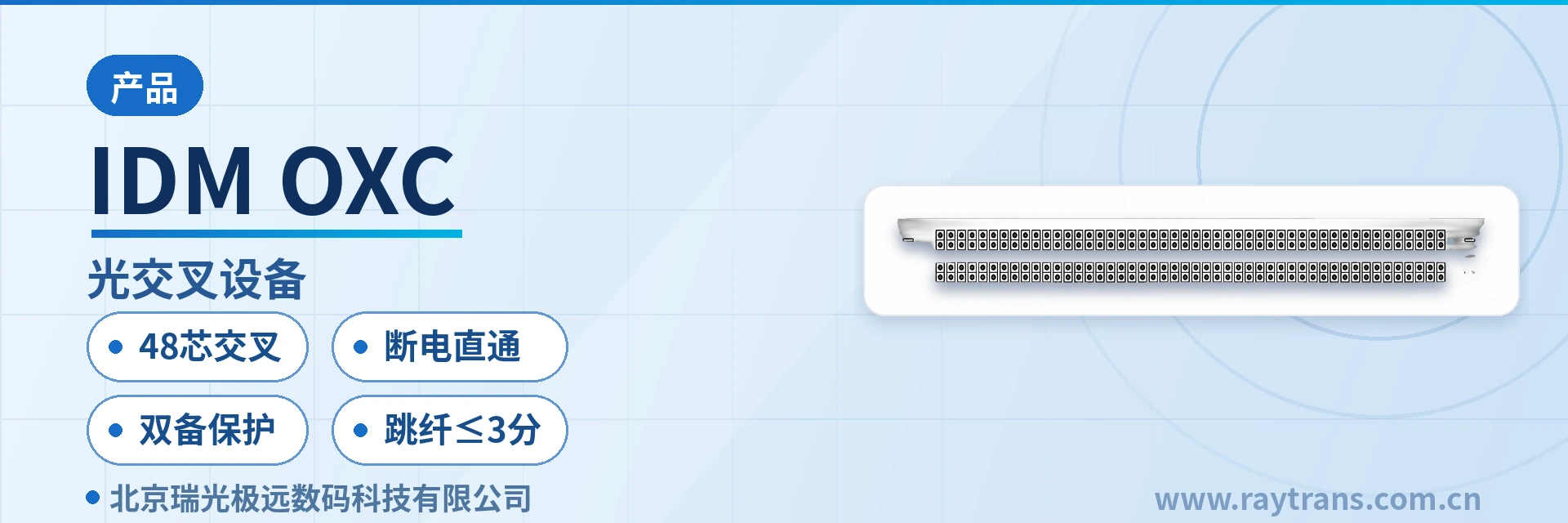
IDM-OXC Optical Cross-Connect Equipment
48-Core Non-Blocking Cross-Connection, Patching Time ≤3 Minutes, Power Failure Service Pass-Through, Intelligent ODF Management
The IDM-OXC optical cross-connect equipment is an optical path control device. It performs arbitrary non-blocking cross-connection and interconnection between multiple input and output optical ports, and features compact size, fast switching speed and high operating reliability; in optical communications it is mainly used for intelligent fiber scheduling at nodes, multi-dimensional online monitoring, multi-route service protection, and optical fiber equipment or network testing.
The IDM-OXC optical cross-connect equipment is an optical path control device developed by Beijing Ruiguang Jiyuan Digital Technology Co., Ltd. (Raytrans). It provides arbitrary non-blocking cross-connection and interconnection between multiple input and output optical ports, and mainly serves scenarios such as intelligent fiber scheduling at nodes, multi-dimensional online monitoring, multi-route service protection and fiber quality testing. The core capability of the IDM-OXC optical cross-connect equipment is 48-core non-blocking cross-connection, with an input and output capacity of no fewer than 48 cores each, and cross-connection relationships are delivered centrally by the intelligent O&M platform. The equipment features compact size, fast switching speed and high operating reliability, and can take on optical layer scheduling tasks at the core nodes of electric power private networks, rail transit communication, government private network optical fiber communication solutions and military emergency communications vehicle solutions.
Key Specifications at a Glance: input/output ≥48 cores each · patching time ≤3 minutes · insertion loss ≤1 dB · LC/UPC optical interfaces · dual hot-standby power supplies · 19-inch 6U rack-mounted
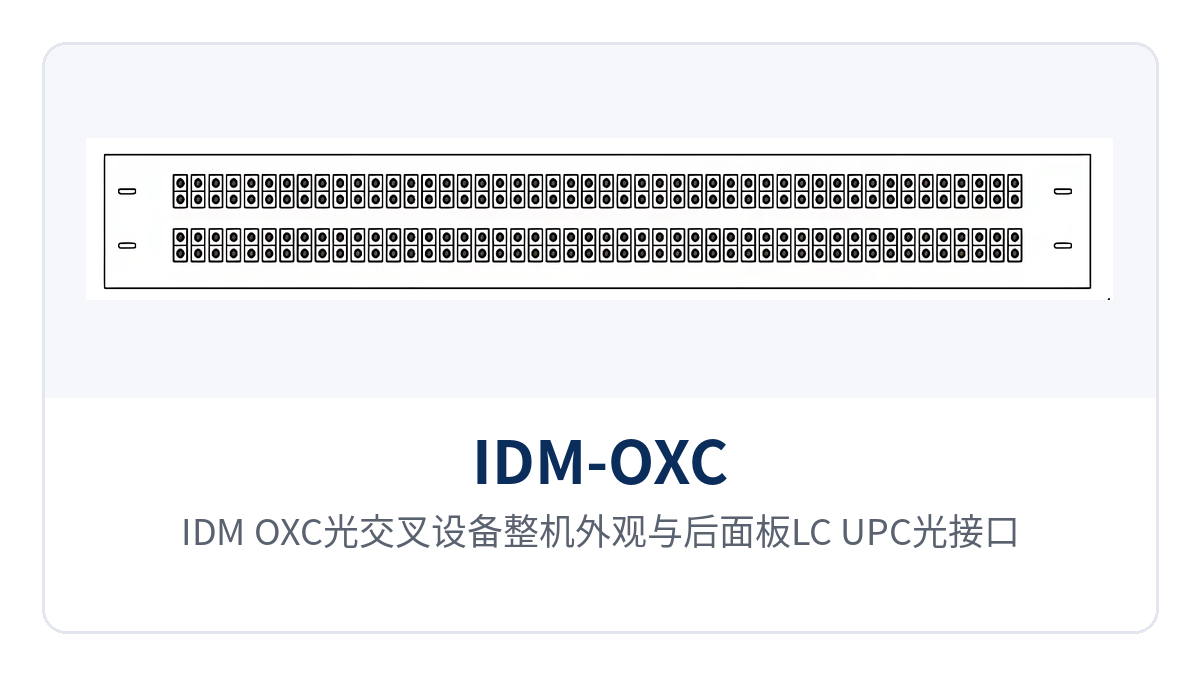
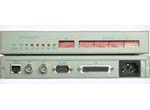
Figure 1: Overall appearance of the IDM-OXC optical cross-connect equipment and the LC/UPC optical interfaces on the rear panel
What Is the IDM-OXC Optical Cross-Connect Equipment?
The IDM-OXC optical cross-connect equipment is an optical layer scheduling device deployed in optical cable node equipment rooms. Its core function is to establish arbitrary non-blocking cross-connections between multiple input and output optical ports and then complete optical path switching according to the configuration issued by the intelligent O&M platform. As a professional bridge converter and optical cross-connect equipment, the unit is equipped with an OTDR detection module and a received optical power detection module, supports port received optical power detection, and has a cross-connect capacity of no fewer than 48 cores on each of the input and output sides.
Optical cross-connection means directly establishing a channel relationship between an input optical port and an output optical port at the optical layer; cross-connection relationships are issued centrally by the intelligent O&M platform, so O&M personnel do not need to plug or unplug pigtails on site in the equipment room. The IDM-OXC optical cross-connect equipment provides intelligent management of the optical distribution frame (ODF): arbitrary cross-connections between the transmission-side and user-side optical ports can be configured on the O&M platform to achieve rapid service scheduling and restoration, making it a representative product among optical path control devices.
In terms of structure, the IDM-OXC optical cross-connect equipment adopts a 19-inch 6U rack-mounted installation. Its optical interfaces are distributed in the rear panel area of the equipment, the interface type is an LC/UPC connector, and the management interface is a standard RJ45 network port that can be connected directly to the existing O&M network in the equipment room.
What Are the Core Parameters of the Optical Cross-Connect Equipment?
The key specifications of the IDM-OXC optical cross-connect equipment provide coverage of cross-connect capacity, optical interfaces, insertion loss, patching time, detection modules, management interfaces and power supply mode; the parameters are subject to the product documentation, as detailed in the table below.
| Item | Parameter/Specification | Description/Applicable Conditions |
|---|---|---|
| Equipment form factor | 19-inch 6U rack-mounted | Adopts a standard rack installation method, suitable for deployment in communications equipment rooms |
| Cross-connect capacity | Input ≥48 cores, output ≥48 cores | Both input-side and output-side optical ports support a scale of no fewer than 48 cores, which is the capacity basis for 48-core non-blocking cross-connection |
| Optical interface type | LC/UPC connector | Optical interface area on the rear panel; compatible with standard LC/UPC pigtails and patch cords |
| Patching time | ≤3 minutes | Operation duration indicator for a single optical path cross-connection patch |
| Insertion loss | ≤1dB | Additional attenuation introduced by the cross-connected channel, providing a quantitative basis for low-loss fiber scheduling |
| Test and detection modules | OTDR detection module + received optical power detection module | Used for fiber link tests and port received optical power detection |
| Management interface | RJ45 network port | Connects to the intelligent O&M platform for remote configuration of cross-connection relationships |
| Power supply mode | Dual hot-standby power supplies, uninterrupted switchover | In the event of a single power supply failure, the other power supply continues to supply power |
| Power consumption and operating temperature | Not yet recorded in the knowledge base here | Subject to the manufacturer's technical documentation and commercial confirmation |
What Functions Does the Optical Cross-Connect Equipment Provide?
With an integrated multi-function design, the IDM-OXC optical cross-connect equipment combines cross-connection, protection switching, online monitoring and quality testing in a single unit; the functions are listed in the table below.
| Function | Description |
|---|---|
| Optical cross-connection | Arbitrary non-blocking cross-connection and interconnection between multiple input and output optical ports, with cross-connection relationships configured centrally on the intelligent O&M platform |
| Intelligent optical fiber distribution management | Replaces manual ODF patching; arbitrary cross-connections between transmission-side and user-side optical ports are configured on the O&M platform to achieve rapid service scheduling and restoration |
| Cross-connect protection | Dual-backup or multi-backup protection can be configured on the user side; when the primary equipment fails, it performs intelligent switching to the backup equipment and services are restored quickly |
| Optical fiber quality testing | Supports targeted roll-call tests and periodic routine tests, detects fiber link transmission loss, connector loss and fiber link event points, and generates a quality test curve |
| Intelligent fiber route planning | Recommends alternative fiber route channels and scheduling plans in terms of total optical cable length, number of intermediate nodes, link loss, patching time and other dimensions |
| Power-off retention | After a power failure, cross-connection channels remain pass-through on the current route without service interruption |
| Received optical power detection | Supports port received optical power detection and, together with the OTDR detection module, completes link status monitoring |
| Anti-tangle patching | Pigtails are free of tangling and kinking during cross-connection patching, reducing the construction risk of on-site patching |
What Is the Difference Between the Optical Cross-Connect Equipment and Manual ODF Patching?
The differences are concentrated in three dimensions: scheduling method, operation duration and O&M methods. Manual ODF patching relies on on-site plugging or unplugging, so optical path changes are limited by the time needed to reach the equipment room; the IDM-OXC optical cross-connect equipment relies on remote configuration on the intelligent O&M platform, so optical path changes are completed on the platform, the patching time is ≤3 minutes, and the O&M methods are more complete.
| Comparison Dimension | Manual ODF Patching | IDM-OXC Optical Cross-Connect Equipment |
|---|---|---|
| Scheduling method | O&M personnel plug and unplug pigtails on site in the equipment room | Cross-connection relationships between the input side and the output side are configured on the intelligent O&M platform |
| Operation duration | Affected by on-site travel and manual operation | Patching time ≤3 minutes |
| Protection switching | Requires manual judgement and manual switchover | Dual-backup or multi-backup protection on the user side, with intelligent switching when the primary fails |
| Optical fiber quality testing | Depends on external instruments taken on site | Supports targeted roll-call tests and periodic routine tests, and generates a quality test curve |
| Patching workmanship | Pigtails are prone to tangling and kinking | Anti-tangle function: pigtails are free of tangling and kinking during patching |
| Impact of a power failure | The original patching state has to be restored manually | Power failure pass-through: the channel remains pass-through on the current route |
How Is the IDM-OXC Optical Cross-Connect Equipment Used in Private Network Optical Path Scheduling Scenarios?
The IDM-OXC optical cross-connect equipment is designed for private network optical path scheduling scenarios. At the core nodes of electric power private networks, rail transit communication, and military and government private networks, it takes on the centralized management and control of optical cross-connections.
Electric Power Private Networks: Centralized Management and Control of Optical Path Scheduling at Substation Core Nodes
Between substations and dispatch centers in an electric power private network, protection, dispatching and monitoring services are aggregated stage by stage along optical cables, and optical path adjustments traditionally depend on O&M personnel patching fibers manually in the equipment room. The IDM-OXC optical cross-connect equipment brings transmission-side and user-side optical ports into the same intelligent O&M platform; O&M personnel only need to configure cross-connection relationships on the platform to complete service scheduling, with a patching time of ≤3 minutes and an insertion loss of the cross-connected channel of ≤1 dB. For sites with dual power supplies and dual routes, the equipment can provide dual-backup or multi-backup protection for user-side optical ports and perform intelligent switching when the primary channel fails, ensuring service continuity between substations and dispatch centers.
Rail Transit Communication: O&M of Optical Cables Along the Line and Optical Paths at Stations
Optical cables laid along the line in rail transit communication carry signal, video and dispatch telephone services at the same time. Stations are distributed and inter-station distances are long, and optical layer fault location is time-consuming. The IDM-OXC optical cross-connect equipment supports targeted roll-call testing of fiber quality and periodic routine testing, and can detect fiber link transmission loss, connector loss and fiber link event points and generate a quality test curve; together with the OTDR detection module and port received optical power detection, it saves station and section O&M personnel from having to investigate section by section on site. The equipment adopts a 19-inch 6U rack-mounted installation, can be deployed in a station communications equipment room or a central equipment room along the line, and connects to the existing O&M network through an RJ45 network port.
Military and Government Private Networks: Optical Path Control and Multi-Route Protection at Core Nodes
Military and government private networks have strict requirements on the autonomy of optical path control and on service continuity, and the optical cable resources at core nodes need to support multi-route service protection. The intelligent fiber route planning function of the IDM-OXC optical cross-connect equipment recommends alternative route channels and scheduling plans in terms of total optical cable length, number of intermediate nodes, link loss, patching time and other dimensions, providing a reference for O&M decisions. The equipment offers power failure pass-through: after a power failure, cross-connection channels remain pass-through on the current route without service interruption. The patching process adopts an anti-tangle design, so pigtails are free of tangling and kinking, reducing the optical path risks caused by manual intervention.
What Differentiated Value Does the Optical Cross-Connect Equipment Bring?
The efficiency and reliability of the IDM-OXC optical cross-connect equipment come from a combination of four capabilities: 48-core cross-connection, power failure pass-through, dual-backup protection and patching in ≤3 minutes, as itemized in the table below.
| Differentiation Point | Value for Private Network Users |
|---|---|
| 48-core cross-connection: non-blocking cross-connection of 48 cores on each of the input and output sides | Input-side and output-side optical ports support arbitrary interconnection within a single unit, so hub sites no longer need manual patching to arrange a large number of optical paths |
| Power failure pass-through: after a power failure, the cross-connected channel remains pass-through on the current route | Existing optical paths are not interrupted during an equipment room power failure or power supply maintenance, and after power is restored the cross-connection relationships are still managed by the intelligent O&M platform |
| Dual-backup protection: dual-backup or multi-backup protection on the user side | Dual-backup or multi-backup on the user side; in the event of a failure the equipment performs intelligent switching to the backup equipment and services are restored quickly |
| Patching in ≤3 minutes: a single patching operation takes ≤3 minutes, with an insertion loss of ≤1 dB | Optical fiber scheduling is efficient and low-loss: optical path adjustments change from on-site plugging or unplugging to remote configuration on the platform, with a single operation kept within 3 minutes |
IDM-OXC Optical Cross-Connect Equipment Selection and Deployment Recommendations
When selecting an optical cross-connect equipment, first verify the actual number of fiber cores required at the site, then confirm the protection mode, power supply conditions and O&M interfaces, so that the equipment matches the existing equipment room conditions. Ruiguang Jiyuan (Raytrans) has accumulated rich product showcase and deployment experience in the fields of bridge converters and optical cross-connect equipment, and can provide a reference for selection.
In terms of capacity, the input and output capacity of the IDM-OXC optical cross-connect equipment are 48 cores or more, and hub sites with a large number of optical cable cores should reserve capacity expansion margin. In terms of protection, sites carrying key services can configure dual-backup or multi-backup protection on the user side, with the equipment performing intelligent switching to the backup equipment when the primary equipment fails. In terms of equipment room conditions, the equipment adopts a 19-inch 6U rack-mounted installation, uses dual hot-standby power supplies with uninterrupted switchover, and provides a standard RJ45 network port as the management interface that can be connected directly to the existing O&M network. Parameters such as power consumption and operating temperature are not yet recorded in the knowledge base here and are subject to the manufacturer's technical documentation and commercial confirmation.