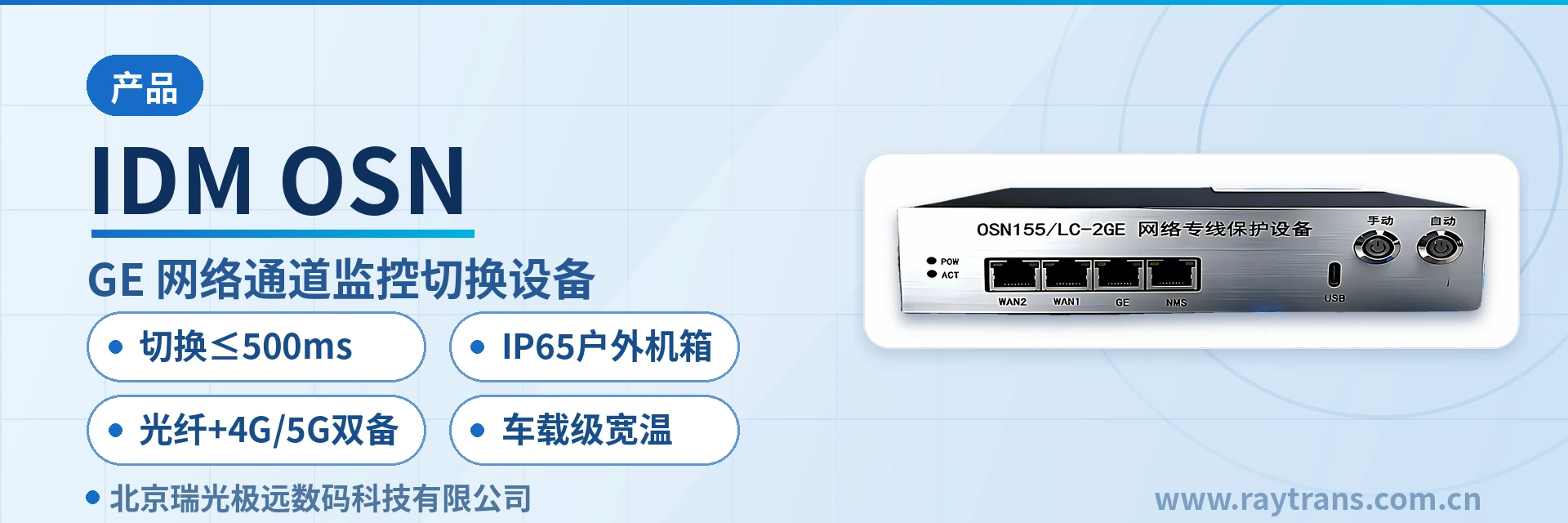
IDM OSN-2GE Network Channel Monitoring and Switching Device
Redundant backup, intelligent switching, convenient O&M, switchover ≤500ms (no data loss)
One second of communication interruption can halt financial transactions, disconnect power monitoring, or cut off emergency command—in mission-critical scenarios, communication reliability has always been a red line that must never be crossed. The IDM OSN-2GE Network Channel Monitoring and Switching Device is purpose-built to address the communication pain points of critical scenarios. With four core capabilities—redundant backup, intelligent switching, convenient O&M, and secure control—it serves as the guardian of communication reliability in energy, finance, industrial, and other sectors.
IDM OSN-2GE dual-channel redundant switching device is a network channel monitoring and switching device developed by Beijing Ruiguang Jiyuan Digital Technology Co., Ltd. As a representative product of a professional optical multiplexer manufacturer, the device can automatically switch services to backup channels such as 4G/5G, microwave, and satellite when the primary optical fiber channel is interrupted, signal quality degrades, or bandwidth utilization is too high. In scenarios such as emergency communications and emergency command vehicles, this bridge converter provides reliable channel assurance for critical services.
The dual-channel redundant switching device serves critical sites where communication must not be interrupted: field monitoring for electric power and oil and gas relies on optical cables along the line to backhaul data, financial trading networks have hard requirements for message integrity, and production line communications in industrial Internet workshops cannot tolerate noticeable interruption. The device is designed around four core capabilities: redundant backup, intelligent switching, convenient O&M, and secure control. It can be configured with an IP65 waterproof enclosure and is suitable for installation at outdoor and unattended sites in the field. Raytrans, with deep experience in military emergency communications vehicle solutions and smart mining communication solutions, integrates high-reliability switching technology into the product design to meet product showcase and live deployment requirements in harsh environments.
Key Specifications at a Glance: Optical fiber + 4G/5G dual backup · Failure switchover ≤500ms · Automatic switching when bandwidth exceeds 90% · Seamless switchover with no data loss · IP65 outdoor enclosure · Vehicle-grade wide temperature
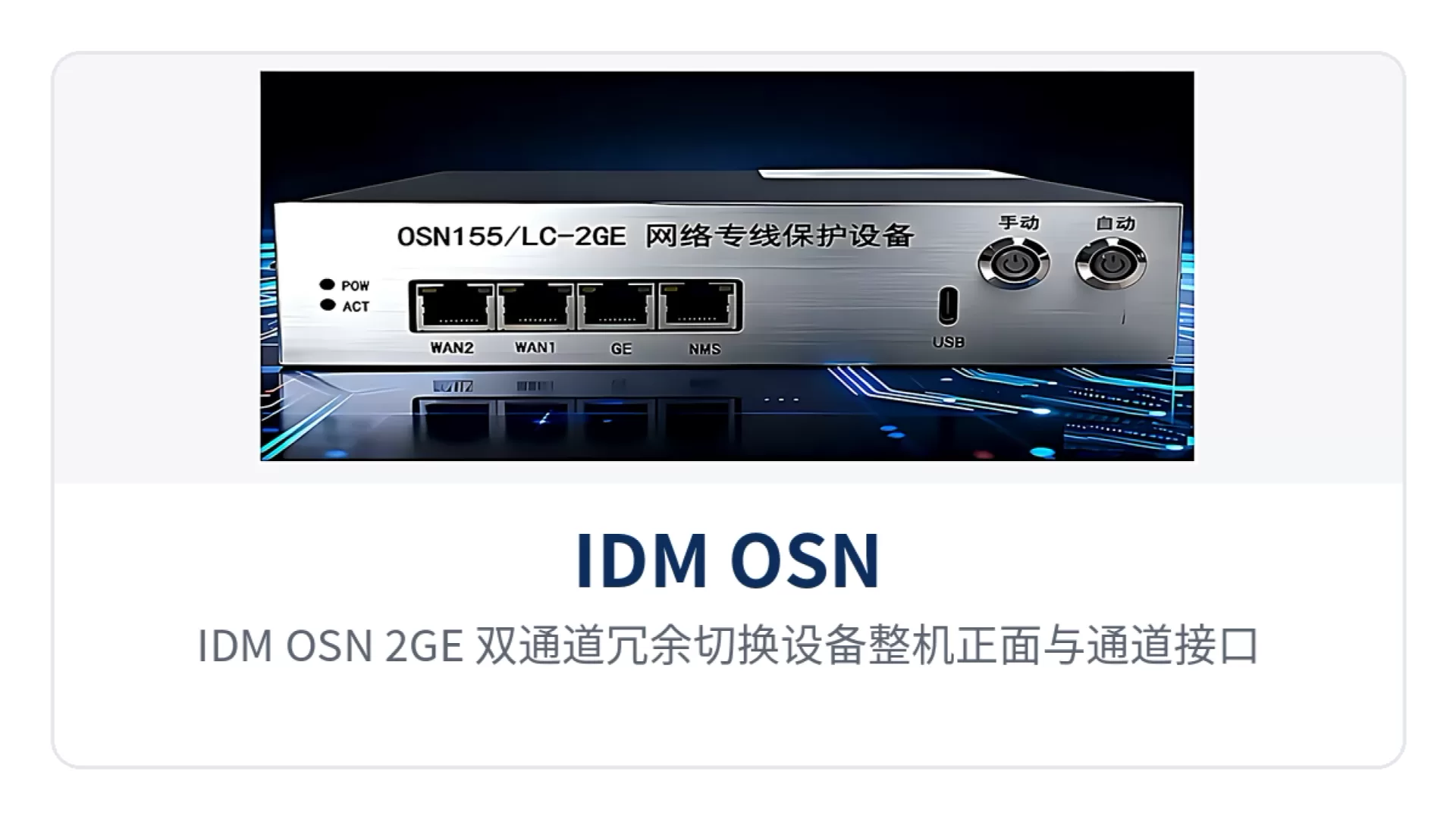
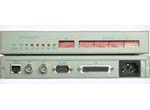
Figure 1: IDM OSN-2GE dual-channel redundant switching device front view and channel interfaces
What Are the Components of the IDM OSN-2GE Dual-Channel Redundant Switching Device?
The IDM OSN-2GE consists of four sections: channel access, status monitoring, switching execution, and service output. The unit presents itself externally as a single continuous Ethernet service outlet. The channel access section connects to the primary optical fiber channel and the 4G/5G wireless backup channel respectively, and can be extended with links such as microwave, satellite, and wireless narrowband as backups.
The status monitoring section continuously collects the up/down status, bandwidth utilization, and signal quality of each channel as the basis for switchover decisions. The switching execution section completes channel switchover according to the preset priority, and the service output section transparently forwards the data of the currently available channel to upper-layer devices. Service-side devices do not need to care which channel is currently in use, and switching remains transparent to upper-layer applications.
Dual primary/backup channels are the basic operating mode of the IDM OSN-2GE: the optical fiber carries normal service traffic, while the 4G/5G channel stays online on standby and maintains availability probing. Once the fiber side is interrupted or its quality drops to the threshold, the device switches services to the wireless channel, and switches back according to priority after the fiber recovers.
For sites requiring more channels, channels can be extended on the basis of the dual primary/backup channels, with microwave, satellite, and wireless narrowband links participating in path selection under the same priority mechanism.
Which Three Conditions Determine Network Channel Monitoring and Switching?
The IDM OSN-2GE triggers channel switching based on three conditions: interruption of the primary channel, degradation of primary channel signal quality to the set threshold, and primary channel bandwidth utilization exceeding 90%. The interruption decision comes from link layer up/down detection, the signal quality decision comes from continuous measurement of bit errors, packet loss, and receive level, and the bandwidth decision comes from real-time statistics on primary channel traffic utilization. If any of the three conditions is met, the device switches services to the backup channel according to the preset priority.
The bandwidth condition targets sites where the link is not down but can no longer keep up. In industrial workshop and surveillance backhaul scenarios, the primary channel easily approaches saturation when multiple video streams or large volumes of data are concurrent. If switching waits until packet loss or link interruption occurs, the service side is already experiencing stuttering. The IDM OSN-2GE switches to the backup channel in advance when bandwidth utilization exceeds 90%, absorbing congestion before it becomes perceptible to services.
What Core Functions Does the IDM OSN-2GE Support?
Function | Description |
|---|---|
Dual-channel redundant backup | The primary optical fiber channel and the 4G/5G backup channel are online simultaneously; when the primary channel fails, services are carried by the backup channel |
Automatic channel failure switchover | Automatic switchover when the primary channel is interrupted or its quality degrades, with switchover latency ≤500ms |
Automatic switching when bandwidth exceeds 90% | Switches to the backup channel when primary channel bandwidth utilization exceeds 90%, relieving link congestion |
Primary/backup channel priority configuration | The usage priority of the primary optical fiber channel and the backup channel is configurable, and services switch back according to priority after recovery |
Seamless switchover with no data loss | Services remain continuous during switchover, and monitoring and control data are not lost due to the switchover |
Anti-interference and multi-channel backup | Multi-channel mutual backup ensures production line communications in workshop environments with strong electromagnetic interference |
Real-time channel status monitoring | Real-time detection of the up/down status, bandwidth, and signal quality of each channel as the basis for switchover decisions |
Domestic core components for data security | Domestic core components are used, and link data is not forwarded through third-party networks, meeting the data security requirements of financial and private networks |
IP65 outdoor enclosure | Supports direct installation at outdoor and field sites |
LoRa module expansion | Can be extended with a LoRa module to connect IoT sensing devices |
Low-power covert mode | Can operate in a low-power covert mode at emergency sites |
Vehicle-grade wide-temperature design | Adapts to vehicle-mounted and outdoor temperature environments such as tunnels and elevated roads |
How Is the ≤500ms Automatic Channel Failure Switchover Latency Achieved?
The ≤500ms automatic channel failure switchover latency comes from the combination of three mechanisms: continuous probing, preset priority, and hardware-level switchover. The device continuously probes the availability status of each channel; when a failure occurs, switchover is executed according to the established priority without manual confirmation; and the backup channel always remains online, so the switchover process does not involve redialing or link establishment.
The key to the mechanism is that the backup channel stays online on standby. If the backup channel were to start establishing only after the primary channel disconnects, the switching time would be determined by the link establishment process rather than controlled by the device.
Knowledge Block: What a Switchover Latency of ≤500ms Means for Services
A switchover latency of ≤500ms means that the time from the primary channel being judged unavailable to services being carried by the backup channel does not exceed 500 milliseconds. This magnitude presupposes that the backup channel stays online on standby: the wireless channel always maintains the link, so switchover only requires changing the path selection, not reconnecting.
For video surveillance services, a switchover on the order of 500 milliseconds does not cause interruption of the video session; for transaction and dispatch data services, the device uses a seamless switchover mechanism to ensure that data is not lost before and after switching. This specification is the upper limit of switching time given by the device under design conditions. Actual performance depends on the backup channel link quality and the networking approach, and is subject to the manufacturer's technical documentation and commercial confirmation.
Technical Specifications of Optical Fiber + 4G Dual-Channel Backup
Item | Parameter/Specification | Description/Applicable Conditions |
|---|---|---|
Channel configuration | Primary optical fiber channel + 4G/5G backup channel | Dual primary/backup channels as the basic form, expandable to microwave, satellite, and wireless narrowband |
Failure switchover latency | ≤500ms | Automatic switchover when the primary channel is interrupted or its quality degrades |
Bandwidth trigger threshold | Primary channel bandwidth utilization exceeds 90% | For service burst and link congestion scenarios |
Primary/backup channel priority configuration | Priority of the optical fiber and backup channels is configurable | Set by O&M personnel according to service importance |
Switchover service continuity | Seamless switchover, no data loss | Meets the requirements of financial and other services with high data integrity requirements |
Channel status monitoring | Real-time detection of connectivity, bandwidth and signal quality | Basis for switchover decisions |
Ingress protection (IP) rating | IP65 outdoor enclosure | Supports outdoor and field site installation |
Operating temperature | Vehicle-grade wide-temperature design | The specific temperature range is not yet recorded in the knowledge base; the manufacturer's technical documentation shall prevail |
Expansion interface | Supports LoRa module expansion | For connecting IoT sensing devices |
Power supply mode | Not yet recorded in the knowledge base | Subject to the manufacturer's technical documentation and commercial confirmation |
Service interface type and quantity | Not yet recorded in the knowledge base | Subject to the manufacturer's technical documentation and commercial confirmation |
Enclosure dimensions and installation method | Not yet recorded in the knowledge base | Subject to the manufacturer's technical documentation and commercial confirmation |
Differentiated Value: Corresponding Capability for Three Types of Critical Services
Service scenario | Corresponding capability of IDM OSN-2GE | Value |
|---|---|---|
Field monitoring for the electric power and oil and gas industries | Optical fiber + 4G/5G dual-channel backup, failure switchover ≤500ms, monitoring signals uninterrupted | When extreme weather causes an optical cable interruption, monitoring and control signals are taken over by the wireless channel, and field sites stay online |
Financial private network transactions | Optical fiber primary/backup priority configuration, seamless switchover with no data loss, meeting service continuity requirements | Channel switchover is transparent to transaction messages, and data integrity is not affected by the switchover |
Industrial Internet workshop | Anti-interference + multi-channel backup, automatic switchover when bandwidth exceeds 90%, production line never stops | When workshop interference is strong and bandwidth is saturated, the link automatically gives way, keeping production line communication continuously available |
Typical Application Scenarios
Field Monitoring for the Electric Power and Oil and Gas Industries: How Monitoring Stays Online When the Optical Fiber Is Cut
Most field monitoring points for electric power and oil and gas pipelines rely on optical cables along the line to backhaul data, and extreme weather, external damage during construction or geological disasters can all cause an optical cable interruption. As a professional optical multiplexer manufacturer, Raytrans offers the IDM OSN-2GE bridge converter, which uses optical fiber as the primary channel and 4G/5G as the backup channel at these sites. Within 500 milliseconds after the primary channel is interrupted, monitoring video and telemetry and remote control data are switched to the wireless channel. What O&M personnel see is only a change in the channel from which the data comes; the service itself is not interrupted.
The IP65 outdoor enclosure allows the device to be installed directly on towers, in field cabinets or at unattended sites, with no need to build a separate equipment room for channel switching. After the optical cable is repaired, the device switches services back to the optical fiber channel according to the preset priority, and the link recovery process likewise requires no manual intervention. This product showcase solution is also applicable to the field monitoring part of a smart mining communication solution.
Financial Private Network Transactions: How Channel Switchover Achieves Zero Data Loss
The core transmission requirement of a financial private network is data integrity; even a one-second interruption may cause missing transaction messages or reconciliation errors. In financial scenarios, the IDM OSN-2GE uses optical fiber as the primary channel, with the backup channel staying online on standby according to priority. The switchover adopts a seamless switchover mechanism, so service data is not lost during the switchover, and transaction messages are not retransmitted or out of order due to channel changes.
The device uses domestic core components, and link data is not forwarded through third-party networks, making it easier to meet financial institutions' requirements for data security. The priority and switchover threshold of the primary and backup channels can be configured according to service level, configuring critical transaction links as priority switchover targets, so that channel resources align with service importance.
Industrial Internet Workshop: How to Keep Production Line Communication Running When Interference Is Strong and Bandwidth Is Saturated
The electromagnetic environment in an industrial workshop is complex; variable-frequency drives, welding equipment and mobile machinery all interfere with communication links, and the production line control system's tolerance for interruption is measured in milliseconds. On the workshop side, the IDM OSN-2GE adopts an anti-interference design and multi-channel backup, with real-time monitoring of channel status, and automatically switches to the backup channel when the primary channel's signal quality degrades or bandwidth utilization exceeds 90%.
After switching to the backup channel, the production line's control commands and device status data continue to be carried by other channels. The device supports LoRa module expansion, allowing low-power sensing terminals in the workshop to be incorporated into the same switching system, reducing the number of separate networking setups on site, and providing reliable bridge converter support for industrial scenarios such as smart mining communication solutions.
Urban Emergency Management: How to Preserve Command Signals When All Primary Channels Fail
In disaster scenarios such as earthquakes and floods, terrestrial optical fibers and base stations may be damaged at the same time, and emergency communications require a combination of channels that does not depend on a single terrestrial network. In urban emergency scenarios, the IDM OSN-2GE can incorporate satellite, microwave and wireless narrowband channels into the aggregation and backup system, so that after the primary channel is interrupted, command signals continue to be carried by available channels.
The low-power covert mode suits usage conditions where on-site power supply is limited and exposure risk needs to be reduced. The number of channels of the device can be expanded according to on-site conditions, and emergency command vehicles and temporary command posts can use the same priority configuration, reducing on-site re-commissioning time. This bridge converter from Raytrans showcases its adaptability in the emergency communications field, and also provides a technical reference for channel redundancy in military emergency communications vehicle solutions.
Rail Transit: How Dispatch Orders Are Reliably Delivered in Tunnel and Elevated Scenarios
Signal fluctuations are pronounced in tunnels and elevated sections along metro and high-speed rail lines, and train operation dispatch orders impose high requirements on transmission latency and stability. The IDM OSN-2GE adopts a vehicle-grade wide-temperature design and adapts to the temperature and vibration environment of tunnels and outdoor elevated sections.
The device detects signal quality in real time. When channel quality fluctuates, it switches to a stable channel at millisecond-level speed, keeping the transmission of dispatch orders on a continuously available link. Primary/backup channel priority configuration can be adjusted according to the link conditions of the line section, making it easy for O&M personnel to update the switchover policy after line upgrades.
Summary: What Projects Is the Dual-Channel Redundant Switching Device Suitable For
The IDM OSN-2GE dual-channel redundant switching device is suitable for projects that list communication continuity as a key indicator: field monitoring points for the electric power and oil and gas industries need to maintain data backhaul after an optical cable interruption, financial private networks need channel switchover without affecting data integrity, industrial Internet workshops need to keep production line communication working under interference and bandwidth congestion, and urban emergency response and rail transit need to keep command and dispatch links available when the terrestrial network is damaged or fluctuating.
During selection, you can first confirm the types and number of channels available on site, then configure primary/backup channel priority and the switchover threshold according to service importance, and finally determine enclosure protection and wide-temperature configuration based on installation conditions. The effect of private network link redundancy protection depends on the degree of independence of the primary and backup channels — when both channels run over the same optical cable or the same base station, backup capability will decline accordingly, and this needs to be checked separately during both solution design and acceptance stage.