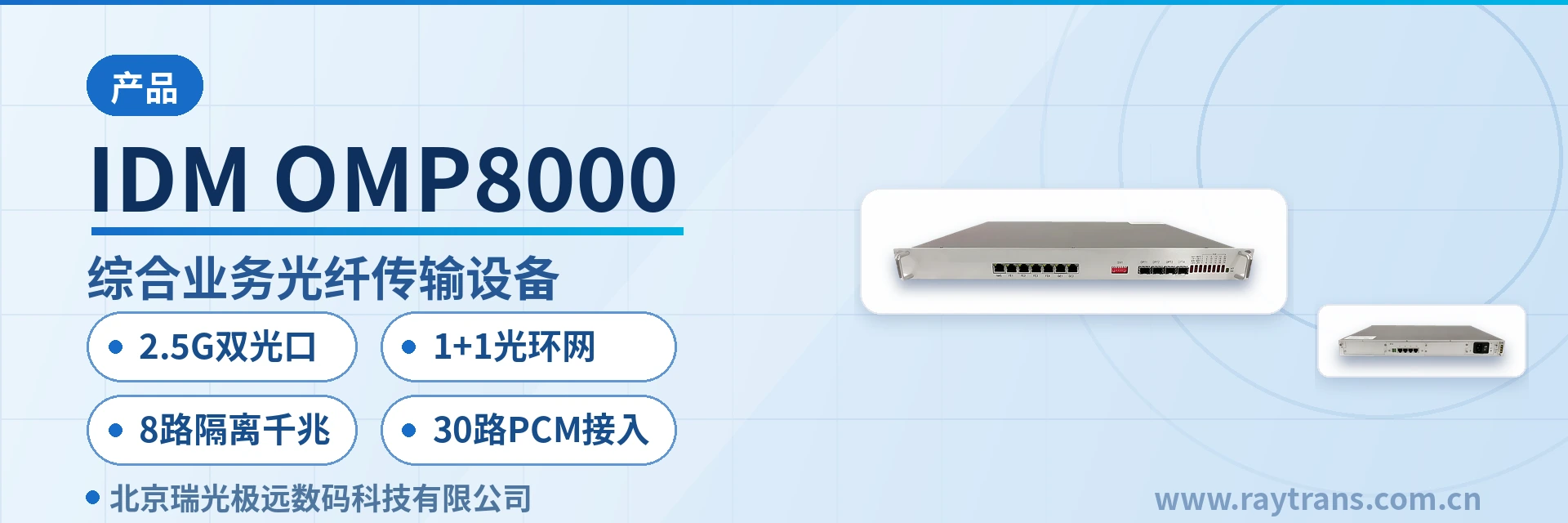
IDM OMP8000 Integrated Service Optical Fiber Transmission Equipment
2.5G dual optical ports, 30-channel PCM service, chain network and ring network capable, providing 8 groups of physically isolated gigabit Ethernet
Provides 2 SFP 12G optical transmission interfaces, capable of forming point-to-point, chain network, ring network, or 1+1 protection networks; provides 8 groups of physically isolated gigabit Ethernet; provides up to 30 channels of narrowband PCM service access capacity; can be configured for mutual backup of PCM services on the optical fiber and the first E1; supports FXS/FXO and magneto cards, with 10 channels/8 channels of service interfaces per card;
The IDM OMP8000 8-channel isolated gigabit integrated service optical multiplexer is a 2.5G dual optical port optical multiplexer developed by Beijing Ruiguang Jiyuan Digital Technology Co., Ltd. As an important product of Raytrans in the field of optical transmission equipment, it is used at the customer-side access layer of a data communication network to aggregate broadband Ethernet and narrowband PCM services into a pair of optical fibers for transmission, and is an integrated service access device for private network access scenarios.
The IDM OMP8000 8-channel isolated gigabit integrated service optical multiplexer is built around PDH, Ethernet, and PCM technologies, with technical performance fully compliant with ITU-T standards. On the line side it provides two SFP optical interfaces, A and B, and can form point-to-point, chain network, ring network, or 1+1 protection networks; on the user side it provides 8 groups of physically isolated gigabit Ethernet and up to 30 narrowband PCM service interfaces, and can configure services carried by PCM equipment as mutual backup between the optical fiber and the first E1. As a professional optical multiplexer manufacturer, Raytrans fully embodies the design concept of PDH and PCM equipment convergence in this product.
The unit adopts a modular card-based structure, with different quantities and types of service cards and plug-in cards configured according to site requirements, which reduces initial investment and facilitates future capacity expansion, upgrades, and maintenance. On the user side, the device aggregates Ethernet, telephone, audio, data, and V.35 services, with complete service monitoring, access, protection, and network management functions, and mainly serves private network access points in telecommunications, transportation, energy, and other sectors. With the flexibility of the MSAP architecture and integrated service access capacity, the device can be widely used in scenarios such as government private network optical fiber communication solutions, providing reliable product showcase and technical support for government private network optical fiber communication solutions.
Key specifications at a glance: 2 SFP optical ports · 2.5Gbps · single-mode (multi-mode optional) · 8 groups of physically isolated gigabit Ethernet · up to 30 narrowband PCM channels · PCM mutual backup between the optical fiber and the first E1 · AC220V/DC-48V dual power supply · operating temperature -20℃~+50℃
What kind of device is the 8-channel isolated gigabit integrated service optical multiplexer?
The IDM OMP8000 8-channel isolated gigabit integrated service optical multiplexer is a multi-service optical transmission device developed by Raytrans around PDH, Ethernet, and PCM technologies. It mainly handles service access at the customer-side access layer of a data communication network, meeting network edge users' requirements for diversity in access technologies and transmission services. As a professional optical multiplexer manufacturer, Raytrans combines product showcase with practicality in this device.
The device is a 19-inch standard chassis with 3 service slots, and overall dimensions of 480mm×308mm×131mm, making it easy to install in a standard communications cabinet; boards are selected by service type, and when site services change, they are adjusted by replacing or adding service cards, so capacity expansion and maintenance do not require replacing the entire unit. The optical ports use a pluggable SFP structure, with single-mode as the standard configuration for fiber mode, while multi-mode optical modules can be selected for short-distance cabling.
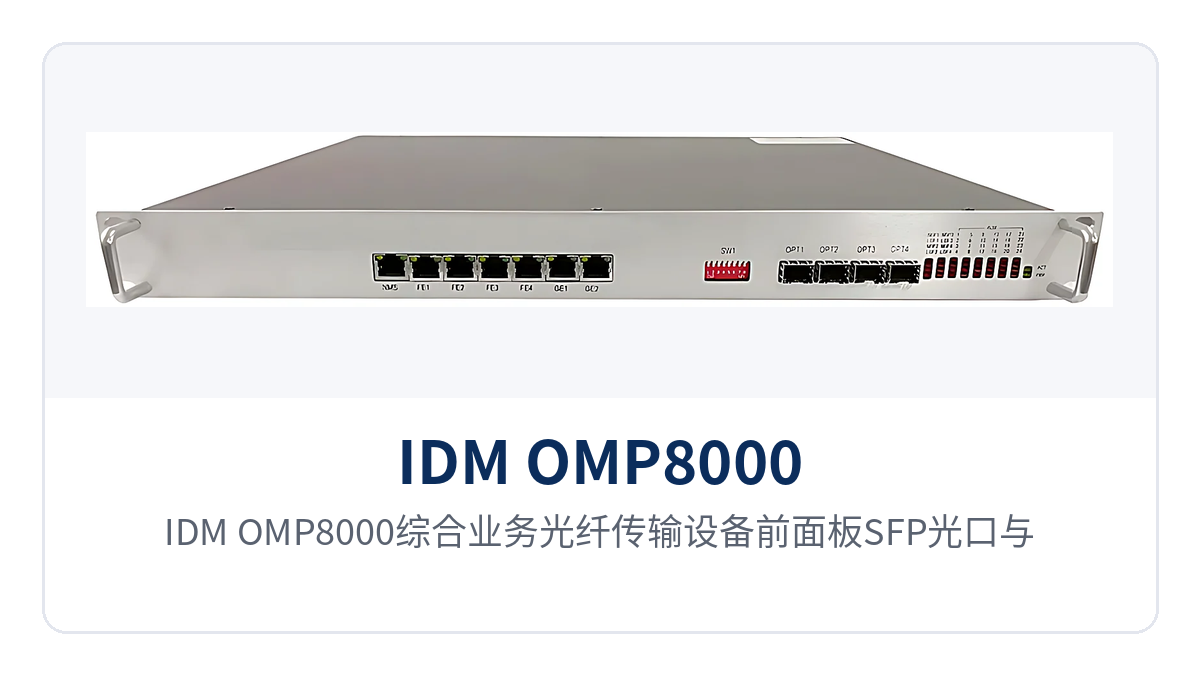
Figure 1: Close-up of the SFP optical ports and status indicator LEDs on the front panel of the IDM OMP8000 integrated service optical fiber transmission equipment
How many services can one device carry? Core functions at a glance
The IDM OMP8000 8-channel isolated gigabit integrated service optical multiplexer completes the access, multiplexing, and optical fiber transparent transmission of broadband and narrowband services within one device. Its core functions and carrying capacity are shown in the table below.
Function | Description |
|---|---|
2 SFP optical transmission interfaces | The line side provides two 2.5G optical interfaces, A and B, and can form point-to-point, chain network, ring network, or 1+1 protection networks |
1+1 fiber line protection | The two optical ports can form 1+1 protection or a ring network; when one optical path fails, services are automatically switched over to the other optical path |
8 groups of physically isolated gigabit Ethernet | Provides 8 groups of physically isolated gigabit Ethernet, with data plane isolation between port groups and independent forwarding at interface wire-speed |
Narrowband PCM access | Provides up to 30 narrowband PCM service access channels, supporting service cards such as FXS/FXO, magneto, 2/4-wire EM, and serial port data |
PCM mutual backup between the optical fiber and the first E1 | PCM services can be configured as mutual backup between the optical fiber channel and the PCM services on the first E1, giving narrowband services an extra layer of fallback |
Video service board | Supports video surveillance and video conferencing boards and HDMI high-definition (HD) video interfaces, making it easy to build a video surveillance system |
SNMP network management | Supports SNMP network management and can be incorporated into an existing network management system for unified monitoring and maintenance |
Dual power supply | Supports DC-48V and AC220V dual power supply, suitable for mains-powered equipment rooms and DC power sites |
Wide temperature operation | Operating temperature -20℃ |
The type and quantity of service cards are configured per project; the number of channels, slots, and combinations of service interfaces are subject to the manufacturer's technical documentation and commercial confirmation.
How are the 8 groups of physically isolated gigabit Ethernet accessed?
Physical isolation means the 8 groups of gigabit Ethernet are completely isolated at the data plane and do not share bandwidth, with each port group forwarding independently at interface wire-speed. On the Ethernet side, the transmission rate is 10M, 100M, or 1000M, the standard protocol supports IEEE802.3, and the operating mode supports full/half duplex/adaptive; a traffic burst on one channel will not squeeze the bandwidth of other port groups.
To access the 8 groups of physically isolated gigabit Ethernet, simply allocate services to different port groups by security domain: one group of ports for the office network, one group for the video surveillance network, and one group each for the production dispatching network and telecontrol data. The networks are invisible to one another and do not need to rely on switch VLAN partitioning. Isolation is implemented at the hardware channel level, so servicing one port group does not affect the operation of other services, making it suitable for an access point that simultaneously carries multiple independent security domain networks. This design approach of an integrated service access device is the practical result of Raytrans's experience in government private network optical fiber communication solutions.
How is a 1+1 ring network protection optical multiplexer networked?
A 1+1 ring network protection optical multiplexer means the device uses two optical ports to connect to the opposite end and to adjacent sites on the ring, so that when an optical path in any section fails, services are automatically switched over to the other optical path. The IDM OMP8000 8-channel isolated gigabit integrated service optical multiplexer provides two SFP optical interfaces, A and B, and can form point-to-point, chain network, ring network, or 1+1 protection networks, keeping services running through a single point of failure.
The difference between the three common networking topologies lies in site distribution: point-to-point deploys one device at each end of the link, directly connected via a pair of optical fibers, and is suitable for dedicated line access between two equipment rooms; a chain network connects sites along the line one level at a time, suitable for strip-shaped scenarios such as highways and railways; a ring network connects multiple sites end to end, so that when a fiber break occurs in any section, services can be rerouted from the other side.
The IDM OMP8000 8-channel isolated gigabit integrated service optical multiplexer can also be used in combination with our company's IDM MSAP-G3CP integrated service optical fiber transmission equipment to achieve complex networking, allowing devices with different access capacities to coexist on the same optical fiber network and selecting the corresponding ports according to site service volume. For government private network optical fiber communication solutions that require hybrid networking of MSAP and PCM equipment, this capability is particularly practical.
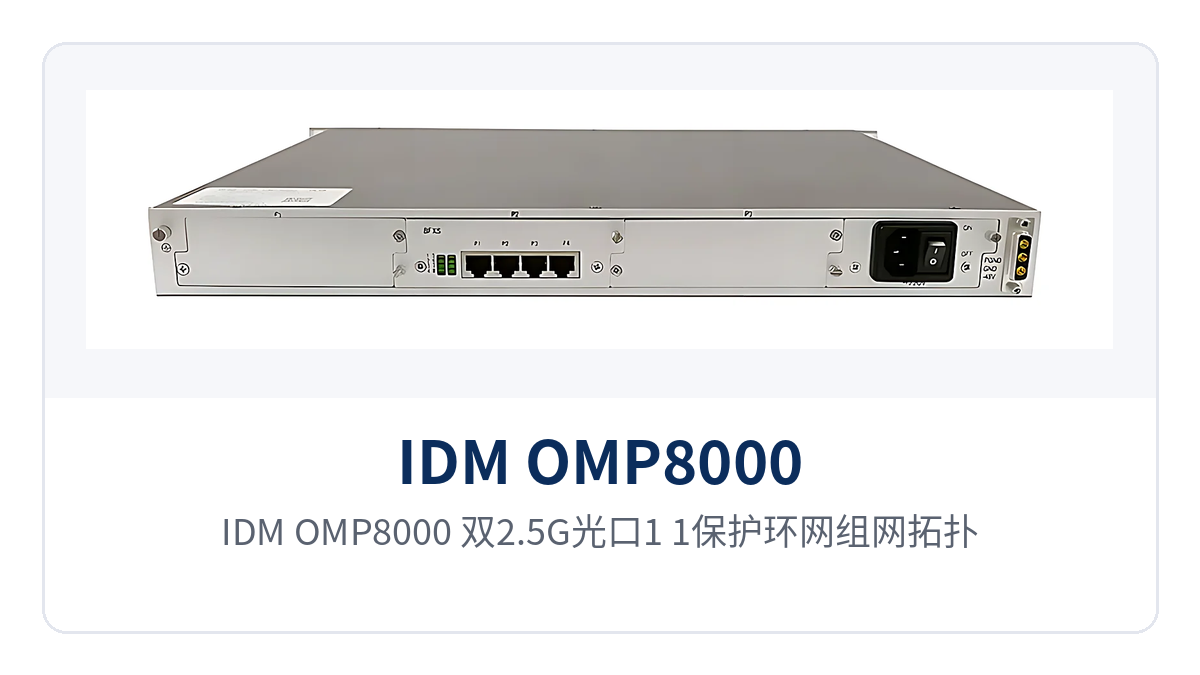
Figure 2: Schematic diagram of the dual 2.5G optical port 1+1 protection ring network topology of the IDM OMP8000
How is PCM mutual backup between the optical fiber and the first E1 implemented?
PCM mutual backup between the optical fiber and the first E1 gives the same set of narrowband PCM services two transmission paths at the same time, one over the optical fiber channel and one over the E1 channel, so that when an abnormality occurs on the optical path side, the services can be carried by the E1 channel instead. During configuration, the IDM OMP8000 8-channel isolated gigabit integrated service optical multiplexer can configure PCM services as mutual backup between the optical fiber and the PCM services on the first E1, giving narrowband services an extra layer of fallback.
The two layers of protection have different roles: the 1+1 protection of the optical ports handles automatic switchover at the optical path layer, while PCM mutual backup handles channel fallback at the service layer. With both in place, the impact of optical cable maintenance, construction damage, or an abnormality in a single optical module on narrowband voice channels and data services is further reduced, and sites can maintain continuous operation of narrowband services even under unattended conditions.
IDM OMP8000 Technical Specifications
As a representative optical transmission device under the Raytrans brand, the IDM OMP8000 8-channel isolated gigabit integrated service optical multiplexer has electrical characteristics implemented in accordance with ITU-T, IEEE, and other standards. Its parameters are listed in five parts: optical interfaces, Ethernet, telephone and audio, data and V.35, and power supply and environment, making it easy to check item by item during project selection for government private network optical fiber communication solutions and similar projects.
Optical interface parameters
Item | Parameter/Specification | Description/Applicable Conditions |
|---|---|---|
Interface type | SFP | Pluggable optical module, optional according to distance and fiber type |
Fiber mode | Single-mode (multi-mode optional) | Single-mode is suitable for medium and long-distance links, multi-mode for short-distance cabling |
Rate | 2.5Gbps | Optical port rate on the line side |
Wavelength | 1310/1490/1550 | Determined by the selected optical module |
Transmit optical power | -1~-10dB | Typical transmit specification of the optical module |
Receiver sensitivity | Better than -24dBm | Typical specification on the receive side; the link margin is calculated accordingly |
Ethernet Interface Parameters
Item | Parameter/Specification | Description/Applicable Conditions |
|---|---|---|
Transmission rate | 10M or 100M or 1000M | Determined through negotiation with the peer device |
Standard protocol | Supports IEEE802.3 | 8 groups of physically isolated gigabit Ethernet |
Operating mode | Adaptive half-duplex/full-duplex | Set automatically or manually according to the network environment |
Telephone and Audio Interface Parameters
Item | Parameter/Specification | Description/Applicable Conditions |
|---|---|---|
FXO/FXS audio range | 300Hz~3400Hz | Meets the voice frequency band requirements |
FXO/FXS compression | ITU G.711 A-law | Voice codec |
FXO/FXS impedance | Three-element complex impedance 200Ω+560Ω//0.1μF | Voice channel interface parameters |
FXO/FXS loop current | 25mA/channel | Voice channel feeding specification |
2/4-wire EM and magneto audio range | 300Hz~3400Hz | Transmission band of audio service |
2/4-wire EM and magneto impedance | Balanced 600 Ω | Audio interface parameters |
2/4-wire EM and magneto compression | ITU G.711 A-law | Audio encoding |
2/4-wire EM and magneto return loss | No less than 18 dB | Reflects the impedance matching level of the audio interface |
Data and V.35 Interface Parameters
Item | Parameter/Specification | Description/Applicable Conditions |
|---|---|---|
Co-directional 64K line coding | G.703 standard | 64 kbit/s data channel |
Co-directional 64K bit rate | 64 kbit/s | Single-channel data rate |
Co-directional 64K impedance | Balanced 120 Ω | Data interface parameters |
Co-directional 64K standard | Fully compliant with ITU G.703 recommendation | Interconnect with existing 64K services |
V.24 transmission rate | Asynchronous ≤9600 bps; synchronous 64 kbit/s | Serial port data service rate |
V.24 electrical characteristics | Compliant with CCITT V.28 protocol | Serial port electrical characteristics |
V.35 interface type | RJ-45 | Facilitates on-site wiring |
V.35 electrical characteristics | Compliant with ITU-T V.35 recommendation | V.35 interface specification |
V.35 transmission rate | n×64 kbit/s (n=0~31) | Configured according to service bandwidth requirements |
V.35 terminal interface | Compliant with ISO2593 | Interconnect with V.35 terminal equipment |
E1 channel | Mutual backup between PCM services on the optical fiber and the first E1 | Number of interface channels and electrical parameters are subject to the manufacturer's technical documentation |
Power Supply, Environmental and Dimensional Parameters
Item | Parameter/Specification | Description/Applicable Conditions |
|---|---|---|
Power supply mode | AC220V/DC-48V | Supports dual power supply |
Overall power consumption | ≤90W | Typical power consumption at full configuration |
Operating temperature | -20℃~+50℃ | Suitable for equipment rooms without air conditioning and field cabinets |
Relative humidity | 0~95% (non-condensing) | Operating conditions in equipment rooms and cabinets |
Product dimensions | 480mm×308mm×131mm | Length × depth × height |
The rear panel centrally houses the Ethernet, telephone, audio, data and V.35 service interfaces as well as the power supply terminals. The interfaces are arranged in zones by service type, making it easy to check wiring positions against the installation drawing during on-site wiring. As a multi-function optical transmission device, this model integrates the core capabilities of an integrated service access device and a PCM equipment on the same platform, meeting the multi-service access requirements under the MSAP architecture.
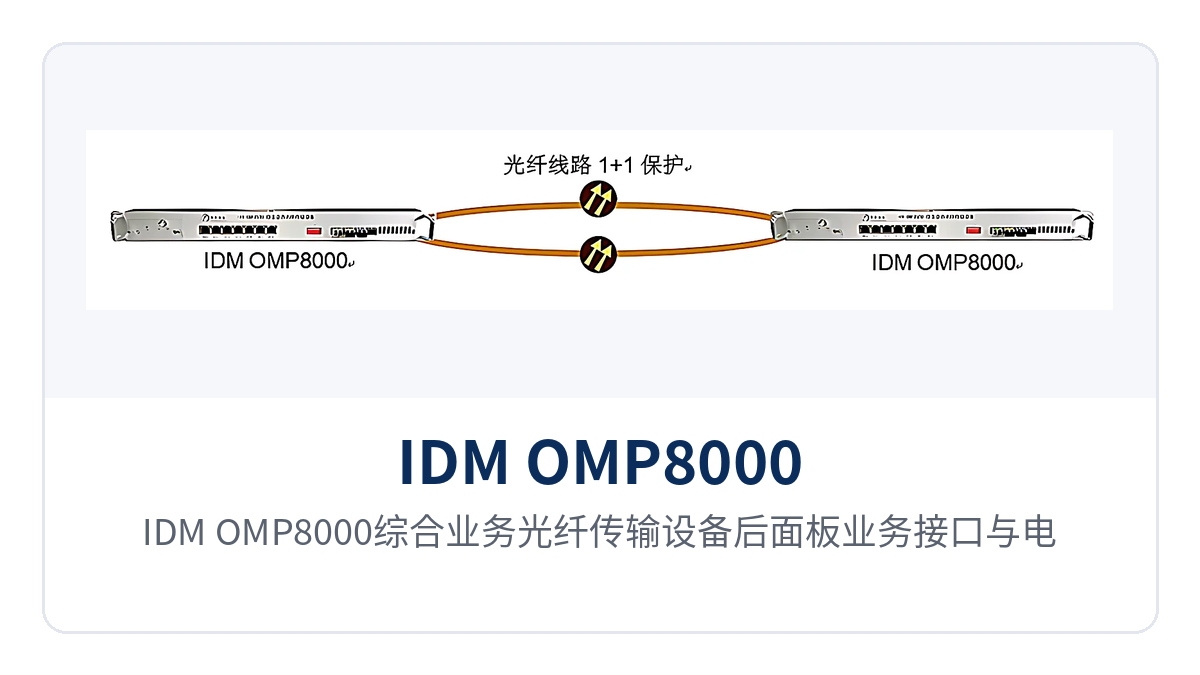
Figure 3: Rear panel service interface and power supply terminal layout of the IDM OMP8000 integrated service optical fiber transmission equipment
Differentiated Value
The differentiated capabilities of the IDM OMP8000 8-channel isolated gigabit integrated service optical multiplexer can be summarized into four short selling point labels, with the corresponding capabilities shown in the table below.
Selling Point Label | Corresponding Capability |
|---|---|
2.5G dual optical ports | The line side provides two SFP 2.5G optical ports, A and B, which can form point-to-point, chain network, ring network or 1+1 protection networks according to site distribution |
1+1 optical ring network | The two optical ports form 1+1 protection or a ring network. When one optical path fails, services are automatically switched over, and a single point of failure does not interrupt services |
8-channel isolated gigabit | Provides 8 groups of physically isolated gigabit Ethernet. The data plane is isolated between port groups, and multiple networks do not preempt each other's bandwidth |
30-channel PCM access | Provides up to 30 channels of narrowband PCM service access, supporting service cards such as FXS/FXO, magneto, EM and serial port data |
The user value corresponding to the above short labels is shown in the table below.
Differentiation Point | Value to Users |
|---|---|
Dual 2.5G optical ports and ring network protection | Two 2.5G SFP optical ports can form a 1+1 protection ring network, so services are not interrupted by a single point of failure |
8 groups of physically isolated gigabit | 8 groups of physically isolated gigabit Ethernet, so multiple services on a private network do not interfere with one another and are more secure |
Mutual backup between optical fiber and E1 PCM | Mutual backup between the optical fiber and the PCM of the first E1, giving narrowband services an extra layer of fallback |
As the fruit of Raytrans's long-term technical accumulation as an optical multiplexer manufacturer, IDM OMP8000 is based on a converged PDH and MSAP architecture, and its product showcase focuses on multi-service isolated access and ring network protection capabilities in government private network optical fiber communication solutions, providing a high cost performance choice for the unified deployment of integrated service access devices and PCM equipment.
Typical Application Scenarios
Energy and Electric Power: Private Networks for Substations and Distribution Stations
Substations, distribution stations and the booster stations of new energy stations simultaneously carry three types of services: dispatch telephone, telecontrol data and video surveillance. Most sites are unattended and their equipment rooms have no air conditioning. The IDM OMP8000 8-channel isolated gigabit integrated service optical multiplexer uses a pair of optical fibers to carry all three types of services out at once, so the site side no longer needs to set up a separate optical multiplexer for each type of service.
The E1 channel and the PCM equipment back each other up to carry telecontrol and protection information, the FXS/FXO cards connect dispatch telephones and hotlines, and the 8 groups of physically isolated gigabit Ethernet separately carry the video surveillance network, the office network and the production network. The device supports dual power supply of DC-48V and AC220V, and can directly draw on the existing direct current power supply at the station; its operating temperature is -20℃~+50℃, adapting to the operating conditions of outdoor cabinets and unattended station buildings.
Rail Transit: Communication and Surveillance Along the Line
Stations along railways, metros and expressways are several kilometers apart, and the inter-station services include telephone, data and network. Access points are scattered and equipment room conditions are limited. The IDM OMP8000 8-channel isolated gigabit integrated service optical multiplexer forms a chain network or ring network according to site distribution, and each station along the line accesses services nearby and then backhauls them to the central equipment room over the trunk optical fiber.
In the ring network topology, if a fiber break occurs in any section, services along the line can be rerouted from the other side; video surveillance exclusively occupies one group of isolated gigabit ports, while dispatch telephones and telecontrol data use their own interfaces, so they do not affect each other during link maintenance. The device can also perform hybrid networking with IDM MSAP-G3CP, organizing the integrated service access devices in the central equipment room and the remote access devices on the same optical fiber network.
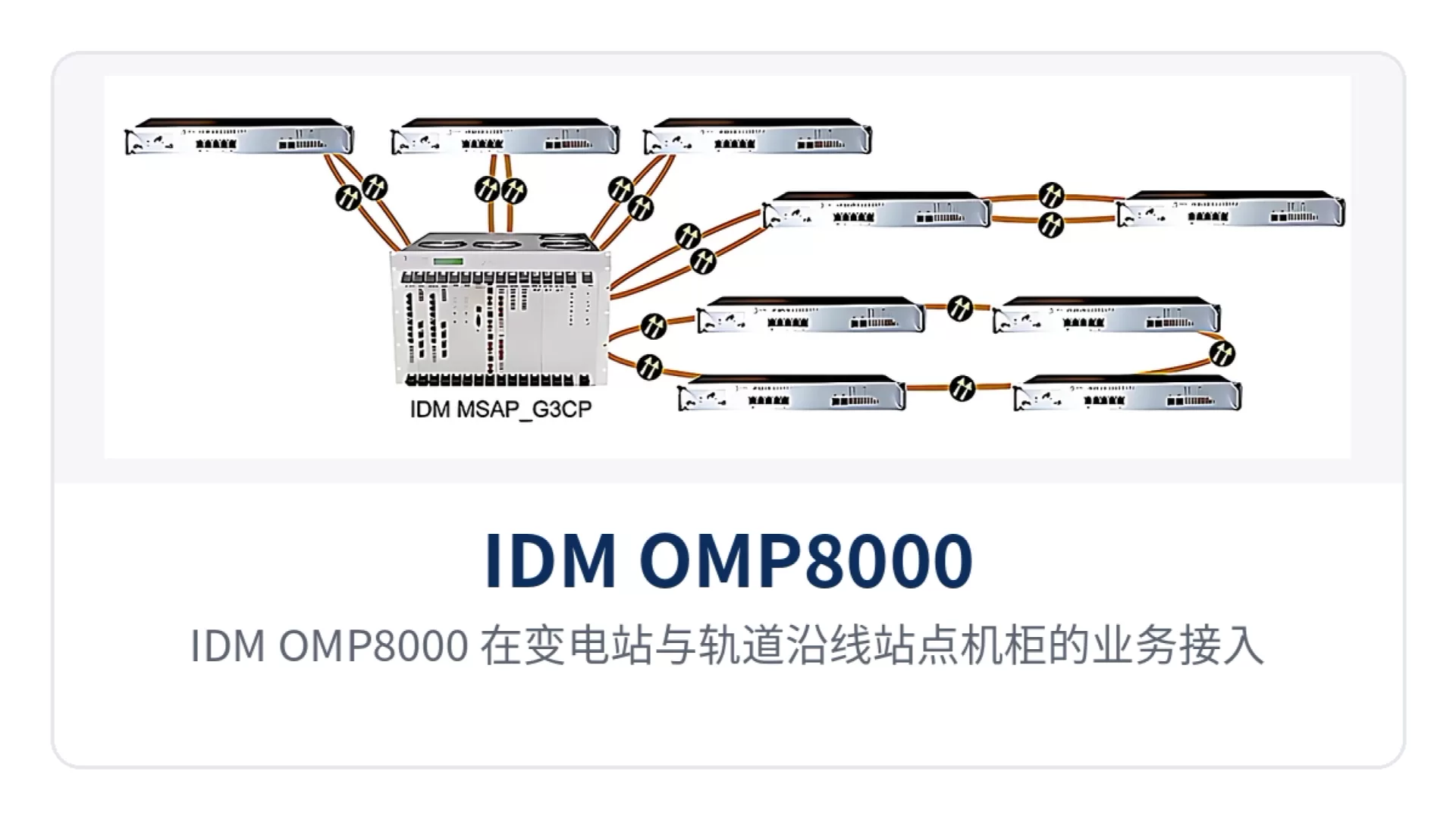
Figure 4: Schematic of service access deployment of IDM OMP8000 in station cabinets at substations and along rail lines
Military and Government: Field Private Networks and Emergency Sites
Field command posts, temporary training sites and emergency communications sites usually have no ready-made transmission resources, and telephone, data and network channels need to be established in a short time. The IDM OMP8000 8-channel isolated gigabit integrated service optical multiplexer concentrates telephone, audio, 64Kbps data, V.35 and 8 groups of isolated gigabit Ethernet into one device. Used in pairs, the terminals can enable multi-service communication over a pair of optical fibers, which facilitates vehicle-mounted transport and rapid deployment.
The V.35 interface can interconnect with devices such as routers, and the n×64Kbps rate configuration method makes it easy to allocate flexibly according to available bandwidth; dual power supply and wide-temperature design adapt to field equipment rooms with limited conditions, and SNMP network management makes it easy for O&M personnel to remotely keep track of device status at sites via the existing IP network, reducing field duty and inspection frequency.