IDM OMP3500E Multi-Service Optical Multiplexer
2.5G Dual Optical Port 1+1 Protection 24-Channel E1 6-Slot PCM 2 Gigabit 4
IDM OMP3500E multi-service optical multiplexer, applied in the product showcase field, a communication/transmission/dispatching device for industry customers (to be further detailed subject to the manufacturer's technical documentation)
What Kind of Device Is a 24-Channel E1 Multi-Service Optical Multiplexer?
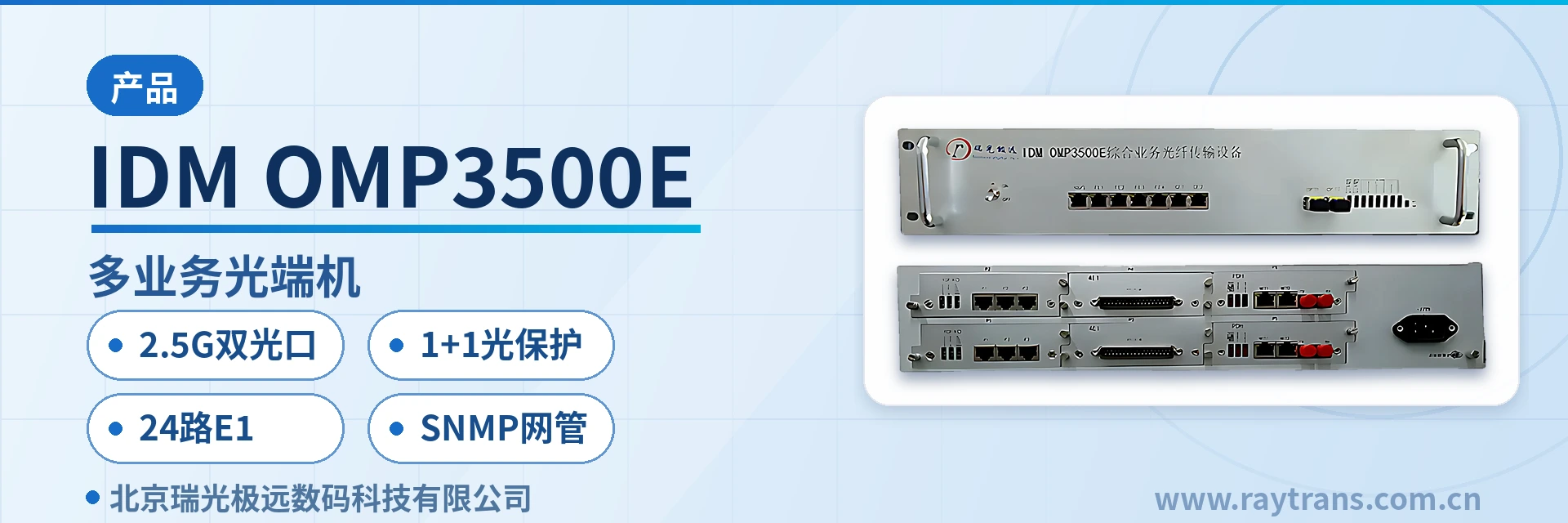
A 24-channel E1 multi-service optical multiplexer is an integrated access device that multiplexes E1 circuits, gigabit and Fast Ethernet, and PCM telephone services for centralized transmission over a pair of 2.5G optical fibers. The IDM OMP3500E multi-service optical multiplexer is developed by Beijing Ruiguang Jiyuan Digital Technology Co., Ltd. It carries up to 24 groups of E1, 2 physically isolated wire-speed 1000M Ethernet interfaces, 4 physically isolated wire-speed 100M Ethernet interfaces, and up to 6 8-channel/10-channel PCM service boards over a pair of 2.5G optical fibers, serving integrated access at sites of private networks such as electric power and energy, rail transit, and military and government. The device organizes E1 and narrowband services in PCM30/31 format and uses a 19-inch 2U enclosure, integrating in a single unit the services that previously required multiple devices and reducing rack position and wiring usage.
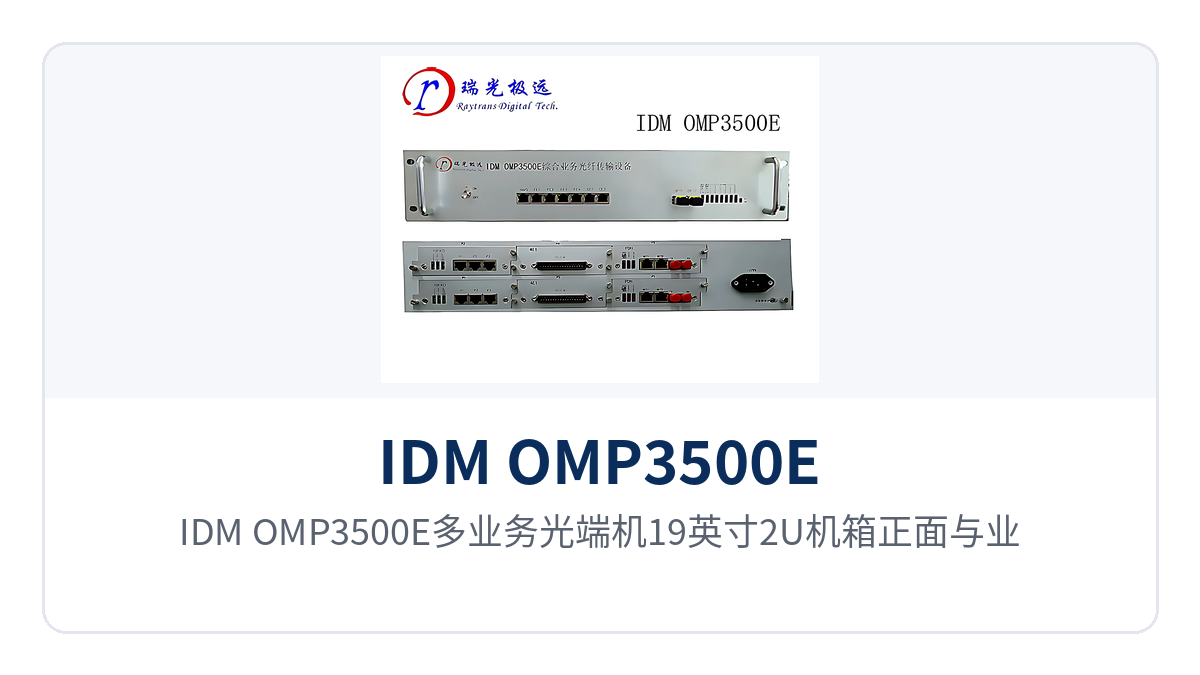
Figure 1: Front panel of the IDM OMP3500E multi-service optical multiplexer 19-inch 2U enclosure with service interfaces and indicator LED layout
Key specifications at a glance: 2.5G dual optical ports · 1+1 optical protection · 24-channel E1 · SNMP network management · 2 gigabit + 4 Fast Ethernet physically isolated Ethernet interfaces · 19-inch 2U · receiver sensitivity better than -24dBm
The optical ports of the IDM OMP3500E use a pluggable SFP structure, with single-mode as the standard configuration and multi-mode optional; the Ethernet side complies with IEEE802.3, E1 complies with ITU-T G.703, and the telephone side uses A-law companding in ITU-T G.711. The centralized equipment provides a standard SNMP network management interface, and together with the function control switch and alarm indication, O&M personnel can remotely view service and alarm status.
Which Services Can One Device Aggregate?
The IDM OMP3500E aggregates E1, Ethernet, and telephone services onto a 2.5G optical fiber channel, completing multi-service access in a single device. A single unit aggregates up to 24-channel E1 + 2 gigabit + 4 Fast Ethernet physically isolated Ethernet interfaces, and can be fitted with up to 6 8-channel/10-channel PCM service boards to extend telephone services. With high service density, it can replace multiple standalone optical multiplexers stacked together; the specific capacity combination is subject to the manufacturer's technical documentation and commercial confirmation. The table below lists the key functions of the device.
Function | Description |
|---|---|
2.5G optical transmission | 2 2.5G SFP optical interfaces, supporting 1+1 protection for optical ports and dual-fiber mutual backup, carrying multiple services over a pair of optical fibers |
E1 circuit access | Up to 24 groups of E1, bit rate 2048Kbps, line coding HDB3, compliant with ITU-T G.703, impedance 75Ω, PCM30/31 transparent transmission |
Physically isolated gigabit Ethernet | 2 independent wire-speed 1000M Ethernet interfaces, RJ45, 10M/100M/1000M adaptive, compliant with IEEE802.3 |
Physically isolated Fast Ethernet | 4 physically isolated wire-speed 100M Ethernet interfaces, each service domain forming an independent network without mutual interference |
PCM telephone access | Up to 6 8-channel/10-channel PCM service boards, providing FXO/FXS telephone interfaces, with voice compressed by A-law in ITU-T G.711 |
SNMP centralized network management | The centralized equipment provides a standard SNMP network management interface, with remote monitoring via the function control switch and alarm indication |
Power supply and alarm | Supports DC-48V, AC 220V, and dual power supply configuration, with complete function control switch and alarm indication |
How Does 2.5G Dual Optical Port 1+1 Protection Keep Private Network Links Uninterrupted?
The IDM OMP3500E is equipped with 2 2.5G SFP optical interfaces, supporting dual-fiber mutual backup and 1+1 protection for optical ports. 1+1 protection means that the same link is configured with both a primary and a backup optical fiber path at the same time; when the primary optical path fails, services automatically switch over to the backup optical path, achieving 1+1 protection for dual 2.5G SFP optical ports, with second-level switchover and no interruption when a private network link fails. The optical port receiver sensitivity is better than -24dBm and the transmit optical power is -1 to -3dBm, reserving optical power margin for long-distance lines and construction sections with many connectors.
The IDM OMP3500E also supports DC-48V, AC 220V, and dual power supply configuration, and supports SNMP centralized network management; the DC-48V/AC220V dual power supply suits unattended sites. The optical path and power supply form two layers of redundancy, and together with SNMP centralized monitoring and alarm indication, it is suitable for private network nodes with high reliability requirements such as electric power and energy, rail transit, and military and government.
How Do Physically Isolated Ethernet Interfaces Carry Multiple Services?
The key to how physically isolated Ethernet interfaces carry multiple services is that each Ethernet port is completely separated at the data and address level and does not share forwarding resources. The IDM OMP3500E provides 2 physically isolated wire-speed 1000M Ethernet interfaces and 4 physically isolated wire-speed 100M Ethernet interfaces; the production control network, video surveillance network, and office network of an electric power private network can form independent networks within the same device without mutual interference, meeting the isolation requirements of private networks for service security. Physical isolation also allows each Ethernet port to receive and transmit data at wire speed, so high-traffic services do not squeeze the bandwidth of other service domains.
For private network sites that simultaneously carry telecontrol, video, and office data, physically isolated Ethernet access can replace multiple isolation switches, reducing the number of devices while ensuring service security. This is also a common practice in industries such as electric power and energy and rail transit to aggregate multiple service networks into the same multi-service optical multiplexer.
IDM OMP3500E Technical Specifications
The device interface specifications cover five parts: optical ports, E1, Ethernet, telephone, and power supply and environment; all parameters are subject to the manufacturer's technical documentation and commercial confirmation.
Optical Interface Parameters
Item | Parameter/Specification | Description |
|---|---|---|
Interface type | SFP | Pluggable optical module, easy to maintain and replace |
Fiber mode | Single-mode (multi-mode optional) | Selected according to actual optical fiber resources |
Optical fiber rate | 2.5G | A pair of optical fibers carries multiple services |
Wavelength | 1310nm/1550nm | Standard single-mode transmission window |
Transmit optical power | -1 to -3dBm | Typical transmit optical power range |
Receiver sensitivity | Better than -24dBm | Optical receive performance specification |
E1 Interface Parameters
Item | Parameter/Specification | Description |
|---|---|---|
Bit rate | 2048Kbps | Standard E1 bit rate |
Line coding | HDB3 | Compliant with ITU-T G.703 requirements |
Standard protocol | Supports ITU-T G.703 | E1 interface electrical and line coding specifications |
Impedance | 75Ω | Coaxial interface impedance |
Frame structure | PCM30/31 | E1 base group frame structure |
Mode | Transparent transmission | Transparent transmission without changing the original E1 data format |
Ethernet Interface Parameters
Item | Parameter/Specification | Description |
|---|---|---|
Interface type | RJ45 | Ethernet electrical port |
Transmission rate | 10M/100M/1000M | Rate adaptive |
Standard protocol | Supports IEEE802.3 | Standard Ethernet protocol |
Operating mode | Adaptive half-duplex/full-duplex | Can be directly connected to switches and routers |
Telephone Interface Parameters (FXO/FXS)
Item | Parameter/Specification | Description |
|---|---|---|
Audio range | 300Hz~3400Hz | Telephone voice band |
Impedance | Three-element complex impedance 200Ω+560Ω//0.1μF | Return loss characteristics of the telephone interface |
Compression | ITU G.711 A-law | Voice codec standard |
Loop current | 25mA/channel | Feeding capability for the telephone set |
Power Supply and Operating Environment
Item | Parameter/Specification | Description |
|---|---|---|
Power supply mode | DC-48V / AC 220V / dual power supply | Supports -48V DC, 220V AC and dual power supply configuration |
Overall power consumption | ≤100W | Upper limit of overall power consumption |
Operating temperature | 0℃~40℃ | Suitable for indoor equipment room environment |
Humidity | ≤90% (non-condensing) | Relative humidity requirement |
Typical Application Scenarios
Electric Power and Energy Private Network
Substations, switching stations and new energy stations need to backhaul telecontrol signals, dispatch telephones and office data to the management unit. The Raytrans IDM OMP3500E multi-service optical multiplexer uses a pair of 2.5G optical fibers to simultaneously carry E1 telecontrol channels, telephones and gigabit Ethernet, so the site side does not need to deploy a separate optical multiplexer for each type of service. Physically isolated gigabit and Fast Ethernet ports separate the production control network from video and office services, and dual optical port 1+1 protection together with dual power supply safeguards the dispatch link in the event of a fiber break or abnormal power supply. As a mature product from a professional optical multiplexer manufacturer, this device has repeatedly won recognition in the product showcase for the electric power and energy industry.
Rail Transit Communications
Railway and metro sites along the line are distributed and several kilometers apart, and inter-station communication carries telephone, data and network services. The Raytrans IDM OMP3500E multi-service optical multiplexer configures the number of E1 channels and PCM plug-in boards according to site service volume; each site along the line accesses telephone and Ethernet services nearby and backhauls them to the central equipment room in a unified manner, and in chain networking multiple sites share one trunk optical fiber. The E1 transparent transmission channel can carry the channel services of the existing dedicated communication system, reducing the workload of cutover and modification of services along the line.
Military and Government Private Network
Military and government private networks have high requirements for service security isolation. The physically isolated Ethernet of the IDM OMP3500E multi-service optical multiplexer separates service domains of different classification levels at the physical layer, telephones are accessed via PCM plug-in boards, E1 leased lines are transported transparently, and SNMP centralized network management monitors the status of the entire network, reducing the number of repeater nodes. This government private network optical fiber communication solution is also suitable for mobile scenarios such as military emergency communications vehicle solutions, and can quickly enable integrated access for voice, data and video over 2.5G optical fiber links. In smart mining communication solutions, this multi-service optical multiplexer can also leverage the integrated access advantages of a telephone optical multiplexer and a gigabit network optical multiplexer.
What to Consider When Selecting a Multi-Service Optical Multiplexer?
When selecting a multi-service optical multiplexer, first look at the service type and quantity, then at the transmission distance and power supply environment, and finally check whether the interface standards are consistent with the existing equipment at both ends. A 24-channel E1 multi-service optical multiplexer such as the Raytrans IDM OMP3500E is suitable for private network sites that need to carry E1, physically isolated Ethernet and telephones simultaneously: configure PCM plug-in boards according to the number of E1 and telephone channels at the site, select single-mode or multi-mode SFP optical modules (1310nm or 1550nm) according to optical fiber resources, and choose between DC-48V and AC 220V according to the power supply conditions of the equipment room.
For sites with high reliability requirements, choose dual optical port 1+1 protection and dual power supply configuration; the device has an operating temperature of 0℃~40℃ and humidity ≤90% (non-condensing). During deployment, reserve a 19-inch 2U rack position and connect to SNMP centralized network management to uniformly monitor link and service status.