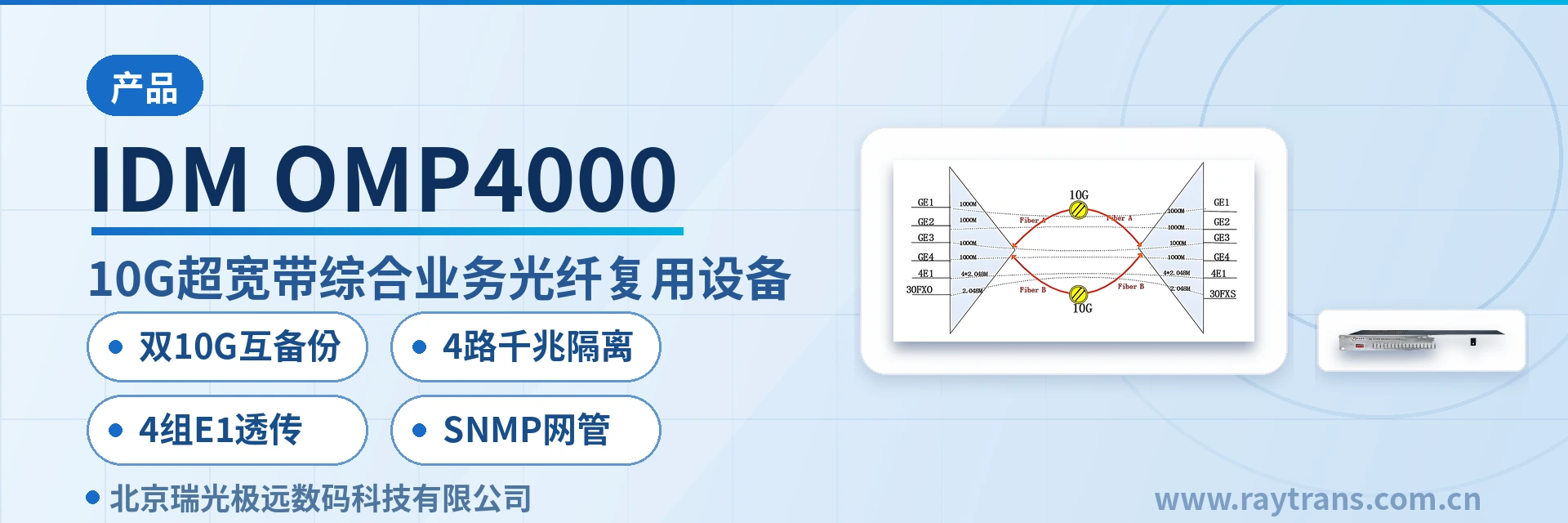
IDM OMP4000-10G Multi-Service Optical Multiplexer
Dual 10G optical ports, mutual backup, 4 physically isolated gigabit ports, 30 telephone channels,
For the 10G ultra-broadband integrated service optical multiplexing equipment, our company provides 2 x 10Gbps SFP optical interfaces with dual-fiber mutual backup, 4 physically isolated 10/100/1000M Ethernet interfaces supporting data transmission rates of 10/100/1000Mbps; 4 groups of E1 interfaces supporting transparent transmission mode; 30 standard-defined telephone interfaces (a telephone module is required if this service is needed); and a standard SNMP network management interface. In addition, the device is simple to install and can meet the requirements of various application environments.
The IDM OMP4000-10G dual-10G mutual-backup optical multiplexer is a 10G ultra-broadband integrated service optical multiplexing equipment developed by Beijing Ruiguang Jiyuan Digital Technology Co., Ltd. (Raytrans). As a multi-service optical multiplexer for the private network market, it carries E1, gigabit Ethernet and telephone voice services simultaneously over a single optical fiber. Its optical interfaces use SFP modules with an optical fiber rate of 10Gbps, and 2 10Gbps SFP optical ports can be configured for dual-fiber mutual backup. The Ethernet interfaces are 4 physically isolated 10/100/1000M ports, E1 interfaces are transparently transmitted in accordance with ITU-T G.703, and telephone voice is encoded in accordance with ITU G.711 A-law. It is suitable for private networks such as electric power, rail transit, and military and government networks to backhaul dedicated lines, data and voice from dispersed sites to the central equipment room. The equipment can be widely used in scenarios such as government private network optical fiber communication solutions, military emergency communications vehicle solutions and smart mining communication solutions. As an ideal choice among telephone optical multiplexers and multi-service optical multiplexers, Raytrans, with its reliable product showcase and deep technical accumulation as an optical multiplexer manufacturer, continues to provide high-quality optical multiplexer products and solutions for users in various industries.
Key specifications at a glance: optical fiber rate 10Gbps · dual 10Gbps SFP optical ports with mutual backup (single-mode, multi-mode optional, 1310nm/1550nm) · 4 physically isolated 10/100/1000M Ethernet ports · 4 groups of E1 transparent transmission (2048Kbps, HDB3, ITU-T G.703, 75Ω/120Ω, PCM30/31) · 30 telephone interfaces (telephone module required, ITU G.711 A-law, 25mA per channel) · DC-48V/AC220V dual power supply, overall power consumption ≤100W · standard 19-inch 1U chassis
What Kind of Device Is a Dual-10G Mutual-Backup Optical Multiplexer?
A dual-10G mutual-backup optical multiplexer is a device that packs services of multiple different interface types into the same optical fiber channel for transmission. One unit is placed at each end: one end multiplexes E1, Ethernet and telephone voice signals onto a 10Gbps optical path, and the other end demultiplexes and restores them, delivering each service to the existing switch, protection device or voice channel equipment in its original interface standard. As a typical product showcase, this type of optical multiplexer is widely used in government private network optical fiber communication solutions, military emergency communications vehicle solutions and smart mining communication solutions.
The optical ports of the IDM OMP4000-10G use pluggable SFP modules, with an optical fiber rate of 10Gbps, single-mode fiber (multi-mode optional), wavelengths of 1310nm/1550nm, a transmit optical power of -1~-3dBm, and a receiver sensitivity better than -24dBm. On this basis, the link loss budget can be calculated and SFP optical modules of the corresponding distance grade can be selected. The equipment provides 2 10Gbps SFP optical ports, which can be configured for dual-fiber mutual backup, with the two optical paths backing up each other. This multi-service optical multiplexer is developed and manufactured by Raytrans and is a high-bandwidth multiplexing model in its telephone optical multiplexer product line.
The three services each occupy an independent channel inside the IDM OMP4000-10G and do not change each other's encoding or frame structure. E1 services are carried by transparent transmission at a bit rate of 2048Kbps and line coding of HDB3, without changing the time slot content; Ethernet services use adaptive negotiation at 10M/100M/1000M and comply with IEEE802.3; telephone voice runs over PCM voice channels, with an audio range of 300Hz~3400Hz, ITU G.711 A-law compression, and a loop current of 25mA per channel. The three services share the 10Gbps optical path bandwidth and arrive at the opposite-end site simultaneously. As a professional optical multiplexer manufacturer, Raytrans integrates complete telephone optical multiplexer and multi-service optical multiplexer functions into this series of optical multiplexers.
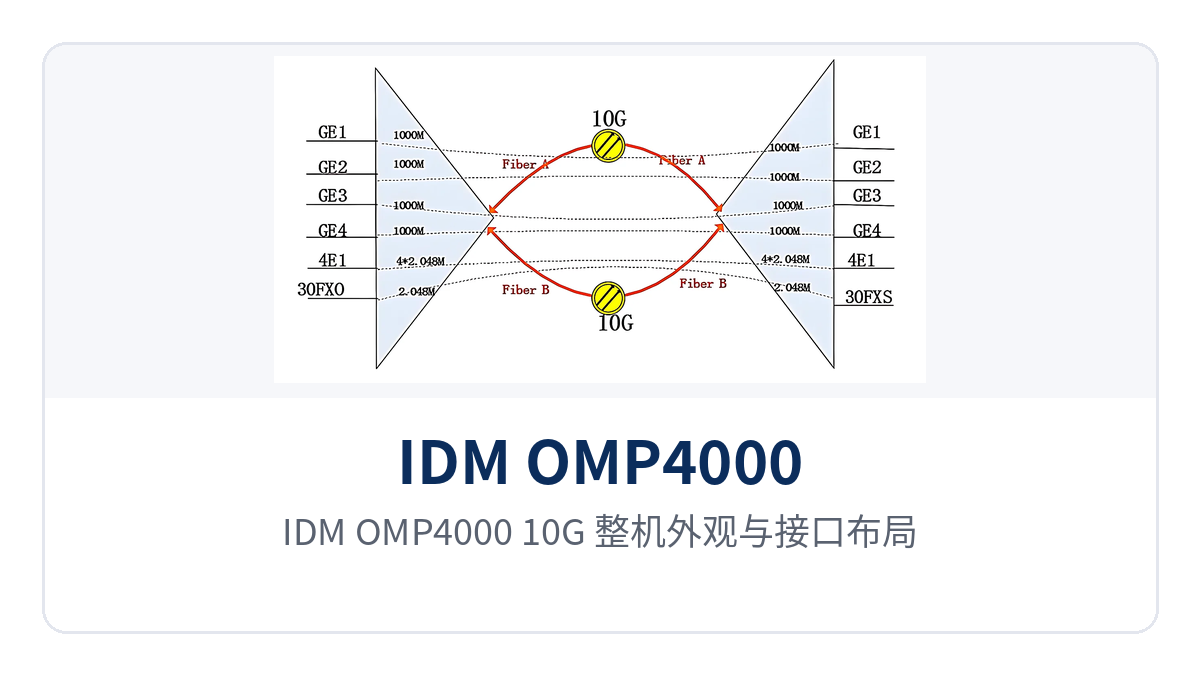
Figure 1: Overall appearance and interface layout of the IDM OMP4000-10G
What Interfaces and Functions Can One Device Provide?
The IDM OMP4000-10G uses a single 1U device to simultaneously provide four types of capabilities: optical fiber transmission, E1 channels, gigabit Ethernet and telephone voice, replacing the multiple single-function transmission devices previously deployed separately. As a highly integrated multi-service optical multiplexer, it combines the voice access capability of a telephone optical multiplexer with Ethernet multiplexing capability in one optical multiplexer. The functions and their corresponding interface standards are shown in the following table:
Function | Description |
|---|---|
10Gbps optical fiber transmission | The optical interface is SFP, the optical fiber rate is 10Gbps, single-mode (multi-mode optional), wavelengths 1310nm/1550nm, and a single optical fiber simultaneously carries E1, Ethernet and telephone voice services |
Dual 10G optical port mutual backup | Provides 2 10Gbps SFP optical interfaces, configurable for dual-fiber mutual backup, with the two optical paths backing up each other to reduce single point of failure on the trunk link |
4 groups of E1 transparent transmission | Bit rate 2048Kbps, line coding HDB3, compliant with ITU-T G.703, impedance 75Ω/120Ω optional, frame structure PCM30/31, and transparent transmission mode does not change the time slot content |
4 physically isolated gigabit Ethernet interfaces | Provides 4 physically isolated 10/100/1000M Ethernet interfaces, compliant with IEEE802.3, with RJ45 connectors, supporting full/half duplex and 10M/100M/1000M adaptive |
Telephone voice access | Audio range 300Hz~3400Hz, three-element complex impedance 200Ω+560Ω//0.1μF, ITU G.711 A-law compression, loop current 25mA per channel; when voice services are required, a telephone module is configured to provide 30 standard telephone interfaces |
SNMP network management and alarms | Provides a standard SNMP network management interface; the chassis has a function control switch and alarm indication for remote monitoring of the equipment's operating status |
Dual power supply redundant power feeding | Supports DC-48V, AC220V and dual power supply access, with the two power feeds connected separately, so a single power supply failure does not affect service operation |
The specific number of ports, number of service channels and isolation configuration are subject to the manufacturer's technical documentation and commercial confirmation. The equipment adopts a standard 19-inch 1U chassis architecture, is simple to install, and can meet the requirements of various application environments. As an optical multiplexer manufacturer, Raytrans can provide corresponding product showcase and selection support for government private network optical fiber communication solutions, military emergency communications vehicle solutions and smart mining communication solutions.
Key Specifications
The technical specifications of the IDM OMP4000-10G cover six parts: optical interfaces, E1 interfaces, Ethernet interfaces, telephone voice interfaces, power supply and power consumption, and environmental conditions. The key indicators are shown in the following table, and the values are subject to the manufacturer's product documentation and factory testing:
Item | Parameter/Specification | Description/Applicable Conditions |
|---|---|---|
Optical interface type | SFP | Pluggable optical module, easy to replace by distance and to keep as spare parts |
Fiber mode | Single-mode (multi-mode optional) | Selected according to line distance and fiber core conditions |
Optical fiber rate | 10Gbps | Shared by E1, Ethernet and telephone voice services |
Number of optical ports | 2 x 10Gbps SFP optical ports | Configurable for dual-fiber mutual backup |
Wavelength | 1310nm/1550nm | Two wavelengths selectable |
Transmit optical power | -1~-3dBm | Typical single-mode value; subject to actual measurement with an optical power meter |
Receiver sensitivity | Better than -24dBm | The link loss budget can be calculated on this basis |
E1 bit rate | 2048Kbps | Line coding HDB3 |
E1 standard protocol | Supports ITU-T G.703 | Standard E1 interface specification |
E1 impedance | 75Ω/120Ω | Selected according to the interface of the interconnected equipment |
E1 frame structure | PCM30/31 | Primary group frame structure |
E1 mode | Transparent transmission | Services are transmitted as they are, without changing the time slot content |
Ethernet interface | RJ45, 10M/100M/1000M | 4 physically isolated ports, compliant with IEEE802.3, full-duplex/half-duplex/adaptive |
Telephone voice audio range | 300Hz~3400Hz | Telephone voice channel bandwidth |
Telephone voice impedance | Three-element complex impedance 200Ω+560Ω//0.1μF | Telephone subscriber line interface standard |
Telephone voice compression | ITU G.711 A-law | 64Kbps PCM encoding |
Telephone voice loop current | 25mA/channel | Feeding capability of each voice channel |
Power supply mode | DC-48V / AC220V / dual power supply | Dual power supply access improves power supply reliability |
Overall power consumption | ≤100W | Overall value including service cards and optical modules |
Operating temperature | 0℃~40℃ | Equipment room and temperature-controlled cabinet environments |
Humidity | ≤90% (non-condensing) | Upper limit of relative humidity |
Equipment form factor, optical ports and power supply connections
IDM OMP4000-10G adopts a standard 19-inch 1U chassis architecture. The front panel concentrates the E1, Ethernet and telephone service interfaces together with operating indicator LEDs, while the rear panel houses the SFP optical ports and power supply terminals. Installation and maintenance are both performed at the front of the cabinet, making it suitable for private network projects with a large number of sites and a large maintenance radius. Raytrans provides complete product showcase and technical documentation for this multi-service optical multiplexer, making it easy for integrators to rapidly deploy it in government private network optical fiber communication solutions, military emergency communications vehicle solutions and smart mining communication solutions.
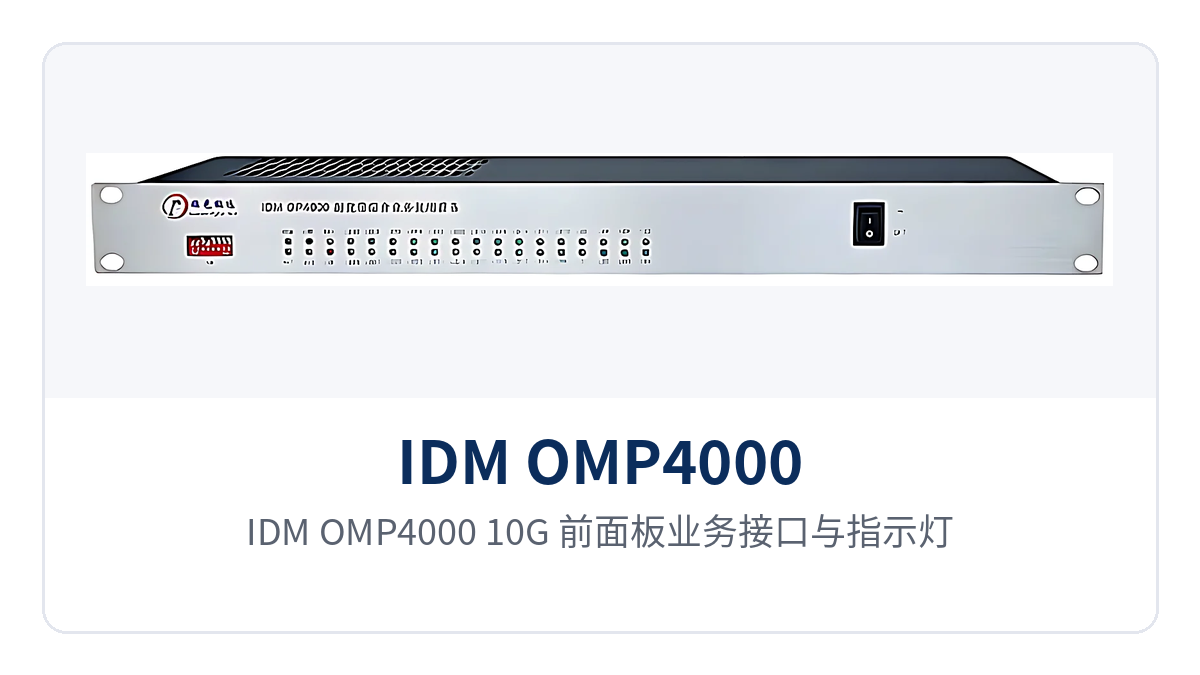
Figure 2: IDM OMP4000-10G front panel service interfaces and indicator LEDs
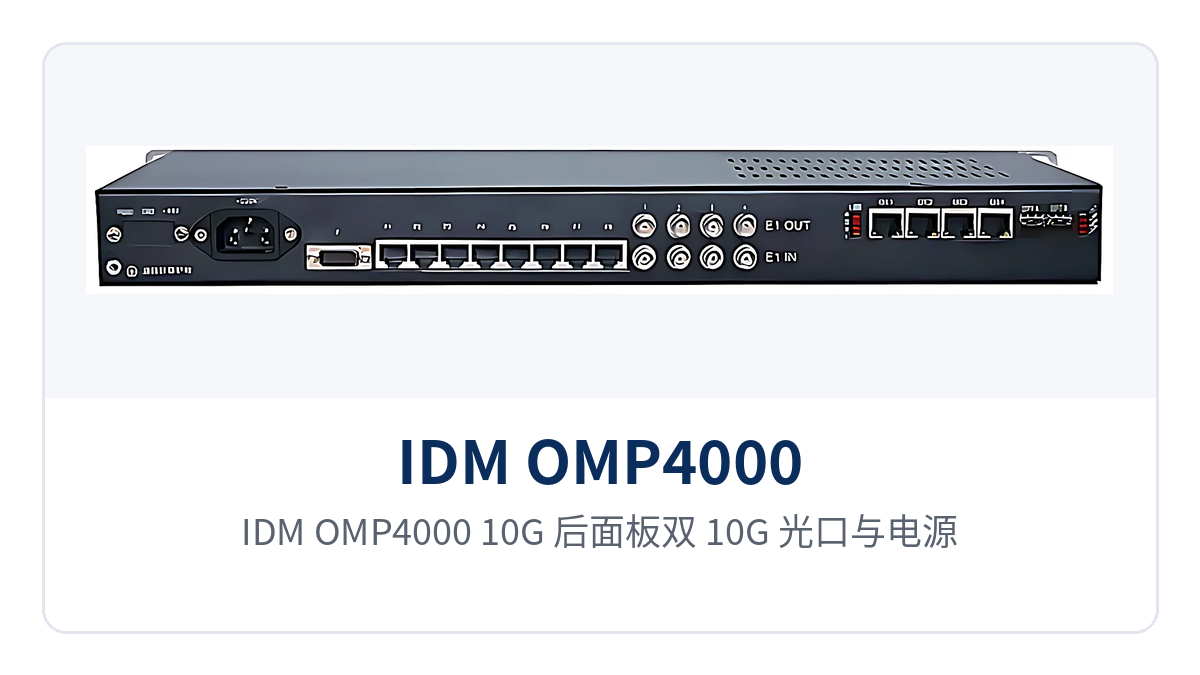
Figure 3: IDM OMP4000-10G rear panel dual 10G optical ports and power supply terminals
How do the dual 10G SFP optical ports implement dual-fiber mutual backup?
The key to dual-fiber mutual backup is to connect two devices with two independent optical fibers, so that services are not interrupted when either fiber or optical module fails. IDM OMP4000-10G provides 2 x 10Gbps SFP optical interfaces. The two fibers can run along different duct routes or different optical cable sections. The optical ports work in 1+1 protection mode, and services are switched to the standby optical path after the primary optical path fails, so the single point of failure risk of the trunk link is reduced accordingly. Optical modules are selected according to link length, and pluggable replacement does not require touching other boards in the chassis. This feature makes the optical multiplexer stand out in scenarios with extremely high requirements on link reliability, such as military emergency communications vehicle solutions.
How is the dual power supply connected?
The key point of dual power supply access is to feed two independent power sources to the two power inputs of the device, so that service remains uninterrupted when either feed fails. The IDM OMP4000-10G supports three power supply modes: DC-48V, AC220V and dual power supply. The -48V direct current and 220V AC mains power commonly used in communications equipment rooms can each occupy one feed. The overall power consumption is ≤100W, with low requirements on storage battery capacity and equipment room air conditioning. During wiring, first check whether the equipment room power format matches the device labeling, then check whether the grounding and terminal crimping are secure, and then power on to observe the power and alarm indicator LEDs. After confirming normal received optical power, verify services one by one. As an optical multiplexer manufacturer, Raytrans provides well-developed dual power supply redundancy design for demanding applications such as smart mining communication solutions.
Differentiated Value: Dual 10G Mutual Backup, 4-Channel Gigabit Isolation and E1 Transparent Transmission
As a product showcase model for private networks, the IDM OMP4000-10G concentrates its differentiation in four points: dual 10G mutual backup on the trunk optical path, physical isolation of Ethernet ports, E1 transparent transmission in compliance with standards for interfacing with existing private networks, and SNMP network management for remote maintenance. The capabilities of this optical multiplexer and their actual value to private network customers are listed in the table below:
Differentiation Point | Value to Private Network Customers |
|---|---|
Dual 10G mutual backup: dual 10G SFP mutual backup, no fiber break on the private network trunk link | 2 10Gbps SFP optical ports can be configured for dual-fiber mutual backup; when the primary optical path fails, services are switched to the backup optical path; one 10Gbps optical fiber simultaneously carries three types of services — E1, gigabit Ethernet and telephone voice — saving fiber core resources |
4-channel gigabit isolation: 4-channel gigabit physical isolation, secure separate loading of production and management networks | 4 10/100/1000M Ethernet ports are physically isolated and independent of one another, and can separately carry production control network, office management network and video surveillance services without crosstalk; the interfaces are adaptive at 10M/100M/1000M, requiring no on-site setup |
4 groups of E1 transparent transmission: 4 groups of E1 transparent transmission compatible with G.703, seamless interfacing with power relay protection | 4 groups of E1 channels are transparently transmitted in accordance with ITU-T G.703, with a bit rate of 2048Kbps, HDB3 line coding and selectable 75Ω/120Ω impedance; the relay protection device and dispatching switching equipment at the opposite end require no configuration adjustment |
SNMP network management: standard SNMP network management interface provided | O&M personnel can monitor device status and alarms of remote stations from the central equipment room, reducing on-site inspection frequency at unattended sites |
Typical Application Scenarios
As a multi-service optical multiplexer, the IDM OMP4000-10G is deployed mainly in point-to-point mode: one device at each end, interconnected by optical fiber. The E1, Ethernet and telephone services at the site side are restored at the central equipment room and then connected to existing transmission and switching equipment; when a site is expanded, only service boards need to be added, without laying new optical cables.
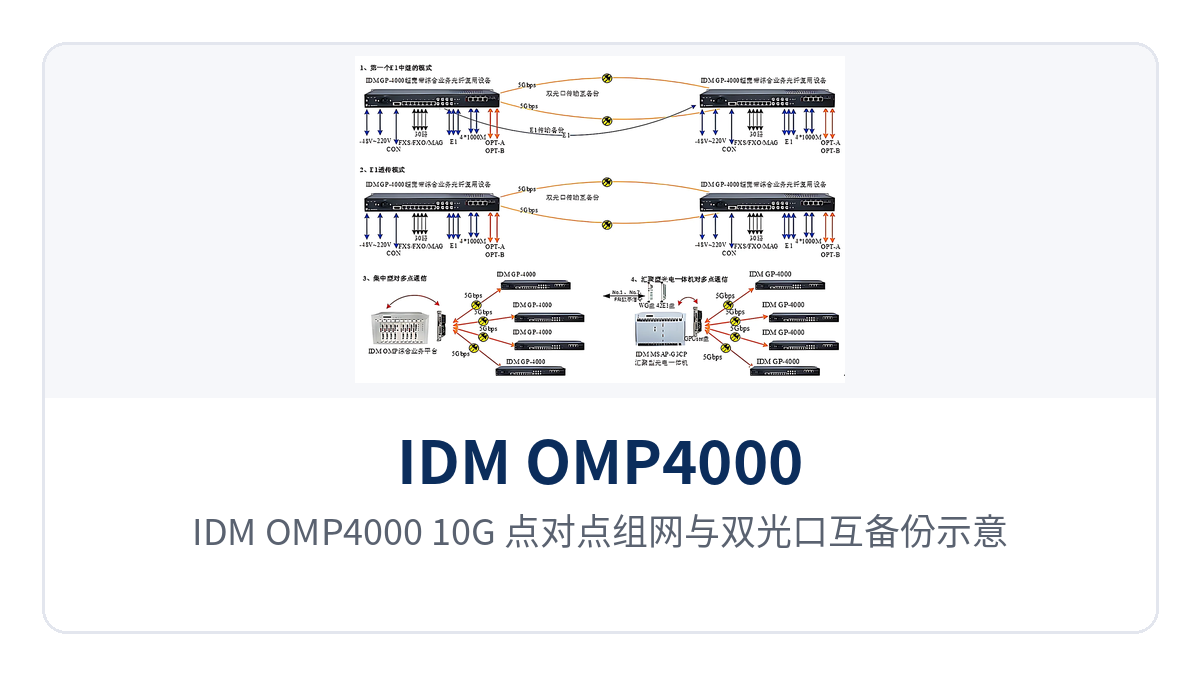
Figure 4: IDM OMP4000-10G point-to-point networking and dual optical port mutual backup
Electric Power and Energy Industrial Private Network
Between electric power substations, switching stations and new energy stations, dispatch telephones, automation E1 dedicated lines and in-station data need to be transmitted simultaneously. The IDM OMP4000-10G is installed at each station, using one 10Gbps single-mode fiber to multiplex the inter-station dispatch audio, E1 channels and data services for transmission, replacing the previous practice of stacked devices and multiple line rentals. The 4 groups of E1 channels are transparently transmitted in accordance with ITU-T G.703 and can be directly connected to relay protection devices and dispatching switching equipment, with no configuration adjustment required at the opposite end; the telephone voice interface is encoded in accordance with ITU G.711 A-law, with a loop current of 25mA per channel, and can be directly connected to dispatch telephone equipment.
Rail Transit and Pipe Gallery Communications
Metro stations, depots and urban underground pipe galleries have distributed sites with long spacing, and dedicated telephones, monitoring data and device network management information usually need to be transmitted simultaneously between stations. The dual 10G optical ports of the IDM OMP4000-10G can run through different ducts respectively to form dual-fiber mutual backup, preventing a total interruption of inter-station services caused by a single optical cable being dug up; the 4 physically isolated Ethernet ports can carry train-operation-related networks and O&M office networks separately without affecting each other. The 1U enclosure of the device is deployed in station communications equipment rooms and pipe gallery node cabinets, facilitating centralized maintenance.
Military and Government Private Networks
Military and government private networks impose high requirements on link survivability and self-maintenance, and sites are often distributed in the field and remote areas. The IDM OMP4000-10G uses one 10Gbps optical fiber to aggregate voice, data and dedicated line services, reducing the amount of optical cable laying and the exposure surface; DC-48V and AC220V dual power supply access adapts to mixed power supply scenarios of field generators, storage batteries and mains power, and the SNMP network management interface allows the superior equipment room to remotely monitor the operating status of each site, reducing personnel travel. This optical multiplexer is also suitable for government private network optical fiber communication solutions and military emergency communications vehicle solutions, and can also leverage its optical fiber multiplexing advantages in smart mining communication solutions.
How to Select an Optical Multiplexing Equipment
How to select optical multiplexing equipment can be closed out by checking three items one by one: number of service channels, optical fiber line conditions, and power supply and environmental conditions.
Check service types and number of channels: confirm how many groups of E1 channels, how many channels of telephone voice and how many channels of Ethernet are required, and compare them one by one with the 4 groups of E1, 4 physically isolated gigabit ports and 30 telephone interfaces (telephone module required) of the IDM OMP4000-10G; if the number of channels does not match, confirm other configuration models in the same series with the optical multiplexer manufacturer.
Check optical fiber line conditions: confirm single-mode or multi-mode, whether the wavelength is 1310nm or 1550nm, and the link loss budget; after calculating with the transmit optical power of -1~-3dBm and the receiver sensitivity better than -24dBm, determine the distance grade of the SFP optical module; the trunk link is recommended to be planned with dual optical port mutual backup.
Check power supply and environment: DC-48V, AC220V or dual power supply must match the site power supply; the ambient temperature is 0℃~40℃ and the humidity does not exceed 90% (non-condensing); deployment in a standard equipment room or in a temperature-controlled cabinet is recommended.
After power-on, first confirm normal received optical power at the optical port indicator LEDs, then verify E1, Ethernet and telephone services one by one, which can shorten the commissioning time.
Conclusion
As a dual 10G mutual backup optical multiplexing equipment, the IDM OMP4000-10G uses one optical fiber to simultaneously carry E1, gigabit Ethernet and telephone voice services: 2 10Gbps SFP optical ports can provide dual-fiber mutual backup, keeping the private network trunk link free of fiber breaks; 4 physically isolated gigabit ports securely separate production and management services; 4 groups of E1 transparent transmission are compatible with G.703 for seamless interfacing with power relay protection; the standard SNMP network management interface, together with DC-48V/AC220V dual power supply and ≤100W overall power consumption, adapts to unattended sites of electric power, rail transit and military and government private networks. This optical multiplexer product showcases the technical accumulation of Raytrans in the field of multi-service optical multiplexers. During selection, first check the number of service channels and board configuration, then calculate the link loss budget, confirm the site power supply and environmental conditions, and confirm the final configuration and quotation with the optical multiplexer manufacturer. For a complete networking solution, please contact Beijing Ruiguang Jiyuan Digital Technology Co., Ltd. (www.rdtcom.com, tel:010-51668966).