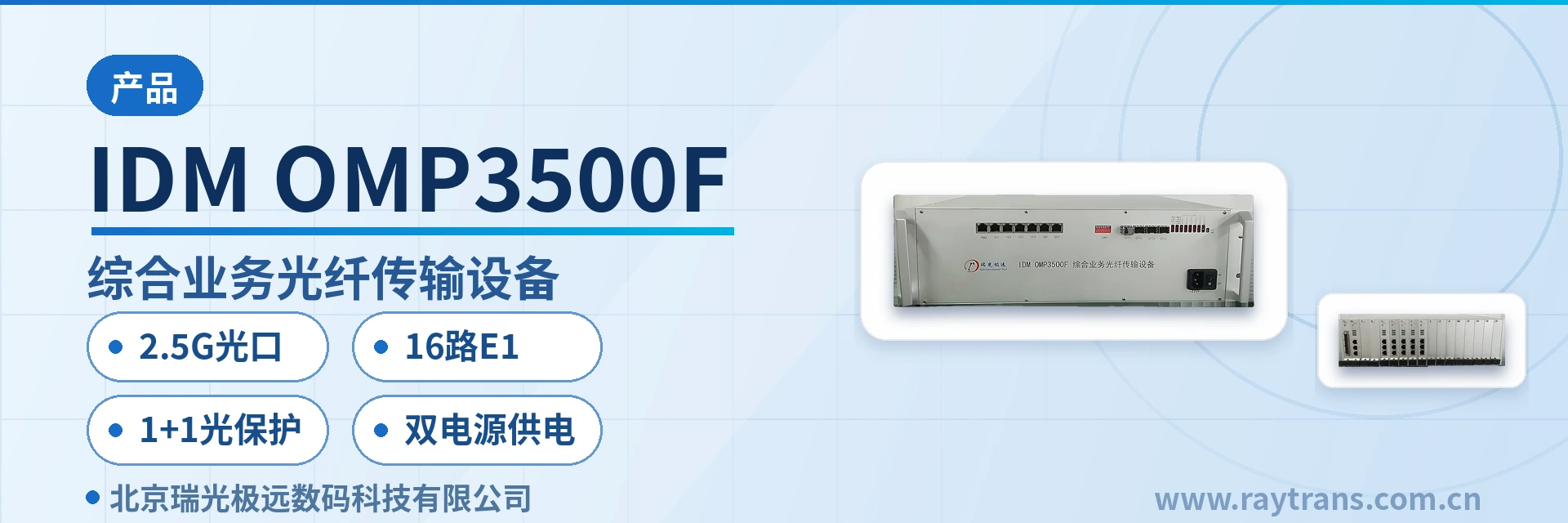
IDM OMP3500F Integrated Service Optical Fiber Transmission Equipment
2.5G dual optical port, 2 gigabit + 4 Fast Ethernet physically isolated network ports, 120-channel voice,
2.5G optical interface, 19-inch 3U standard chassis, (up to 24 groups of E1 + 2 physically isolated wire-speed 1000M Ethernet + 4 physically isolated wire-speed 100M Ethernet + up to 12 8-channel/10-channel PCM service boards); provides a standard SNMP network management interface. The IDM OMP3500F physically isolated gigabit network optical multiplexer is simple to install and can meet the requirements of various application environments.
IDM OMP3500F single-fiber 2.5G aggregation integrated access device is an integrated multiplexing platform developed by Beijing Ruiguang Jiyuan Digital Technology Co., Ltd. It consists of 2.5G optical fiber transmission interfaces, a 19-inch 3U standard chassis and a card-based service structure. It is used at private network access points to carry 16 groups of transparent transmission E1, 2 groups of physically isolated wire-speed gigabit Ethernet, 4 groups of physically isolated wire-speed 100M Ethernet and up to 120 channels of narrowband PCM services over a pair of 2.5G optical fibers, and provides 2 groups of 2.5G optical port mutual backup. As a multi-service optical multiplexer for private network access, this single-fiber 2.5G aggregation integrated access device integrates telephone, leased-line data and Ethernet access into the same device, replacing the stacking of multiple single-service devices and reducing equipment room space usage and cabling between devices. With its deep accumulation in the optical multiplexer field, Raytrans integrates the functions of single-service products such as telephone optical multiplexers and gigabit network optical multiplexers into one multi-service optical multiplexer, providing a highly integrated product showcase for government private network optical fiber communication solutions and military emergency communications vehicle solutions.
The IDM OMP3500F chassis structure adopts a 19-inch standard chassis and card-based design, providing 17 3U user card slots. It adopts large-scale ASIC chip design with high integration, and the boards support configuration as required; when the service type at a site changes, it can be adjusted by replacing boards. The narrowband PCM side has time-slot non-blocking cross-connection capability between 4 groups of E1 and all subscriber interfaces, and provides multiple clock modes to meet the clock requirements of various application environments. As a representative product of a professional optical multiplexer manufacturer, Raytrans achieves unified bearing of telephone optical multiplexers, gigabit network optical multiplexers and multi-service optical multiplexers on this platform, and can widely serve scenarios such as video surveillance, government private network optical fiber communication solutions and military emergency communications vehicle solutions.
Key specifications at a glance: 2.5G optical port · 16-channel E1 · 2 groups of gigabit + 4 groups of 100M physically isolated Ethernet · 120-channel narrowband PCM · 1+1 optical protection · 20/40/80KM options · dual power supply · 19-inch 3U
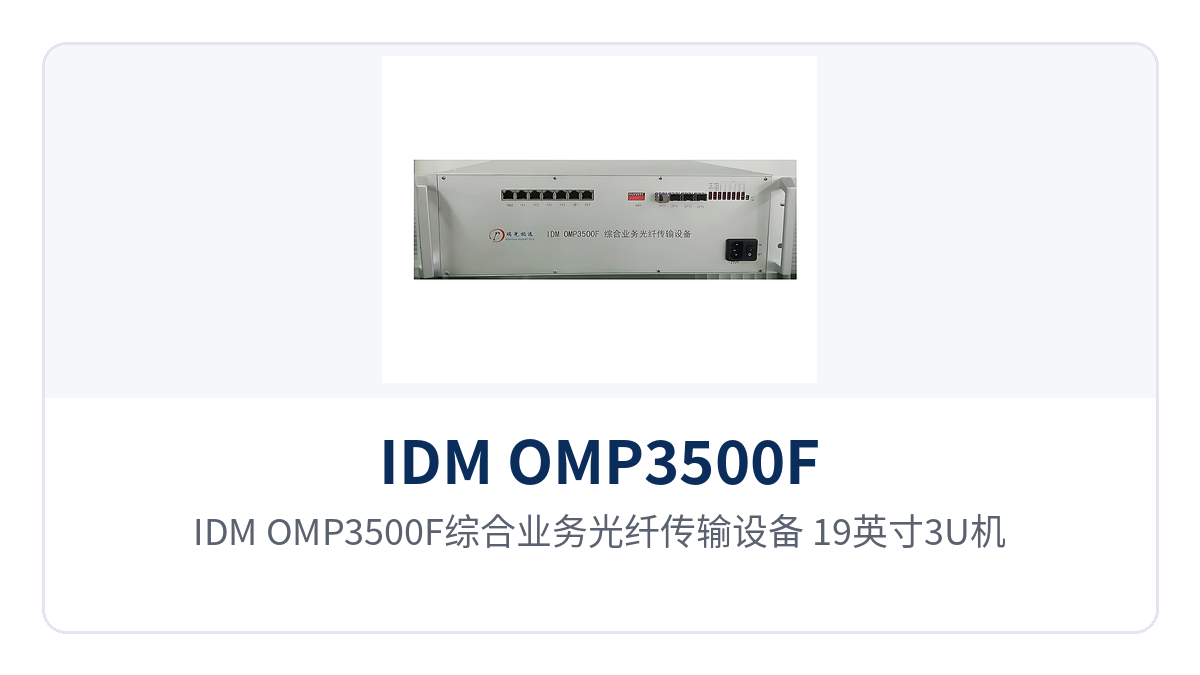
Figure 1: IDM OMP3500F integrated service optical fiber transmission equipment 19-inch 3U chassis overall appearance and service card slots
What kind of device is a single-fiber 2.5G aggregation integrated access device?
A single-fiber 2.5G aggregation integrated access device is an integrated multiplexing platform that multiplexes three types of services—E1, Ethernet and narrowband PCM—onto a pair of 2.5G optical fibers for transmission. Model IDM OMP3500F is based on PDH, Ethernet and PCM technologies, and its technical performance complies with standard recommendations such as ITU-T G.703 and IEEE 802.3. The 2.5G optical bandwidth simultaneously carries 2 groups of physically isolated wire-speed gigabit Ethernet, 4 groups of physically isolated wire-speed 100M Ethernet, 16 groups of transparent transmission E1 and up to 120 channels of narrowband PCM; the 16 groups of E1 are transmitted as-is by transparent transmission, and narrowband PCM services are accessed after time-slot non-blocking cross-connection between 4 groups of E1 and all subscriber interfaces. One device simultaneously provides voice, leased-line data and Ethernet interfaces, so an access point does not need to configure multiple single-service devices separately by service type, and the equipment room structure and O&M objects are simplified accordingly. As a representative product of a professional optical multiplexer manufacturer, this multi-service optical multiplexer launched by Raytrans has mature applications in government private network optical fiber communication solutions and military emergency communications vehicle solutions.
Knowledge block: How multi-service over a single fiber is implemented on a pair of 2.5G optical fibers
Multi-service over a single fiber means the 2.5G optical bandwidth is divided into multiple channels carrying different services, and the channels transmit independently without interfering with one another. IDM OMP3500F simultaneously carries 2 groups of physically isolated wire-speed gigabit Ethernet, 4 groups of physically isolated wire-speed 100M Ethernet, 16 groups of transparent transmission E1 and up to 120 channels of narrowband PCM over a 2.5Gbps optical fiber, with the three types of services each occupying an independent channel. IDM OMP3500F provides 2 groups of SFP 2.5G optical transmission interfaces, and can form point-to-point, chain network, ring network or 1+1 protection networks. When one optical fiber fails, services switch over to the other optical port without manual attendance on site for patch cord changes. This design, which combines the functions of a telephone optical multiplexer and a gigabit network optical multiplexer, makes the multi-service convergence advantage in the product showcase immediately clear.
How many services can a pair of 2.5G optical fibers carry? Core functions at a glance
The functions of IDM OMP3500F are divided into four categories: optical transmission, Ethernet access, TDM and PCM access, and network management and protection. See the table below for details.
Function | Description |
|---|---|
2.5G optical fiber transmission | Provides 2 SFP 2.5G optical transmission interfaces, single-mode (multi-mode optional), with transmission distances of 20KM, 40KM and 80KM, default configuration 40KM |
Physically isolated Ethernet | Provides 2 groups of physically isolated wire-speed gigabit Ethernet and 4 groups of physically isolated wire-speed 100M Ethernet; the data planes of the port groups are isolated with no bandwidth preemption |
E1 transparent transmission | Provides 16 groups of transparent transmission E1, with physical interfaces of CC3-16 or CC3-8, compliant with ITU-T G.703, line coding HDB3 |
Narrowband PCM access | Provides access capacity for up to 120 channels of narrowband PCM services, with various subscriber interfaces such as voice, data and image |
Time-slot non-blocking cross-connection | Time-slot non-blocking cross-connection between 4 groups of E1 and all subscriber interfaces, with multiple clock modes |
Dual optical port mutual backup | Provides 2 groups of 2.5G optical fiber mutual backup, and can form point-to-point, chain network, ring network or 1+1 protection networks |
SNMP network management | Provides a standard SNMP network management interface and can be incorporated into an existing network management system for unified management |
Modular expansion | 19-inch 3U standard chassis, card-based design, providing 17 3U user card slots; supports video surveillance and video conferencing boards |
Dual power supply | Supports DC-48V and AC220V dual power supply, with overall power consumption ≤90W |
IDM OMP3500F supports video surveillance and video conferencing boards, and also supports DC-48V and AC220V dual power supply. Both the power supply and service boards can be maintained as required, reducing site downtime.
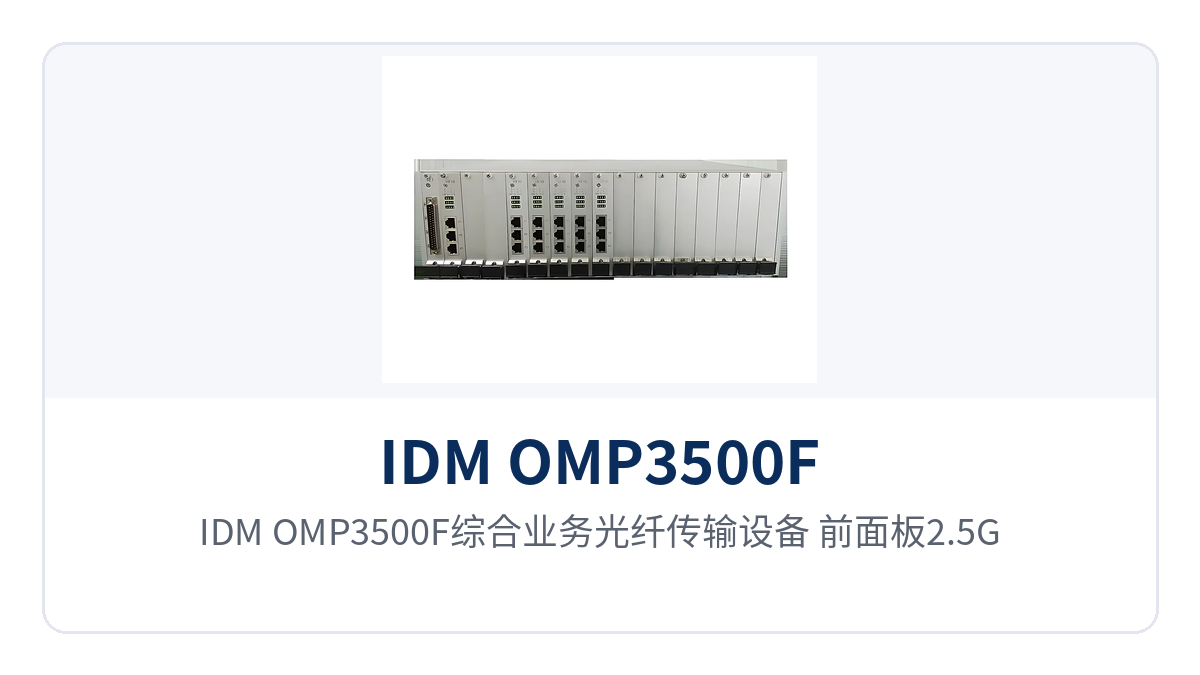
Figure 2: IDM OMP3500F integrated service optical fiber transmission equipment close-up of the front panel 2.5G SFP optical ports and physically isolated Ethernet interfaces
How do 16-channel E1 and 120-channel narrowband PCM access the same device?
Narrowband PCM is the part of IDM OMP3500F designed for telephone and low-speed data access. The chassis can hold up to 12 8-channel/10-channel PCM service boards, and each board provides different capacity according to interface type, as shown in the table below.
Interface card type | Capacity per card | Typical use |
|---|---|---|
FXS/FXO card | 10 or 8 channels per card | Analog telephone subscriber line and trunk line access |
Magneto card | 10 or 8 channels per card | Magneto telephone, mostly used in mining and unattended field scenarios |
2/4-wire EM card | 4 channels per card | Switch E&M trunk |
RS232/RS422/RS485 card | 8 channels per card | Serial port data, telecontrol and monitoring data |
GSM/CDMA card | 2 channels per card | Wireless trunk or emergency channel |
USER universal interface card | 4 PCM service modules can be mixed, up to 2 channels per module | Flexible combination of multiple narrowband services |
The E1 side is transmitted as-is. The 16 groups of E1 on the IDM OMP3500F are transmitted in transparent transmission mode, with a bit rate of 2.048Mbps and HDB3 line coding, compliant with ITU-T G.703, and selectable 75Ω/120Ω impedance; time-slot non-blocking cross-connection is performed between the 4 groups of E1 and all subscriber interfaces, facilitating direct interfacing with existing stored program control (SPC) switching, dispatching exchange and other equipment.
How to configure 2.5G optical port 1+1 mutual backup and 20/40/80KM transmission?
Transmission distance is determined by the optical module selection. The IDM OMP3500F supports 20KM, 40KM and 80KM single-mode SFP optical modules (multi-mode optional), with an optical rate of 2.5Gbps, wavelengths of 1310/1490/1550nm, transmit optical power of -1~-10dB, and receiver sensitivity better than -24dBm; the default configuration is 40KM. Applications of 40KM and above require SFP module selection based on the optical power budget, and link verification with an optical power meter during acceptance testing.
Protection is provided by 2 groups of SFP 2.5G optical ports: the optical ports can form point-to-point, chain network, ring network or 1+1 protection networks. When one optical fiber fails, services are automatically switched to the other optical port, reducing the impact of a single point of interruption on services. The SNMP Ethernet network management incorporates site equipment into the existing network management system for unified management, so O&M personnel can monitor the operating status of remote stations from the central equipment room. As a brand with years of deep experience as an optical multiplexer manufacturer, Raytrans has widely deployed this multi-service optical multiplexer in its product showcase across scenarios such as video surveillance, government private network optical fiber communication solutions and military emergency communications vehicle solutions.
IDM OMP3500F Technical Specifications
As a multi-service optical multiplexer, the IDM OMP3500F has technical specifications divided into optical interface, E1 interface, Ethernet and power supply and environment sections. The electrical characteristics of the interfaces comply with ITU-T, IEEE and other standard recommendations, and the parameters are subject to the optical multiplexer manufacturer's technical documentation and factory testing.
Item | Parameter/Specification | Description/Applicable Conditions |
|---|---|---|
Optical interface type | SFP | Provides 2 2.5G optical transmission interfaces, supporting optical port mutual backup |
Fiber mode | Single-mode (multi-mode optional) | Selected according to line distance |
Optical rate | 2.5Gbps | Wavelength 1310/1490/1550nm |
Transmission distance | 20KM/40KM/80KM | Default configuration 40KM, corresponding to the selected SFP optical module |
Transmit optical power | -1~-10dB | Typical single-mode value; subject to actual measurement with an optical power meter |
Receiver sensitivity | Better than -24dBm | Link budget verification required for long-distance applications |
E1 bit rate | 2.048Mbps | HDB3 line coding, compliant with ITU-T G.703 |
E1 interface impedance | 75Ω/120Ω | PCM30/31 frame structure, transparent transmission mode |
E1 physical interface | CC3-16/CC3-8 | Corresponding to 16 or 8 groups of E1 output |
Item | Parameter/Specification | Description/Applicable Conditions |
|---|---|---|
Ethernet rate | 10M/100M/1000M | Supports IEEE 802.3, Adaptive half-duplex/full-duplex |
Ethernet group count | 2 gigabit groups + 4 fast Ethernet groups | Physically isolated between groups, line-rate forwarding |
Narrowband PCM capacity | Up to 120 channels | The chassis supports up to 12 8-channel/10-channel PCM service boards |
FXO/FXS interface | Audio 300Hz~3400Hz | ITU G.711 A-law compression, three-element complex impedance 200Ω+560Ω//0.1μF, loop current 25mA per channel |
Magneto interface | Audio 300Hz~3400Hz | Balanced 600 Ω, compression ITU G.711 A-law, return loss no less than 18 dB |
Codirectional 64K interface | Bit rate 64Kbps | Line coding G.703 standard, impedance balanced 120Ω |
V.24 interface | Asynchronous ≤9600bps; synchronous 64Kbps | Electrical characteristics comply with CCITT V.28 protocol |
V.35 interface | n×64Kbps (n=0~31) | Interface type RJ-45, complies with ITU-T V.35 recommendation |
Item | Parameter/Specification | Description/Applicable Conditions |
|---|---|---|
Power supply mode | AC220V/DC-48V | Dual power supply, can provide ~220V and -48V simultaneously |
Overall power consumption | ≤90W | Typical value |
Operating temperature | -20℃~+50℃ | Relative humidity 0~95% (non-condensing) |
Chassis structure | 19-inch 3U standard chassis | Provides 17 3U user card slots, card-based design |
Product dimensions | 482×309×132(mm) | Length × depth × height |
Network management | SNMP Ethernet network management | Provides a standard SNMP network management interface |
Differentiated Value
The differentiated capabilities of the IDM OMP3500F multi-service optical multiplexer, combined with the actual requirements of private network access points, are reflected in the following three points, as detailed in the table below.
Differentiated Selling Point | Value to Users |
|---|---|
Single-fiber 2.5G aggregation of 16 E1 channels + 2 gigabit + 4 fast Ethernet physically isolated Ethernet, with services backhauled over one fiber | A pair of 2.5G optical fibers simultaneously carries 16 E1 transparent transmission channels, 2 gigabit and 4 fast Ethernet physically isolated Ethernet groups, and 120 narrowband PCM channels. An access point no longer needs multiple single-service devices stacked by service type, saving cabinet space and cabling between devices |
2 groups of 2.5G optical ports with 1+1 mutual backup, supporting chain/ring networking, with selectable transmission distance of 20/40/80KM | 2 groups of SFP 2.5G optical ports can form point-to-point, chain, ring or 1+1 protection networks. 20KM/40KM/80KM single-mode optical modules are selected according to station spacing. Services switch over automatically in the event of an optical path failure, reducing the impact of a single point of interruption on services along the line |
AC220V and DC-48V dual power supply, operating at -20℃~+50℃, suitable for unattended sites in the field | AC and DC power feeds can be connected according to on-site conditions, and a failure of one power feed does not affect services; the -20℃~+50℃ operating temperature suits equipment rooms without air conditioning and is suitable for long-term operation at unattended sites in the field |
Typical Application Scenarios
Electric Power and Energy Industrial Private Network
Substations, distribution stations, switching stations and step-up stations of new energy stations simultaneously carry three types of services: dispatch telephone, telecontrol data and video surveillance. The IDM OMP3500F carries all three types of services out over a pair of 2.5G optical fibers in one pass: 16 E1 transparent transmission channels carry telecontrol and protection information channels, RS232/RS422/RS485 interface cards connect serial telecontrol and monitoring data, FXS/FXO cards connect dispatch telephones and hotlines, and 4 fast Ethernet physically isolated Ethernet groups separately carry the video surveillance network, office network and production network, with no bandwidth preemption between the networks. AC220V and DC-48V dual power supply and an operating temperature of -20℃~+50℃ suit the operating conditions of unattended sites such as distribution rooms and switching stations.
Rail Transit and Expressway Electromechanical Private Network
Access points of expressway and rail transit electromechanical systems are distributed along the line with large spacing, and the service types and quantities at toll stations, service areas, traction substations and stations vary. The IDM OMP3500F provides three grades of single-mode optical modules: 20KM, 40KM and 80KM, which can be selected according to station spacing, and supports chain, ring or 1+1 protection network networking. Voice dispatching, surveillance video and leased-line data at sites along the line are terminated in the same optical multiplexer, compressing equipment room space and the number of devices at the same time. The 1+1 mutual backup of 2 groups of 2.5G optical ports keeps the impact of a single point of interruption on services along the line under control.
Military and Government Private Networks and Unattended Sites in the Field for Oilfields and Mining
Field equipment at military and government private networks and oilfield and mining field sites is mainly based on magneto telephones, serial port telecontrol, and video surveillance, with relatively demanding power supply and environmental conditions. The IDM OMP3500F uses magneto cards, serial port cards, and physically isolated Ethernet for on-site access. Its AC220V and DC-48V dual power supply and -20℃~+50℃ operating temperature suit equipment rooms without air conditioning, while long-distance optical modules of over 40KM cover station spacing in the field. SNMP network management makes it easy for O&M personnel to remotely monitor site operating status over the existing IP network, reducing field duty and inspection frequency.
Conclusion
The IDM OMP3500F single-fiber 2.5G aggregation integrated access device integrates 16 groups of E1 transparent transmission, 2 groups of gigabit and 4 groups of fast Ethernet physically isolated Ethernet, and 120 channels of narrowband PCM over a pair of 2.5G optical fibers. With dual 2.5G optical port 1+1 mutual backup, 20/40/80KM optical module selection, and AC220V/DC-48V dual power supply wide-temperature design, it is a reliable choice for multi-service over a single fiber in electric power and energy, rail transit industrial private networks, military and government private networks, and unattended sites in the field in oilfields and mining areas. For a complete single-fiber 2.5G aggregation integrated access device networking solution and selection and quotation, please contact the sales team of Beijing Ruiguang Jiyuan Digital Technology Co., Ltd.