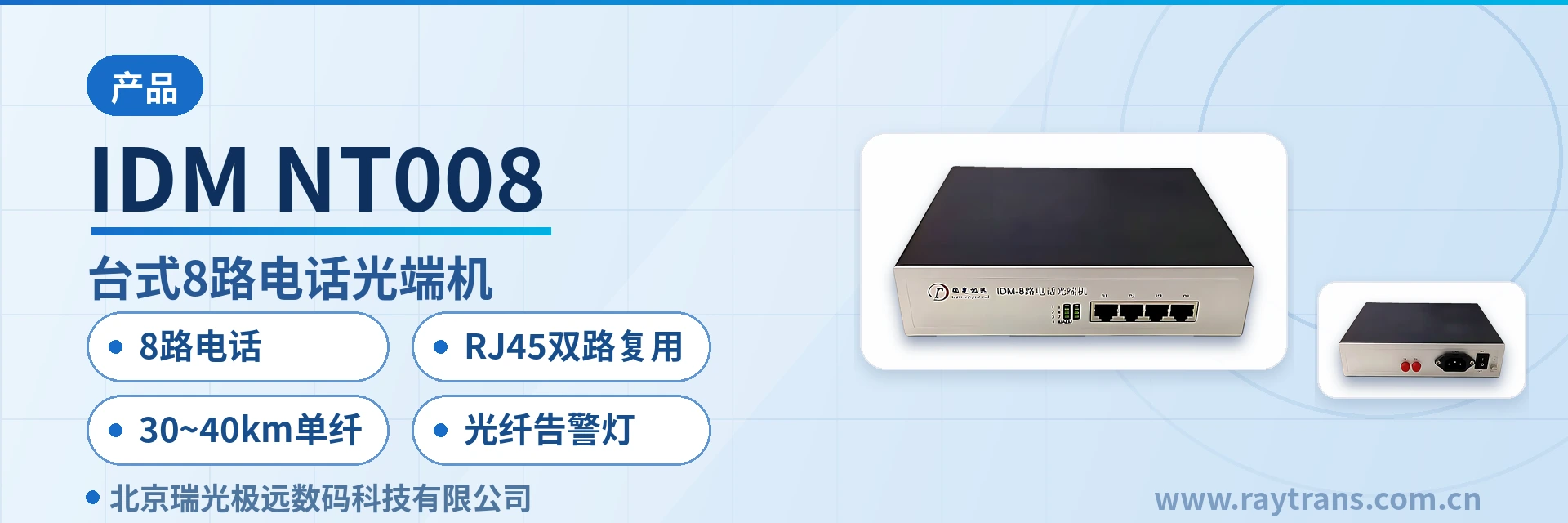
IDM-NT008 Desktop 8-Channel Telephone Optical Multiplexer
4 RJ45 Connectors Carrying 8-Channel Voice, Single Fiber 30~40km Without Building a Switching Office, Alarm LED
The IDM-NT008 desktop 8-channel multi-service optical multiplexer provides 8 telephone interfaces through 1 optical fiber channel; the 8-channel telephone optical multiplexer features high integration and compact size; the IDM-NT008 desktop 8-channel multi-service optical multiplexer extends voice and data services to various user areas, achieving cross-boundary line extension and serving as a substitute for remote small offices and deferred switching offices; alternatively, it addresses the limitations of twisted pair in terms of frequency band and transmission distance in urban areas, expanding the service range of the switching office.
The IDM-NT008 desktop 8-channel multi-service optical multiplexer is a desktop integrated service optical fiber access device developed by Beijing Ruiguang Jiyuan Digital Technology Co., Ltd.; it provides 8 telephone interfaces to the user side through 1 optical fiber channel and is used for point-to-point optical fiber subscriber line provisioning. The product demonstrates the flexible capability of the optical multiplexer at the access layer. The device extends voice services to various user areas, achieving cross-boundary line extension and serving as a substitute for remote small offices and deferred switching offices; it is also used in urban areas to address the limitations of twisted pair in terms of frequency band and transmission distance. As a professional optical multiplexer manufacturer, Raytrans offers this multi-service optical multiplexer and telephone optical multiplexer product for wide application in scenarios such as government private network optical fiber communication solutions, and the Raytrans brand series of optical multiplexers continues to provide reliable access for various private network communications.
Key specifications at a glance: 8 FXO/FXS telephone channels · 4 8P8C RJ45 connectors (2 channels per port: pins 4/5 for the first channel and pins 3/6 for the second channel) · single fiber 3040km · FC optical port by default · audio 300Hz3400Hz · ITU G.711 A-law · compact desktop size
What Kind of Device Is the 8-Channel Multi-Service Optical Multiplexer?
The IDM-NT008 desktop 8-channel multi-service optical multiplexer is designed with dedicated large-scale integrated circuits and completes the connection between subscriber terminals or between subscriber terminals and the public switched telephone network through the optical fiber transmission medium. As a mature multi-service optical multiplexer product, a single unit provides 8 telephone channels, supports FXO and FXS interfaces, can connect 8 ordinary telephones, and can also provide interfacing for 8 central office analog trunks.
The 8 telephone channels are brought out through 4 RJ45 connectors (8P8C telephone interfaces), with 2-channel multiplexing at each port: pins 4/5 for the first channel and pins 3/6 for the second channel. One standard network cable carries two voice channels, halving the cabling volume at the same subscriber line provisioning volume, and the use of patch panels and cable trunking decreases accordingly.
In urban areas, the desktop 8-channel multi-service optical multiplexer breaks through the limitations of twisted pair in terms of frequency band and transmission distance, expanding the service range of the switching office; in remote suburbs or at private network sites, cross-boundary line extension can be completed without building a new switching office, shortening the site enablement cycle accordingly.
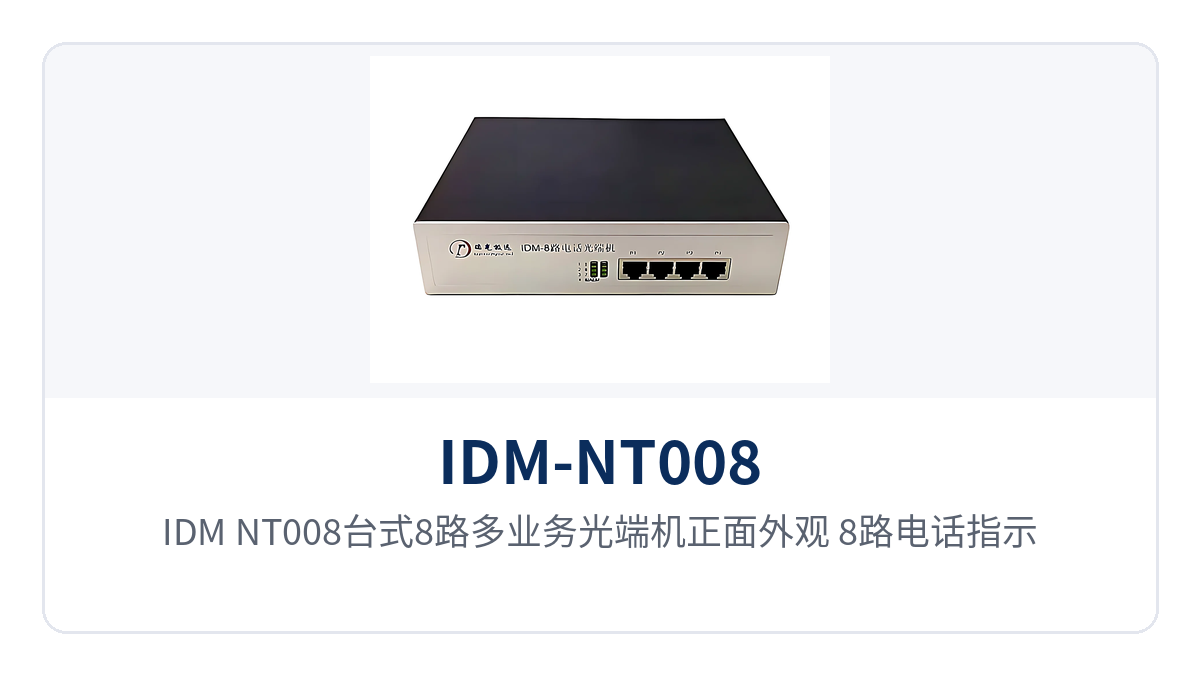
Figure 1: Front appearance of the IDM-NT008 desktop 8-channel multi-service optical multiplexer, close-up of the 8 telephone indicator LEDs and 4 RJ45 telephone interfaces
What Functions and Interfaces Does the 8-Channel Multi-Service Optical Multiplexer Provide?
| Function | Description |
|---|---|
| 8 Telephone Channels | A single unit provides 8 telephone channels, supports FXO and FXS interfaces, and can connect 8 telephones or provide interfacing for 8 central office analog trunks |
| 4 RJ45 Connectors for Telephone Interfaces | 8P8C interfaces with 2-channel multiplexing per port: pins 4/5 for the first channel and pins 3/6 for the second channel; the 4 ports carry 8 telephone channels |
| 8 Telephone Indicator LEDs | Solid on indicates the telephone channel is in use, flashing indicates ringing, and off indicates the channel is idle, displaying the real-time voice channel status of each channel |
| 8/ALM Optical Fiber Alarm Indicator LED | Flashing indicates an optical fiber alarm and it stays off during normal operation, so the optical fiber link status can be judged on site |
| Optical Fiber Point-to-Point Access | Completes the connection between subscriber terminals or with the public switched telephone network through the optical fiber transmission medium, so calls do not depend on the public network |
| Cross-Boundary Line Extension | Replaces remote small offices and deferred switching offices, expanding the service range of the switching office |
| Desktop Installation with Compact Size | High integration and compact size, suitable for space-constrained locations such as equipment rooms, wiring closets and business outlets |
The optical fiber access end is divided into TX and RX; TX connects to the RX at the opposite end, and RX connects to the TX at the opposite end. When the device at the opposite end is powered on and the optical fiber is properly connected, the 8/ALM indicator LED of the IDM-NT008 stays off; if the 8/ALM indicator LED flashes, it indicates a problem with the optical fiber.
Core Technical Specifications
| Item | Parameter/Specification | Description/Applicable Conditions |
|---|---|---|
| Voice Interface | 8 FXO/FXS channels | 4 8P8C ports (RJ45 connectors) with 2-channel multiplexing per port (pins 4/5 for the first channel and pins 3/6 for the second channel) |
| Audio Range | 300Hz~3400Hz | Meets the voice band requirements of the public telephone network |
| Compression | ITU G.711 A-law | 64Kbps standard PCM voice codec, providing intercommunication with the public switched telephone network |
| Impedance | Three-element complex impedance 200Ω+560Ω//0.1μF | Meets the working conditions of standard analog telephone lines |
| Loop Current | 25mA per channel | Feeding capability of each telephone interface |
| Optical Fiber Channel | 1 point-to-point optical fiber channel | Single fiber transmission over 30~40km; the optical ports are divided into TX and RX |
| Optical Fiber Port | FC port by default | There are three interface types; special instructions are required at ordering according to the optical cable connector type |
| Transmission Distance | 30~40km as the general configuration | Depends on the optical fiber type and link loss; it can be customized per project |
| Indicator LEDs | 8 telephone indicator LEDs + 8/ALM alarm indicator LED | Solid on = in use / flashing = ringing / off = idle; a flashing alarm LED indicates an optical fiber alarm |
Differentiated Value: Why 4 RJ45 Ports and Single-Fiber Long-Distance Transmission Save Cost
| Differentiation Point | Capability and Value |
|---|---|
| 8 Telephone Channels | A single unit provides 8 FXO/FXS telephone channels; one device completes subscriber line provisioning for 8 voice channels, reducing the rack positions and power supply requirements in the equipment room accordingly |
| Dual-Channel Multiplexing via RJ45 Connectors | The 4 RJ45 connectors carry 8 telephone channels with 2-channel multiplexing per port, halving the cabling; construction and maintenance involve only these 4 ports |
| 30~40km Single Fiber | Single fiber transmission over 30~40km replaces remote small offices and deferred switching offices, so subscriber line provisioning does not require a new switching office |
| Optical Fiber Alarm LED | A flashing 8/ALM alarm LED immediately indicates an optical fiber link failure, so positioning requires no instruments and the troubleshooting time is shortened |
| Carrier-Class Voice Quality | G.711 A-law compression + 300~3400Hz audio; carrier-class voice quality with intercommunication with the public switched telephone network (PSTN) |
How to Wire the Single-Fiber 8-Channel Telephone Optical Multiplexer
The telephone interfaces use 4 8P8C (RJ45) ports with 2 channels per port: pins 4/5 for the first channel and pins 3/6 for the second channel. The central office device connects to the SPC exchange and the device at the remote end connects to the telephone; check the service interface wiring sequence before powering on.
There are three interface types for the optical fiber ports; please specify according to the optical cable connector type at ordering. If no special instructions are given, the FC port is configured by default, and the transmission distance is generally configured for 30~40km. The optical fibers are connected in a crossover manner: TX connects to the RX at the opposite end and RX connects to the TX at the opposite end.
If there is no telephone service, troubleshoot in the following order:
- Check whether the central office and remote end devices are installed in reverse: the central office device connects to the SPC exchange and the device at the remote end connects to the telephone;
- Check whether the service interface wiring sequence is wrong: pins 4/5 for the first channel and pins 3/6 for the second channel;
- Check the optical fiber link; the 8/ALM indicator LEDs at both ends staying off means the optical fiber is normal;
- Check whether the telephone itself is intact.
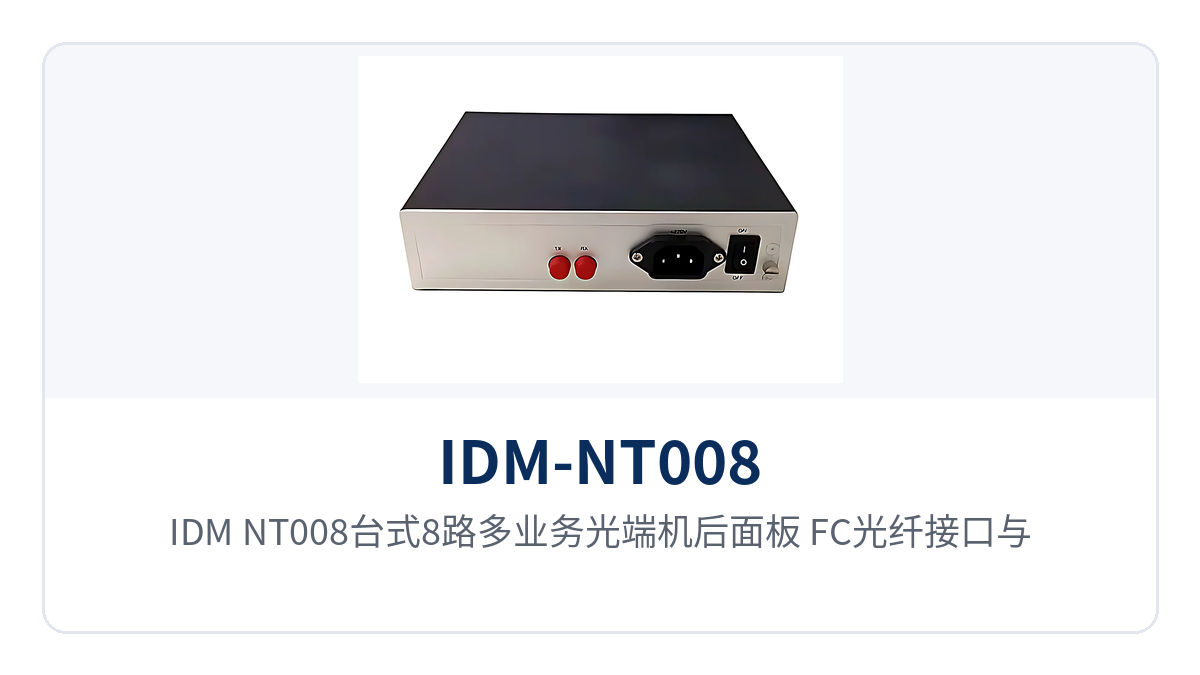
Figure 2: Rear panel of the IDM-NT008 desktop 8-channel multi-service optical multiplexer, close-up of the FC optical fiber port and TX/RX ports
Typical Application Scenarios
Electric Power/Energy Private Network: 8 Telephone Channels at Remote Substations
In power/energy private networks, substations and switching stations have limited space in their communications cabinets, and the compact IDM-NT008 desktop 8-channel telephone optical multiplexer can be installed directly in the cabinet or placed on a desktop. On the substation side, only one optical fiber is needed to provide 8 telephone channels to the remote end, and the 4 RJ45 ports save cables and cabinet space, halving the cabling volume compared with conventional subscriber line provisioning. When the transmission distance is configured for 30~40km, the substation reaches the dispatch station directly over a single fiber, and dispatch telephones use a dedicated optical fiber channel throughout, independent of the public network.
Rail Transit and Tunnels Along the Line: 8 Section Telephone Channels Over a Single Fiber
Section telephones along rail transit lines and tunnels are numerous and widely spaced; the IDM-NT008 performs multiplexing of the 8 telephones in a tunnel onto one optical fiber, carrying 8 section telephone channels over a single fiber. The in-use and ringing status of the voice channels is visible intuitively through the panel indicator LEDs, so the duty operator can keep track of section telephone usage without going on site. Once the optical fiber becomes abnormal, the flashing 8/ALM alarm LED indicates the failure, and section telephones can be restored quickly with the TX/RX crossover wiring rule.
Mining Areas/Oilfield Field Operations Areas: Cross-Boundary Line Extension Replaces Small Offices
Mining areas and oilfield field operations areas are far from urban areas, and building a new switching office for a small number of telephones is not economical. The IDM-NT008 provides coverage for field operations areas with single-fiber transmission over 3040km, completing cross-boundary line extension for 8 telephone channels and replacing remote small offices and deferred switching offices, so both the initial construction investment and the later maintenance costs decrease. Voice uses ITU G.711 A-law encoding over an audio range of 300Hz3400Hz; the voice quality is clear, and the call experience between field operations area personnel and the dispatch center approaches that of a local telephone call.