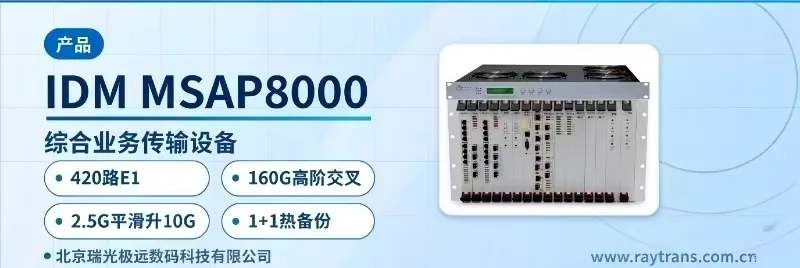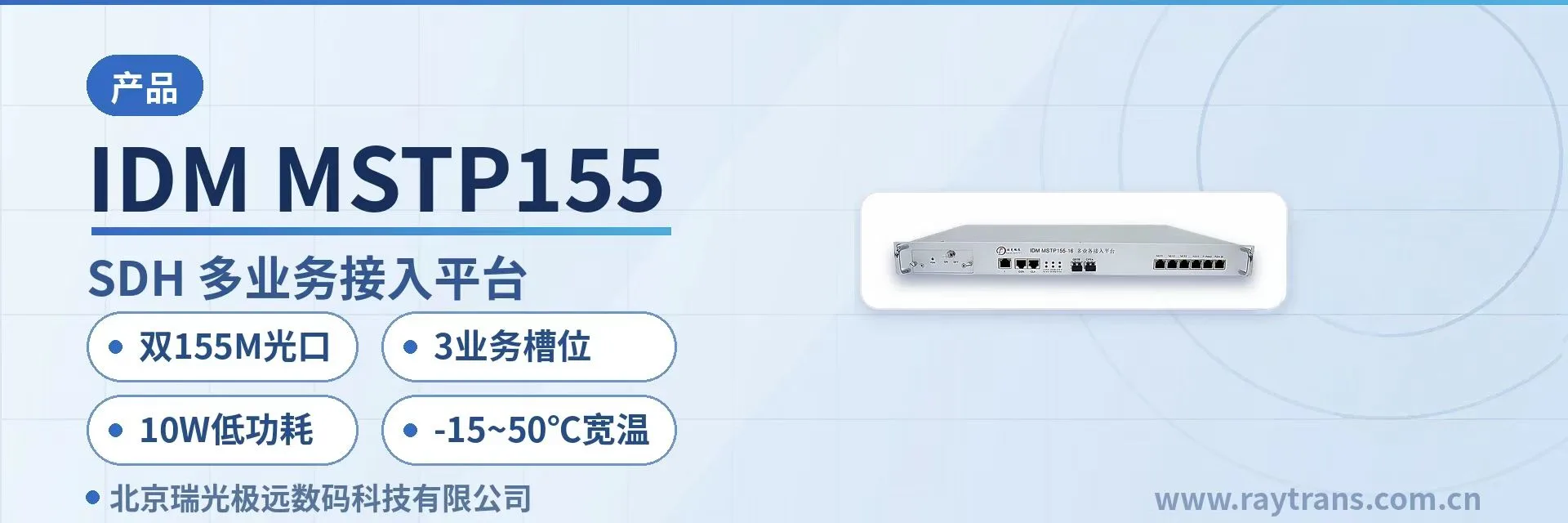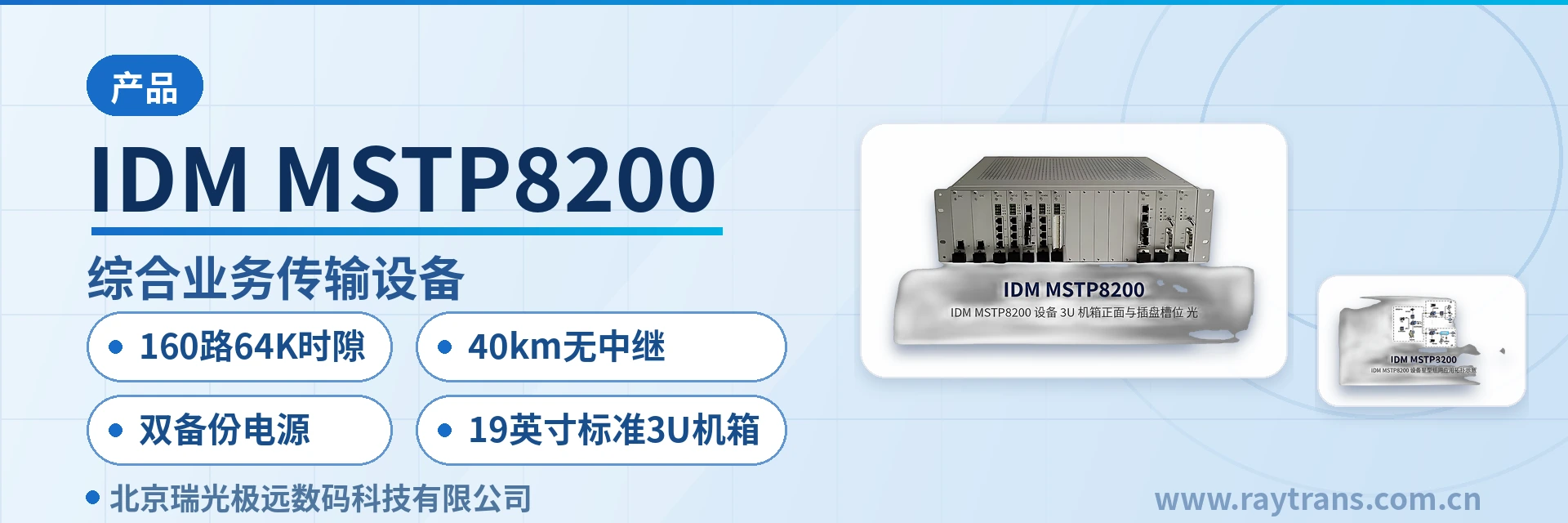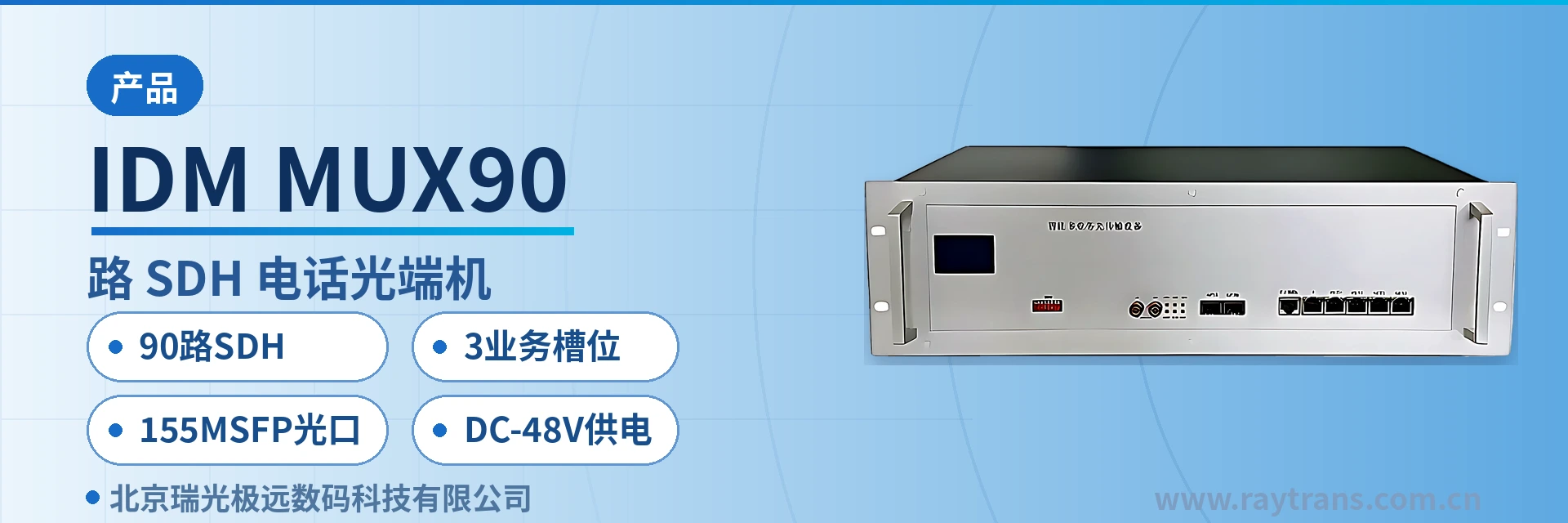
IDM-MUX90 90-Channel SDH Telephone Optical Multiplexer
3-slot mixed insertion, fully configured with 24 E1 channels; telephone, E1, Ethernet, and video carried over the same fiber, saving one PC
155M optical interface, 19-inch standard 1U chassis, providing 4 groups of EOS 10/100M Ethernet interfaces; 3 service slots, each slot can accommodate one 8×E1 card, for a total of 24 E1 ports; or an 8-channel/10-channel 64K subscriber service card; or an 8-port Fast Ethernet switching card; or a 720P high-definition video input/output interface card.
IDM-MUX90 90-channel SDH telephone optical multiplexer is an STM-1 multi-service access device built around SDH technology, developed by SDH equipment manufacturer Beijing Ruiguang Jiyuan Digital Technology Co., Ltd. (Raytrans), and used to carry telephone, E1, Ethernet, and video services simultaneously over a 155.52 Mbps optical fiber link. This SDH equipment integrates SDH optical transmission, PCM service access, and Ethernet transmission into a single chassis, so an access node no longer needs separate optical transmission devices for voice, data, and video.
The device uses a standard 19-inch 1U chassis with a 3-service-slot mixed insertion structure; the slots accept 8×E1 cards, 8-channel or 10-channel 64K service cards, 8-port Fast Ethernet switching cards, and 720P video input/output cards. A single device aggregates 90 telephone channels; sites with dense traffic take more 64K service cards, data-oriented sites take Ethernet switching cards, and capacity scales with the cards, so the product showcase adapts flexibly to different site requirements.
Key Specifications at a Glance: 90 telephone channels aggregated · 3-service-slot mixed insertion · 155M SFP optical port · 4 groups of EOS Fast Ethernet · 24 E1 channels at full configuration · AC220V/DC-48V dual power supply · ≤90W · -20℃~+50℃
As a professional optical multiplexer manufacturer, Raytrans can provide access-layer support for government private network optical fiber communication solutions based on this SDH equipment, meeting the requirements for unified bearing of government voice and data.
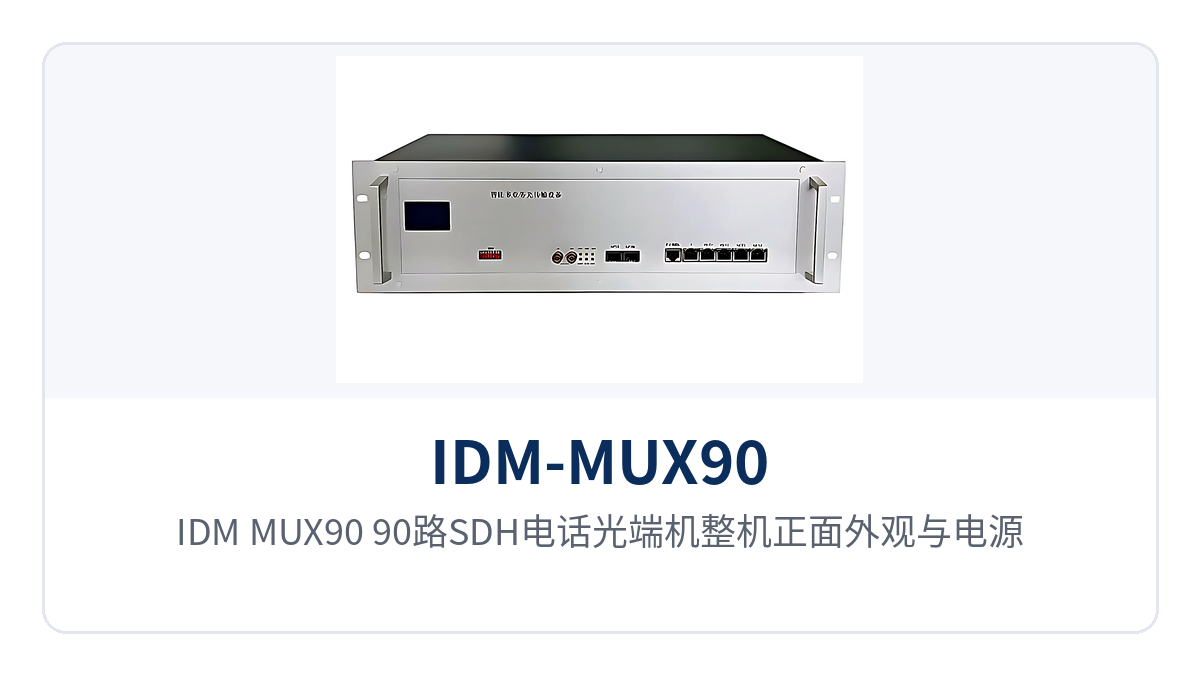
Figure 1: Front view of the IDM-MUX90 90-channel SDH telephone optical multiplexer, with power and optical link indicator LEDs
How the SDH 155M optical port carries services: how STM-1 maps to VC-12
The STM-1 line rate of SDH is 155.52 Mbps, services use VC-12 as the basic container, one VC-12 carries one 2.048 Mbps E1, and one STM-1 can accommodate 63 VC-12s. The E1 interface complies with ITU-T G.703, with a bit rate of 2.048 Mbps and HDB3 line coding, a PCM30/32 frame structure, and 30 of the 32 time slots per frame carrying services. As a typical product showcase from an SDH equipment manufacturer, Raytrans SDH equipment follows exactly this mapping relationship for service bearing over the 155M optical port.
The 155M SFP optical port sends the STM-1 signal onto the optical fiber, with receive/transmit rates of 155.52 Mbps, a transmit wavelength of 1310 nm and a receive wavelength of 1550 nm, a transmit optical power of -12~-6 dBm, and a receiver sensitivity better than -32 dBm. The optical module is in an SFP package; single-mode is standard and multi-mode is optional according to the on-site optical cable, and the wavelengths and interface types at both ends must be paired. The SFP optical port design of this optical transmission equipment can be used directly for 155M link construction in government private network optical fiber communication solutions.
How to configure cards for a 3-slot mixed-insertion optical multiplexer: function overview
Card configuration proceeds according to the site service list: first count the voice channels and E1 directions, then check the Ethernet and video requirements, and then fill the slots with service cards. The three-slot mixed insertion covers four types of access—voice, data, Ethernet, and video—listed item by item in the table below for easy verification.
| Function | Description |
|---|---|
| 3-service-slot mixed insertion | Provides 3 service slots that accept E1 cards, 64K service cards, Ethernet switching cards, and video cards, combined according to the site list |
| 155M SFP optical port | SFP-packaged optical interface, receive/transmit rate 155.52 Mbps, single-mode standard, multi-mode optional, supporting point-to-point, chain, and ring networks |
| E1 access (8×E1 card) | Each slot takes one 8×E1 card; three slots at full configuration provide 24 E1 interfaces in total, compliant with ITU-T G.703, impedance 75 Ω/120 Ω |
| 64K subscriber services | Each card provides 8 or 10 64K subscriber interfaces, carrying FXO/FXS, EM 2/4-wire, magneto, V.24, V.35, and codirectional 64K |
| Ethernet switching (8-port card) | Each card provides 8 Fast Ethernet switching interfaces, so data access for multiple terminals within a site is completed on the same card |
| 4 groups of EOS Ethernet | Provides 4 groups of EOS 10/100M Ethernet interfaces, with bandwidth allocated as N×VC12 (N≤50), compliant with IEEE802.3 |
| 720P video access | The video input/output card carries 720P high-definition (HD) video, with monitoring images and voice sharing the same optical fiber link |
| Dual power supply options | AC220V and DC-48V power supply formats are selectable, with overall power consumption ≤90W |
| 19-inch 1U chassis | Standard 1U chassis that fits into a communications cabinet and occupies one rack unit |
| Environmental adaptation | Operating temperature -20℃ |
In the function table, the card most directly related to voice is the 64K service card: the FXO interface connects to the switch side, the FXS interface directly serves a telephone, the audio range is 300 Hz~3400 Hz, compression follows ITU G.711 A-law, and the loop current is 20 mA per channel. The EM 2/4-wire and magneto cards are used for trunk and direct-connect voice channels that do not rely on switch power feeding, with a balanced 600 Ω impedance and a return loss of no less than 18 dB. As a professional optical multiplexer manufacturer, Raytrans covers the complete access capability from voice to video in the product showcase of this SDH equipment.
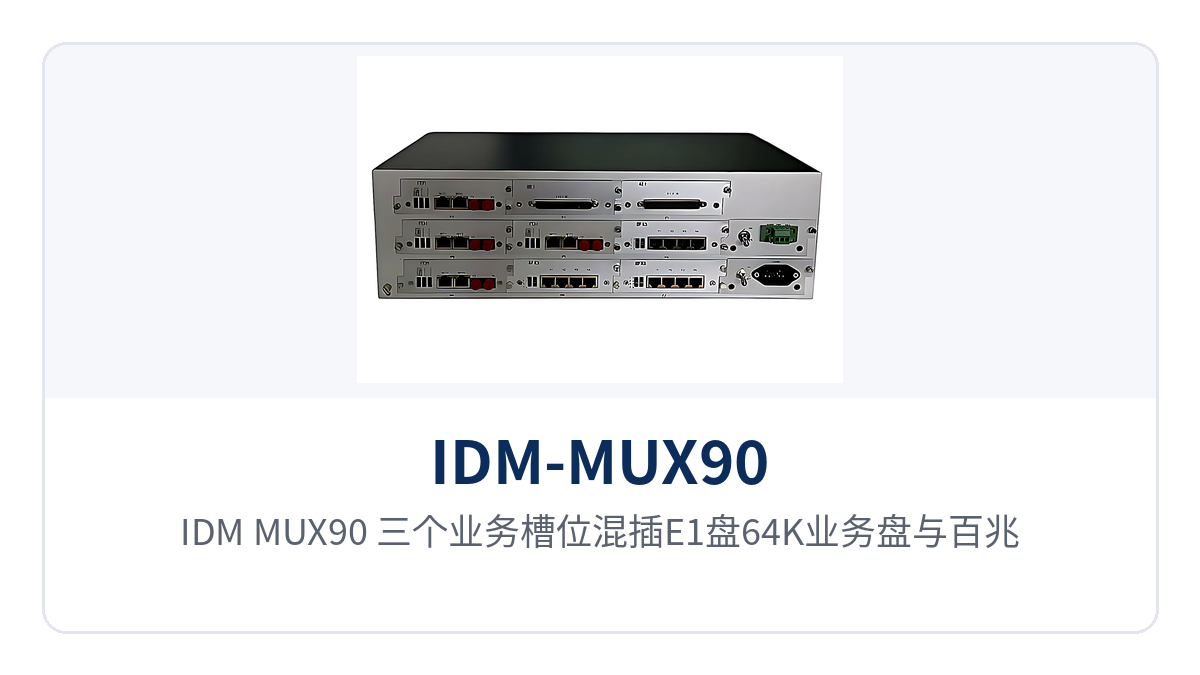
Figure 2: Close-up of the three service slots of the IDM-MUX90 with an E1 card, a 64K service card, and a Fast Ethernet switching card mixed in
How to verify the key specifications: optical port, E1, Ethernet, and power supply
The specifications are listed in four groups—optical interface, E1 interface, Ethernet and service interfaces, and power supply and environment. When verifying, first check the optical power budget, then count the voice channels and E1 directions, and then confirm the power supply format and cabinet space. Special interface requirements should be stated at the time of ordering to avoid adding converters on site.
| Item | Parameter/Specification | Description/Applicable Conditions |
|---|---|---|
| Interface type | SFP | Single-mode standard, multi-mode optional |
| Receive/transmit rate | 155.52 Mbps/155.52 Mbps | STM-1 line rate, identical for receive and transmit |
| Receive/transmit wavelength | 1310 nm/1550 nm | Wavelengths and interface types at both ends paired |
| Transmit optical power | -12~-6 dBm | Available optical power range at the transmit side |
| Receiver sensitivity | Better than -32 dBm | Receive threshold for weak optical links; distance calculated per the optical power budget |
| Item | Parameter/Specification | Description/Applicable Conditions |
|---|---|---|
| Bit rate | 2.048 Mbps | Standard E1 line rate |
| Line coding | HDB3 | Line coding compliant with ITU-T G.703 |
| Impedance | 75 Ω/120 Ω | 75 Ω coaxial or 120 Ω balanced, selected on site |
| Frame structure | PCM30/32 | 32 time slots per frame, 30 carrying services |
| Signaling | Channel-associated signaling (CAS) | Voice channel status is passed along with the voice time slots |
| Number of E1 at full configuration | 24 | Each of the 3 slots takes one 8×E1 card |
| Item | Parameter/Specification | Description/Applicable Conditions |
|---|---|---|
| Ethernet interface | RJ-45, N×VC12 (N≤50) | Supports IEEE802.3, full/half duplex/adaptive |
| EOS Ethernet | 4 groups of 10/100M | Physically isolated, can connect to different service network segments separately |
| 64K subscriber services | 8 or 10 channels per card | Carries telephone, EM, magneto, V.24, V.35, and codirectional 64K |
| FXO/FXS | 300 Hz~3400 Hz, ITU G.711 A-law | Three-element complex impedance 200 Ω+560 Ω//0.1 μF, loop current 20 mA per channel |
| Codirectional 64K | G.703 standard, 64 Kbps | Balanced 120 Ω impedance |
| V.24 | Asynchronous ≤9600 bps; synchronous 64 Kbps | Electrical characteristics compliant with CCITT V.28 |
| V.35 | RJ-45, n×64 Kbps (n=0~31) | Compliant with ITU-T V.35; terminal interface compliant with ISO2593 |
| Video interface | 720P HD input/output | The video card occupies one service slot |
| Item | Parameter/Specification | Description/Applicable Conditions |
|---|---|---|
| Power supply mode | AC220V/DC-48V | Dual power supply options, selected according to site power conditions |
| Overall power consumption | ≤90W | Power supply access and heat dissipation load for long-term online operation |
| Operating temperature | -20℃~+50℃ | Communications equipment room and field cabinet environments |
| Relative humidity | 0~95% (non-condensing) | Normal operation under non-condensing conditions |
| Dimensions | 482×309×132 (mm) | Length × depth × height, 19-inch rack installation |
The power supply row determines whether a site can draw power directly: substations and communications equipment rooms can use DC-48V power supply, while office buildings and wiring closets can use AC220V power supply, and both formats are selectable on the same model. With overall power consumption ≤90W, a site can simply connect to the existing power conditions without adding a separate power distribution panel or cooling fan. The above specifications form the basis for verifying the selection of Raytrans SDH equipment in government private network optical fiber communication solutions.
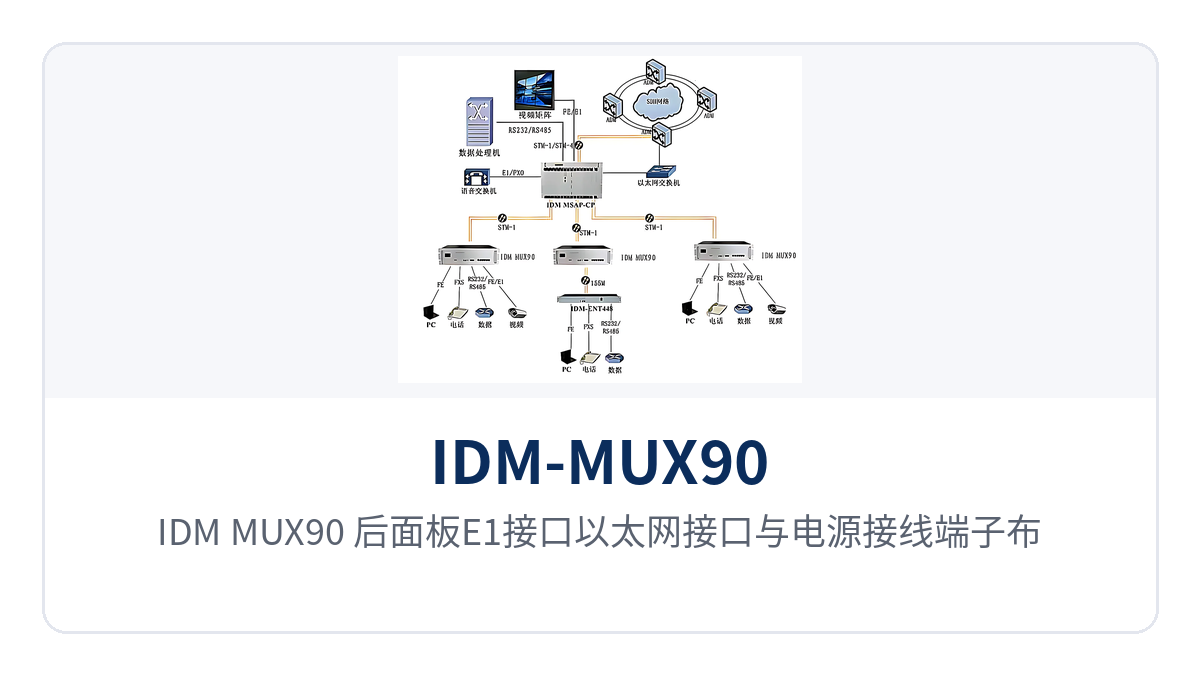
Figure 3: Layout of the E1 interfaces, Ethernet interfaces, and power terminals on the rear panel of the IDM-MUX90
How to network a 90-channel SDH telephone optical multiplexer: chain, ring, and star
The networking approach is determined by site distribution: several sites strung along a line use the chain type, occupying optical paths in two directions; sites arranged in a circle use the ring type, so when one optical path is interrupted services are rerouted in the other direction; a central station connecting to multiple remote stations uses the star type, with one device at the central side aggregating services from all directions.
One 155.52 Mbps STM-1 can accommodate 63 VC-12s; telephone and E1 services occupy containers at a 2.048 Mbps granularity, and Ethernet services are allocated bandwidth as N×VC12 (N≤50). During planning, first reserve enough fixed containers for voice and E1, then allocate the remaining containers to Ethernet and video, so that data services do not squeeze out voice time slots. In government private network optical fiber communication solutions, Raytrans SDH equipment flexibly adapts to chain, ring, and star topologies, and works with the unified network management of the optical transmission equipment to aggregate services across multiple sites.
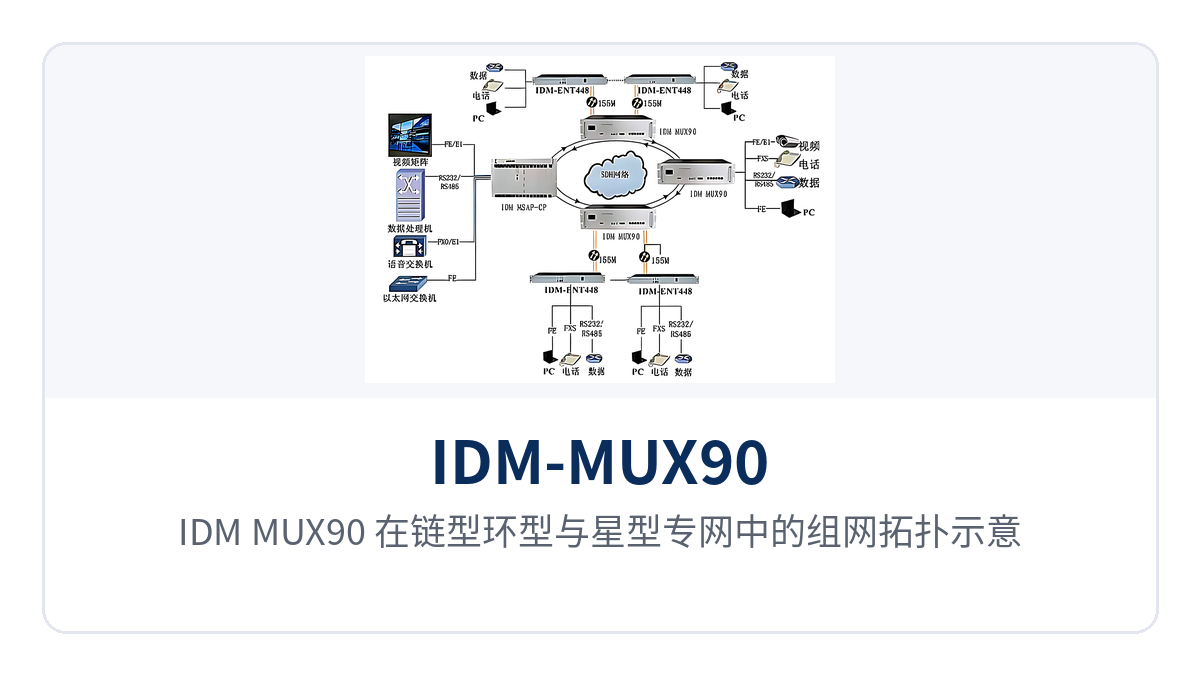
Figure 4: Networking topology of the IDM-MUX90 in chain, ring, and star private networks
Differentiated value: 90-channel SDH aggregation in a single unit, 155M SFP optical port, and dual power supply
The three differentiated capabilities each have verifiable criteria that can be copied directly into technical specifications and bid parameter tables during the design phase as core selling points in the product showcase. All three hold simultaneously under the site conditions of electric power, rail transit, and military and government private networks, and they are also the main differences between this SDH integrated service access device and ordinary telephone optical multiplexers that carry voice only.
| Differentiation Point | Customer Value |
|---|---|
| 90 SDH channels aggregated in a single unit, 3 service slots for mixed insertion | One device simultaneously accesses E1, 64 kbit/s services, Fast Ethernet switching and video cards, so an access node no longer needs to cascade multiple single-function devices |
| 155M SFP optical port transmitting and receiving at 155.52 Mbps | Receiver sensitivity better than -32 dBm leaves power margin on weak optical links with many splice points, making long-distance link transmission more stable |
| AC220V/DC-48V dual power supply selectable | Both AC equipment rooms and DC sites can draw power directly; the same model covers both types of sites, unifying spare parts and O&M practices |
| -20℃ |
Unattended equipment rooms and field cabinets can stay online long-term, so sites need no additional environmental control |
Typical Application Scenarios
Electric Power Private Network: One Device at a Substation Carries 90 SDH Channels and 24 E1 Channels with Mixed Insertion
Between a substation and the dispatch center, both dispatch telephone and telecontrol, metering and monitoring data are carried. As professional SDH equipment, IDM-MUX90 aggregates the E1 and 64 kbit/s services entering the station; the three slots are mixed-inserted according to the number of bays, and voice channels and data are sent to the dispatch center over the same 155M optical link, reducing the number of incoming lines.
Unattended sites vary widely in environment and power supply access conditions. The device is designed for -20℃+50℃ and 095% non-condensing humidity, and the station's -48V DC distribution panel can supply power directly via DC-48V. When a new bay is added, only service cards and cross-connect configuration are added, while the chassis and external wiring remain unchanged.
Rail Transit Communication: 155M SFP Weak-Light Reception Better Than -32 dBm, No Interruption over Long Sections
Stations along the line, trackside equipment rooms and section substations are distributed over dozens of kilometers, and inter-station liaison telephone, broadcast control and monitoring data need to be aggregated at the central side. The 155M SFP optical port has receiver sensitivity better than -32 dBm, leaving power margin on section links with many optical cable splice points, so communication over long sections is not interrupted by optical power attenuation.
Service cards are configured according to the number of interfaces at each station: stations with heavy traffic take 64 kbit/s service cards, and monitoring points take Ethernet switching cards or video cards. In ring networking, when one fiber is abnormal, services are rerouted in the other direction, and O&M personnel determine the fault section from network management and front panel alarms.
Military and Government Private Network: DC-48V and AC220V Dual Power Supply Selectable, 3 Slots Mixed-Inserted As Required
Power supply conditions at field command posts, vehicle-mounted racks and temporary duty posts vary with the site: indoor equipment rooms have AC power, while vehicle-mounted and field sites mostly use DC power. With AC220V/DC-48V dual power supply selectable, sites draw power according to existing power supply conditions without installing inverters or power distribution panels for the device.
The 3 slots are mixed-inserted as required with E1, 64 kbit/s services, Fast Ethernet switching and video cards, so one device handles the access and upstream transmission of voice, data and image services. The 19-inch 1U chassis fits into a standard cabinet or vehicle-mounted rack, and during mobile deployment the hoisting and wiring workload decreases with the number of devices. For government private network optical fiber communication solutions, the device can be flexibly configured with cards according to each site's service list, covering telephone, data and video access requirements with one solution.