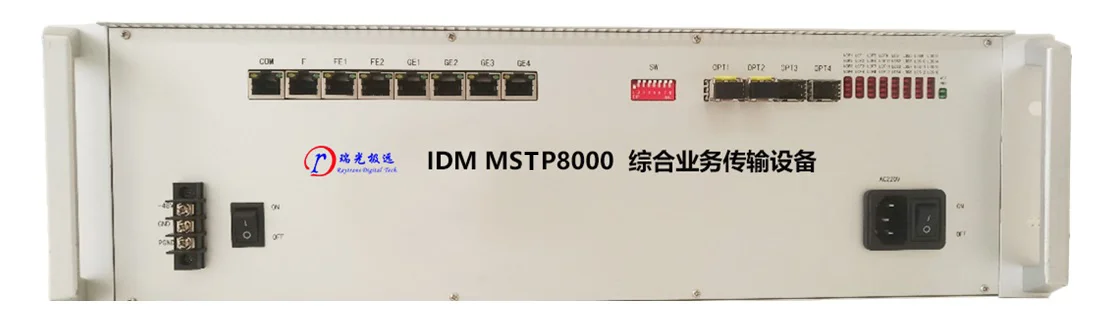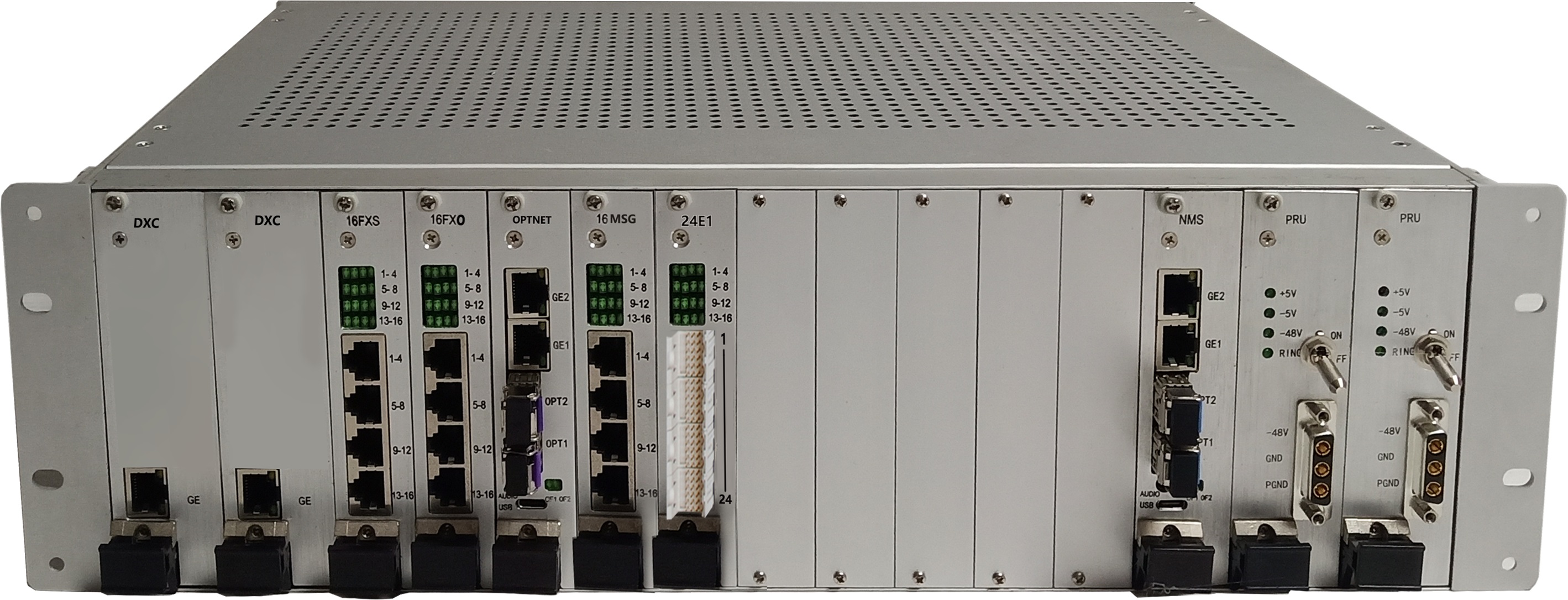
IDM MTP
IDM MTP
The IDM MTP-155 Intelligent Multi-Service Optical Transmission Equipment features modular functional design, including SDH optical transmission unit, E1 link interface control unit, EOS unit, PCM unit, SNMP unit, and protection switching unit. It adopts a shockproof, waterproof, and EMC-compliant chassis design, providing service interfaces suitable for military field operations. In addition to the standard configuration of 4 channels of 10/100M Ethernet, 16 channels of E1, 16 channels of 2-wire and 4 channels of 4-wire voice, 1 channel of V.35, 2 channels of V.24, 1 channel of E1 link, and 1 channel of V.35 channel, the equipment also features 4 expansion slots for inserting various service boards.
1. Overview
The IDM MTP-155 Intelligent Multi-Service Optical Transmission Equipment is developed by Beijing Ruiguang Jiyuan Digital Technology Co., Ltd. using advanced international integrated circuits, programmable logic circuits, and high-speed microprocessors. It multiplexes E1 signals, audio signals, telephone/magneto signals, and wire-speed 100M Ethernet signals for transmission over STM-1 (155Mbit/s) fiber optic and E1 channels, supporting intelligent mutual backup between STM-1 optical fiber and E1 link transmission channels.
The IDM MTP-155 Intelligent Multi-Service Optical Transmission Equipment features modular functional design, including SDH optical transmission unit, E1 link interface control unit, EOS unit, PCM unit, SNMP unit, and protection switching unit. It adopts a shockproof, waterproof, and EMC-compliant chassis design, providing service interfaces suitable for military field operations. In addition to the standard configuration of 4 channels of 10/100M Ethernet, 16 channels of E1, 16 channels of 2-wire and 4 channels of 4-wire voice, 1 channel of V.35, 2 channels of V.24, 1 channel of E1 link, and 1 channel of V.35 channel, the equipment also features 4 expansion slots for inserting various service boards.
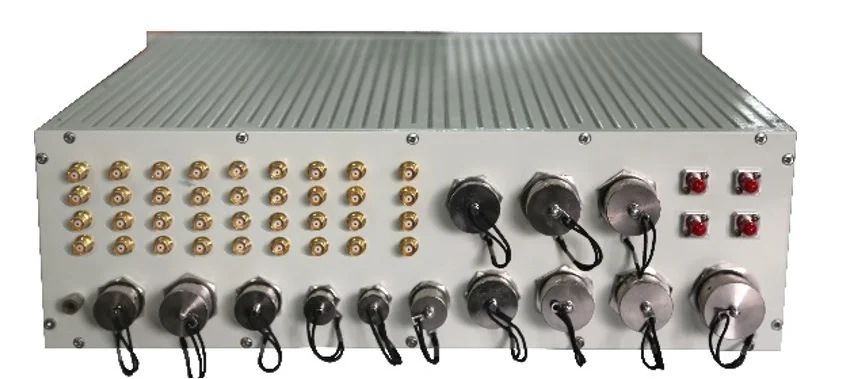
IDM MTP-155 Intelligent Multi-Service Optical Transmission Equipment
2. Features
- Adopts standard 19-inch 3U chassis structure design;
- The system adopts modular design, and the service access slots are universal, allowing various required services to be connected according to user configuration requirements;
- Supports intelligent mutual backup function between E1 links and SDH optical links;
- Supports local telephone switching function, supporting 1~2 channels of E1 digital trunk interfaces (supporting No.7, PRI, and No.1 signaling);
- Supports SNMP network management protocol, supporting remote equipment service configuration; supports northbound interface, providing alarm information upload;
- Supports dual hot-backup power supplies; supports replaceable optical ports;
- Supports STM-1 optical interface, E1 services, FXS/FXO services, magneto services, V.24 services, V.35 services, and Ethernet services;
- Provides E1 link interface;
- Provides 5-in-1 2-wire audio card: each board provides 16 channels of 2-wire audio, and each 2-wire audio channel can be configured as FXO/FXS/hotline/magneto/2100Hz magneto mode;
- All interfaces can be optionally equipped with aviation plug connectors;
- The equipment features excellent waterproof and moisture-proof design.
3. Main Tactical and Technical Specifications
Fiber optic line interface
Quantity: 2 Rate: 155Mbit/s Characteristics: Complies with ITU-T G.957 standard.E1 link interface
Quantity: 1 Rate: 2.048Mbps Characteristics: Complies with ITU-T G.703 standard.Service interfaces:
E1 circuit interface
u Quantity: 16 (75Ω, unbalanced) Rate: 2.048Mbps Characteristics: Complies with ITU-T G.703 standard.
Ethernet interface
u Quantity: 4 Rate: 10M/100M auto-negotiation Characteristics: Complies with IEEE802.3 standard.
V.35 interface
u Quantity: 1 Rate: N×64Kbit/s (n≤30) Characteristics: Complies with ITU-T V.35 standard.
RS232 interface
u Quantity: 2 Rate: ≤19.2Kbit/s Characteristics: Complies with EIA RS232 standard.
2-wire/4-wire voice interface
u Quantity: 20 channels (4 channels of 4-wire, 16 channels of 2-wire) Rate: 64Kbit/s Mode: hotline, magneto, subscriber, trunk.
Order wire interface: 1;
Synchronization clock interface: 1 pair, 1 external input clock interface, 1 output synchronization clock interface.
Management interface
Interface characteristics: Complies with IEEE 802.3 relevant provisions;
Interface communication protocol: SNMP.The network management system provides a northbound interface, with the capability to access the optical fiber communication transmission network management system;
2M service switching time from optical cable link to E1 link: ≤50ms (using hot backup mode), ≤15s (using dial-up mode to establish E1 link), ≤50s (using integrated network management mode to establish E1 link);
Error performance characteristics: Fiber optic link complies with ITU-T G.826 relevant provisions;
Equipment power supply mode: AC/DC dual power supply;
Equipment dimensions: Height ≤3U, installable in a 19-inch standard cabinet.
4. Technical Specifications
4.1 Optical Interface Technical Parameters
Interface Type : | SFP(Hot-pluggable) | Fiber Mode : | Single-mode(Multi-mode optional) |
Rate : | 155Mbit/s | Wavelength : | 1310nm or 1550nm |
Transmit Power : | -15~-8dBm | Receiver Sensitivity : | Better than -32dBm |
Transmission Distance : | 40Km, with optional long-distance optical modules available for extended fiber transmission over greater distances. | ||
4.2 E1 Interface Technical Parameters
Line Code : | HDB3 | Line Rate : | 2048Kbps±50ppm |
Impedance : | 70Ω(Unbalanced) | Frame Structure : | PCM31/30 |
Signaling : | Channel Associated Signaling | Jitter Performance : | Compliant withITU-T G.823 |
Standard Protocols : | SupportsITU-T G.703/G.704 | Frame Mode : | Framed/Unframed selectable, timeslots configurable |
4.3 Ethernet Interface Technical Parameters
Interface Type : | RJ45 | Interface Rate : | 10M/100M selectable |
Standard Protocol : | Supports IEEE802.3 standard | Operating Mode : | Half/Full Duplex |
4.4 Automatic Telephone Interface Technical Parameters
Ø FXS Interface Performance Specifications
Freq Band : | 300~3400 Hz | Imp edance : | (200Ω+560Ω//104) |
Loop Resistance : | <2KΩ | Receive Level : | -3.5dBr |
Transmit Level : | 0 dBr | Idle Channel Noise : | <-65 dBmop |
Cros stalk : | ≤-65 dBmop |
|
|
Ø FXO Interface Performance Specifications
Frequency Band : | 300~3400 Hz | Impedance : | (200Ω+680Ω//104) |
Transmit Level : | 0 dBr | Receive Level : | -3.5dBr |
Crosstalk : | ≤-65 dBmop | Idle Channel Noise : | <-65 dBmop |
4.5 Magnet Ringing Telephone / 2100Hz Magnet Ringing Telephone Interface Specifications
Frequency Band : | 300~3400 Hz | Impedance : | 600Ω |
Transmit Level : | 0 dBr | Receive Level : | -3.5dBr |
Crosstalk : | ≤-65 dBmop | Idle Channel Noise : | <-65 dBmop |
4.6 Hotline Telephone Interface Specifications
Freq Band : | 300~3400 Hz | Imp edance : | 600Ω |
Loop Resistance : | <2KΩ | Receive Level : | -3.5dBr |
Transmit Level : | 0 dBr | Idle Channel Noise : | <-65 dBmop |
Cros stalk : | ≤-65 dBmop |
|
|
4.7 RS232/RS485 Interface Specifications
Asynchronous Rate : | <=19.2K adaptive | Synchronous Rate : | 64K |
Interface : | Compliant withITU-T RS232 andITU-RS485 interface standards | ||
4.8 V35 Interface Specifications
Rate : | N*64K N<=32 | Mode : | SupportsDCE and DTE modes |
Interface : | Complies withITU-T V.35 interface standard | ||
5. Environmental Specifications
5.1 Operating/Storage Environment
Temperature (℃): -25℃~55℃
Storage temperature: -40℃~75℃
Relative humidity (%): ≤95%, non-condensing
5.2 Operating Power Requirements
The equipment supports AC 220V and DC -48V/DC 24V power input.
AC voltage: 187V253V-58V / DC -19V~-28V
DC voltage: DC -38V
6. Application Example
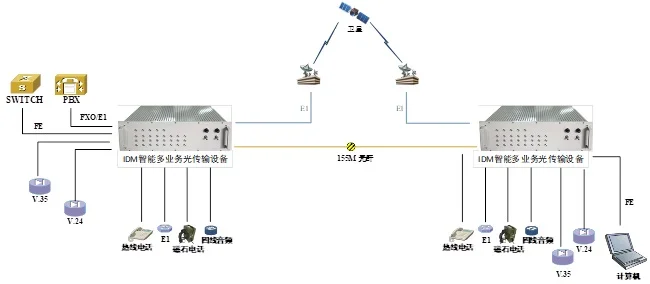
In the application solution, an IDM intelligent multi-service optical transmission device is deployed at both the central office and remote end respectively. The transmission line adopts 155M (STM-1) and E1 links as mutually backup transmission channels. The central office can access the telephone switching network via FXO analog trunk or E1 digital trunk, and access the IP network via the Fast Ethernet interface, while also providing access for V.35, V.24, hotline telephone, ordinary telephone, E1, and four-wire audio services.
The remote device can be deployed at a base site or installed on a communication vehicle, providing access for V.35, V.24, hotline telephone, ordinary telephone, E1, four-wire audio, and Ethernet services.
When the optical fiber transmission channel is in good condition, all services are transmitted through the 155M optical fiber, with Ethernet service bandwidth configured in 2M granularity, capable of providing N×2M high-bandwidth Ethernet service transmission. When a fiber fault occurs, the equipment automatically switches to the E1 link channel, enabling transmission of designated 64K and N×64K services over the E1 channel, with Ethernet service bandwidth configured in 64K granularity, capable of providing N×64K low-bandwidth Ethernet service transmission. When the optical fiber channel fault is restored, the equipment automatically switches all services back to fiber transmission.
FAQs
What are the features of SDH technology and MSTP products?
I. Development Directions of Next-Generation SDH Technology and Products Regarding the development direction of…
View answerWhat is the difference between PDH and SDH?
I. PDH PDH is the Plesiochronous Digital Hierarchy, which is divided into the European standard and the…
View answerWhat is an E1 line? What are the core knowledge points?
E1 Basics Frame Structure of the E1 Channel In an E1 channel, 8 bits form one timeslot (TS)…
View answerLow-Cost SDH Is an Inevitable Choice for Access Network Construction in the Near to Medium Term
The current status of metropolitan optical networks is that SDH/MSTP (DWDM) optical networks have become the mainstream…
View answerIntroduction to Ethernet Over SDH Technology
Interface specifications: On the SDH side, provides 1 x 155.52Mbps LVDS interface, supporting STM-1.
View answer