IDM MSTP8200 Integrated Service Transmission Equipment
160-channel 64K time slot access, VC12 full cross-connect, one unit replaces multiple narrowband multiplexers
The MSTP8200 integrated service transmission equipment provides STM-16/STM-4/STM-1 optical interfaces and gigabit Ethernet ports based on EOS technology; it also supports E1 interfaces and various 64K services including FXS/FXO, V.35/V.24, hotline, and magneto, and can access video signals, making it easy to build a video surveillance system.
IDM MSTP8200 160-channel 64K time slot SDH transmission equipment is an access-type optical-electrical integrated SDH equipment developed by Beijing Ruiguang Jiyuan Digital Technology Co., Ltd. It consists of a 19-inch standard 3U card-based chassis, SFP-type STM-16/STM-4/STM-1 optical interface units, a VC12 cross-connect unit, and various service access cards, and is used for multi-service access, cross-connection, and transmission in industrial private networks such as electric power and energy, rail transit, and video surveillance. As a professional SDH equipment manufacturer, Raytrans has implemented 160-channel 64K time slot service access on this product, achieving full cross-connect of TDM services with a VC12 cross-connect capacity of 6174×6174. Combined with tributary 1+1 path protection and dual backup power supply, it undertakes access layer transmission in electric power and energy industrial private networks, rail transit and railway private networks, and video surveillance and security private networks. It is widely applicable to scenarios such as government private network optical fiber communication solutions, military emergency communications vehicle solutions, smart mining communication solutions, and video surveillance systems, providing a reliable product showcase for multi-service access of optical transmission equipment in industrial private networks.
Key Specifications at a Glance: 160-channel 64K access · VC12 full cross-connect · 1+1 path protection · dual backup power supply (SFP-type STM-16/STM-4/STM-1 optical interfaces · 40 km repeaterless · 19-inch 3U chassis with 15 3U user card slots · voice and 64K data services mixed in the same chassis)
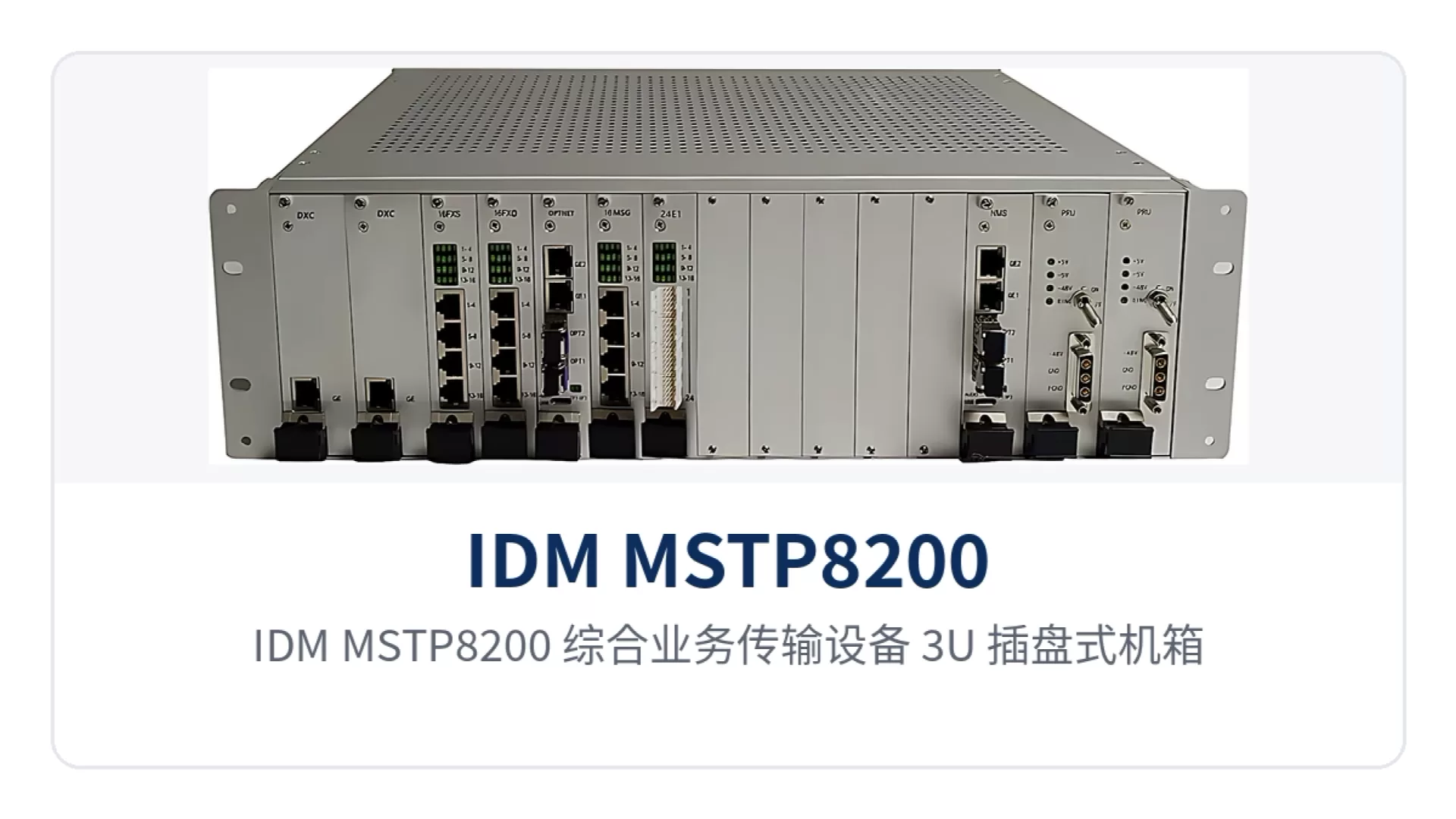
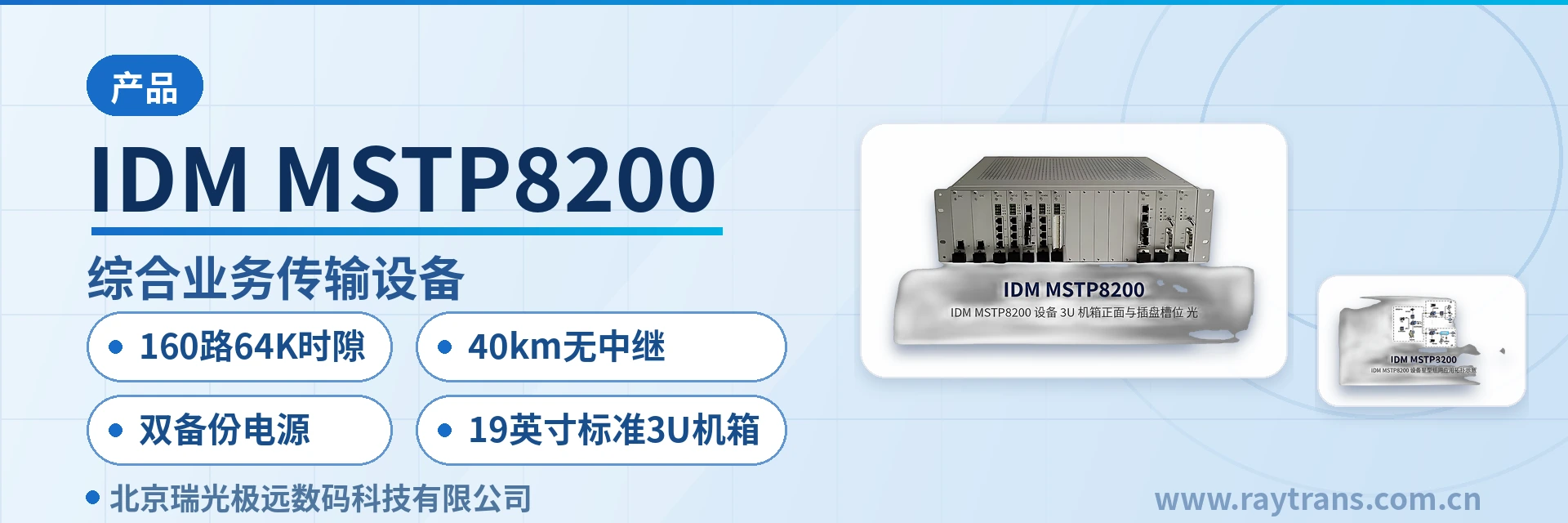
Figure 1: IDM MSTP8200 Integrated Service Transmission Equipment 3U card-based chassis front view and service card slot layout
What Kind of Device Is a 160-Channel 64K Time Slot SDH Transmission Equipment?
IDM MSTP8200 160-channel 64K time slot SDH transmission equipment is an STM-N level multi-service SDH optical transmission system designed according to the functional modules defined in ITU-T Recommendation G.783. It consists of SFP-type STM-16/STM-4/STM-1 optical interfaces, a VC12 cross-connect unit, a clock unit, and service access cards, with technical performance conforming to ITU-T standards. As a mature SDH equipment, this product simultaneously provides the service monitoring, access, protection, and network management capabilities of SDH equipment and the Ethernet access capability required of MSTP equipment, and features ITU-T G.813 standard network element timing, VC-12 cross-connection, and path protection functions. Raytrans continues its modular product showcase approach across this series of optical transmission equipment, making it easy for users to select options as required.
The unit adopts a 19-inch standard 3U chassis and card-based design, and can serve as an add-drop multiplexer (ADM) or terminal multiplexer (TM) to form point-to-point and point-to-multipoint chain and ring transmission networks. Service cards are configured according to the project service list; for capacity expansion, simply add or replace service cards while the chassis and backplane continue to be used, reducing the number of racks and associated cables accordingly.
How Does Standalone 160-Channel 64K Time Slot Access Replace Multiple Narrowband Service Multiplexers?
Standalone 160-channel 64K time slot access, with one device replacing multiple narrowband service multiplexers, is the core value of IDM MSTP8200 for the multi-service access layer of industrial private networks. The equipment uses STM-16/STM-4/STM-1 optical ports as the uplink backbone, converging 64K narrowband services from various sites into the same cross-connect matrix within a single unit, so that voice, data, hotline, and magneto services no longer each require a separate narrowband multiplexer.
The equipment provides 10 user slots for inserting service cards, and can access voice and data services such as PDH, E1, FXO/FXS, V.24/V.28/V.35, EM2/4, hotline phone, magneto telephone, high-fidelity audio, X.50, and 10M/100M Ethernet. The number of devices and the variety of spare parts that would otherwise need to be configured separately at the access layer are thereby reduced.
How Are 160-Channel 64K Time Slot Services Accessed?
To access 160-channel 64K time slot services, simply select service cards by service type, have them all enter the VC12 cross-connect matrix, and then assign them to the target optical direction by site affiliation.
Voice services: carried by the 5-in-1 2-wire audio card 3U-8MVOICE, each card provides 8 channels of 2-wire audio, and each channel can be configured as FXO, FXS, hotline, magneto, or 2100 magneto mode.
Data services: carried by E1 cards, V.24/V.28/V.35 cards, and codirectional 64K cards, and can share the same cross-connect matrix with voice services.
Special data services: a radar data access card can be inserted, each card provides 4 radar data interfaces, with synchronous rate supporting 300bps~128kbps and asynchronous rate supporting up to 38.4kbps and below with adaptive capability.
Expansion slots: 3UMPCONV user optical port expansion cards and WG300 signaling exchange cards can be inserted, and when service types change, simply replace the card.
After services enter the equipment, they are uniformly split into 64K time slots and allocated as needed in the VC12 cross-connect matrix, with a single unit able to access 160-channel 64K time slot services. During access planning, first count the number of voice channels, data, and audio channels by site, then verify the number of service cards and slot occupancy, to avoid rework after being put into operation due to insufficient slots or time slots.
What Core Functions Does the 160-Channel 64K Time Slot SDH Transmission Equipment Have?
IDM MSTP8200 integrates SDH optical transmission, TDM full cross-connect, and multi-service access in the same chassis. The functions and their descriptions are shown in the table below.
Function | Description |
|---|---|
SFP-type STM-16/STM-4/STM-1 optical interfaces | Provides optical interfaces at three rates of 2.5G, 622.08Mbps, and 155.52Mbps, single-mode 1310nm/1550nm wavelength, supporting SDH ring and chain networking |
Tributary 1+1 path protection | Each tributary channel is configured with active and standby paths; when the active line is abnormal, services switch over to the standby line, improving link availability of industrial private networks |
Full cross-connect of TDM interface services | VC12 cross-connect capacity 6174×6174, VC3 granularity 288×288, VC4 granularity 128×128, supporting unidirectional, bidirectional, and broadcast services |
160-channel 64K time slot access | Provides 64K time slot service access capability for narrowband dedicated lines, with voice, data, and audio services carried on the same platform |
Physically isolated EoS Ethernet | Provides physically isolated EoS Ethernet, with each group's bandwidth configurable by VC4 (N=1 |
5-in-1 2-wire audio card | 3U-8MVOICE single card provides 8 channels of 2-wire audio, each channel configurable as FXO/FXS/hotline/magneto/2100 magneto mode |
Radar data access card | Single card provides 4 radar data service interfaces, supporting synchronous and asynchronous operating modes, with synchronous rate supporting 300bps~128kbps |
E1 interface | 2.048Mbps bit rate, HDB3 line coding, impedance 75Ω/120Ω, frame structure PCM30/32, channel-associated signaling |
Clock source selection | Optional line clock, external clock (2Mbit/s or 2MHz), and free-run |
Service and signaling expansion cards | 3UMPCONV user optical port expansion cards and WG300 signaling exchange cards can be inserted |
Ethernet management channel | Ethernet management channel based on DCC, E1, N*64K, and TCP/IP, providing SNMP simple network management protocol |
Dual backup power supply | DC-48V and AC220V power supply, with optional DC+DC, AC+AC, AC+DC dual backup power supply |
In government private network optical fiber communication solutions, this SDH equipment can undertake backbone and access layer transmission; in military emergency communications vehicle solutions, its compact chassis and multi-service access capability are suitable for rapid deployment; in smart mining communication solutions, it can uniformly carry voice, data, and video surveillance system backhaul, and meet the multi-service access requirements of industrial private networks. As an SDH equipment manufacturer, Raytrans provides complete support from product showcase to networking configuration for the above scenarios.
Technical Specifications of the 160-Channel 64K Time Slot SDH Transmission Equipment
Optical Interface Parameters
Item | Parameter/Specification | Description/Applicable Conditions |
|---|---|---|
STM-16 optical interface | SFP, receive/transmit rate 2.5G, single-mode, 1310nm/1550nm | Transmit optical power -12~-6dBm, receiver sensitivity better than -32dBm |
STM-4 optical interface | SFP, receive/transmit rate 622.08Mbps, single-mode, 1310nm/1550nm | Transmit optical power -12~-6dBm, receiver sensitivity better than -32dBm |
STM-1 optical interface | LC, receive/transmit rate 155.52Mbps, single-mode, 1310nm/1550nm | Transmit optical power -12~-6dBm, receiver sensitivity better than -32dBm |
Repeaterless transmission distance | 40 km | Standard model; when exceeding 40 km, a long-distance optical module can be customized or optionally installed |
Service Interface Parameters
Item | Parameter/Specification | Description/Applicable Conditions |
|---|---|---|
E1 interface | 2.048Mbps, HDB3, impedance 75Ω/120Ω | Complies with ITU-T G.703, frame structure PCM30/32, channel-associated signaling |
Ethernet (FE) | RJ-45, transmission rate N×VC12 (N≤50) | Complies with IEEE802.3, Adaptive half-duplex/full-duplex |
Ethernet (GE) | RJ-45, transmission rate N×VC12 (N≤63) | Complies with IEEE802.3, Adaptive half-duplex/full-duplex |
FXO/FXS interface | Audio range 300Hz~3400Hz, compression ITU G.711 A-law | Three-element complex impedance 200Ω+560Ω//0.1μF, loop current 20mA/channel |
Codirectional 64K interface | Bit rate 64Kbps, balanced impedance 120Ω | Complies with ITU G.703 recommendation |
E&M 2/4-wire interface | Audio range 300Hz~3400Hz, balanced impedance 600Ω | Compression ITU G.711 A-law, return loss no less than 18dB |
Magneto interface | Audio range 300Hz~3400Hz, balanced impedance 600Ω | Compression ITU G.711 A-law, return loss no less than 18dB |
V.24 interface | Asynchronous ≤9600bps; synchronous 64Kbps | Electrical characteristics comply with CCITT V.28 protocol |
V.35 interface | RJ-45, transmission rate n×64Kbps (n=0~31) | Electrical characteristics comply with ITU-T V.35 recommendation, terminal interface complies with ISO2593 |
Unit Parameters
Item | Parameter/Specification | Description/Applicable Conditions |
|---|---|---|
Cross-connect capacity | VC12 6174×6174, VC3 288×288, VC4 128×128 | Full cross-connect between TDM interface services, supporting unidirectional, bidirectional, and broadcast services |
Service access capacity | Supports 160 channels of 64K time slot services | 64K narrowband leased lines allocate time slots as required by the site |
Chassis structure | 19-inch standard 3U chassis, card-based design, 15 3U user card slots | 10 user slots for service cards, unit dimensions 480mm308mm131mm |
Clock source | Line clock, external clock (2Mbit/s or 2MHz), free-run | Selected according to networking conditions |
Power supply mode | AC220V/DC-48V | Optional DC+DC, AC+AC, AC+DC dual backup power supply, overall power consumption ≤150W |
Operating environment | Operating temperature -10℃ | Suitable for equipment room and industrial site cabinet environments |
How to Network with Tributary 1+1 Path Protection
How to network tributary 1+1 path protection: configure the same tributary channel as an active and a standby path, and when the active line has a fiber break or abnormal received optical power, services switch over to the standby line. IDM MSTP8200 configures active and standby tributaries on SFP optical interfaces, and together with STM-16/STM-4/STM-1 optical ports forms protected ring network or chain network links, an effective means of improving link availability for industrial private networks such as electric power, railway, and video surveillance systems; for the specific switchover mechanism and switchover time, it is recommended to confirm with the SDH equipment manufacturer on a project basis.
During networking, divide the protection scope according to the importance of the services below: key services such as dispatch telephone, protection information, and surveillance backhaul are arranged on tributaries with 1+1 protection, while general data services run over unprotected channels, covering more sites with limited fiber core resources.
How to Plan Sites for a 40 km Repeaterless STM-16 Optical Port
How to plan sites for a 40 km repeaterless STM-16 optical port: the key is matching station spacing with bandwidth. The STM-16 optical interface transmits at 2.5G rate over single-mode 1310nm/1550nm wavelengths within 40 km without a repeater, and can be preferred for long-distance industrial ring networks with larger station spacing; for sections with shorter station spacing and smaller service volume, STM-4 (622.08Mbps) or STM-1 (155.52Mbps) optical ports are sufficient, avoiding excess rate and investment.
The standard model has a repeaterless transmission distance of 40 km; beyond 40 km it can be customized, or a long-distance optical module can be installed to achieve longer-distance optical fiber transmission. When planning sites, first measure the actual distance and optical cable attenuation between sites, then select optical modules by distance grade, reducing the number of repeater stations and the investment in supporting power supplies and cabinets.
How to Schedule Narrowband Services with VC12 Full Cross-Connect 6174×6174
VC12 cross-connect 6174×6174, full non-blocking scheduling of TDM services, means any accessed 64K time slot can be routed to any target optical direction without being restricted by other occupied connections. The scheduling route is: the 64K services of each user slot first converge into the cross-connect matrix, are configured to the corresponding STM-N tributary according to site affiliation, and the opposite-end device then restores them to the user interface; voice channels and data dedicated lines are therefore allocated on demand and flexibly aggregated within the ring network.
When adding a site or adjusting service assignment, only the cross-connect configuration is changed, while the external optical cable and user-side wiring remain untouched, resulting in low on-site workload. The VC3 granularity 288×288 and VC4 granularity 128×128 cross-connect capacity provide dispatching resources for wide services such as Ethernet, sharing the same matrix with VC12 narrowband scheduling.
How to Connect DC-48V and AC220V Dual Backup Power Supplies
How to connect DC-48V and AC220V dual backup power supplies: simply select one or a combination of the two according to the existing power supply conditions of the equipment room. The device power supply mode is AC220V or DC-48V, with optional DC+DC, AC+AC, AC+DC dual backup power supplies; after dual backup access, the active and standby power supplies back each other up, and when one fails the other continues to supply power, suitable for DC-powered substation equipment rooms and single-phase AC field sites.
Sites with only a DC distribution panel: choose DC+DC dual backup, with two DC power supplies introduced separately.
Sites with only mains power: choose AC+AC dual backup, with two AC power supplies introduced separately.
Sites with both DC and mains power: choose AC+DC dual backup, with AC and DC backing each other up, unifying spare parts and O&M practices.
The overall power consumption does not exceed 150W; for the specific configuration of the dual backup power supplies, it is recommended to confirm with the manufacturer based on the actual power supply conditions of the equipment room.
Differentiated Value: 160 Channels of 64K Access · VC12 Full Cross-Connect · 1+1 Path Protection · Dual Backup Power Supply
The three differentiated capabilities of IDM MSTP8200 correspond to three types of real-world problems at the access layer of industrial private networks: 160 channels of 64K time slot access in a standalone unit, replacing multiple narrowband service multiplexers with one device, with the number of devices and rack space in the equipment room decreasing accordingly; VC12 cross-connect 6174×6174, full non-blocking scheduling of TDM services, with circuit additions and adjustments requiring only configuration changes; STM-16/4/1 optical ports with 40 km repeaterless transmission and tributary 1+1 path protection, requiring fewer repeaters at long-distance sites and providing backup for key links. The optional DC and AC dual backup power supply further supports the power supply reliability of unattended sites.
Differentiation Point | Customer Value |
|---|---|
160 channels of 64K access | Centralized access of narrowband services in a standalone unit, reducing the number of access layer devices, racks, and cables, and narrowing O&M objects and the variety of spare parts |
VC12 full cross-connect | 6174×6174 cross-connect capacity schedules 64K time slots on demand, with new circuits requiring only configuration changes and no impact on in-service services |
1+1 path protection | Automatic switchover between active and standby tributaries, so key services such as dispatch telephone and protection information do not lose channels for long periods due to a single-segment fiber break |
Dual backup power supply | Optional DC+DC, AC+AC, AC+DC, adapting to DC equipment rooms and field AC sites, so sites with different power supply conditions can use the same model |
Typical Application Scenarios
Electric Power and Energy Industrial Private Network
In the electric power and energy industrial private network, Raytrans IDM MSTP8200, as a typical SDH equipment, is deployed at the access layer between substations, switching stations, and the dispatch center, forming an SDH ring network at 2.5G rate over STM-16 optical ports, covering line corridors with large station spacing over 40 km repeaterless transmission. Dispatch voice is carried by the 5-in-1 2-wire audio card, with the FXS side connected to dispatch telephones and the FXO side connected to switching equipment, and magneto mode adapting to existing magneto telephones; protection information and monitoring data are allocated channels by 64K time slot, sharing the same cross-connect matrix with voice. Tributary 1+1 path protection and dual backup power supply keep channels available for communications at unattended substations when a single-segment fiber or a single power supply fails, fully meeting the requirements of the government private network optical fiber communication solution for high-reliability optical transmission equipment.
Rail Transit and Railway Private Network
In the rail transit and railway private network, IDM MSTP8200 accesses the transmission network of stations along the line, depots, and traction substations via STM-4/STM-1 optical ports, carries services such as signal interlocking and blocking through E1 interfaces, and completes per-station allocation of 64K time slots along the line through VC12 cross-connect. Train dispatch telephones and section official telephones can be enabled with one 5-in-1 2-wire audio card configured for multiple ports, and hotline and magneto modes adapt to existing railway telephone types. After inter-station services are concentrated into one 3U device, the number of devices and cables in equipment rooms along the line decreases, and the network management system is incorporated into unified road network monitoring via SNMP, providing reliable SDH equipment access capability for the military emergency communications vehicle solution.
Video Surveillance and Security Private Network
In the video surveillance and security private network, IDM MSTP8200 can directly access video signals to form a video surveillance system, backhaul surveillance images over physically isolated EoS Ethernet, while narrowband channels simultaneously carry control signals and dispatch voice. The 40 km repeaterless transmission of the STM-16 optical port reduces field repeater equipment and power supply points, and tributary 1+1 path protection and DC-48V/AC220V dual backup power supply keep communications running at field cabinets and unattended monitoring points; surveillance images and production data are carried over separate channels, and hardware-layer isolation keeps the security network and the production network from crossing over, a typical product showcase of an SDH equipment manufacturer for the smart mining communication solution and multi-service access in industrial private networks.
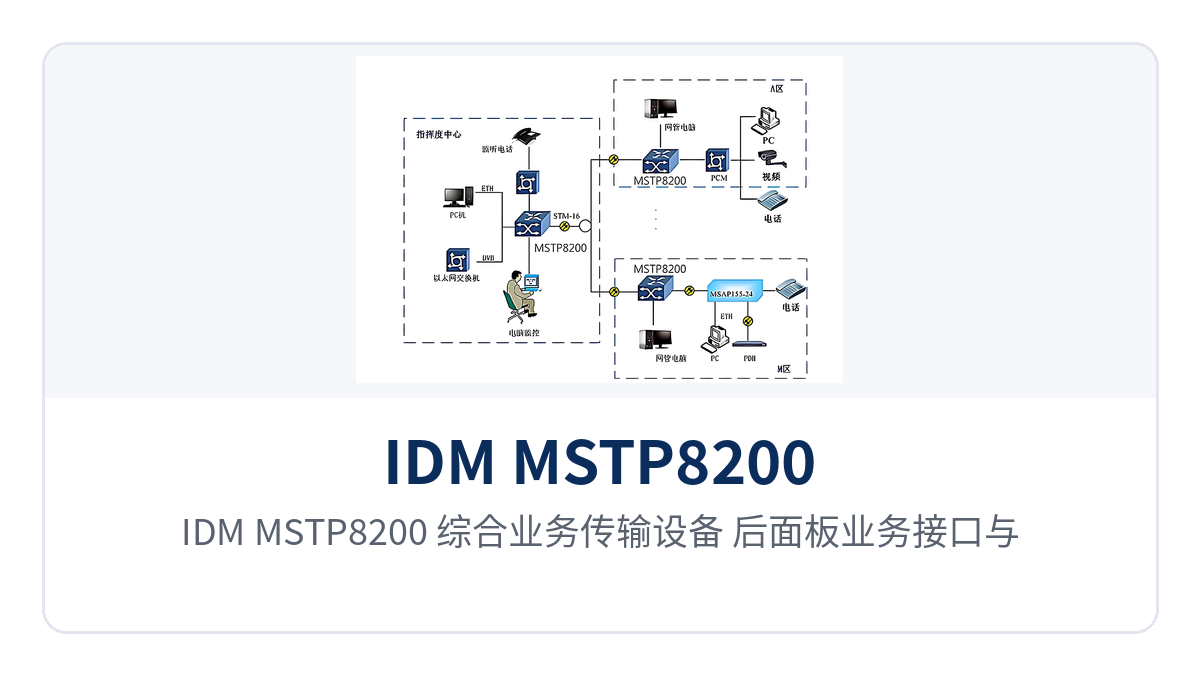
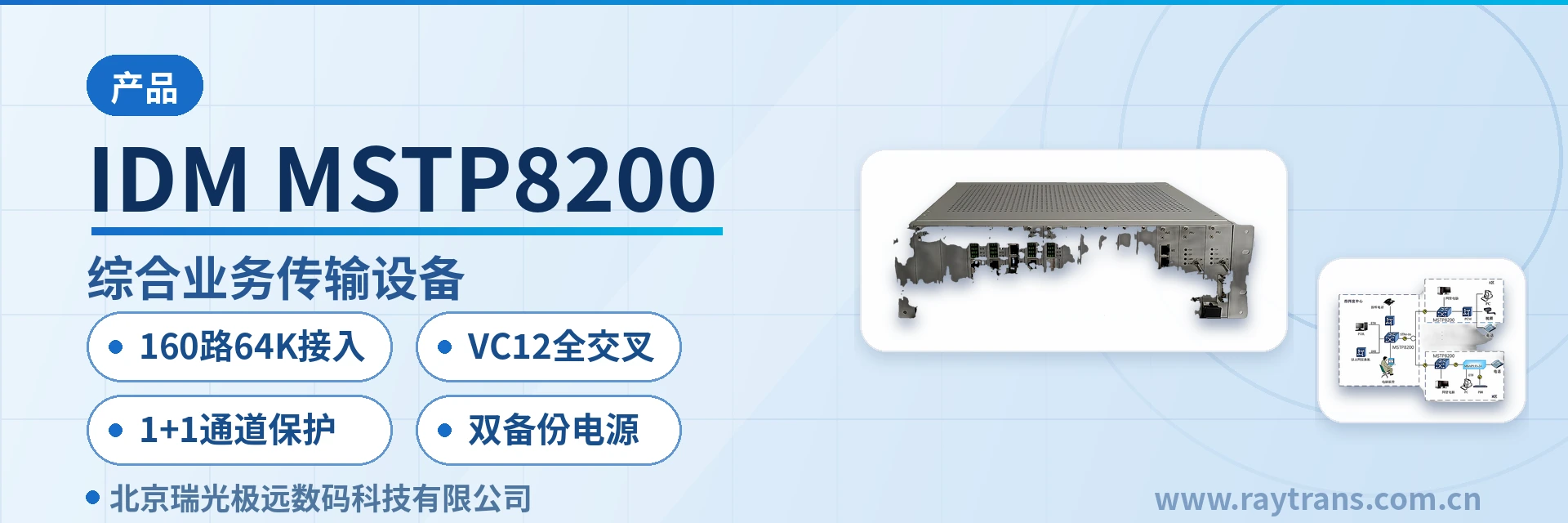
Figure 2: Close-up of the service interfaces and dual backup power supply terminals on the rear panel of the IDM MSTP8200 Integrated Service Transmission Equipment