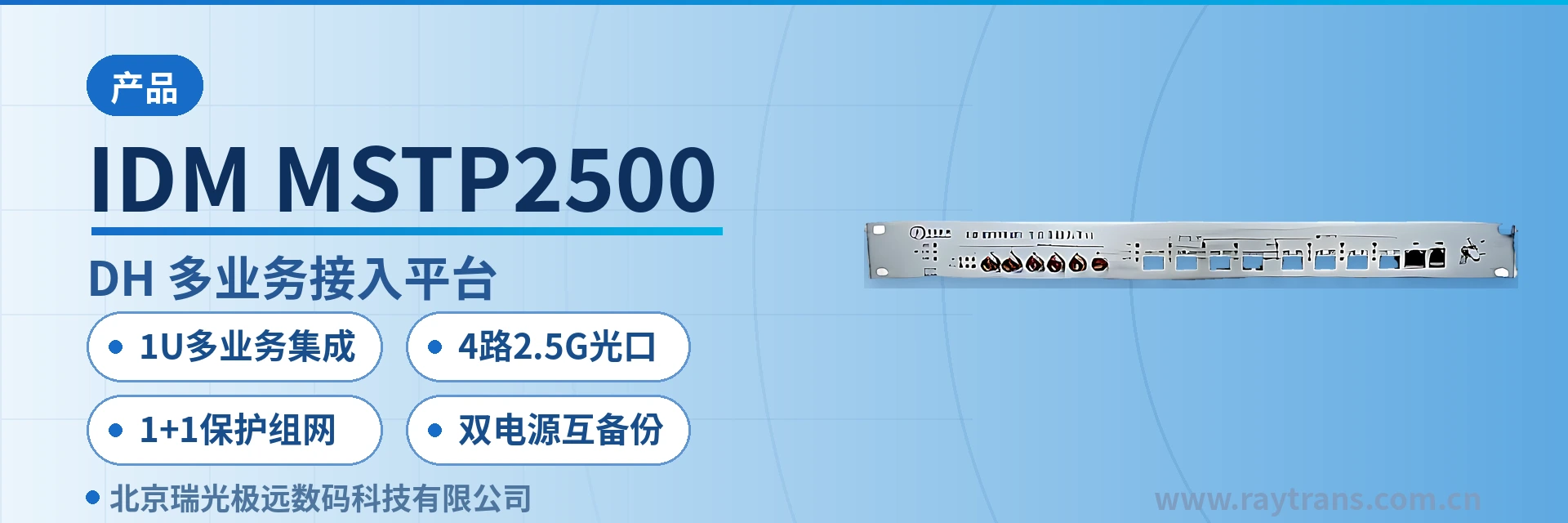
IDM-MSTP2500 SDH Multi-Service Access Platform
SDH PCM Ethernet three-in-one 1U saves two devices 8 optical ports multi-ring networking
The SDH equipment is an STM-16 class MSTP product launched by our company according to market demand. It enables the transmission of multiple services such as Ethernet, traditional PDH, digital TV signals, and high-speed fiber access signals over the SDH system, and can meet users' needs for optical fiber transmission and access of broadband and narrowband services. This product adopts a single-chip integrated design solution and features high integration, small size, and rich service interfaces.
IDM-MSTP2500 2.5G optical port multi-service SDH platform is an STM-16 class MSTP multi-service transmission device developed by Beijing Ruiguang Jiyuan Digital Technology Co., Ltd. It integrates three functions—SDH optical transmission, PCM multiplexing, and Ethernet access—into a single 19-inch 1U chassis, and is used to simultaneously transport voice, E1 and E3 leased lines, Ethernet, and digital TV signals over an SDH transmission network. It mainly targets power dispatch, military networks, and broadcast and television transmission private networks, and is a representative SDH device that Raytrans has introduced for the private network market.
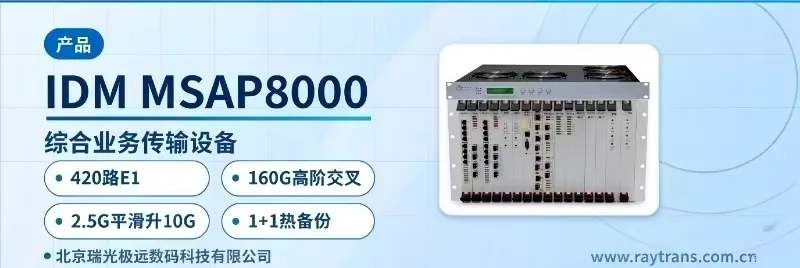
Key specifications at a glance: 4 configurable 2.5G/622M optical ports · 4 configurable 622M/155M optical ports · 2 GE + 8 FE · 3 E3 + 16 E1 · 1+1 protection and multi-ring networking · dual mutual-backup power cards · 19-inch 1U chassis
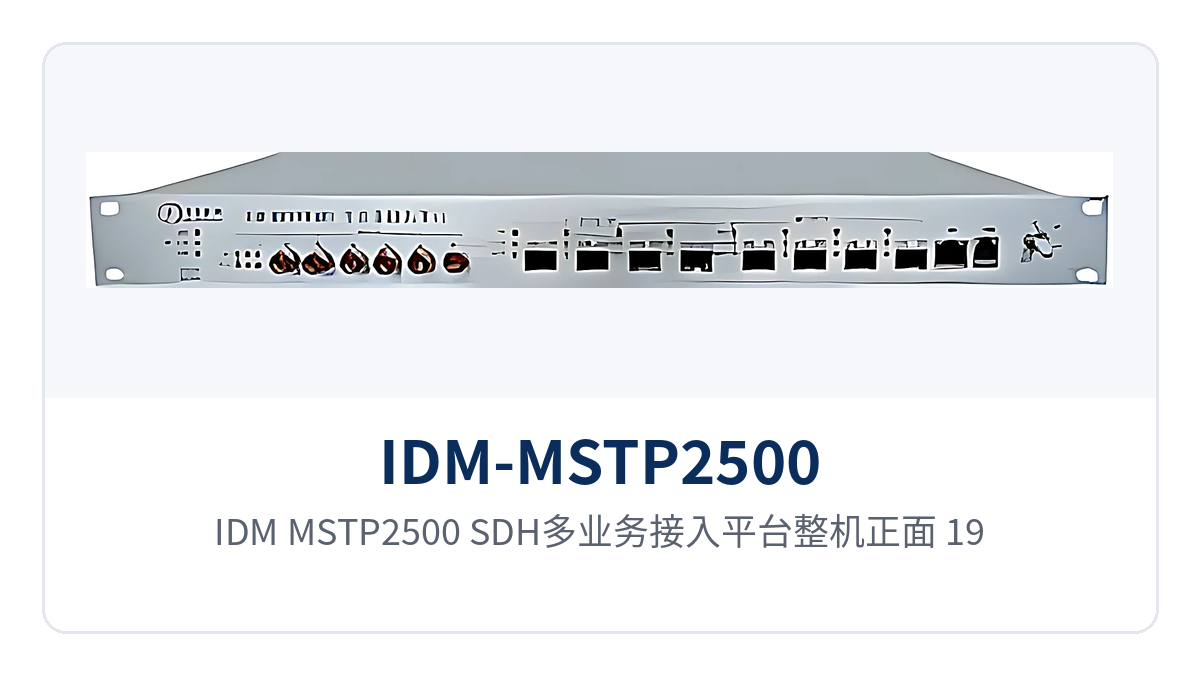
Figure 1: Front view of the IDM-MSTP2500 SDH multi-service access platform, 19-inch 1U chassis appearance and optical port alarm indicator LEDs
What kind of device is the 2.5G optical port multi-service SDH platform?
The 2.5G optical port multi-service SDH platform refers to an access device that connects to the SDH transmission plane through 2.5Gb/s (STM-16) optical interfaces on the trunk side and completes add/drop and cross-connection of multiple service types within the same chassis. As a typical SDH device, the IDM-MSTP2500 adopts a single-chip integrated design featuring high integration, small size, and rich service interfaces, consolidating the functions previously handled by three types of equipment—SDH transmission, PCM multiplexing, and Ethernet access—into a 1U height, demonstrating a clear compactness advantage in the product showcase.
As an STM-16 multi-service optical transmission device, the IDM-MSTP2500 can be used in public network backbone transmission networks and private network systems, and its interface configuration can also be adjusted according to customized services. The device complies with the relevant ITU-T recommendations and SDH technical specifications, with service granularity ranging from 2.048Mb/s for E1 up to 2.5Gb/s for STM-16. A site only needs to select interfaces and optical modules according to the service list, without replacing the platform.
At traditional private network access points, these three types of services are usually handled by different devices, requiring multiple devices in the cabinet as well as patch cords and pigtails between devices. 1U multi-service integration consolidates the three functions into the same chassis, reducing the number of devices, cabling, and variety of spare parts at the access point simultaneously. When a site is expanded, it is sufficient to add interfaces according to the service list without adding a complete unit.
What services can a single 1U device access?
The service interfaces of the IDM-MSTP2500 are organized into five categories: transmission direction, tributary interfaces, cross-connect granularity, network protection, and network management. The number and rate of interfaces are determined at ordering according to the site service list. The following table lists each function item and its role, making it easy for engineers to check the configuration against on-site services.
| Function | Description |
|---|---|
| SDH optical transmission | Provides 4 rate-configurable 2.5Gb/s (STM-16) or 622Mb/s (STM-4) optical interfaces, plus 4 rate-configurable 622Mb/s (STM-4) or 155Mb/s (STM-1) optical interfaces |
| PCM multiplexing and voice access | Integrates PCM multiplexing, provides 16 E1 interfaces and FXO/FXS interfaces, connecting user telephones and analog trunks of switches |
| E3 service access | Provides 3 E3 (34Mb/s) interfaces, carrying third-order PDH services and providing independent channels for leased lines |
| Ethernet access | Provides 2 GE (gigabit Ethernet) interfaces and 8 FE (Fast Ethernet) interfaces, supporting physical isolation or VLAN partitioning |
| Channelized cross-connection | FE is cross-connected with VC-12 as the minimum granularity, GE with VC-3 as the minimum granularity; the full time-slot cross-connection function supports flexible add/drop of services |
| Digital TV and high-speed data access | Supports transmission of digital TV signals (DVB-ASI) and high-speed fiber access signals (ESCON) over the SDH system |
| Network protection | Supports 1+1 protection and hybrid networking, and can form point-to-point, chain, ring, and multi-ring networks |
| Network management access | Provides F (100Base-T) and f (RS232) network management interfaces, with the five ITU-T-recommended functions of configuration, alarm, performance, maintenance, and security, and supports remote access for off-site monitoring |
| Power redundancy | Supports AC220V or DC-48V power supply, with dual mutual-backup power cards |
FE is cross-connected with VC-12 as the minimum granularity and GE with VC-3 as the minimum granularity. A gigabit Ethernet service is scheduled in SDH channels at VC-3 granularity, while Fast Ethernet and E1 services are scheduled at VC-12 granularity. The full time-slot cross-connection function enables time slots in any optical direction to be dropped to local tributaries or forwarded to another direction, so service scheduling is not limited by fixed time slot positions, making add/drop of services more convenient.
The isolation mode of Ethernet interfaces is selected according to project security requirements: the 8 FE ports can be divided into mutually independent VLANs or made into physically isolated independent channels, with the office network, video surveillance network, and production network each using their own ports. The 2 GE interfaces are used for uplink aggregation or connecting to a central switch, with bandwidth bundled at N×2.048Mb/s granularity and the per-port rate specified during configuration.
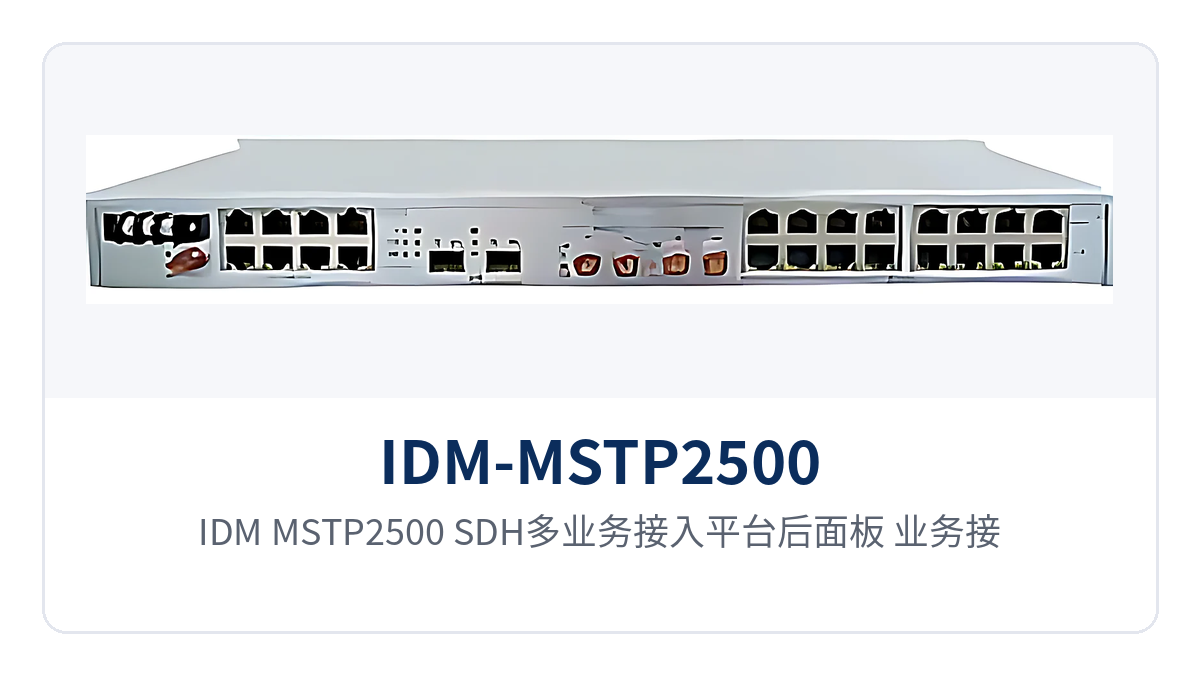
Figure 2: Rear panel of the IDM-MSTP2500 SDH multi-service access platform, layout of service interfaces, optical interfaces, and dual power cards
How do 4 2.5G optical ports and 4 622M optical ports form a multi-ring network?
Rate configurability means that the same optical port position can be equipped with a 2.5Gb/s (STM-16) or 622Mb/s (STM-4) optical module according to the inter-station distance and service capacity, while the other 4 optical port positions can be equipped with 622Mb/s (STM-4) or 155Mb/s (STM-1) modules. The IDM-MSTP2500 has a total of 8 configurable optical port positions, balanced port by port according to line capacity and peer rate, so a single SDH device can serve as a high-capacity aggregation node or be deployed in a medium-speed access segment.
The 4 2.5G optical ports can be configured as STM-16 or STM-4 as needed and used in combination with the other 4 622M/155M optical ports, so a structure in which 2.5G trunk directions and 155M tributary directions coexist on the same device is possible. The optical interface type is FC (SC and others can be customized), the fiber mode is mainly single-mode with multi-mode optional, the receive/transmit wavelength is 1310nm/1550nm, and the transmission distance is 20Km; long-distance optical modules can be installed to extend the inter-station distance.
1+1 protection networking is the basis for this device to form a multi-ring network. The working channel and protection channel are established simultaneously; when a section of optical cable or an optical module fails, services continue to be transmitted along the other direction of the ring. The 8 optical ports can work simultaneously, and one device can be attached to two rings at the same time, forming a multi-ring networking structure with tangent or intersecting rings, with services between rings scheduled through full time-slot cross-connection.
Networking topologies include point-to-point, chain, ring, and multi-ring, and the device can also be networked jointly with centralized MSTP systems. Point-to-point is used for direct connection between two end stations, chain is suitable for stations connected in series along a line, and ring and multi-ring are used for dispatch and transmission nodes with high requirements for link continuity, where services can be rerouted in both directions within the ring and a single point of interruption does not affect the remaining nodes.
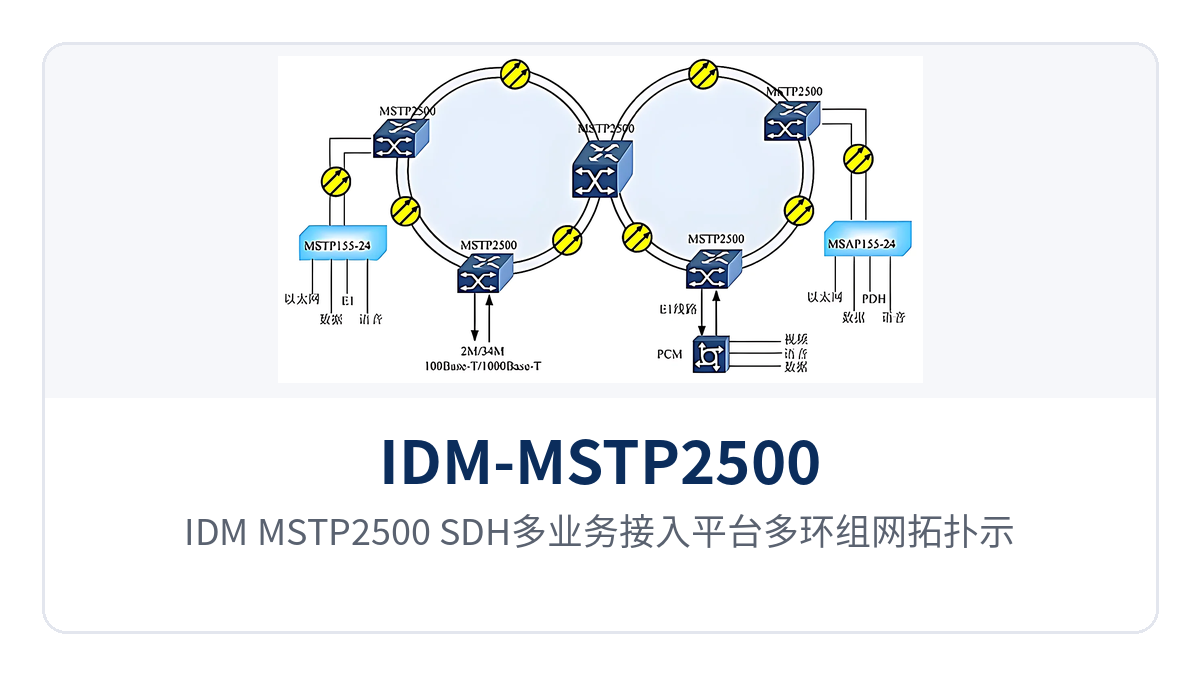
Figure 3: Multi-ring networking topology of the IDM-MSTP2500 SDH multi-service access platform, tangent rings and central aggregation structure
How does dual mutual-backup power supply ensure uninterrupted power for private networks?
The IDM-MSTP2500 supports both AC220V and DC-48V power supply modes and adopts a dual mutual-backup power card structure, with both power cards online simultaneously; when one fails, the other continues to power the unit. If the equipment room has a DC power distribution panel, DC-48V can be used; if only AC mains power is available, AC220V is used, so the site does not need to add a separate conversion device for the equipment.
The overall power consumption is ≤50W, so the heat output and electrical load of the 1U chassis in the cabinet are low. The power cards and service interfaces are located in different positions of the chassis, so O&M personnel do not need to disturb the service-side cabling when replacing a power card. This is also the practical value of dual mutual-backup power cards at unattended sites, where maintenance can be scheduled during daytime service gaps. As a professional SDH equipment manufacturer, Raytrans can provide users with complete support from selection and configuration to networking implementation based on the actual requirements of government private network optical fiber communication solutions and military emergency communications vehicle solutions.
Key specifications and technical specifications
During selection and bidding, the three items of optical interfaces, tributary interfaces, and power supply are usually checked first. The following table lists the main technical specifications of this SDH device by interface type. The electrical characteristics of the interfaces comply with ITU-T G.703 and IEEE802.3; for items not listed, the manufacturer's technical documentation and commercial confirmation shall prevail.
| Item | Parameter/Specification | Description/Applicable Conditions |
|---|---|---|
| Optical interface type | FC (SC and others can be customized) | Mainly single-mode, multi-mode optional |
| Optical interface rate | 2.5G/622M/155M | 4 ports configurable as 2.5G or 622M, 4 ports configurable as 622M or 155M |
| Receive/transmit wavelength | 1310nm/1550nm | Determined by the equipped optical module |
| Transmit optical power | -15~-8dBm | Standard single-mode configuration |
| Receiver sensitivity | Better than -32dBm | Margin reserved for long-distance reception |
| Transmission distance | 20Km | Long-distance optical modules can be installed for longer transmission |
| Item | Parameter/Specification | Description/Applicable Conditions |
|---|---|---|
| E1 bit rate/line coding | 2048Kbps / HDB3 | Complies with ITU-T G.703, impedance 75Ω/120Ω |
| E1 frame structure/signaling | PCM30/31, channel-associated signaling | Used for 2M circuits and trunk services |
| E3 interface | 34Mb/s, 3 channels | Carries third-order leased-line services |
| Ethernet interface | RJ-45, N×2.048Mbps (N≤50) | Supports IEEE802.3, full/half duplex/adaptive |
| Ethernet port | 2 GE + 8 FE | Physically isolated or VLAN partitioned |
| FXO/FXS interface | Audio 300Hz~3400Hz, G.711 A-law | Three-element complex impedance 200Ω+560Ω//0.1μF, loop current 25mA per channel |
| Item | Parameter/Specification | Description/Applicable Conditions |
|---|---|---|
| Power supply mode | AC220V or DC-48V | Dual mutual-backup power cards |
| Overall power consumption | ≤50W | 1U chassis operation |
| Chassis structure | 19-inch 1U standard chassis | Complies with relevant ITU-T recommendations and SDH technical specifications |
| Network management interface | F (100Base-T) and f (RS232) | Supports the five functions of configuration, alarm, performance, maintenance, and security |
| Operating environment | Not yet recorded in the knowledge base | Subject to the accompanying technical documentation and commercial confirmation |
Differentiated value: what problems does this 1U device solve in private networks
The value of the IDM-MSTP2500 is concentrated in three areas: the number of devices, optical port configuration, and power redundancy, corresponding to the real conditions of tight space at private network access points, varying line rates, and complex power supply conditions. The following table maps the four capabilities to on-site benefits item by item, making it easy to check each during solution review.
| Differentiated Capability | Value for Private Network Users |
|---|---|
| 1U multi-service integration: SDH, PCM and Ethernet in one chassis | Access points no longer stack three types of equipment in separate cabinets; cabinet space, cabling between devices and the variety of spare parts are reduced simultaneously |
| Four 2.5G optical ports: four optical port slots configurable at STM-16 or STM-4 rates | A single device is flexibly configured according to line capacity, and high-capacity aggregation segments and medium-speed access segments share the same platform |
| 1+1 protection networking: 1+1 protection for optical ports and support for multi-ring structures | When a section of optical cable or an optical module fails, services are transmitted along the other direction of the ring, and dispatch and transmission links are not interrupted |
| Dual mutual-backup power supplies: AC220V and DC-48V dual formats | When station power is switched or a single card fails, the unit continues to operate, reducing downtime at unattended sites |
Typical Application Scenarios
In private networks, the IDM-MSTP2500 mostly serves as an aggregation and transmission node, connecting upward to the transmission plane through 2.5G optical ports and downward aggregating site services through E1, E3, Ethernet and voice interfaces. Different industries have different requirements for link continuity, interface types and signal formats. The following describes deployment methods for three types of sites: electric power, military networks and broadcasting. The actual configuration is subject to the site service list.
Electric Power Dispatch Private Network: One 1U Device Carries E1, E3 and Ethernet Multi-Service
Between substations and the dispatch center, there are dispatch telephones, telecontrol and protection information, as well as office and video surveillance Ethernet. Service types are numerous while the service volume at a single point is not large. The IDM-MSTP2500 uses 16 E1 interfaces to carry telecontrol and protection channels, FXO/FXS interfaces to connect dispatch telephones and switch trunks, and 8 FE and 2 GE interfaces to carry the office network and the video surveillance network respectively. One 1U device carries E1, E3 and Ethernet multi-service.
Dispatch links have high requirements for continuity. Dual mutual-backup power supplies and the AC220V/DC-48V dual formats allow the device to keep working when station power is switched, while 1+1 protection switches services to the other direction of the ring when an optical cable fails. Substation equipment room space is limited, and the 1U chassis can be installed directly in a standard rack, so there is no need to reserve positions and cabling channels separately for three types of equipment.
Military Network Communications: Multi-Ring Networking and Remote Network Management for Unattended Sites
Military network sites are distributed dispersedly, and some sites are unattended, making it difficult to attend on site immediately after a link interruption. The four 2.5G optical ports support 1+1 protection and multi-ring networking, and the tangent-between-rings structure ensures that a single site failure does not affect the remaining nodes. The F (100Base-T) and f (RS232) network management interfaces support remote network management access, so O&M personnel can grasp the alarm and performance status of site devices from the central equipment room.
Power supply conditions in field and mobile scenarios are not fixed. The AC220V and DC-48V formats can be selected according to on-site power, and dual power cards in mutual backup reduce downtime caused by a single card failure. The device integrates voice, E1 leased lines and Ethernet into the same 1U chassis, so the number of accompanying devices and the loaded weight of a mobile command post decrease accordingly, and setup time is shortened as well.
Broadcasting Digital TV Transmission: DVB-ASI Signals Transmitted Directly over the SDH System
Digital TV signals enter the transmission network in DVB-ASI format, which previously required additional adaptation and conversion equipment beyond SDH equipment. The IDM-MSTP2500 supports direct transmission of digital TV signals (DVB-ASI) over the SDH system, and also supports transmission of high-speed fiber access signals (ESCON) over the SDH system, so TV stations and transmitting stations do not need to configure a separate conversion unit for each type of signal.
Broadcasting nodes often need program transmission, in-station office Ethernet and duty telephones at the same time. The 8 FE and 2 GE interfaces can be divided into VLANs or physically isolated, and the 16 E1 and voice interfaces carry inter-station leased lines and dispatching calls. The three E3 interfaces provide an independent channel for services at the 34 Mbit/s level. When service types increase, there is no need to replace the entire unit; capacity expansion only requires adjusting the interface configuration.