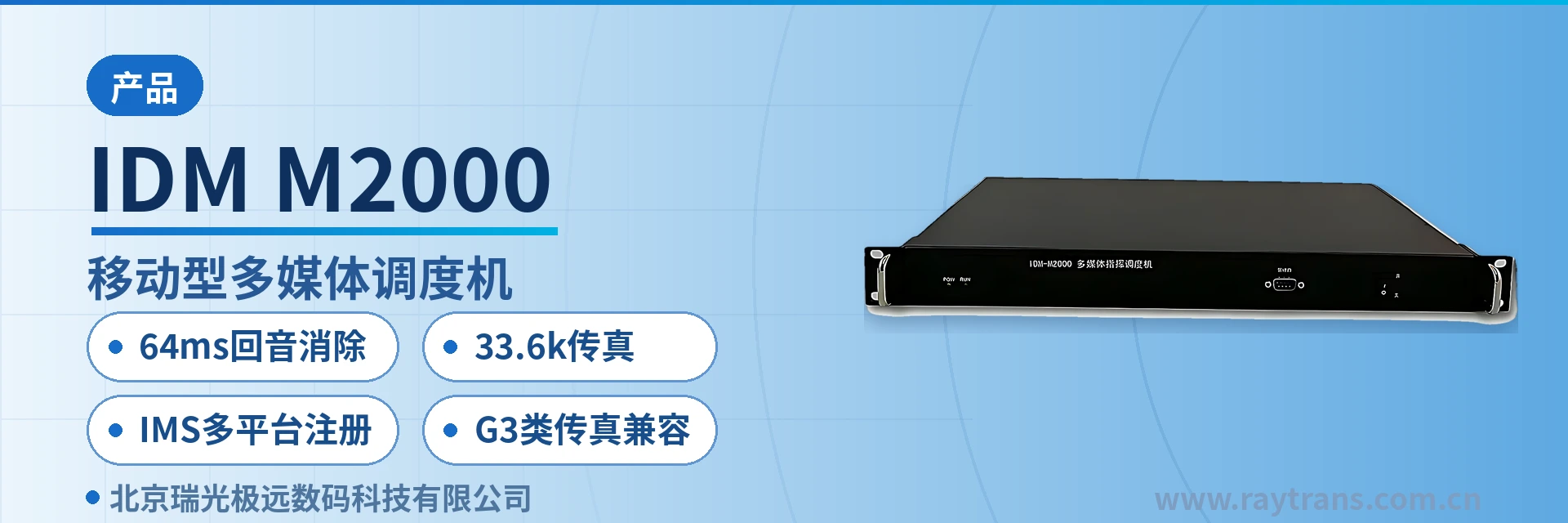
IDM-M2000 Mobile Multimedia Dispatching Exchange
4-channel radio, mobile phone, and PSTN convergence into one network; 1U standalone dispatch; high priority
The IDM-M2000 is a compact portable multimedia dispatching exchange that integrates multiple communication means such as mobile phone communication, radio communication, subscriber telephones (FXS), and loop-start trunks (FXO). Through advanced digital voice processing technology and encrypted network transmission technology, devices such as intercoms of different frequency bands, VHF radio sets, HF radio sets, traditional PSTN (public switched telephone network) telephones, IP softphones, and traditional IP telephones are seamlessly connected to the dispatch system network.
The IDM-M2000 mobile multimedia dispatching exchange is a portable converged communication dispatching exchange for field and vehicle-mounted scenarios, developed by the command and dispatch system manufacturer Beijing Ruiguang Jiyuan. It connects mobile phones, HF and VHF radio sets, FXS subscriber telephones, and FXO loop-start trunks to the same dispatch network to deliver audio and video dispatching and converged dispatching. The device uses a 19-inch 1U desktop structure. It can form a small-scale command and dispatch system as a standalone unit, or serve as a remote trunking access gateway for a large converged communication command and dispatch system, meeting application requirements such as product showcase and military emergency communications vehicle solutions.
Key Specifications at a Glance: 19-inch 1U desktop structure · 4-channel radio set interfaces · 2-channel GSM/CDMA trunk · 4 or 8 FXS/FXO channels · echo cancellation G.168-2004 with 64 ms tail · T.38 fax at 33.6 kbps · IMS multi-platform registration · dispatch console access and multimedia dispatching supported
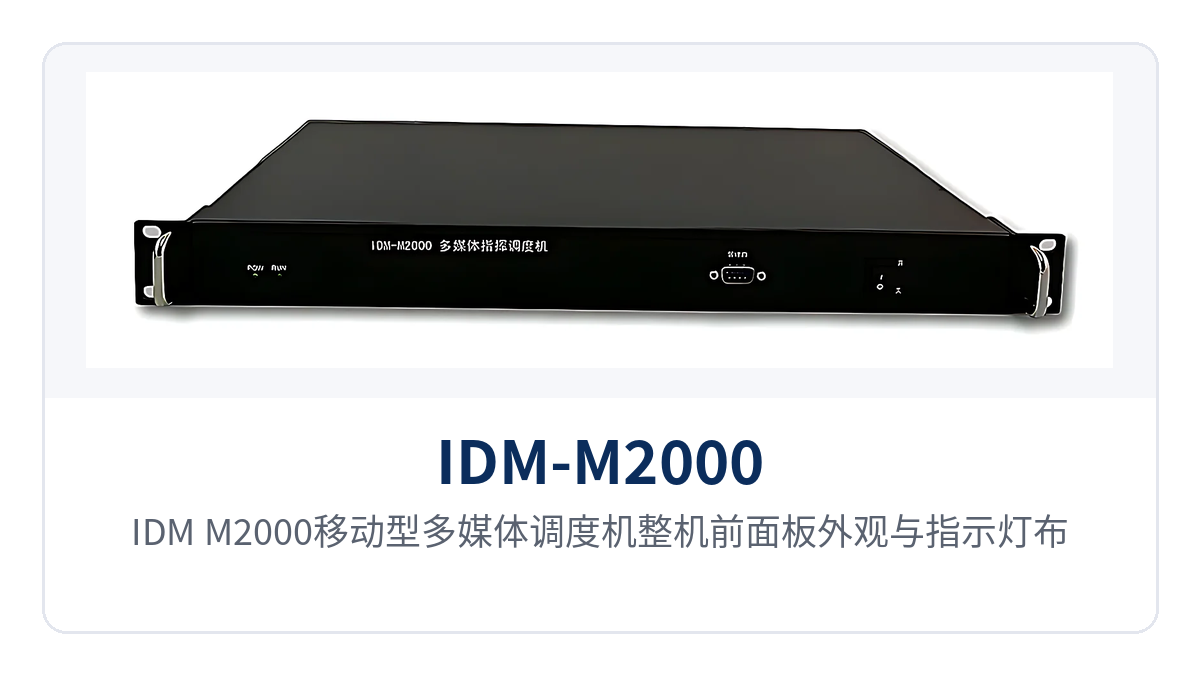
Figure 1: Overall front panel appearance and indicator LED layout of the IDM-M2000 mobile multimedia dispatching exchange
How does a portable converged communication dispatching exchange bring mobile phones, radio sets, and telephones into one dispatch network?
The access logic of the IDM-M2000 has three layers: the wireless side takes over radio sets and trunking, the wired side takes over telephones and trunks, and the dispatch side unifies all voice paths into extensions that can be called, grouped, and managed. These three layers of capability fit into one 1U enclosure, so on site there is no need to equip a separate gateway device for each type of terminal; one converged dispatching device completes all voice tandem work beyond audio and video dispatching and product showcase.
The wireless side can access 4 radio sets, covering HF, VHF single sideband (SSB) radio sets, and 350M/800M trunking intercom. After access, intercoms and radio sets on different frequency bands can listen to and talk to each other, and can also hold two-way calls with wired terminals. Differences in frequency and format are converted inside the device, which is exactly the core value of converged communications on the wireless side.
The wired side provides both FXS subscriber interfaces and FXO loop-start trunks. The number of channels for connecting ordinary telephones or wired intercom terminals is 4 or 8, with 4 channels per module. The trunk direction can be configured with GSM/CDMA interfaces, and the WAN port can be an RJ45 electrical port or an FC optical port, serving as the access channel for IP telephones.
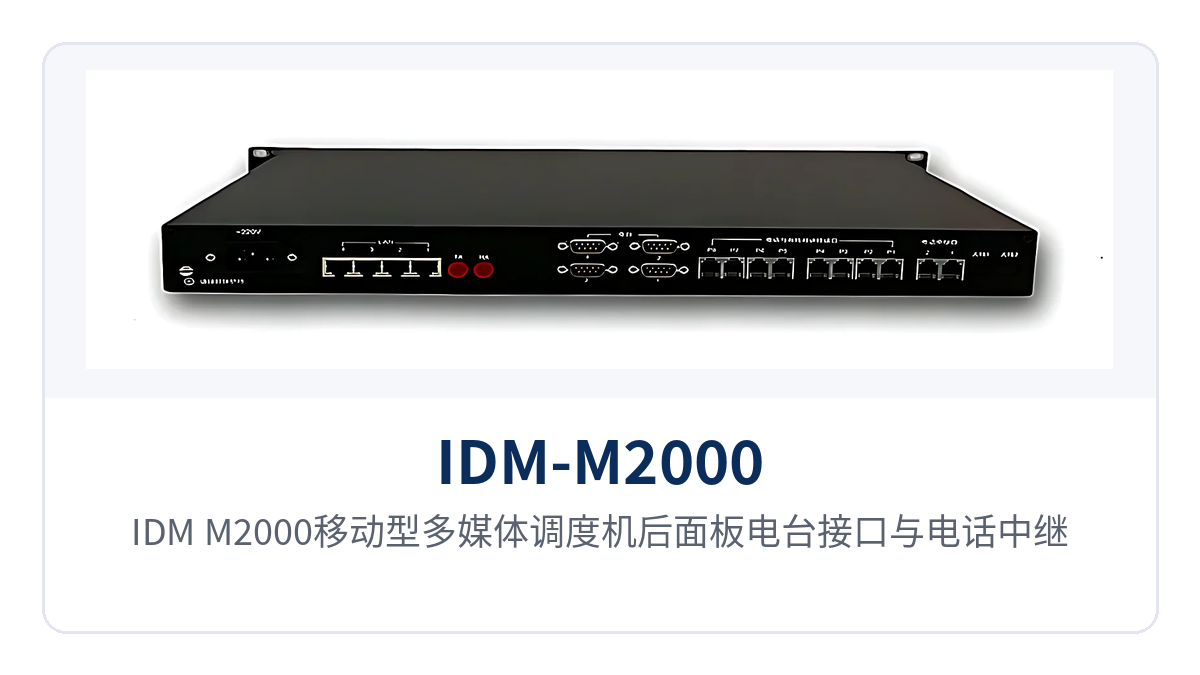
Figure 2: Rear panel radio set interface and telephone trunk interface layout of the IDM-M2000 mobile multimedia dispatching exchange
The dispatch side works on the SIP standard. Call control supports SIP/UDP, SIP/TCP (RFC3261), the IMS platform (3GPP), and MGCP (RFC3435). Voice codecs include G.711 (a/µ), G.729a, G.722.2, and G.722. DTMF can be sent by in-band transparent transmission, RFC2833, or IP-INFO. As the core unit of a converged communication command and dispatch system, the device can work with a dispatch console to form a complete converged dispatching link.
When an outside line calls in, telephone extensions in the same group call ring simultaneously, and the rest stop ringing once any of them goes off-hook. When multiple outside lines call in at the same time, calls are answered by priority, and calls of the same priority are ordered by ringing sequence. Wired intercom terminals are usually set higher than inside line telephones, and high-priority users can interrupt the trunking talk right of low-priority users.
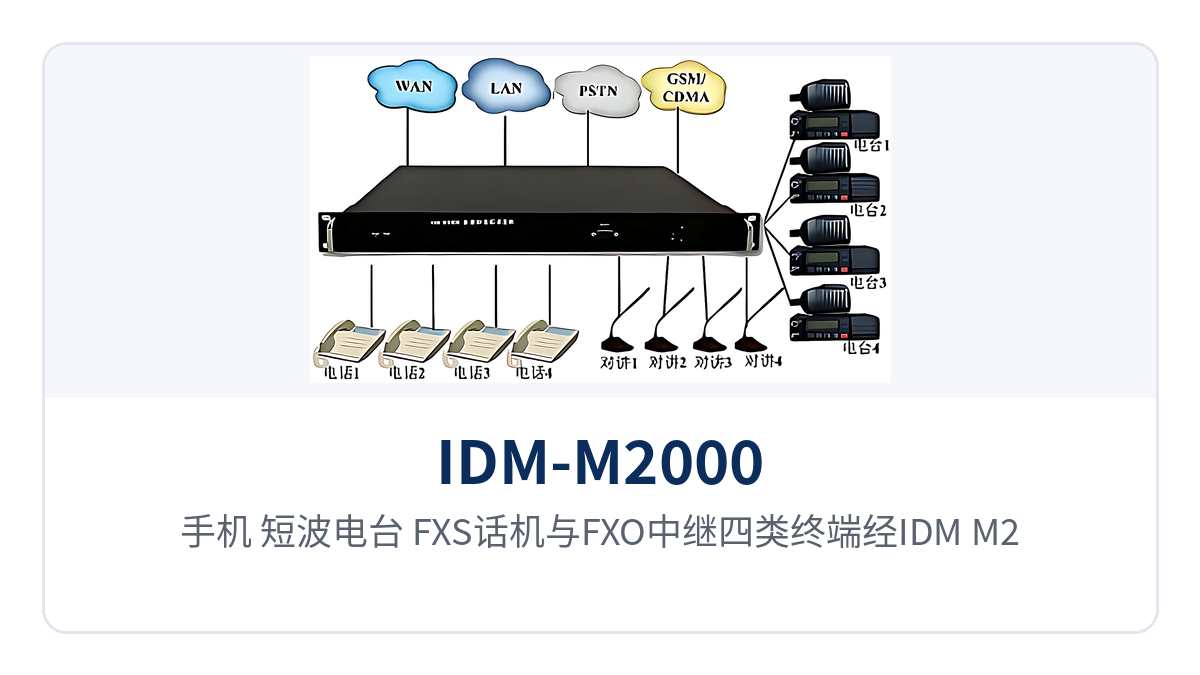
Figure 3: Networking diagram of four types of terminals—mobile phones, HF radio sets, FXS telephones, and FXO trunks—converging into the dispatch network through the IDM-M2000
Key Specifications and Performance Specifications
Function and performance parameters are subject to the product documentation. The table below is grouped by functional role for item-by-item checking of interface quantities and protocol definitions against the project list. Environmental, power supply, dimensions, and weight specifications not listed in the table must be confirmed with the manufacturer before ordering and shall not be used as a basis for selection.
| Function | Description |
|---|---|
| Multi-network convergence access | Mobile phone communications, radio set communications, FXS subscriber telephones, FXO loop-start trunks, SIP softphones, and traditional IP telephones access the same dispatch network |
| Radio set and trunking bridging | Any two or more radio sets and trunking systems can be bridged for intercommunication, and terminals on different frequency bands can listen to each other |
| Group call and priority answering | Extensions in the same group ring simultaneously; outside lines are answered by priority; high priority can interrupt the trunking talk right of low priority |
| Voice codec and DTMF | G.711 (a/µ), G.729a, G.722.2, and G.722 codecs; DTMF supports in-band transparent transmission, RFC2833, and IP-INFO |
| Fax | G.711 transparent transmission fax and T.38 fax, compatible with G3 fax machines, at 33.6 kbps (transparent transmission/T.38 V3) |
| Audio quality enhancement | Echo cancellation complies with G.168-2004 with a 64 ms tail, and the jitter buffer adjusts automatically |
| Dispatch call functions | Call hold, call park, call waiting, three-party call, simultaneous ringing, barge-in/do not disturb barge-in, monitoring/do not disturb monitoring, hotline, call pickup, call forwarding, one number two phones, extension lock, extension group, caller ID, external-to-external transfer, etc. |
| Value-added applications | Recording-to-text transcription, traversal service (external network extension registration, branch networking, mobile office), IP telephone plug-and-play, open API, multi-level voice navigation, intelligent duty |
| Network management | Supports the IDM network management system and third-party network management systems (TR-069, SNMP) |
Interface quantities and protocol definitions vary by device configuration. The table below lists items explicitly stated in the product documentation for direct reference in selection and networking design. Values are given for a standalone unit; for capacity expansion, add them module by module, and check item by item against the configuration list before ordering to avoid definition misalignment.
| Item | Parameter/Specification | Description/Applicable Conditions |
|---|---|---|
| Equipment form factor | 19-inch 1U desktop structure | Can be used standalone, with a dispatch console, or as a remote trunking access gateway |
| Radio set interfaces | 4 channels | Supports HF, VHF SSB, and 350M/800M trunking intercom |
| Wired terminal interfaces | 4 or 8 channels | Connects ordinary telephones or wired intercom terminals, 4 channels per module |
| GSM/CDMA trunk | 2 channels | Accesses mobile carrier networks |
| WAN port | RJ45 electrical port or FC optical port | Serves as the IP telephone access channel, can access 2 IP telephones |
| Ordinary telephone trunk | From 2 channels | FXO loop-start trunk accesses PSTN or an upper-level switch |
| Call control | SIP/UDP, SIP/TCP (RFC3261), IMS platform (3GPP), MGCP (RFC3435) | Interfaces with softswitches, IMS, and IP PBX |
| Network protocols | Telnet, SSH, HTTP, HTTPS, DHCP client, PPPoE client, DNS (NSRV records), STUN, 802.1X | Used for deployment commissioning and remote maintenance |
| Caller ID | Bellcore Type 1 and Type 2, ETSI, BT, NTT, DTMF | Selected according to the switching mechanism of the opposite end |
| Codecs | G.711 (a/µ), G.729a, G.722.2, G.722 | Selected according to link bandwidth and audio quality requirements |
| DTMF sending | In-band voice transparent transmission, RFC2833, IP-INFO | Matched to the capabilities of the opposite end device |
| Fax | G.711 transparent transmission, T.38, compatible with G3, 33.6 kbps | Two modes: transparent transmission/T.38 V3 |
| Line release | Busy tone detection, reverse polarity detection, line release on power failure | Adapts to hang-up detection of switches of different formats |
| Audio quality enhancement | G.168-2004 echo cancellation (64 ms tail), automatic jitter buffer adjustment | Hands-free and high-noise field environments |
| SIP trunk | IMS, multi-platform registration/calling, Skype Connect | Can register with multiple platforms simultaneously |
| Analog outside line | Caller ID, busy tone detection, reverse polarity detection | FXO trunk line state detection |
| Power supply and operating environment | Not yet recorded in the knowledge base | Subject to the accompanying technical documentation and commercial confirmation |
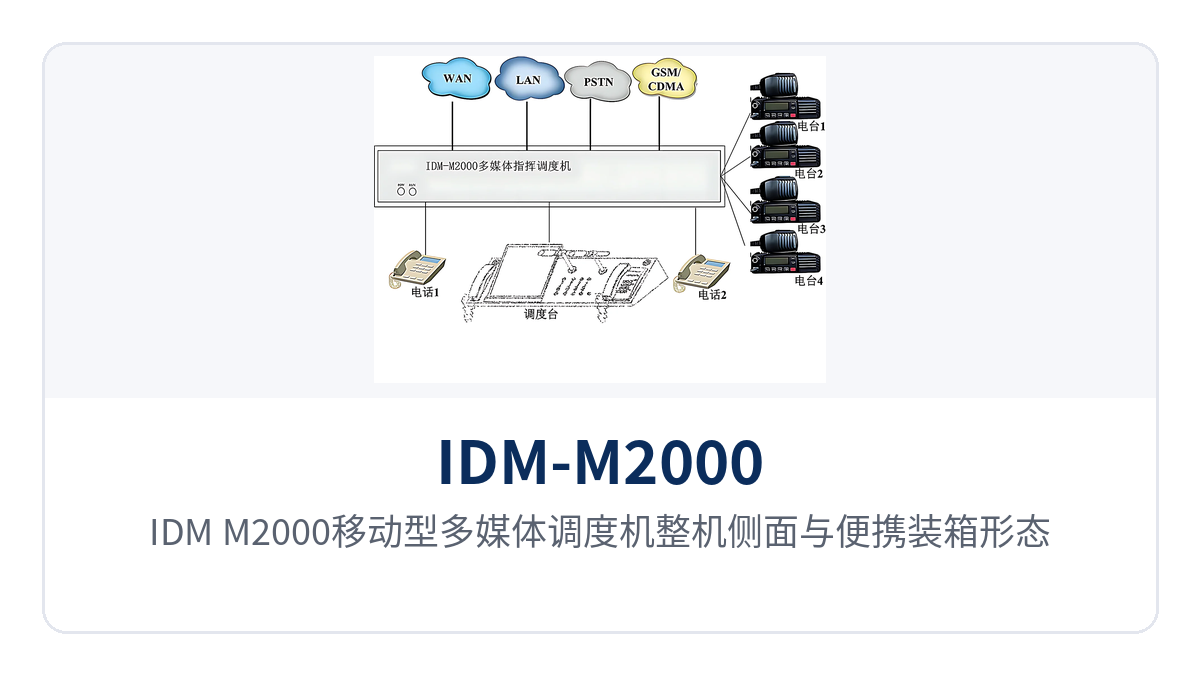
Figure 4: Overall side view and portable packing form of the IDM-M2000 mobile multimedia dispatching exchange
Four Capability Highlights: 64 ms Echo Cancellation, 33.6 k Fax, IMS Multi-Platform Registration, G3 Fax Compatibility
The four capability highlights correspond to four types of specific on-site problems. Each is explained below in terms of its technical focus, applicable conditions, and verification method at acceptance, so that projects can write the selling points into requirement lists and turn them into verifiable delivery metrics rather than leaving them at the promotional level.
- 64 ms echo cancellation: Echo cancellation complies with G.168-2004 with a 64 ms tail. In field hands-free or vehicle-mounted amplified environments, intercom echo is suppressed and command instructions are heard clearly.
- 33.6 k fax: T.38 fax and G.711 transparent transmission fax are supported in parallel, at 33.6 kbps (transparent transmission/T.38 V3), so private network faxes do not lose pages.
- IMS multi-platform registration: SIP trunks support IMS and multi-platform registration/calling. One device can register with multiple platforms simultaneously, making cross-network convergence access more flexible.
- G3 fax compatibility: Compatible with G3 fax machines, so existing fax terminals need not be replaced, and messages between command posts and duty rooms are sent and received as before.
These four capabilities solve three engineering problems: on-site hands-free announcements that cannot be heard clearly, private network fax page loss, and the need for multiple sets of equipment for cross-network access. All three are common rework points in emergency and field dispatching, and can be written as acceptance check items during selection and verified call by call. Command and dispatch system manufacturers represented by Raytrans have developed the above capabilities into deliverable converged dispatching product forms around scenarios such as multimedia dispatching exchanges and military emergency communications vehicle solutions.
Typical Application Scenarios
The IDM-M2000 is usually deployed in emergency command vehicles, temporary command posts, or remote sites, connecting various radio sets and telephones downward and accessing the upper-level converged communication command and dispatch system upward through the IP network or optical ports. The following three industry scenarios are the more common uses in actual projects.
Emergency Command and Firefighting: Unified Announcements for Multi-Format Terminals on Site
At firefighting and rescue sites, 350M trunking intercom, HF radio sets, and mobile phones coexist, and the rear command center needs to bring all three types of audio into the same converged dispatch network. The IDM-M2000 accesses various radio sets and FXS telephones in the communication vehicle, and the dispatch console can then initiate calls to any terminal, organize group calls, or use barge-in.
On-site noise is high and commanders mostly use hands-free calls. Echo cancellation is configured per G.168-2004 with a 64 ms tail, so amplified announcements are not interrupted by their own echo. Vehicle space is limited, and the 19-inch 1U desktop structure is easy to fix in a cabinet or equipment rack, ready for use as soon as the vehicle arrives.
Electric Power and Energy Inspection: Temporary Dispatch Nodes in Mountainous Areas and Substations
Transmission line inspection in mountainous areas and substation maintenance sites often lack available dispatch extensions, and inspection teams need to talk directly with the duty room of the centralized control station. After the device accesses 2 GSM/CDMA trunks, mobile phones can intercommunicate with on-site radio sets and FXS telephones, making it suitable for temporary camps and short-cycle operations.
Substations continue to use existing SPC switching and fax machines. FXO loop-start trunks can directly interface with ordinary telephone trunk interfaces, and G3 fax machines can still send and receive messages as before after connection. Outside line calls are answered by priority, with duty room telephones taking precedence over ordinary extensions, so emergency repair instructions are not delayed by busy lines.
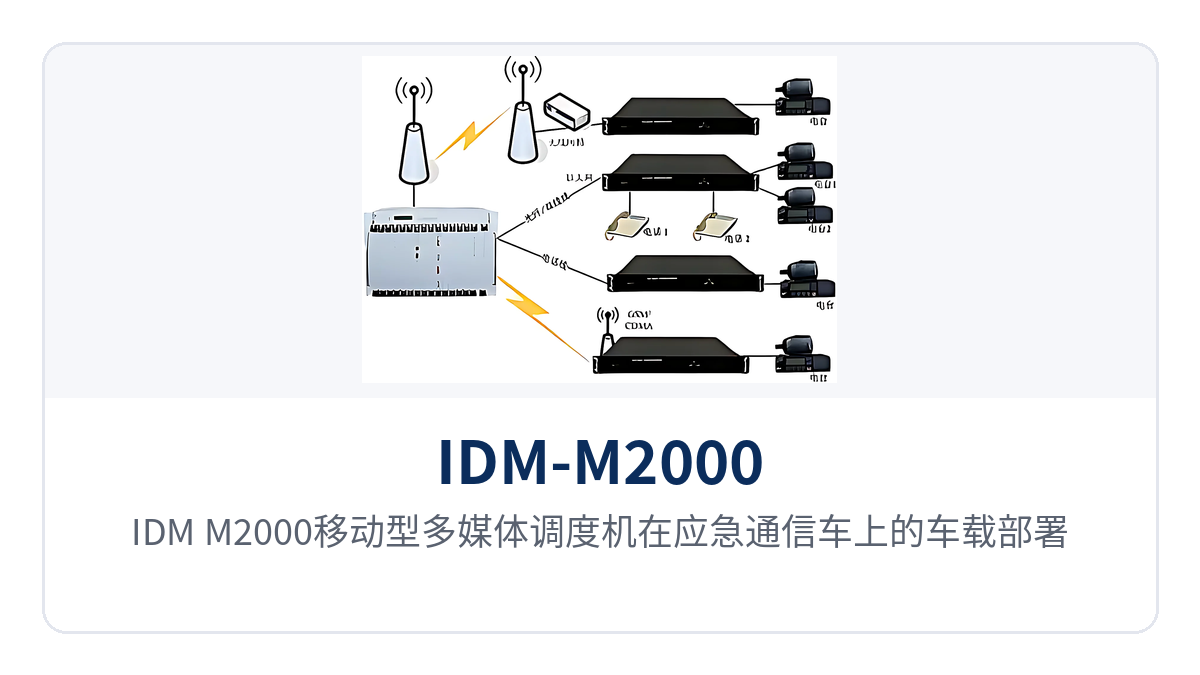
Figure 5: Vehicle-mounted deployment scenario of the IDM-M2000 mobile multimedia dispatching exchange on an emergency communications vehicle
Military and Armed Police Field Communications: Border Defense Outposts and Vehicle-Mounted Command Posts
The HF radio sets, VHF/UHF radio sets, and trunking intercoms commonly used at border defense outposts and field command posts belong to different systems, and cross-system announcements rely on manual relay. The device connects 4 radio sets to the same audio and video dispatch network, so any two or more radio sets and trunking systems can be bridged, and outposts and patrol teams no longer need to rely on verbal orders. This capability is also a key element of the military emergency communications vehicle solution.
A single device can form a small-scale dispatch system for temporary emergency dispatching. When a wider scope is required, the device can serve as a remote trunking access gateway and be integrated into a higher-level dispatch system, bringing radio sets and phones at remote sites into the central dispatch console for unified management.