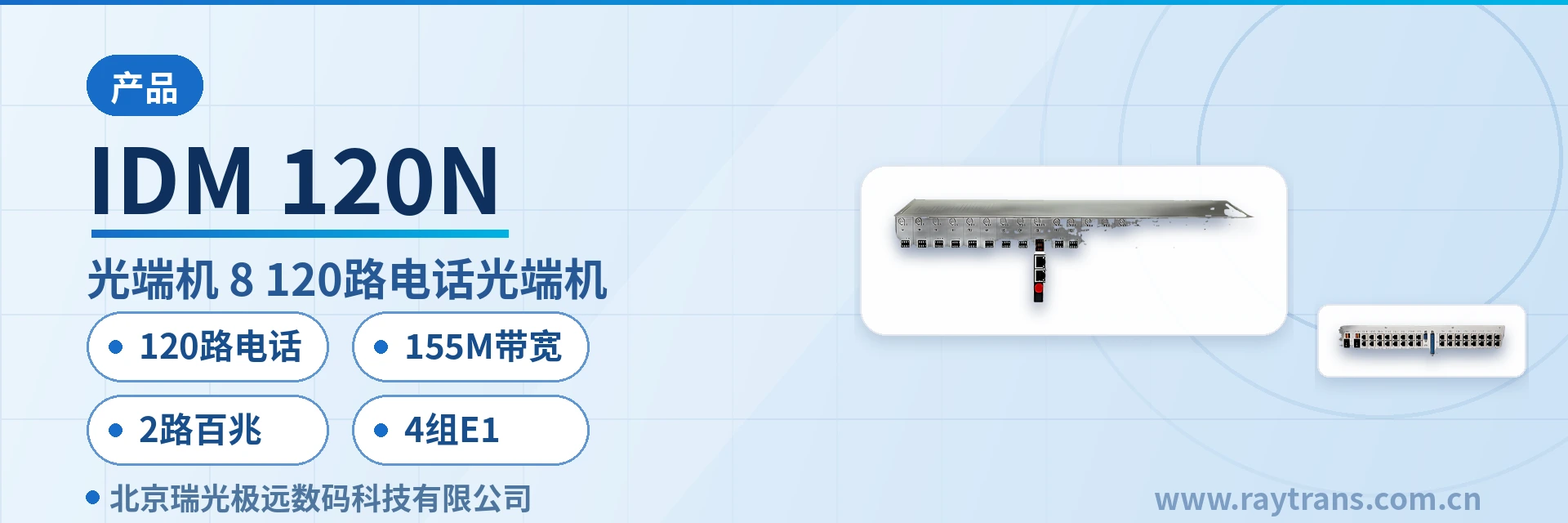
IDM-120N Telephone Optical Multiplexer
120-channel telephone, 4 groups of E1, 2 channels of Fast Ethernet over a single fiber, 16 slots expandable by card
The IDM-120N multi-service optical multiplexer uses a 19-inch 3U standard chassis; its total optical fiber transmission bandwidth is 155M, providing 2 shared line-rate 100M Ethernet interfaces, 4 groups of E1 transmission interfaces, and 120 telephone subscriber channels; the IDM-120N multi-service optical multiplexer provides 16 subscriber interface slots; reserved multi-function card slots for flexible expansion, supporting any network topology;
The IDM-120N telephone optical multiplexer is a 155M multi-service telephone optical multiplexer developed by Beijing Ruiguang Jiyuan Digital Technology Co., Ltd. It is designed with dedicated large-scale integrated circuits and is a PCM integrated service optical fiber transmission equipment, used to simultaneously carry 120 telephone subscriber channels, 4 groups of E1 transparent transmission interfaces, and 2 channels of shared line-rate 100M Ethernet over a single 155M bandwidth optical fiber link. The unit adopts a 19-inch 3U standard chassis and provides 16 subscriber interface slots. The voice channel capacity is configured by combining FXO/FXS service cards and can be flexibly expanded as services grow. As a representative product showcase model under Raytrans, a professional optical multiplexer manufacturer, the IDM-120N telephone optical multiplexer targets scenarios such as electric power private networks, public security and military private networks, and banking dedicated lines. It is a multi-service fiber access device for private network nodes and can be widely deployed in government private network optical fiber communication solutions and military emergency communications vehicle solutions.
Key Specifications at a Glance: 120 telephone subscriber channels · 155M optical fiber transmission bandwidth · 4 groups of E1 transparent transmission (ITU-T G.703, PCM30/31) · 2 channels of shared line-rate 100M Ethernet · 1+1 hot-swappable dual backup for power card and ringing current card · 19-inch 3U chassis with 16 subscriber slots
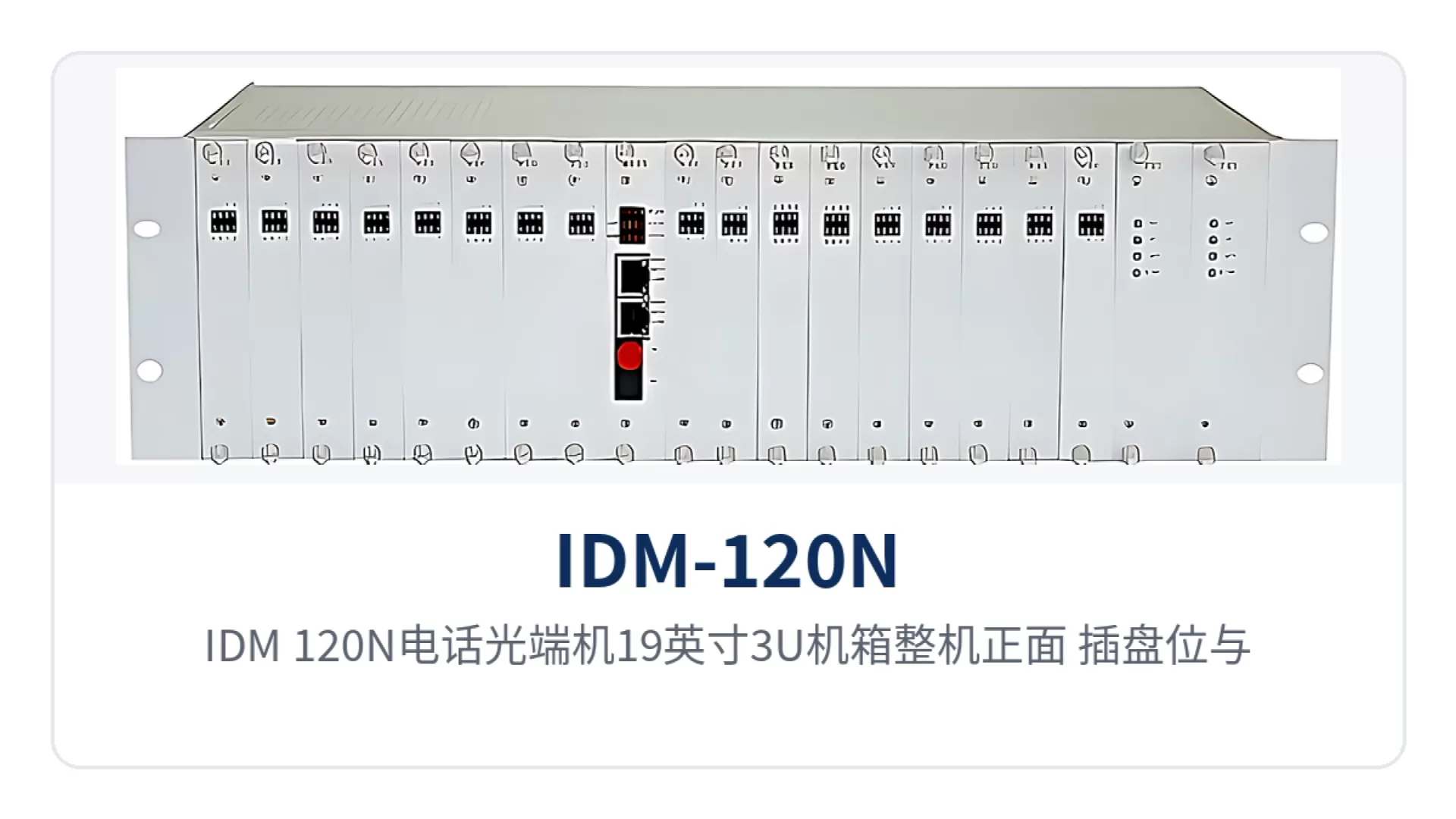
Figure 1: IDM-120N telephone optical multiplexer 19-inch 3U chassis front view, close-up of card slots and alarm indicator LEDs
What kind of equipment is the 155M multi-service telephone optical multiplexer?
The IDM-120N telephone optical multiplexer is a PCM integrated service optical fiber transmission equipment that multiplexes three types of services—narrowband telephony, E1 leased lines, and 100M Ethernet—onto a single optical fiber. One unit is placed at each end: one end connects analog telephones and digital interfaces, while the other end restores them as-is. As a 155M multi-service telephone optical multiplexer, the equipment organizes voice channels and E1 channels according to the PCM30/31 format. The E1 channel has a bit rate of 2048Kbps and HDB3 line coding, compliant with ITU-T G.703. Both FXO and FXS telephone interfaces support polarity reversal and caller ID. The three types of services each occupy an independent channel within the equipment and do not interfere with one another. This product is developed and manufactured by Raytrans, an optical multiplexer manufacturer, and can be deployed in government private network optical fiber communication solutions and military emergency communications vehicle solutions. As a multi-service optical multiplexer, it also features the transmission characteristics of a PDH optical multiplexer, making it suitable for scenarios requiring integrated access via a telephone optical multiplexer.
Can a single optical fiber simultaneously transmit telephone, E1, and Ethernet?
Can a single optical fiber simultaneously transmit telephone, E1, and Ethernet? Yes—a single 155M optical fiber link is divided into three mutually independent service channels. The telephone channel compresses analog voice channels into 64Kbps digital voice using ITU-T G.711 A-law, with an audio range of 300Hz to 3400Hz and a loop current of 25mA per channel. The 120 voice channels are configured by combining 8-channel-per-card FXO/FXS service cards. The E1 channel carries 4 groups of 2048Kbps transparent transmission channels, adopts channel-associated signaling, and can interface with existing PCM and SDH equipment. The Ethernet channel provides 2 RJ-45 interfaces, 10/100Base-T, compliant with IEEE802.3, full/half duplex adaptive, sharing line-rate 100M bandwidth. The three types of services are transmitted over the same fiber, each independent, occupying only a pair of optical fibers at the site side. This product showcase capability of the multi-service optical multiplexer is precisely a reflection of Raytrans's technical accumulation in the field of telephone optical multiplexers.
What functions and interfaces does the IDM-120N telephone optical multiplexer have?
The IDM-120N telephone optical multiplexer provides the following functions centered on high-capacity voice channel aggregation and multi-service optical fiber transmission.
| Function | Description |
|---|---|
| 120 telephone subscriber channels | A single unit provides 120 telephone subscriber channels. FXO connects to the exchange side, FXS connects to the telephone side. Both interface types support polarity reversal and caller ID |
| 4 groups of E1 transparent transmission interfaces | Provides 4 groups of E1 channels with a bit rate of 2048Kbps and HDB3 line coding, compliant with ITU-T G.703, with selectable 75Ω/120Ω impedance, and transparent transmission of channel-associated signaling |
| 2 channels of shared line-rate 100M Ethernet | Provides 2 RJ-45 Ethernet interfaces, 10/100Base-T, compliant with IEEE802.3, full/half duplex adaptive, sharing line-rate 100M bandwidth |
| 16 subscriber interface slots | The 19-inch 3U chassis provides 16 subscriber interface slots. 8FXO-120 and 8FXS-120 service cards are inserted according to voice channel direction, with capacity configured by card combination |
| Dual backup and hot-swappable power card and ringing current card | The power card PRU-120 and the power and ringing current card RPRU-120 are each configured in 1+1 mode, supporting hot-swappable replacement during operation, ensuring services uninterrupted in the power supply and ringing links |
| Multi-function card slot expansion | Reserved multi-function card slots allow flexible expansion as services grow, supporting any network topology |
| Function control switch and alarm indication | The panel provides a function control switch and alarm indication, facilitating on-site commissioning and fault location |
| Online network management functions | Supports online real-time configuration, query, and fault statistics management through network management, combined with alarm indication for centralized maintenance |
How does a single unit replace multiple stacked devices?
Consolidating three types of services that previously required multiple stacked devices into a single 3U unit is the core value of the IDM-120N telephone optical multiplexer. For Raytrans, an optical multiplexer manufacturer, this multi-service optical multiplexer product showcase demonstrates a highly integrated design philosophy, effectively saving space and cabling costs in both government private network optical fiber communication solutions and military emergency communications vehicle solutions.
| Differentiation Point | Value to Private Network Nodes |
|---|---|
| A single unit provides 120 telephone accesses, with 16 service slots for on-demand expansion | One 3U unit achieves the subscriber line provisioning volume that previously required multiple stacked voice devices. Voice channel capacity scales with service cards, reducing equipment room rack positions and cabling accordingly |
| 155M total optical fiber bandwidth, simultaneously carrying 2 channels of 100M Ethernet and 4 groups of E1 | Telephone, E1 leased lines, and two channels of 100M data are transmitted simultaneously over one optical fiber without interference, eliminating the need for a separate optical multiplexer for each service type |
| 1+1 redundancy for both power and ringing current cards, with hot-swappable support ensuring services uninterrupted | The power card and power and ringing current card are each configured in 1+1 mode. A single board failure can be resolved by hot-swappable replacement during operation, ensuring services uninterrupted in the power supply and ringing links |
Unit card composition and how to expand the 120-channel telephone optical multiplexer
The IDM-120N telephone optical multiplexer consists of a chassis backplane, main control cards, power cards (power and ringing current cards), and FXO/FXS service cards. The models and functions of each card are as follows.
| No. | Name | Model | Description | Quantity |
|---|---|---|---|---|
| 1 | Equipment chassis backplane | IDM-120 | 19-inch 3U chassis, providing 19 card slots | 1 |
| 2 | E1 interface main control card | CMU-E1-120 | Provides E1 interface access | 1 |
| 3 | Optical interface main control card | CMU-120 | Provides 1 group of optical interface access, 2 groups of wire-speed 100M Ethernet interfaces, 4 groups of E1 interfaces | 1 |
| 4 | Power card | PRU-120 | Provides 1+1 power supply and power supply for the unit, used on the FXO side, -48V input | 2 |
| 5 | Power and ringing current card | RPRU-120 | Provides 1+1 power supply, power supply for the unit, and ringing voltage, used on the FXS side, -48V input | 2 |
| 6 | FXO service card | 8FXO-120 | 8 FXO interfaces, exchange side | On demand |
| 7 | FXS service card | 8FXS-120 | 8 FXS interfaces, user side | On demand |
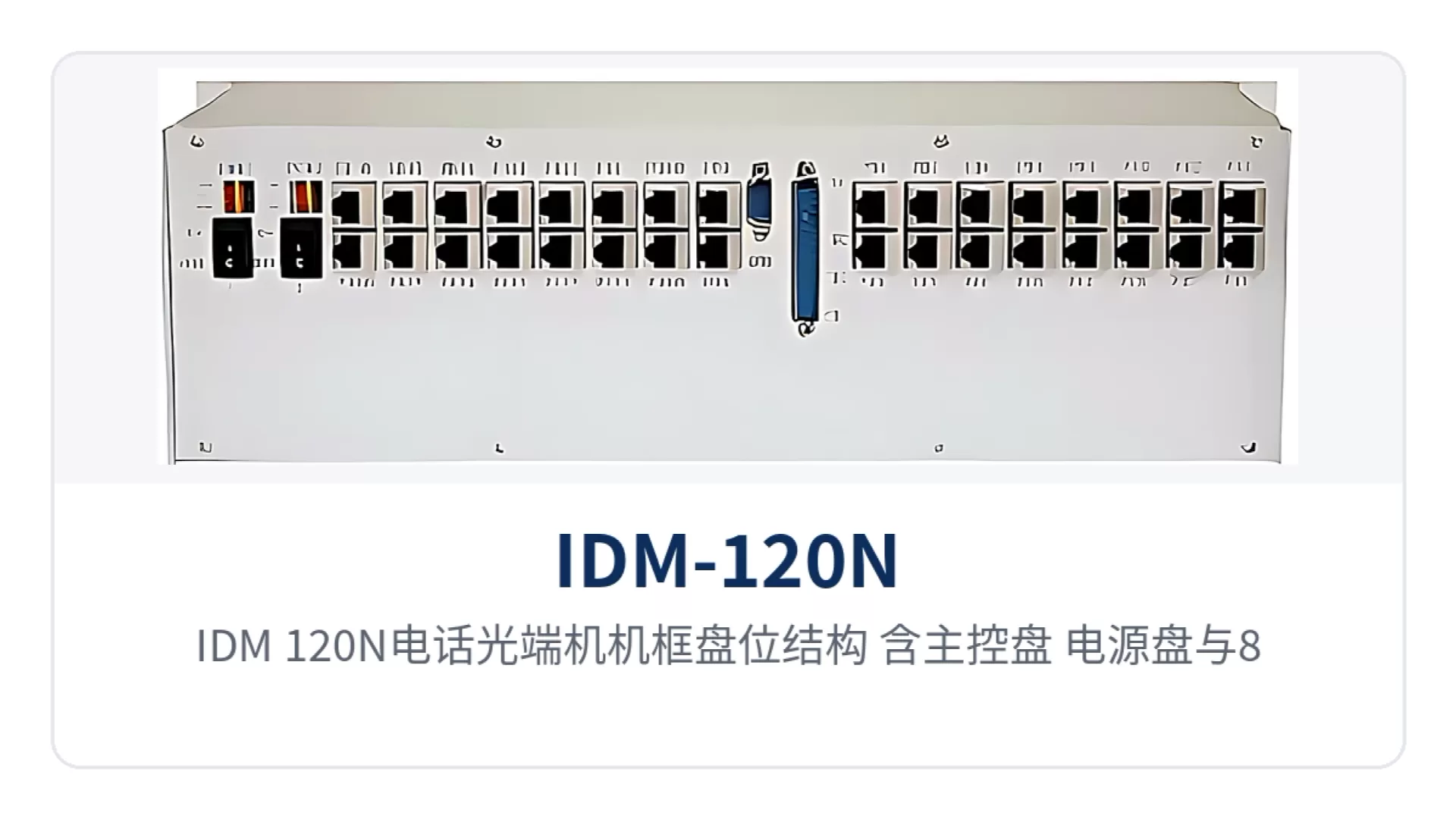
Figure 2: IDM-120N telephone optical multiplexer chassis card slot structure, including main control card, power card, and 8-channel FXO and FXS service cards
In a single unit configuration, only one of the E1 interface main control card and the optical interface main control card is selected.
How to expand the 120-channel telephone optical multiplexer—the answer lies in this card-based structure. The 19-inch 3U chassis provides 19 card slots and 16 subscriber interface slots. Voice channel capacity grows with the number of FXO/FXS service cards, and a single unit provides 120 telephone subscriber channels according to product documentation. When services grow, simply add the corresponding service cards according to voice channel direction. The reserved multi-function card slots in the chassis can also accommodate future expansion without replacing the entire unit. As a professional optical multiplexer manufacturer, Raytrans's PDH optical multiplexer product showcase demonstrates flexible expansion capability. Whether for government private network optical fiber communication solutions or military emergency communications vehicle solutions, on-demand configuration can be achieved through the card-based structure, meeting the diverse access requirements of telephone optical multiplexers and multi-service optical multiplexers.
IDM-120N telephone optical multiplexer technical specifications and interface specifications
The following specifications cover optical interfaces, E1 interfaces, Ethernet, telephone interfaces, and power supply environment, based on IDM-120N product documentation, for reference in networking design and equipment selection.
Optical interface parameters
| Item | Parameter/Specification | Description/Applicable Conditions |
|---|---|---|
| Interface type | FC (SC and others can be customized) | Selected according to on-site optical fiber connectors |
| Fiber mode | Single-mode (multi-mode optional) | Single-mode for longer distance transmission |
| Optical fiber rate | 155bps±50ppm | Corresponds to the unit's 155M optical fiber transmission bandwidth |
| Wavelength | 1310nm | Single-mode fiber transmission window |
| Transmit optical power | -2~-11dBm | Transmit optical power range |
| Receiver sensitivity | Better than -36dBm | Actual transmission distance calculated according to optical power budget |
E1 interface parameters
| Item | Parameter/Specification | Description/Applicable Conditions |
|---|---|---|
| Bit rate | 2048Kbps | Standard E1 bit rate |
| Line coding | HDB3 | Compliant with ITU-T G.703 line coding requirements |
| Standard protocol | ITU-T G.703 | E1 electrical interface standard |
| Impedance | 75Ω/120Ω | Coaxial or balanced interface optional |
| Frame structure | PCM30/31 | Voice channels organized according to PCM30/31 format |
| Signaling | Channel-associated signaling | Common signaling method for interfacing with SPC switching offices |
Ethernet Interface Parameters
| Item | Parameter/Specification | Description/Applicable Conditions |
|---|---|---|
| Interface type | RJ-45 | Ethernet electrical interface |
| Transmission rate | 10/100Base-T, 10M/100M | Rate adaptive |
| Standard protocol | IEEE802.3 | Ethernet standard protocol |
| Operating mode | Full/half duplex/adaptive | Can be directly connected to Ethernet devices such as switches |
FXO/FXS telephone interface parameters
| Item | Parameter/Specification | Description/Applicable Conditions |
|---|---|---|
| Audio range | 300Hz~3400Hz | Telephone voice band |
| Impedance | Three-element complex impedance 200Ω+560Ω//0.1μF | Return loss characteristics of the telephone interface |
| Compression | ITU G.711 A-law | Voice codec |
| Loop current | 25mA per channel | Feeding capability for the telephone set |
| Additional functions | Polarity reversal, caller ID | Supported by both FXO and FXS interfaces |
Power Supply, Environment and Chassis
| Item | Parameter/Specification | Description/Applicable Conditions |
|---|---|---|
| Power supply mode | DC-48V or AC 220V | Selected according to equipment room or on-site power supply conditions |
| Overall power consumption | ≤250W | Upper limit of overall power consumption |
| Operating temperature | 0℃~+40℃ | Suitable for indoor equipment room environment |
| Humidity | 95% non-condensing | Relative humidity requirement |
| Product dimensions | Length×Depth×Height 480×200×132mm | 19-inch 3U chassis installation dimensions |
Typical Application Scenarios: Electric Power, Public Security and Military, and Banking Leased Lines
The IDM-120N telephone optical multiplexer can be widely used in public telephone network services of telecommunications and Netcom operators, as well as leased-line information and data services for sectors such as electric power, banking, public security, and military. The following three typical uses fully demonstrate the value of this optical multiplexer in multi-service access and product showcase.
Electric Power Private Network: Same-Fiber Access for Substation Telephone and Data Services
Electric power private network sites usually need to enable dispatching and office telephone services at the same time, and to interconnect with E1 leased-line channels carrying service data. After deploying the IDM-120N telephone optical multiplexer at sites such as substations and power supply stations, telephone services are provisioned through FXO/FXS interfaces, E1 channels carry leased-line data through transparent transmission in accordance with ITU-T G.703, and 2-channel Fast Ethernet interfaces backhaul IP services. A single 155M optical fiber completes all access, eliminating the need for a separate transmission device for telephone and data.
Public Security and Military Private Networks: High-Reliability Voice and Leased-Line Data Transmission
Public security and military private networks have high requirements for voice quality and link reliability, and sites are often unattended. The IDM-120N telephone optical multiplexer carries 120 voice channels plus E1 and Ethernet services over a 155M optical fiber bandwidth. Voice uses ITU-T G.711 A-law encoding, and E1 complies with ITU-T G.703 and the PCM30/31 format, allowing intercommunication with existing private network transmission equipment. The power card and the power and ringing current card support 1+1 dual backup and hot-swappable operation, so a single board failure can be replaced during operation. Together with online network management for remotely monitoring the operating status of each site, this reduces on-site inspection workload.
Banking Leased Lines: Centralized Backhaul of Telephone and Data at Business Outlets
Banks have many business outlets over a wide distribution, and the outlet side needs subscriber line provisioning and leased-line data backhaul while ensuring availability. At the outlet side, the IDM-120N telephone optical multiplexer connects telephones through FXS interfaces, interfaces with switching and data-side equipment through FXO interfaces or E1 channels, and carries outlet IP services over Fast Ethernet interfaces. Voice channels and data from multiple outlets are centrally backhauled to upper-level nodes. DC-48V or AC 220V power supply can be selected according to equipment room conditions, and the 19-inch 3U chassis is suitable for in-cabinet installation in a standard cabinet.
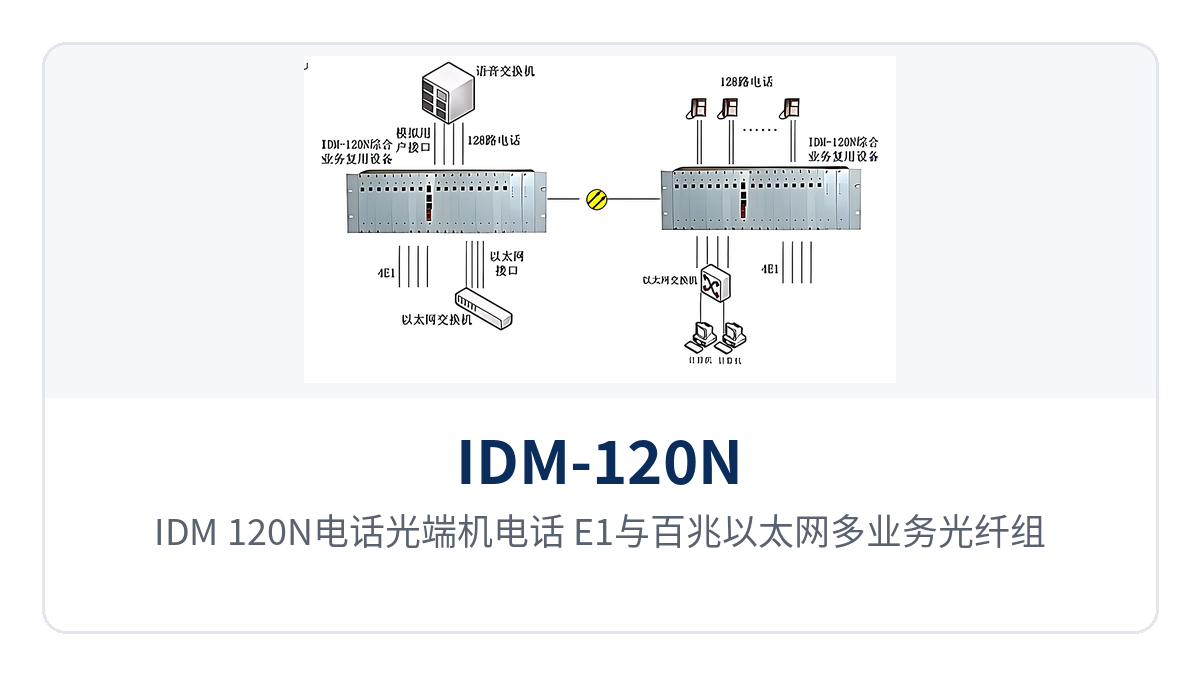
Figure 3: Application diagram of IDM-120N telephone optical multiplexer for multi-service optical fiber networking of telephone, E1 and Fast Ethernet
Selection and Deployment Recommendations
The IDM-120N telephone optical multiplexer is a 155M multi-service telephone optical multiplexer, suitable for private network nodes that require high-capacity subscriber line provisioning while supporting E1 and Fast Ethernet services. During selection, determine the FXO/FXS service card configuration according to voice channel direction and quantity, select FC (SC and other interfaces can be customized) optical interfaces and single-mode (multi-mode optional) optical fiber according to optical fiber resources, and select DC-48V or AC 220V according to on-site power supply conditions. The device operates at an operating temperature of 0℃~+40℃ and a humidity of 95% non-condensing, and is recommended for deployment in an indoor equipment room environment. For sites with high reliability requirements, the 1+1 hot-swappable dual backup of the power card and the power and ringing current card, together with online network management, enables centralized maintenance of configuration, query, and fault statistics. As a professional optical multiplexer manufacturer, Raytrans can provide specific configuration solutions based on project requirements.