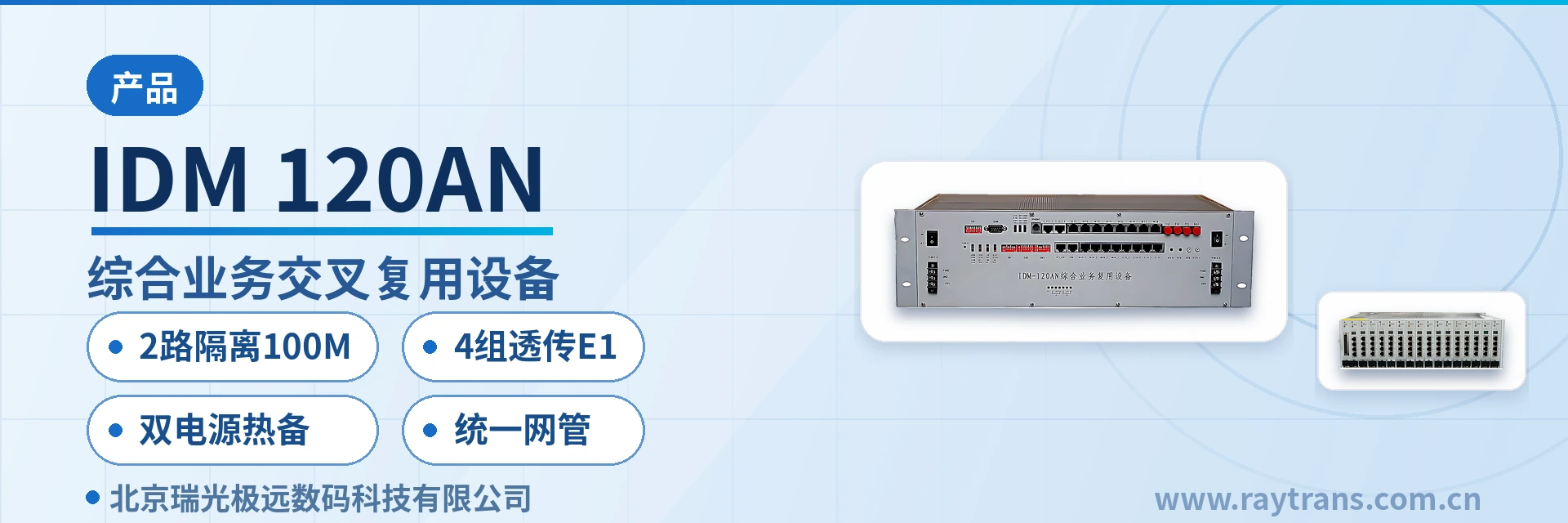
IDM-120AN Integrated Service Cross-Connect Multiplexing Equipment
120-channel voice, 2-channel physically isolated 100M Ethernet, 4 groups of E1 transparent transmission, board
Based on the functions of the IDM-120A, the IDM-120AN multi-service optical multiplexer adds a 155M PDH optical transmission function module, providing 2 physically isolated 100M Ethernet interfaces and 4 groups of E1 transparent transmission interfaces.
IDM-120AN 120-channel isolated Ethernet telephone optical multiplexer is a plug-in board integrated service cross-connect multiplexing equipment developed by Beijing Ruiguang Jiyuan Digital Technology Co., Ltd. It is an optical multiplexer product for multi-service access scenarios, used to carry 120-channel voice and data services, 2 physically isolated 100M Ethernet channels, and 4 groups of transparent transmission E1 services over a pair of optical fibers. As a typical multi-service optical multiplexer, IDM-120AN adds a 155M PDH optical transmission functional module on the basis of IDM-120A's functions. Voice and data services are uploaded via the optical path, and the fiber cores and cables occupied at the site side are correspondingly reduced. It is suitable for multi-service access nodes in electric power private networks, rail transit communication, and military and government private networks, and can be incorporated into government private network optical fiber communication solutions and military emergency communications vehicle solutions.
The 120-channel voice and data services are carried by 4 groups of E1 channels, with a bit rate defined as 2048Kbps per the ITU-T G.703 standard. Services pass through the equipment in transparent transmission mode without changing time slot content, and the E1 transparent transmission interface ensures the integrity of the original service information. The Ethernet side provides 2 100M interfaces, each running on an independent channel within the equipment to achieve physically isolated Ethernet, which can be used by service domain. Traffic and failures on one channel do not affect the other.
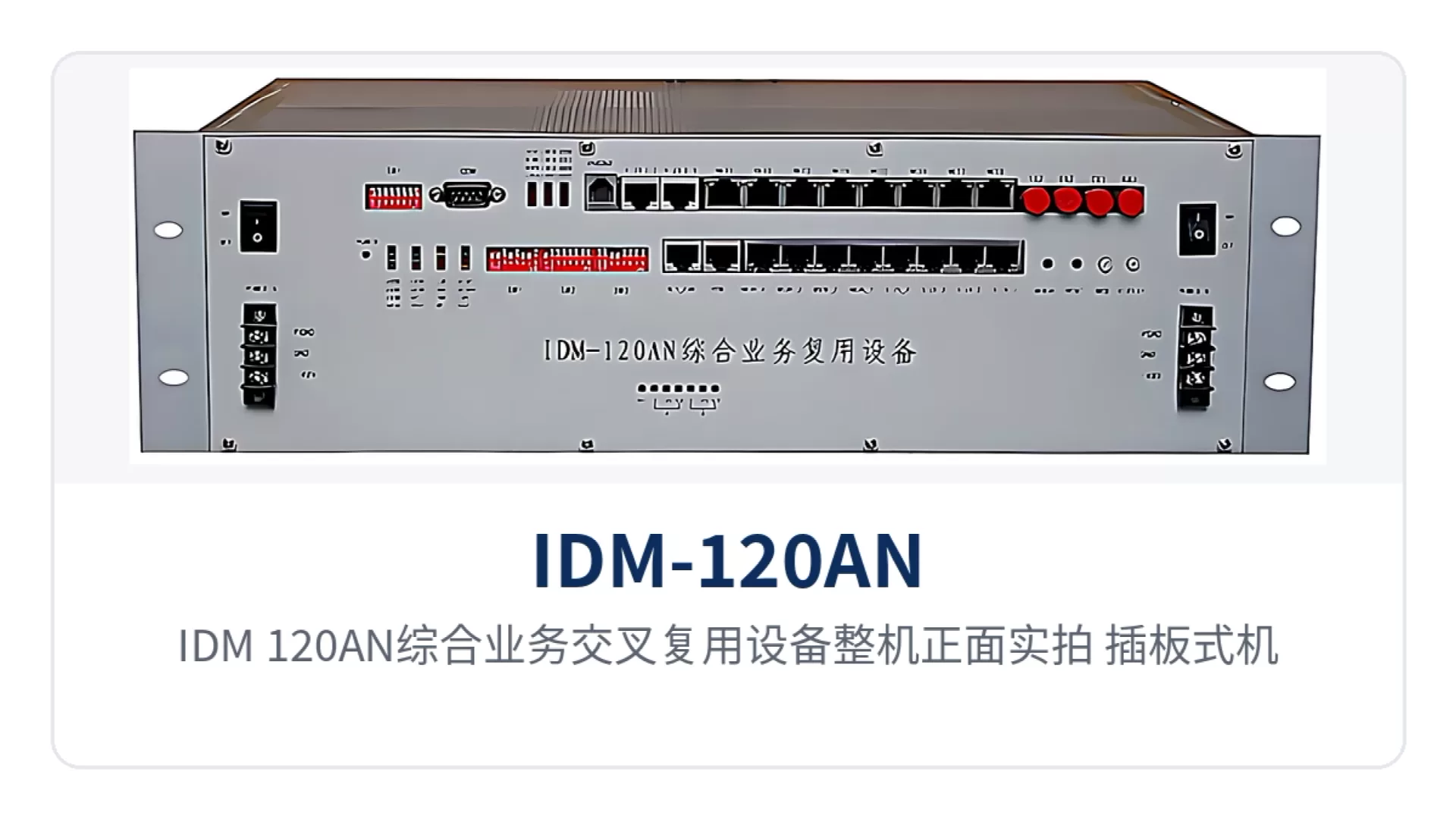
Figure 1: Front view live photo of the IDM-120AN Integrated Service Cross-Connect Multiplexing Equipment, showing the plug-in board chassis structure, panel indicator LEDs and alarm indication
Key Specifications at a Glance: 155M PDH optical transmission · 120-channel voice and data services · 2-channel isolated 100M Ethernet (physically isolated) · 4 groups of transparent transmission E1 · plug-in board structure, user boards support hot-swappable · dual power supply AC220V/DC-48V optional
What Kind of Device Is a 120-Channel Isolated Ethernet Telephone Optical Multiplexer
IDM-120AN 120-channel isolated Ethernet telephone optical multiplexer is an access device that multiplexes voice, E1 leased line, and Ethernet services onto a pair of optical fibers. It is used in pairs: one end accesses various services and converts them into optical signals, and the other end restores them to the corresponding telephone, E1, and Ethernet interfaces. Services are interfaced as-is according to interface standards, without modifying existing SPC switching equipment or private network terminal configurations.
The equipment adopts a plug-in board structure, with user boards supporting hot-swappable. Various voice and data service cards can be configured, each providing 8 channels of service, and service capacity is combined according to the number of service cards installed. The hot-swappable feature allows capacity expansion and service card replacement without powering down the entire unit, minimizing the impact on in-service services during maintenance windows, which is also the practical value of the plug-in board structure at private network nodes.
What Is the Difference Between Physically Isolated Ethernet and Ordinary Ethernet Ports
Physical isolation means the 2 100M Ethernet interfaces each have independent channels and processing resources within the equipment, not sharing bandwidth or intercommunicating Layer 2 traffic, rather than splitting one Ethernet channel into two physical interfaces. Both channels have full 100M forwarding capability.
The differences are mainly in three aspects: bandwidth is exclusively owned by each channel, with the two 100M channels not competing; failures are isolated from each other, so abnormal traffic or a broadcast storm on one channel does not affect the other; and secure domain separation is possible, with video surveillance, office terminals, production systems, and other services connected to different Ethernet ports. For private network users, this approach allows two types of services to be transmitted simultaneously over the same pair of optical fibers while remaining independent, meeting the private network's requirements for secure multi-service domain-separated bearer.
What Devices Can the 4 Groups of Transparent Transmission E1 Connect To
The E1 transparent transmission interface carries the 2.048Mbps services of existing E1 interface devices. IDM-120AN does not parse or alter the time slot content of E1 channels; services are delivered as-is from one end to the other.
Common interfacing targets include digital trunks, PCM multiplexers, and service devices using E1 as an interface, such as dispatching and clock synchronization equipment. Existing E1 devices do not need to be replaced. After connecting to IDM-120AN, services extend along the optical path to the opposite end site. The 4 groups of transparent transmission E1 interfaces offer flexible expansion, adapting to seamless access of existing E1 services in industrial private networks.

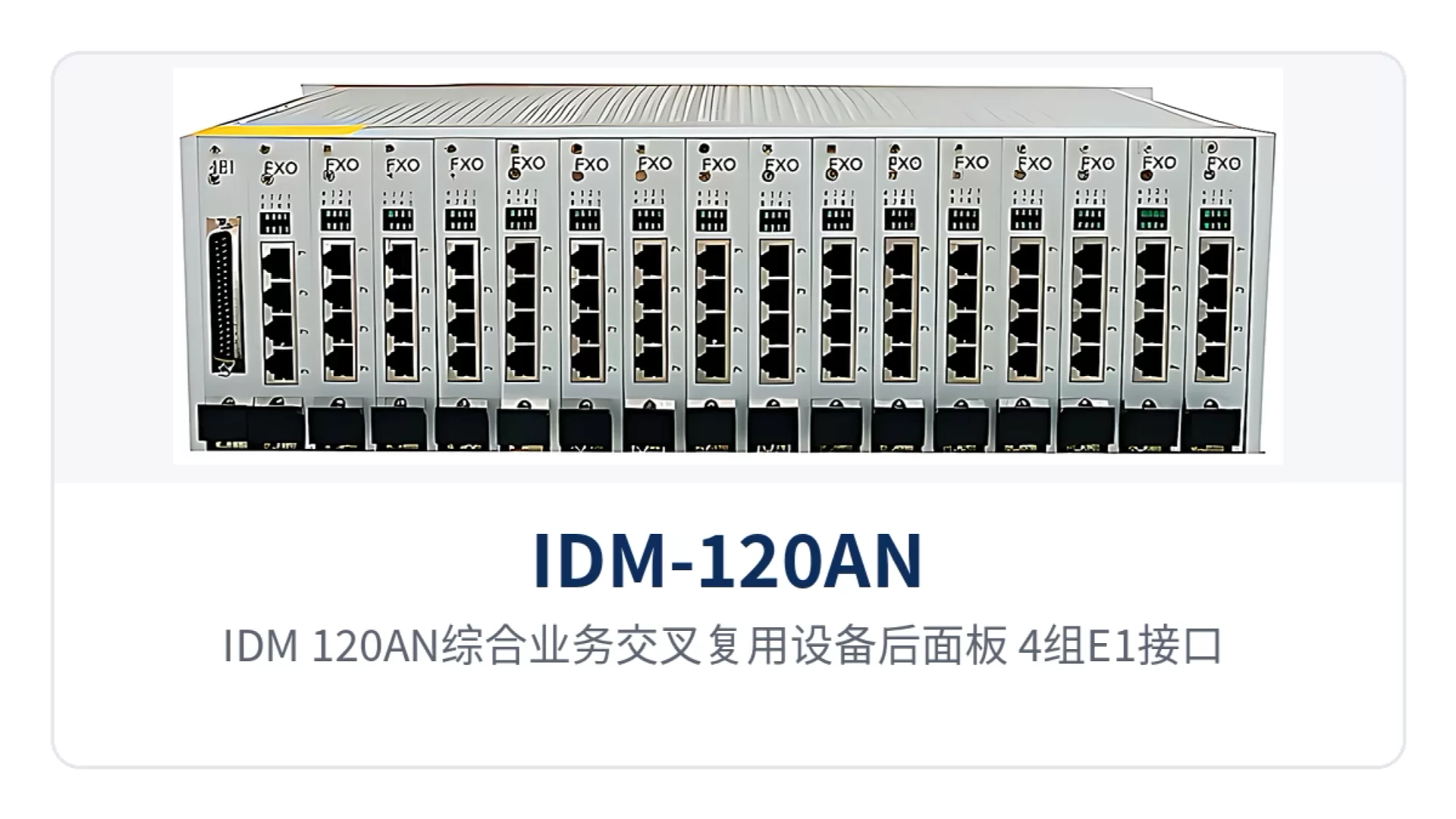
Figure 2: Rear panel of the IDM-120AN Integrated Service Cross-Connect Multiplexing Equipment, showing the layout of 4 groups of E1 interfaces, 2 100M Ethernet ports and dual power supply modules## What Functions and Interfaces Does IDM-120AN Support
IDM-120AN provides the following functions centered on multi-service access, E1 transparent transmission, board capacity expansion, and power supply reliability.
| Function | Description |
|---|---|
| 155M PDH optical transmission | Adds a 155M PDH optical transmission functional module on the basis of IDM-120A's functions; voice and data services are uploaded over a pair of optical fibers |
| 120-channel voice and data services | 4E1 access, transmitting 120-channel voice and data services; a standalone unit can complete high-capacity voice and data subscriber line provisioning |
| 2-channel physically isolated 100M Ethernet | Provides 2 physically isolated 100M Ethernet interfaces, each with exclusive bandwidth, meeting the private network's requirements for secure multi-service domain-separated bearer |
| 4 groups of transparent transmission E1 interfaces | Provides 4 groups of transparent transmission E1 interfaces with a bit rate of 2048Kbps, compliant with ITU-T G.703; existing E1 services are transmitted as-is with flexible expansion |
| Plug-in board structure and hot-swappable boards | Adopts a plug-in board structure, with user boards supporting hot-swappable; capacity expansion and service card replacement require no powering down of the entire unit |
| Multiple service cards available | Various voice and data service cards can be configured, each providing 8 channels of service, combined and configured according to on-site service types |
| Dual power supply | Dual power supply, AC220V or DC-48V optional, with dual power supply hot standby, ensuring high power supply reliability at unattended sites |
| Unified network management and alarms | Provides unified network management and comprehensive alarm functions, with centralized monitoring of equipment operating status and timely fault location |
Key Technical Specifications of IDM-120AN
The parameters in the table below are based on the product documentation of the IDM-120AN Integrated Service Cross-Connect Multiplexing Equipment, for reference in networking design and equipment selection.
| Item | Parameter/Specification | Description/Applicable Conditions |
|---|---|---|
| Optical transmission rate | 155M (PDH) | Adds a 155M PDH optical transmission functional module on the basis of IDM-120A's functions |
| Voice and data service capacity | 120 channels | 4E1 access, transmitting 120-channel voice and data services |
| Service card capacity | 8 channels of service per service card | Various voice and data service cards can be configured; capacity is combined according to the number of service cards |
| E1 interface | 4 groups, transparent transmission | Bit rate 2048Kbps, compliant with ITU-T G.703; services are transmitted as-is without changing time slot content |
| Ethernet interface | 2-channel 100M, physically isolatable | Provides 2 physically isolated 100M Ethernet interfaces, each with exclusive bandwidth |
| Device structure | Plug-in board, user boards support hot-swappable | Capacity expansion and service card replacement require no powering down of the entire unit |
| Power supply mode | Dual power supply, AC220V or DC-48V optional | Dual power supply hot standby, selected according to site power supply conditions |
| Network management and alarms | Unified network management, comprehensive alarm functions | Centralized monitoring of equipment operating status, with timely alarm reporting |
What On-Site Problems Can Multi-Service Isolation, E1 Transparent Transmission and Dual Power Supply Solve
Private network nodes commonly face three types of on-site problems: first, services such as surveillance, office, and production are crowded onto the same Ethernet port and interfere with each other; second, early-built E1 leased line equipment is still in service, and full-segment renovation costs are high; third, unattended sites have varying power supply conditions, and a sudden power failure can interrupt services. The differentiated capabilities of Raytrans IDM-120AN multi-service optical multiplexer address these three types of problems respectively.
| Differentiated Capability | Value to Private Network Nodes |
|---|---|
| 2 physically isolated 100M Ethernet ports | Meets the private network's requirements for secure multi-service domain-separated bearer: the two 100M Ethernet channels forward independently, with surveillance, office, and production services carried in separate domains, and an abnormality on one channel not affecting the other |
| 4 groups of transparent transmission E1 interfaces with flexible expansion | Adapts to seamless access of existing E1 services in industrial private networks: existing E1 devices do not need to be replaced, services are transparently transmitted as-is through the optical multiplexer, and on-site renovation is minimal |
| Dual power supply AC220V/DC-48V optional | Ensures high power supply reliability at unattended sites: AC is drawn from station power and DC from communications power, selected according to on-site power supply conditions, with services uninterrupted upon loss of one power feed |
| 155M PDH optical transmission | Voice, E1, and Ethernet services share a pair of optical fibers, saving line resources and simplifying on-site cabling |
Typical Application Scenarios
Substations and Power Supply Business Outlets in Electric Power Private Networks
Substations and remote power supply outlets generally have only limited fiber core resources, while three types of services—dispatch telephone, E1 telecontrol channel, and surveillance network—need to be uploaded from the station. Raytrans IDM-120AN multi-service optical multiplexer connects voice channels, E1 channels, and the surveillance network separately within the station. Voice and data services are uploaded to the centralized control station via the optical path of the 155M PDH optical multiplexer, occupying only a pair of optical fibers at the site side. With the 2 100M Ethernet ports physically isolated, the surveillance network and office network each use one channel, and production control services and office services are separated at the transmission level, meeting the electric power private network's requirements for secure domain-separated bearer. This is also a common deployment approach in government private network optical fiber communication solutions.
Along-the-Line Sites in Rail Transit Communication
Rail transit along-the-line sites are distributed and widely spaced, and the rack positions and power supply conditions in communications equipment rooms are constrained by the site. IDM-120AN multi-service optical multiplexer adopts a plug-in board structure, with service cards configured according to the actual voice channel and data requirements of each site. Each service card provides 8 channels of service, and additional service cards can be added when services increase later. The optical multiplexer's dual power supply supports both AC220V and DC-48V formats, allowing unified selection according to the power supply conditions of each station along the line, reducing the variety of spare parts, which is particularly practical for unattended communications nodes along the line.
Confidential Nodes in Military and Government Private Networks
Military and government private networks have high requirements for service isolation and operational continuity, and existing E1 leased line equipment has often been running stably for many years, making replacement costly. The 4 groups of transparent transmission E1 interfaces of Raytrans IDM-120AN multi-service optical multiplexer connect existing E1 services as-is and extend them to the opposite end node without modifying in-service equipment; the 2 physically isolated Ethernet channels can carry services in separate domains by service nature; and unified network management and comprehensive alarm functions allow the superior network management center to centrally monitor node operating status for rapid handling. In military emergency communications vehicle solutions, this equipment can likewise serve as a PDH optical multiplexer to provide integrated access for voice, E1, and Ethernet services.

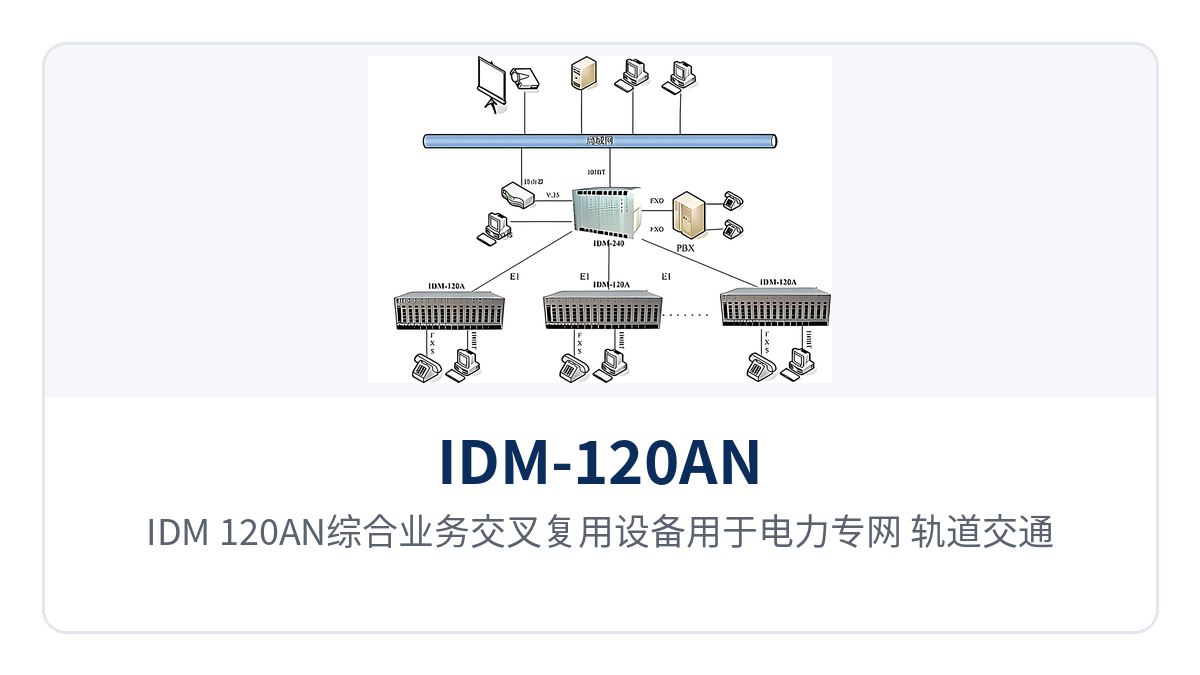
Figure 3: Networking topology diagram of the IDM-120AN Integrated Service Cross-Connect Multiplexing Equipment used in electric power private networks, rail transit, and military and government private networks## Frequently Asked Questions (FAQ)
How to Choose Between Dual Power Supply AC220V and DC-48V
Simply choose according to the power supply conditions available at the site. Choose AC220V when the equipment room has stable AC mains power; choose DC-48V when the communications equipment room is already equipped with -48V DC communications power. The two formats can coexist within the same network, facilitating separate configuration according to each station's conditions, and dual power supply hot standby access is also supported to improve power supply reliability.
How to Expand Capacity of a Plug-In Board Telephone Optical Multiplexer
Capacity expansion is achieved by adding service cards. The telephone optical multiplexer adopts a plug-in board structure, and various voice and data service cards can be configured, each providing 8 channels of service. User boards support hot-swappable, and service capacity increases synchronously as the number of service cards increases. Plugging or unplugging requires no powering down of the entire unit, and in-service services are not affected during capacity expansion and service card replacement.
Is the 120-Channel Isolated Ethernet Telephone Optical Multiplexer Suitable for Unattended Sites
Suitable. The dual power supply of the Raytrans IDM-120AN telephone optical multiplexer supports AC220V or DC-48V, configurable according to on-site conditions, and dual power supply hot standby ensures high power supply reliability for unattended sites; unified network management and comprehensive alarm functions send the operating status and alarms to the superior network management center, so O&M personnel can keep track of the equipment without being stationed on site for long periods.
Selection and Deployment Recommendations
The Raytrans IDM-120AN 120-channel isolated Ethernet telephone optical multiplexer is suitable for private network access nodes with concentrated voice channels that also require Ethernet data backhaul and E1 leased-line transparent transmission. During selection, first determine the service card configuration according to the number of on-site voice channels and data services, with each service card providing 8 channels of service; then connect the two types of data services that need to be carried in separate domains to the 2 physically isolated 100M Ethernet interfaces, avoiding different service domains sharing one channel of bandwidth; existing E1 service devices are connected as they are through the 4 groups of E1 transparent transmission interfaces, with no need to modify in-service equipment. The power supply mode is selected between AC220V and DC-48V according to the conditions of each site, and dual power supply hot standby access is recommended for unattended sites. For the specific configuration scheme, it is recommended to confirm with the optical multiplexer manufacturer based on project requirements, or refer to the PDH optical multiplexer and multi-service optical multiplexer series in the Raytrans product showcase for selection.
What Kind of Device Is a 120-Channel Isolated Ethernet Telephone Optical Multiplexer?
The IDM-120AN 120-channel isolated Ethernet telephone optical multiplexer is an access device that multiplexes three types of services—voice, E1 leased lines and Ethernet—onto a pair of optical fibers, and is used in pairs: one end accesses various services and converts them into optical signals, and the other end restores them into the corresponding telephone, E1 and Ethernet interfaces. Services are interconnected as they are according to interface standards, with no need to change the existing SPC switching equipment or private network terminal configuration.
The device adopts a plug-in board structure, and user boards are hot-swappable. Various voice and data service cards can be configured, with each service card providing 8 channels of service, and the service capacity is combined according to the number of service cards configured. The hot-swappable feature allows capacity expansion and service card replacement without powering down the complete unit, so the maintenance window has little impact on in-service services, which is also the practical value of the plug-in board structure at private network nodes.
What Is the Difference Between Physically Isolated Ethernet and Ordinary Ethernet Ports?
Physical isolation means that the 2 100M Ethernet interfaces each have independent channels and processing resources inside the device, without sharing bandwidth or intercommunicating Layer 2 traffic, rather than splitting one Ethernet channel into two physical interfaces; both channels have full 100M forwarding capability.
The difference is mainly reflected in three aspects: bandwidth is exclusively enjoyed by each channel, and the two 100M channels do not contend with each other; failures are isolated from each other, and abnormal traffic or a broadcast storm on one channel will not affect the other; secure domain separation is possible, with video surveillance, office terminals, production systems and other different services connected to different Ethernet ports. For private network users, this connection method allows the two types of services to be transmitted simultaneously over the same pair of optical fibers while remaining independent of each other, meeting the private network's requirements for secure multi-service domain-separated transport.
What Devices Can the 4 Groups of E1 Transparent Transmission Interfaces Connect To?
The E1 transparent transmission interfaces carry the 2.048Mbps services of existing E1 interface devices. The IDM-120AN does not parse or change the time slot content of the E1 channel, and services are delivered as they are from one end to the other.
Common interfacing targets include digital trunks, PCM multiplexers, and dispatching and clock synchronization service devices that use E1 as their interface. Existing E1 devices do not need to be replaced; after being connected to the IDM-120AN, services extend along the optical path to the opposite-end site. The 4 groups of E1 transparent transmission interfaces offer flexible expansion, adapting to seamless access of existing E1 services in industrial private networks.

What Functions and Interfaces Does the IDM-120AN Support?
The IDM-120AN provides the following functions centered on multi-service access, E1 transparent transmission, board capacity expansion and power supply reliability.
| Function | Description |
|---|---|
| 155M PDH optical transmission | Adds a 155M PDH optical transmission functional module on the basis of the IDM-120A functions, with voice and data services uploaded over a pair of optical fibers |
| 120-channel voice and data services | 4E1 access, transmitting 120 channels of voice and data services; a standalone unit can complete high-capacity voice and data subscriber line provisioning |
| 2 physically isolated 100M Ethernet | Provides 2 physically isolated 100M Ethernet interfaces, with each channel exclusively enjoying its own bandwidth, meeting the private network's requirements for secure multi-service domain-separated transport |
| 4 groups of E1 transparent transmission interfaces | Provides 4 groups of E1 transparent transmission interfaces with a bit rate of 2048Kbps, compliant with ITU-T G.703; existing E1 services are transmitted as they are with flexible expansion |
| Plug-in board structure and hot-swappable boards | Adopts a plug-in board structure, and user boards are hot-swappable; capacity expansion and service card replacement require no powering down of the complete unit |
| Multiple service cards available | Various voice and data service cards can be configured, with each service card providing 8 channels of service, combined and configured according to on-site service types |
| Dual power supply | Dual power supply, AC220V or DC-48V optional, with dual power supply hot standby, ensuring high power supply reliability for unattended sites |
| Unified network management and alarms | Provides unified network management and comprehensive alarm functions, with centralized monitoring of equipment operating status and timely fault location |
Key Technical Specifications of the IDM-120AN
The parameters in the table below are based on the product documentation of the IDM-120AN integrated service cross-connect multiplexing equipment, for reference in networking design and equipment selection.
| Item | Parameter/Specification | Description/Applicable Conditions |
|---|---|---|
| Optical transmission rate | 155M (PDH) | Adds a 155M PDH optical transmission functional module on the basis of the IDM-120A functions |
| Voice and data service capacity | 120 channels | 4E1 access, transmitting 120 channels of voice and data services |
| Service card capacity | 8 channels of service per service card | Various voice and data service cards can be configured, with capacity combined according to the number of service cards |
| E1 interface | 4 groups, transparent transmission | Bit rate 2048Kbps, compliant with ITU-T G.703; services are transmitted as they are without changing time slot content |
| Ethernet interface | 2 channels of 100M, physically isolated | Provides 2 physically isolated 100M Ethernet interfaces, with each channel exclusively enjoying its own bandwidth |
| Device structure | Plug-in board, user boards hot-swappable | Capacity expansion and service card replacement require no powering down of the complete unit |
| Power supply mode | Dual power supply, AC220V or DC-48V optional | Dual power supply hot standby, selected according to site power supply conditions |
| Network management and alarms | Unified network management, comprehensive alarm functions | Centralized monitoring of equipment operating status, with alarms reported in a timely manner |
What On-Site Problems Can Multi-Service Isolation, E1 Transparent Transmission and Dual Power Supply Solve?
Private network nodes commonly face three types of on-site problems: first, services such as surveillance, office and production are crowded onto the same Ethernet port and affect each other; second, E1 leased-line equipment built in the early stage is still in service, and full-segment upgrade is costly; third, unattended sites have varying power supply conditions, and a sudden power failure can interrupt services. The differentiated capabilities of the Raytrans IDM-120AN multi-service optical multiplexer address these three types of problems respectively.
| Differentiated Capability | Value to Private Network Nodes |
|---|---|
| 2 physically isolated 100M Ethernet ports | Meets the private network's requirements for secure multi-service domain-separated transport: the two 100M Ethernet channels forward independently, with surveillance, office and production services carried in separate domains, and an abnormality on one channel does not affect the other |
| 4 groups of E1 transparent transmission interfaces with flexible expansion | Adapts to seamless access of existing E1 services in industrial private networks: existing E1 devices do not need to be replaced, services are transparently transmitted as they are through the optical multiplexer, and on-site modification is minimal |
| Dual power supply AC220V/DC-48V optional | Ensures high power supply reliability for unattended sites: AC is drawn from station power and DC from communications power, selected according to on-site power supply conditions, and services are uninterrupted when one power feed fails |
| 155M PDH optical transmission | Voice, E1 and Ethernet services share a pair of optical fibers, saving line resources and simplifying on-site cabling |
Typical Application Scenarios
Substations and Power Supply Business Outlets of Electric Power Private Networks
Substations and remote power supply outlets generally have only limited fiber core resources, while three types of services—dispatch telephone, E1 telecontrol channel and surveillance network—need to be uploaded within the station. The Raytrans IDM-120AN multi-service optical multiplexer connects voice channels, E1 channels and the surveillance network separately within the station, and voice and data services are uploaded to the centralized control station over the 155M PDH optical multiplexer optical path, occupying only a pair of optical fibers on the site side. With the 2 100M Ethernet ports physically isolated, the surveillance network and the office network each use one channel, and production control services and office services are separated from each other in the transmission segment, meeting the electric power private network's requirements for secure domain-separated transport, which is also a common deployment approach in government private network optical fiber communication solutions.
Along-the-Line Sites of Rail Transit Communication
Rail transit along-the-line sites are distributed and spaced far apart, and the rack positions and power supply conditions of communications equipment rooms are limited by the site. The IDM-120AN multi-service optical multiplexer adopts a plug-in board structure, with service cards configured according to the actual voice channel and data requirements of the site, each service card providing 8 channels of service, and additional service cards can be added when services increase later. The dual power supply of the optical multiplexer supports both AC220V and DC-48V formats, allowing unified selection according to the power supply conditions of each site along the line and reducing the variety of spare parts, which is particularly practical for unattended communication nodes along the line.
Confidential Nodes of Military and Government Private Networks
Military and government private networks have high requirements for service isolation and operational continuity, and existing E1 leased-line equipment has often been running stably for many years, making replacement costly. The 4 groups of E1 transparent transmission interfaces of the Raytrans IDM-120AN multi-service optical multiplexer connect existing E1 services as they are and extend them to the opposite-end node, with no need to modify in-service equipment; the 2 physically isolated Ethernet channels can carry services in separate domains according to service nature; unified network management and comprehensive alarm functions allow the superior network management center to centrally keep track of node operating status for rapid handling. In military emergency communications vehicle solutions, this device can likewise assume integrated access of voice, E1 and Ethernet services in the form of a PDH optical multiplexer.

Selection and Deployment Recommendations
The Raytrans IDM-120AN 120-channel isolated Ethernet telephone optical multiplexer is suitable for private network access nodes with concentrated voice channels that also require Ethernet data backhaul and E1 leased-line transparent transmission. During selection, first determine the service card configuration according to the number of on-site voice channels and data services, with each service card providing 8 channels of service; then connect the two types of data services that need to be carried in separate domains to the 2 physically isolated 100M Ethernet interfaces, avoiding different service domains sharing one channel of bandwidth; existing E1 service devices are connected as they are through the 4 groups of E1 transparent transmission interfaces, with no need to modify in-service equipment. The power supply mode is selected between AC220V and DC-48V according to the conditions of each site, and dual power supply hot standby access is recommended for unattended sites. For the specific configuration scheme, it is recommended to confirm with the optical multiplexer manufacturer based on project requirements, or refer to the PDH optical multiplexer and multi-service optical multiplexer series in the Raytrans product showcase for selection.