WiFi Trunking Intercom Multimedia Portable Terminal
Public Network Trunking with No Range Limit and Unlimited Grouping, Encryption and Call Cut-Off, Command Receipt, Position Backhaul
A WiFi-based portable multimedia terminal that supports voice intercom, audio and video intercom, command confirmation, SMS sending and receiving and other functions. Outstanding voice quality: it adopts advanced voice encoding and decoding and digital error correction technologies, performs high-quality voice processing (echo cancellation), and can ensure clear voice quality over a larger communication range;
What Kind of Device Is the WiFi Trunking Intercom Multimedia Portable Terminal?
The WiFi Trunking Intercom Multimedia Portable Terminal is a WiFi-based portable multimedia terminal developed by Beijing Ruiguang Jiyuan Digital Technology Co., Ltd. (Raytrans). It consists of a wireless access unit, a voice processing unit, a digital encryption unit and a multimedia service unit, and is used in mobile scenarios such as energy and electric power inspection, rail transit and airport ground handling, and petrochemical field operations to perform voice intercom, audio and video intercom, command confirmation, SMS sending and receiving and GPS position backhaul. A single portable multimedia terminal handles four things at once — being heard, being seen, having commands confirmed and having positions backhauled — and on-site personnel can carry it with them to join unified dispatching, making it a portable node close to the front line in the audio and video dispatching system.
Key specifications at a glance: WiFi access · Unbounded public network trunking · Unlimited grouping · Digital encrypted communication · GPS command sending and receiving · Audio and video intercom · Real-time and non-real-time video
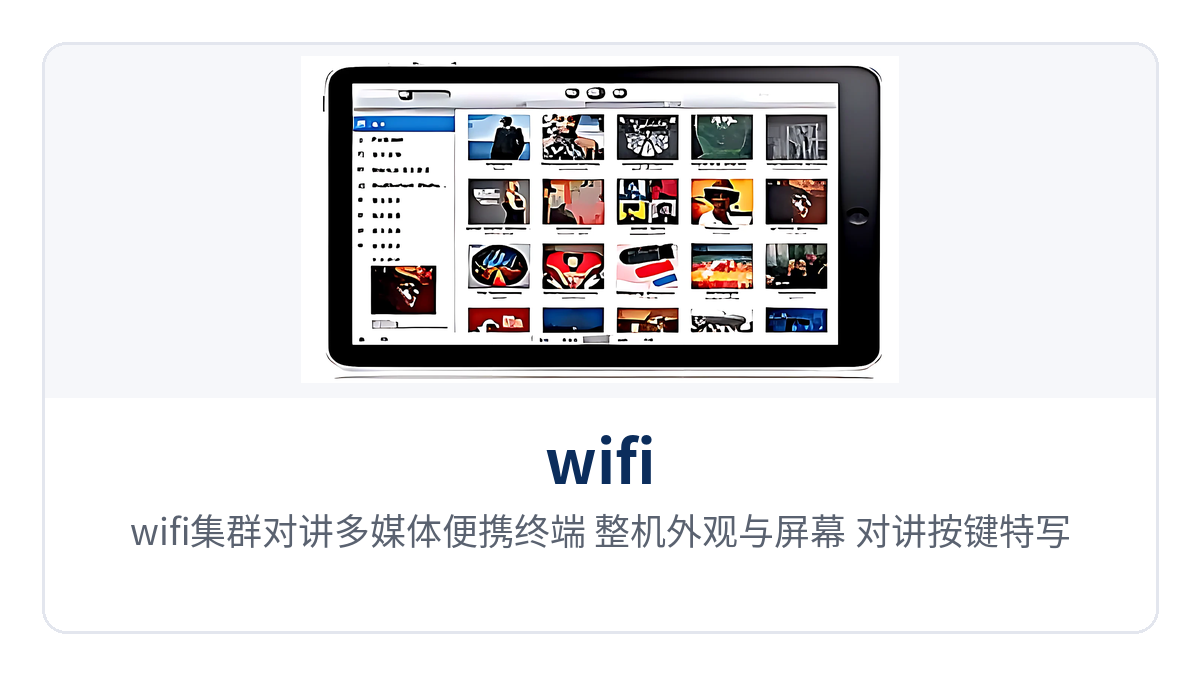
Figure 1: WiFi Trunking Intercom Multimedia Portable Terminal — appearance of the unit with close-ups of the screen and the intercom keys
How Does Public Network Digital Trunking Intercom Break Through Private Network Coverage Blind Spots?
Public network digital trunking intercom is a communication method that places the grouping and call control of trunking intercom on the network side and carries voice over wireless links; it therefore has no range limitation and unlimited grouping, breaking through the constraint of the private network base station coverage radius. The call range of a traditional narrowband walkie-talkie is determined by the coverage of base stations and trunks, so cross-region operations, long-distance inspections and remote station sites lose contact as soon as they move out of the coverage area; with public network digital trunking intercom, personnel in different regions can be grouped into the same talk group, and the number of groups and the way of grouping can be set flexibly according to the organizational structure, unrestricted by private network channel resources, so that the coverage gaps that the private network cannot reach are brought into the same dispatch network.
WiFi access complies with the IEEE 802.11 series of standards, so the terminal can connect nearby to a wireless access point on site without additional cabling; the terminal also provides GPS and GPRS capabilities, so position information and short data can be backhauled to the dispatch center over the wireless link, letting dispatchers know the real-time position of every on-site person and giving audio and video dispatching a positioning dimension.
What Core Functions Are Available?
The WiFi Trunking Intercom Multimedia Portable Terminal organizes its functions around four types of services — voice, video, commands and positioning — and each function and its role are as follows.
| Function | Description |
|---|---|
| Voice Intercom | Supports group intercom and one-to-one calls; it adopts mature voice encoding and decoding and digital error correction technologies and performs echo cancellation, ensuring clear voice quality over a larger communication range |
| Audio and Video Intercom | Both parties see the on-site picture during the call, making it easy to remotely confirm personnel and device status |
| Command Confirmation | Supports sending and receiving of command messages; after a command is delivered it can be confirmed by a receipt, so that industrial commands can be issued and acknowledged |
| SMS Sending and Receiving | Supports text transmission, delivering information in written form to a designated individual or group on occasions where noise is high and speaking is inconvenient |
| Digital Trunking | Public network digital trunking intercom with no range limitation and unlimited grouping, enabling cross-region group dispatch |
| GPS and GPRS | Provides GPS positioning and a GPRS data channel, so that positions and short data can be backhauled to the dispatch center |
| Real-Time Video Service | Supports video conferencing and remote video surveillance, and allows the picture from the camera of the portable multimedia terminal itself to be viewed remotely |
| Non-Real-Time Video | Supports photo taking, video recording upload and video record browsing, so that on-site footage can be retained as a record and retrieved afterwards |
| Digital Encrypted Communication | Uses mature digital encryption technology to encrypt call and command content and ensure the privacy of communication |
Key Specifications
| Item | Parameter/Specification | Description/Applicable Conditions |
|---|---|---|
| Equipment Form Factor | Portable multimedia terminal | Standalone unit carried on the person, integrating voice, video, command and positioning services |
| Wireless Access | WiFi | Complies with the IEEE 802.11 series of standards; it can be connected wherever a wireless access point is available on site |
| Trunking Intercom | Public network digital trunking intercom | No range limitation and unlimited grouping, enabling cross-region group dispatch |
| Voice Processing | Voice encoding and decoding + digital error correction + echo cancellation | Maintains clear voice over a larger communication range |
| Communication Security | Digital encryption | Ensures the privacy of call and command content |
| Command and Positioning | Text transmission, command message sending and receiving, GPS, GPRS | Positions and short data are backhauled to the dispatch center over the wireless link |
| Video Services | Real-time video (video conferencing, remote video surveillance) and non-real-time video (photo taking, video recording upload) | Provides both on-site visibility and an after-the-fact record |
| Power supply mode, overall dimensions and weight of the unit, ingress protection (IP) rating, operating temperature and battery endurance | Not yet recorded in the knowledge base | Subject to the manufacturer's technical documentation and commercial confirmation |
What the Three Differentiated Selling Points Mean on Site
| Differentiation Point | What It Means on Site |
|---|---|
| Public network digital trunking intercom with no range limitation and unlimited grouping, breaking through private network coverage blind spots | Personnel on cross-region inspections, at remote station sites or within private network coverage gaps can be grouped into the same talk group, and the dispatch scope is no longer cut apart by base station coverage |
| Digital encrypted communication that ensures the privacy, safety and reliability of sensitive industrial commands | Dispatch orders related to production operations are transmitted only between terminals holding authorization, preventing eavesdropping or tampering |
| Voice encoding and decoding + digital error correction + echo cancellation for clear calls over a larger communication range | On-site mechanical noise, echo and transmission bit errors are handled stage by stage, so that commands can still be heard clearly as the distance increases |
Typical Application Scenarios
Energy and Electric Power Inspection
Transmission lines and substations are mostly distributed in mountainous areas and rural areas, where both public network and private network coverage are unstable, and inspection teams are often spread along hundreds of kilometers of lines. Inspection personnel carry the WiFi Trunking Intercom Multimedia Portable Terminal, and teams stay in contact with each other through public network digital trunking intercom, free from the private network coverage radius; when a defect is found, photo taking and video recording upload retain on-site evidence, and command messages backhaul the defect location and handling requirements to the duty room; once GPS positions are backhauled over the GPRS channel, dispatchers can see the position of every inspection team member on the map and can dispatch nearby support when risk points such as tower climbing operations arise.
Rail Transit and Airport Ground Handling
The work faces of rail transit platforms, depots and airport aprons span a large area, signals are weak in parts of underground stations and aprons, and job roles such as ground handling, maintenance and cleaning are widely distributed. Staff use the portable multimedia terminal to access the site wireless network and combine voice intercom with audio and video intercom: after the dispatcher issues a command, receipt is confirmed through command confirmation, and when an abnormality occurs during train preparation or flight support, the on-site picture can be backhauled in real time, so that dispatchers at the remote end can determine the direction of handling without traveling to the site.
Petrochemical Field Operations
Field operations are usually carried out far from cities at oil and gas fields, long-distance pipelines and chemical industrial parks; noise in the process areas is high, and the flammable and explosive environment places high demands on communication reliability. The portable multimedia terminal uses digital encrypted communication to keep dispatch orders from leaking, and uses echo cancellation and digital error correction to maintain clear voice in noisy process areas; once teams are grouped wirelessly by work face, inspection data and hazard photos are backhauled over GPRS, video conferencing brings the site and the central control room onto the same screen for consultation, and the steps for passing work permits and handling commands are shortened accordingly.
Selection and Deployment Recommendations
For selection, first check whether a usable cellular network is available on site: public network digital trunking intercom uses the cellular network as its bearer, so areas with good coverage can be grouped and used directly, and cross-region and cross-province operations do not require applying for private network frequency points. Then look at the wireless access conditions: where the site already has WiFi coverage, the portable multimedia terminal can connect nearby, and talk groups can be divided by job role and work face, grouping roles such as inspection, maintenance and dispatch separately. Finally, look at the service combination: when voice dispatching is the main use, focus on confirming the intercom grouping and command confirmation process; when on-site visibility is required, confirm the access mode of video conferencing and remote video surveillance. For parameters such as the overall power supply of the unit, ingress protection (IP) rating and operating temperature, the information is not yet recorded in the knowledge base; before purchase, please refer to the manufacturer's technical documentation and commercial confirmation.
Conclusion
The WiFi Trunking Intercom Multimedia Portable Terminal concentrates public network digital trunking intercom, digital encrypted communication, GPS command sending and receiving and audio and video intercom in a single portable unit, using voice encoding and decoding, digital error correction and echo cancellation to ensure clear voice over a larger communication range and digital encryption to ensure the privacy of sensitive industrial commands. For industry users that need to turn private network coverage gaps into a fully covered dispatch network in scenarios such as energy and electric power inspection, rail transit and airport ground handling, and petrochemical field operations, the portable multimedia terminal can be carried on the person and is ready to use immediately, connecting directly to the existing dispatch system as an on-site communication and dispatch node, providing seamless interfacing with the platform provided by the command and dispatch system manufacturer, and extending audio and video dispatching capability to the front line.