IDM-VNT2204 Optical Terminal Manufacturer | Multi-service Video Optical Terminal | SDH Equipment | Optical Transmission Equipment | MSAP
The IDM-VNT2204 multi-service video optical terminal adopts advanced all-digital uncompressed video transmission technology for high-quality video transmission. It transmits two channels of one-way SD video (or one channel of two-way video) over fiber optic lines, provides 2 groups of Ethernet each sharing 100M wire-speed bandwidth (200M total Ethernet bandwidth on the fiber), meeting the requirements of departments that need to transmit 2 groups of physically isolated 100M Ethernet, and provides 4 voice interfaces (telephone or EM2/4-wire audio) and 2 RS232/RS485 interfaces. It supports high-quality transmission of any high-resolution static and dynamic images. The IDM-VNT2204 multi-service video optical terminal is a high-reliability, cost-effective, high-transmission-quality long-distance video transmission system. It is suitable for fiber optic CCTV network systems, traffic surveillance, industrial surveillance, building surveillance, video conferencing, high-quality video conferencing, distance learning systems, etc.
The IDM-VNT2204 multi-service video optical terminal, developed by Beijing Ruiguang Jiyuan Digital Technology Co., Ltd., is a multi-service video optical terminal designed for government private network fiber optic communication solutions and traffic surveillance video optical terminal scenarios. It simultaneously carries SD video, Ethernet, voice, and low-speed data services over a pair of fiber optic lines, employing all-digital uncompressed video transmission technology. The device transmits two channels of one-way SD video (or one channel of two-way video) over fiber optic lines, provides 2 groups of Ethernet each sharing 100M wire-speed bandwidth (200M total Ethernet bandwidth on the fiber), meeting the requirements of applications that need to transmit 2 groups of physically isolated 100M Ethernet, and provides 4 voice interfaces (telephone or EM2/4-wire audio) and 2 RS232/RS485 interfaces. It supports high-quality transmission of any high-resolution static and dynamic images, and is suitable for long-distance video transmission applications such as fiber optic CCTV network systems, traffic surveillance, industrial surveillance, building surveillance, video conferencing, high-quality video conferencing, and distance learning systems.
Key Specifications at a Glance: Video Channels 2 one-way (or 1 two-way) · Video Transmission All-digital uncompressed · Ethernet 2 groups physically isolated 100M (200M total on fiber) · Voice Interfaces 4 (telephone or EM2/4-wire audio) · Data Interfaces 2 RS232/RS485 · Video Standards NTSC/PAL/SECAM
What is the IDM-VNT2204 Multi-service Video Optical Terminal?
The IDM-VNT2204 multi-service video optical terminal is a multi-service video optical terminal that multiplexes video, Ethernet, voice, and data signals into a single fiber for transmission and restores them to various service interfaces at the far end. Unlike ordinary optical terminals that transmit only video, the multi-service video optical terminal simultaneously provides 2 video channels, 2 groups of Ethernet, 4 voice channels, and 2 data channels on a single device, eliminating the need to stack multiple single-function devices at the site. As a professional optical terminal manufacturer, Raytrans combines multi-service multiplexing capability with the field requirements of fiber optic CCTV network system video optical terminals in this model, making it suitable for integrated surveillance and communication deployment.
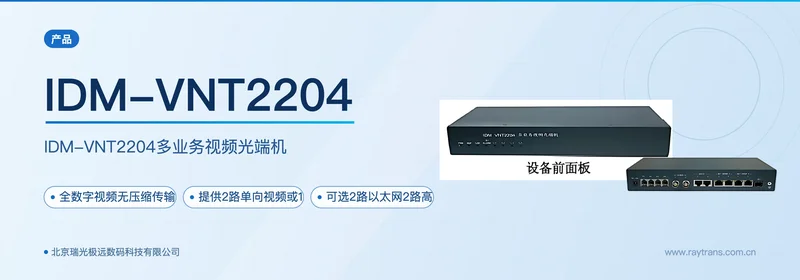
The IDM-VNT2204 multi-service video optical terminal employs all-digital uncompressed video transmission technology. Video signals are sent directly into the optical channel without compression encoding, avoiding picture detail loss and codec delay caused by compression. Video quality reaches broadcast-grade standards; audio quality reaches CD-grade standards, and it is compatible with NTSC, PAL, and SECAM video standards. The device features automatic gain control and adopts a self-recovery fuse circuit design with lightning protection. It supports lossless video regenerative repeating, and its transparent data encoding method makes it compatible with products from major camera manufacturers. The unit features a compact design with a small footprint and flexible, convenient installation. The front panel is laid out with model silkscreen printing and operating status indicators for at-a-glance operational status.

Figure 1: IDM-VNT2204 multi-service video optical terminal front panel (model silkscreen and status indicators)
Core Functions of the IDM-VNT2204 Multi-service Video Optical Terminal
The IDM-VNT2204 multi-service video optical terminal completes multiplexed transmission of video, Ethernet, voice, and data services on a single device. Its core functions are shown in the table below.
Function | Description |
|---|---|
All-digital uncompressed video transmission | Video signals are transmitted over fiber in all-digital form without compression, with no compression loss and no intermodulation interference of analog FM/PM optical terminals |
Multiple video channel access | Provides 2 one-way SD video channels, or 1 two-way video channel, supporting high-quality transmission of any high-resolution static and dynamic images |
2 groups of physically isolated Ethernet | 2 groups of Ethernet each sharing 100M wire-speed bandwidth, each group providing 2 physical interfaces, 200M total Ethernet bandwidth on the fiber, meeting the requirement of transmitting 2 groups of physically isolated 100M Ethernet |
Voice service access | Provides 4 voice interfaces, supporting telephone or EM2/4-wire audio, of which 2 are automatic telephone services |
Data and control access | Provides 2 RS232/RS485 interfaces and 1 control data channel, usable for controlling far-end PTZ and other devices |
Optional audio and Ethernet expansion | Optional 2 Ethernet channels and 2 high-fidelity audio channels, configured per project interface requirements |
Standard compatibility | Compatible with NTSC, PAL, and SECAM video standards, adapting to front-end cameras of different standards |
Automatic gain control | Features automatic gain control, maintaining stable video signals over long-distance links |
Lightning protection and self-recovery protection | Self-recovery fuse circuit design with lightning protection, reducing damage risk from lightning strikes and line anomalies |
Lossless video regenerative repeating | Supports lossless video regenerative repeating for extending transmission distance without video quality loss |
Compact structure | Compact design with small footprint and flexible, convenient installation, suitable for deployment in confined spaces such as cabinets and enclosures |
Technical Specifications of the IDM-VNT2204 Multi-service Video Optical Terminal
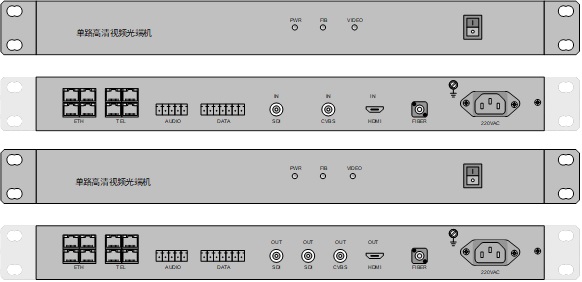
The interface and service configuration parameters of the IDM-VNT2204 multi-service video optical terminal are shown in the table below. The rear panel centrally arranges various service interfaces and power terminals.
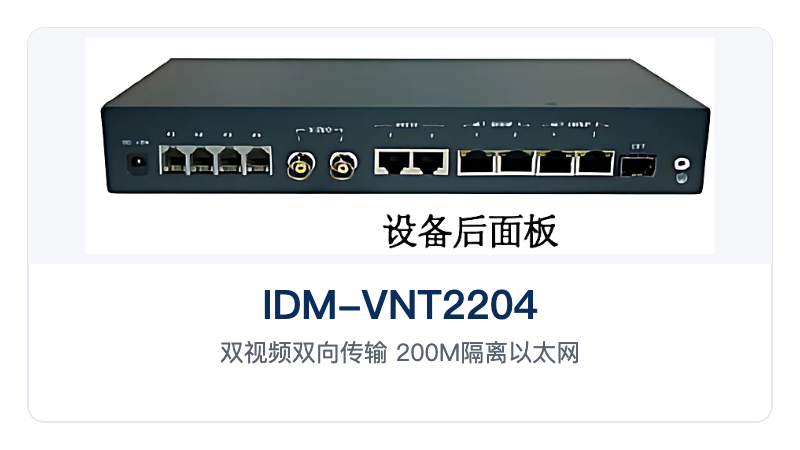
Figure 2: IDM-VNT2204 multi-service video optical terminal rear panel (service interface and power terminal layout)
Item | Parameter/Specification | Description/Applicable Conditions |
|---|---|---|
Video Channels | 2 channels one-way video, or 1 channel two-way video | Standard-definition video, used in pairs at optical transmitter and receiver ends |
Video Transmission Mode | All-digital uncompressed video | Direct transmission without compression encoding |
Video Quality | Broadcast-grade standard | Supports transmission of any high-resolution static and dynamic images |
Video Standards | NTSC, PAL, SECAM | Compatible with all three standards |
Audio Quality | CD-grade standard | Voice/audio channel reproduction quality |
Ethernet Interface | 2 groups of 100M wire-speed Ethernet, physically isolated, 2 physical ports per group | Total 200M Ethernet bandwidth over fiber, meeting transmission requirements of 2 physically isolated 100M Ethernet networks |
Optional Services | 2 channels Ethernet, 2 channels high-fidelity audio access | Configured per project requirements |
Voice Interface | 4 voice channels (telephone or EM2/4-wire audio) | 2 of which are automatic telephone services; specific interface configuration subject to manufacturer technical documentation and commercial confirmation |
Data Interface | 2 channels RS232/RS485 | For data and remote PTZ control services |
Control Data | 1 channel control data | Used with keyboard or joystick to control remote PTZ |
Gain Control | Automatic gain control | Stable signal over long-distance links |
Protection Design | Lightning protection with self-resetting fuse circuit | Automatic recovery after line anomalies |
Transmission Capability | Supports lossless video regeneration and relaying | Long-distance transmission; specific transmission distance subject to manufacturer technical documentation and commercial confirmation |
Structure & Installation | Compact design, small form factor | Flexible and convenient installation |
How is physical isolation of Ethernet implemented in video optical transceivers?
The key to implementing physical isolation of Ethernet in video optical transceivers lies in allocating independent transmission channels for each Ethernet group between the two optical transceivers: the IDM-VNT2204 multi-service video optical transceiver carries 2 groups of 100M wire-speed Ethernet on separate independent channels, with each group providing 2 physical ports on the device. The two service groups share no bandwidth and exchange no data on the optical link, so the two networks connected to the two Ethernet groups are isolated from each other at the link layer. For departments that need to transmit office networks and production networks, or internal networks and private networks separately, this physical isolation approach avoids the risk of network cross-talk that may occur when using ordinary switches to divide VLANs, while a single fiber completes the transmission of both networks without the need to lay separate optical cables for each network. The 2 Ethernet groups occupy a total of 200M Ethernet bandwidth on the fiber, with each group still maintaining 100M wire-speed; bandwidth can be allocated according to actual service traffic during network planning.
How is point-to-point direct fiber connection networked?
Point-to-point networking is a relatively straightforward application of the IDM-VNT2204 multi-service video optical transceiver: one device is deployed at each end, connected directly by a single fiber, enabling bidirectional transmission of video, voice, and control signals. Cameras, telephones, PTZ units, and control keyboards are connected at one end, while the other end displays remote images on a large screen. The two Ethernet groups can be connected to two networks requiring isolation. Duty personnel can control the remote PTZ via a control panel or joystick. The device supports video and voice binding, allowing the video and corresponding voice channels to be switched and called up together. This networking approach does not rely on intermediate transmission equipment, providing a clear link structure with fewer failure points, making it suitable for scenarios where the monitoring point is far from the duty room and a single fiber is needed to send video, voice, and network signals back simultaneously.
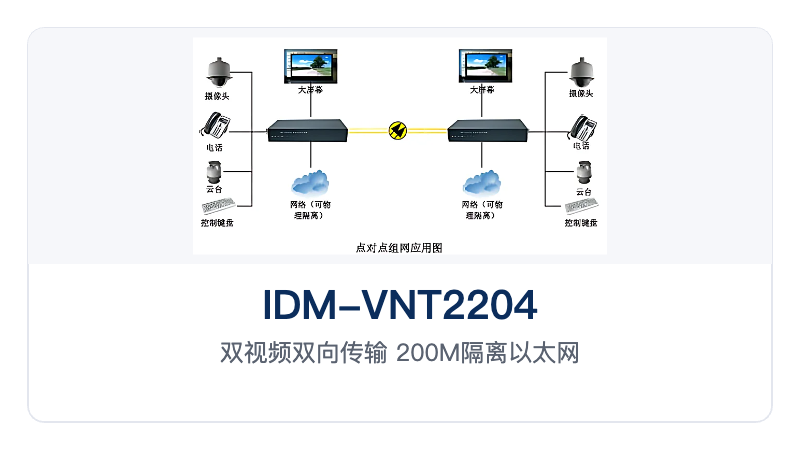
Figure 3: IDM-VNT2204 multi-service video optical transceiver point-to-point networking application diagram
How is a point-to-multipoint star network built with video optical transceivers?
To build a point-to-multipoint star network with video optical transceivers, the approach is to use a centralized multi-service transmission device as the central node and connect multiple IDM-VNT2204 multi-service video optical transceivers as remote stations: the IDM-VNT2204 multi-service video optical transceiver can interoperate with the VNE card of the centralized multi-service transmission device IDM MSAP-CP to form a point-to-multipoint star network, where multiple remote video and voice signals are centrally aggregated at the control center. The control center can display multi-screen video on a large display, and the dispatch console controls remote PTZ units via keyboard or joystick. The device also supports video and voice binding. The remote voice portion can be connected to PCM equipment via the E1 interface of the IDM MSAP-CP, or directly output 64K services for access. This star networking topology is suitable for monitoring projects where front-end points are dispersed and need to be centrally aggregated to a monitoring center, with a single investment at the center side covering multiple remote stations.
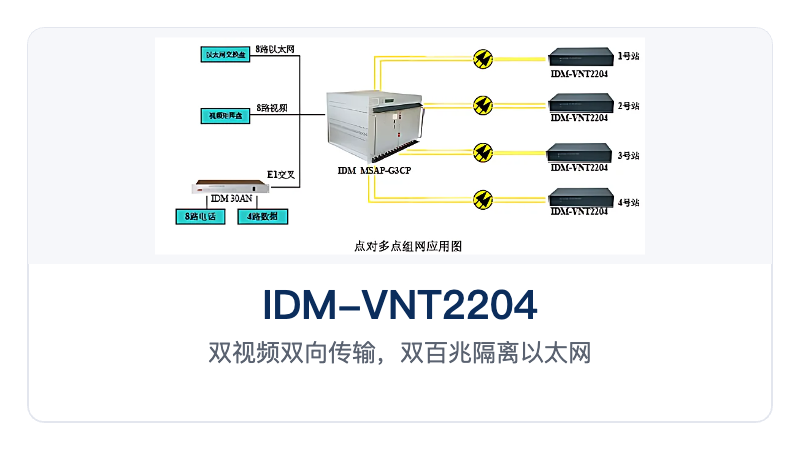
Figure 4: IDM-VNT2204 multi-service video optical transceiver point-to-multipoint star networking application diagram
Typical Application Scenarios
Fiber Optic CCTV Network Systems and Traffic Monitoring
In fiber optic CCTV network systems and traffic monitoring projects, the distance between front-end cameras and the rear monitoring center often exceeds the usable range of coaxial cable and twisted pair, and sites such as roads and tunnels require video, voice broadcasting, and local networks to be sent back simultaneously. The IDM-VNT2204 multi-service video optical transceiver transmits 2 channels of standard-definition video, 2 physically isolated Ethernet groups, 4 voice channels, and 2 RS232/RS485 data channels over a single fiber, requiring only one optical cable between the roadside equipment cabinet and the monitoring center. Broadcast intercom and video can be bound together for switching and viewing by the same duty operator, and the two isolated Ethernet groups separately carry the monitoring-dedicated network and the office network. As a common model used as a traffic monitoring video optical transceiver and a fiber optic CCTV network system video optical transceiver, this device facilitates unified operation and maintenance in road and tunnel monitoring.
Industrial Monitoring and Building Surveillance
In industrial monitoring and building surveillance scenarios, production networks and management networks within factories and campuses are typically required to be transmitted separately, while cameras, access control intercoms, and data acquisition devices are distributed across different buildings. The IDM-VNT2204 multi-service video optical transceiver uses 2 physically isolated 100M Ethernet channels to carry the two networks separately, preventing production data and office data from running on the same network. The 4 voice interfaces can connect telephones or EM2/4-wire audio, meeting communication needs between duty rooms and field sites. The 2 RS232/RS485 interfaces are used to connect control devices and data acquisition terminals. The device's lightning protection and self-resetting fuse circuit design adapts to outdoor cabling environments with longer line runs.
Video Conferencing and Distance Learning Systems
In video conferencing, high-quality video conferencing, and distance learning systems, meeting room images and voice need to be transmitted to remote sites simultaneously and reliably. The IDM-VNT2204 multi-service video optical transceiver employs all-digital uncompressed video transmission technology, achieving broadcast-grade video quality and CD-grade audio quality, compatible with NTSC, PAL, and SECAM standards, and supporting high-quality transmission of any high-resolution static and dynamic images, making it suitable for point-to-point direct connections between meeting rooms and between main and branch campuses. When multiple sub-venues need to be covered, it can be deployed in a point-to-multipoint star topology in conjunction with centralized equipment.
Deployment in Government Private Networks and Military Emergency Communication Vehicle Solutions
In government private network fiber-optic communication solutions, the office network and business private network often require physical isolation, while video conferencing, voice dispatch, and surveillance images must be aggregated to a single center. The IDM-VNT2204 multi-service video optical multiplexer uses 2 groups of physically isolated 100M Ethernet channels to carry the two networks separately, and with 4 voice channels and 2 RS232/RS485 data interfaces, it can complete multi-service backhaul over a single fiber; when multi-point aggregation is required, it can interoperate with the VNE card of the centralized multi-service transmission device IDM MSAP-CP to form a star network, where remote voice is connected to PCM equipment via E1 interfaces or directly outputs 64K services. In military emergency communication vehicle solutions, the device's compact size and flexible installation facilitate rapid deployment in vehicle-mounted cabinets, and on-site video, telephone, and data services can be delivered to the command vehicle over a single fiber; the lightning protection and self-recovery fuse circuit design also adapts to field temporary cabling environments. The specific configurations of the above solutions are subject to the manufacturer's technical documentation and commercial confirmation.
Selection and Deployment Recommendations
When selecting the IDM-VNT2204 multi-service video optical multiplexer, first determine the interface configuration based on the on-site service list: choose the unidirectional configuration when only 2 video channels are required, or select the 1-channel bidirectional video configuration when bidirectional transmission is needed; if there are two networks requiring isolation on site, fully utilize the 2 groups of physically isolated 100M Ethernet channels and connect the two interface groups to the corresponding networks respectively; voice interfaces are configured according to telephone or EM 2/4-wire audio requirements.
FAQs
What Are the Functions and Advantages of Video Optical Terminals?
The function of a video optical terminal is to convert one or multiple channels of analog video signals into optical…
View answerWhat is the difference between a Video Optical Terminal and a Network Video Server?
Composition and Function of Video Optical Terminal and Network Video Server An optical terminal is a device used to…
View answerWhat are common issues when using optical terminals in security surveillance?
Fiber optic technology is increasingly used in security surveillance projects to transmit images, audio, data…
View answer