
IDM HD1080P
IDM HD1080P
The IDM HD1080P Multi-E1 HD Video Codec Transmission Device provides bidirectional HD video (1920x1080P 60fps) transmission over 2 to 4 E1 links. When 3 or 4 E1 links are used, it can also provide one Ethernet transmission interface simultaneously. With 2 E1 links, 108
The IDM HD1080P Multi-E1 HD Video Codec Transmission Device provides bidirectional HD video (1920x1080P 60fps) transmission over 2 to 4 E1 links. When 3 or 4 E1 links are used, it can also provide one Ethernet transmission interface simultaneously.
With 2 E1 links, the 1080P 60fps format can be transmitted smoothly; with 3 E1 links, the image is nearly identical to the original. The transmission delay from encoding input to decoding output is less than 100ms. The Ethernet interface on the device can be used as a configuration monitoring interface, a software encoding/decoding interface, or a transmission interface.
This device can also be simplified to unidirectional HD audio/video transmission.

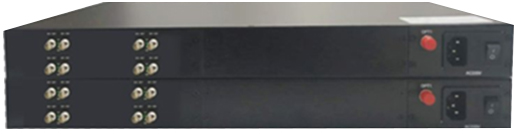
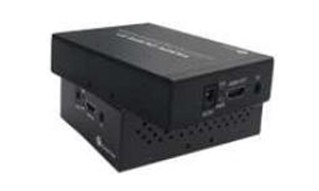
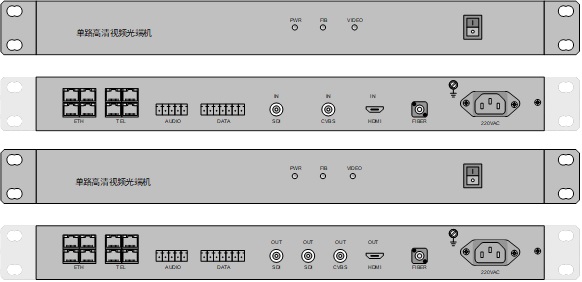
IDM HD1080P Device Structure

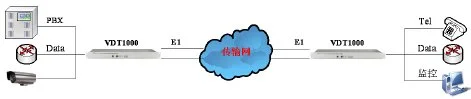
IDM HD1080P Application Mode via Multi-E1 Transmission

IDM HD1080P Application Mode via IP Transmission
**Technical Specifications
**1. Transmission Characteristics
Supports E1 inter-link delay difference detection; maximum relative delay between E1 links is 220ms;
Supports TAG VLAN configuration;
Transparently transmits jumbo frames as defined by IEEE 802.1Q, supporting Ethernet switches with VLAN functionality;
Automatically removes faulty E1 channels (LOS, AIS, LOF alarms, etc.) and automatically restores them when the fault clears;
Supports network management via RS232 serial port, allowing monitoring of device operation and configuration of device working status.
E1 Interface
Line Code: HDB3
Bit Rate: 2048Kbps±50ppm;
Signaling: Channel-associated signaling;
Impedance: 70Ω (unbalanced)/120Ω (balanced);
Frame Structure: PCM31/30
Jitter Performance: Compliant with ITU-T G.823
Standard Protocol: Supports ITU-T G.703/G.704
Mode: Framed/Unframed configurable, timeslots assignableEthernet Interface
Interface Type: RJ45
Interface Rate: 10M/100M selectable;
Standard Protocol: Supports IEEE802.3 standard
Operation Mode: Half/Full duplexAudio/Video
Video Compression: H.264
Digital TV (DTV) Full HD resolution 1080P60/P50
Ultra-low latency: end-to-end delay less than 30ms
Occupies half the network bandwidth of MPEG2
Video Input Interface: HDMI/DVI, VGA, CVBS
Video Output Interface: HDMI/DVI, YPbPr, CVBS
Audio: HDMI-compatible audio, high-fidelity stereo G.711 occupying 128KBPS bandwidth, mono occupying 64KBPS bandwidth
Audio Input Interface: HDMI, RCA
Audio Output Interface: HDMI, RCA
Network Protocol: RTSP and UDP protocols, P2P and MULTICAST modes
Encoder generates standard streams, decodable with VLC standard softwareGeneral Specifications
Operating Temperature: -20℃ - +60℃
Operating Humidity: 95% non-condensing
Operating Voltage: AC 220V/DC -48V/DC +5V optional
FAQs
What Are the Functions and Advantages of Video Optical Terminals?
The function of a video optical terminal is to convert one or multiple channels of analog video signals into optical…
View answerWhat is the difference between a Video Optical Terminal and a Network Video Server?
Composition and Function of Video Optical Terminal and Network Video Server An optical terminal is a device used to…
View answer