Optical Terminal Manufacturer | Optical Transmission Equipment | Video Optical Terminal | Raytrans
Employing advanced all-digital uncompressed video technology, this is a compact fiber-optic transmission product for video, data and other service signals, tailored for the security surveillance market. It transmits up to 1 channel of one-way video, 1 channel of data, and 1 channel of two-way audio over a single fiber. The plug-and-play design makes installation simple and easy, requiring no on-site adjustment.
The IDM-VDA100/110/111 1-channel video optical terminal is a single-channel video fiber-optic transmission device developed by Beijing Ruiguang Jiyuan Digital Technology Co., Ltd. It consists of a transmitter and a receiver pair, used to transmit 1 channel of one-way video (with 1 channel of data and 1 channel of two-way audio optionally superimposed) in real time over fiber in scenarios such as security surveillance. The 1-channel video optical terminal employs all-digital uncompressed video technology, sampling the video signal output from the camera into a digital signal and transmitting it directly over fiber, with the receiver restoring it to video output. The plug-and-play design makes installation simple and easy, requiring no on-site adjustment. Its optical modules and core circuits use standard components, offering high stability. All optical and electrical interfaces comply with international standards, suitable for various working environments.
Core Parameters at a Glance: 1-channel one-way video · Video bandwidth 0Hz~6.5MHz · Video SNR ≥70dB (weighted) · FC single-mode optical port · Transmission distance 20Km · Power consumption ≤6W · Dimensions 144×138×30mm
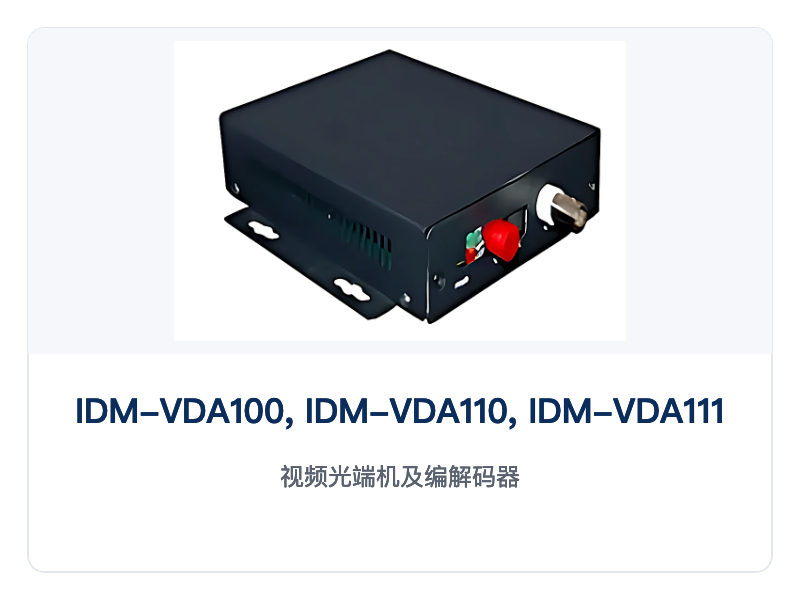
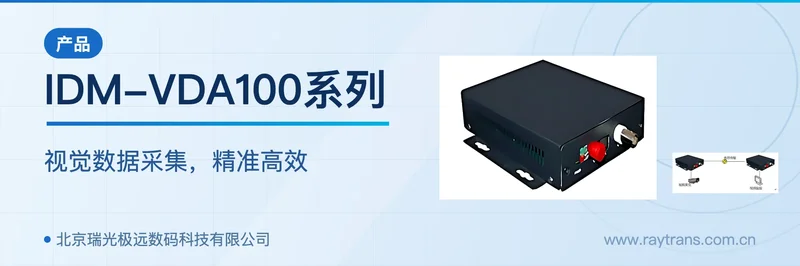
Figure 1: IDM-VDA100 1-channel video optical terminal host appearance with BNC video port and FC optical port close-up
What is a 1-Channel Video Optical Terminal? All-Digital Uncompressed Transmission Principle
All-digital uncompressed video technology means that after the video signal undergoes A/D sampling at the transmitting end, it is transmitted directly over fiber in digital form without compression encoding, and the receiving end performs D/A conversion to restore the video output. The 1-channel video optical terminal adopts this approach, so the video image is not affected by picture loss caused by compression algorithms. The distortion specifications of the video channel are determined by the sampling resolution and the analog front end.
The video channel of the 1-channel video optical terminal has a sampling resolution of 8bit and video bandwidth of 0Hz~6.5MHz, capable of fully carrying PAL, NTSC, SECAM and other video format signals. Video SNR ≥70dB (weighted), luminance nonlinearity <3%, differential gain (DG) <0.7%, differential phase (DP) <0.7° — this set of specifications supports the device's positioning of "video quality up to broadcast-grade standards". The video interface is BNC with input/output impedance of 75Ω (unbalanced) and input/output voltage of 1VP-P (typical), allowing direct connection to the video ports of cameras and monitors.
For the optical link, the transmitter of the 1-channel video optical terminal has receive/transmit rates of 84Mbps/155Mbps and receive/transmit wavelengths of 1550nm/1310nm; the receiver has receive/transmit rates of 155Mbps/84Mbps and receive/transmit wavelengths of 1310nm/1550nm. Optical output power is -15~-8dBm, receiver sensitivity is better than -32dBm (1310nm), and the difference between these two parameters is the available optical power margin of the link.
Features of the IDM-VDA100/110/111 1-Channel Video Optical Terminal
| Feature | Description |
|---|---|
| SNMP Network Management | Supports SNMP network management, enabling real-time online monitoring of 1-channel video optical terminals on the link |
| All-Digital Uncompressed Video | Video quality up to broadcast-grade standards, no compression encoding loss after fiber transmission |
| CD-Grade Audio | Audio quality up to CD-grade standards, audio sampling resolution 16bit, sampling frequency 32KHz |
| Video Format Compatibility | Compatible with PAL, NTSC, SECAM and other video formats, adapting to cameras and monitors of different formats |
| SMT and Port Protection | SMT surface-mount technology with multiple lightning and surge protection on ports |
| Lossless Video Regenerative Repeating | Supports lossless video regenerative repeating, free from electromagnetic interference (EMI) and radio frequency interference (RFI) |
| Transparent Data Encoding | Transparent data encoding scheme compatible with products from major camera manufacturers |
| Adaptive No-Adjustment | Adaptive technology requiring no on-site electrical or optical adjustment |
| Compact Design | Small form factor, dimensions 144×138×30mm, flexible and easy installation |
1-Channel Video Optical Terminal Technical Specifications: Optical Interface, Video, Audio and Data
Optical Interface Specifications
| Item | Parameter/Specification | Description/Applicable Conditions |
|---|---|---|
| Connector Type | FC (SC and others customizable) | Optical port connector type, customizable per project fiber patch cord configuration |
| Fiber Mode | Single-mode (multi-mode optional) | Single-mode is standard configuration, multi-mode is optional |
| Receiver Receive/Transmit Rate | 155Mbps/84Mbps | Receive direction 155Mbps, transmit direction 84Mbps |
| Receiver Receive/Transmit Wavelength | 1310nm/1550nm | Paired with the opposite-end transmitter wavelength |
| Transmitter Receive/Transmit Rate | 84Mbps/155Mbps | Transmit direction 84Mbps, receive direction 155Mbps |
| Transmitter Receive/Transmit Wavelength | 1550nm/1310nm | Paired with the opposite-end receiver wavelength |
| Optical Output Power | -15~-8dBm | Transmit optical power range |
| Receiver Sensitivity | Better than -32dBm (1310nm) | Used to determine available link power margin |
| Transmission Distance | 20Km, long-distance optical modules optional for extended fiber transmission | Based on single-mode fiber configuration |
Video Channel Specifications
| Item | Parameter/Specification | Description/Applicable Conditions |
|---|---|---|
| Connector Type | BNC | Connects to video ports of cameras and monitors |
| Video Sampling Resolution | 8bit | A/D sampling precision |
| Video Bandwidth | 0Hz~6.5MHz | Covers PAL, NTSC, SECAM format video bandwidth |
| Luminance Nonlinearity | <3% | Video transmission distortion specification |
| Differential Phase (DP) | <0.7° | Chrominance phase distortion specification |
| Differential Gain (DG) | <0.7% | Chrominance gain distortion specification |
| Input Overload Voltage | 1.5VP-P (typical) | Allowable overload level at video input |
| Input/Output Voltage | 1VP-P (typical) | Standard video signal level |
| Input/Output Impedance | 75Ω (unbalanced) | Consistent with conventional video coaxial cable impedance |
| Video Signal-to-Noise Ratio | ≥70dB (weighted) | Weighted SNR specification |
High-Fidelity Audio Channel Specifications (IDM-VDA111)
| Item | Parameter/Specification | Description/Applicable Conditions |
|---|---|---|
| Connector Type | RJ45 | Audio input/output connector |
| Audio Sampling Resolution | 16bit | A/D, D/A sampling precision |
| Audio Sampling Frequency | 32KHz | Audio sampling clock |
| Input/Output Impedance | ADC:100KΩ / DAC:10KΩ | Input and output impedances differ; wire according to port labels |
| Input/Output Voltage | 1.5VP-P (typical) | Audio signal level |
| Audio Bandwidth | 20Hz~20KHz | Covers voice and conventional audio service frequency bands |
| Audio Signal-to-Noise Ratio | ≥90dB | Audio channel SNR specification |
| Total Harmonic Distortion | <1% | Audio nonlinear distortion specification |
Data Channel Specifications (IDM-VDA110/IDM-VDA111)
| Item | Parameter/Specification | Description/Applicable Conditions |
|---|---|---|
| Connector Type | RJ-45 | Data port connector |
| Data Types | RS-232, RS422 (4-wire), RS485 (2-wire) | Select wiring method per the interface type of on-site control equipment |
Power, Environmental and Structural Specifications
| Item | Parameter/Specification | Description/Applicable Conditions |
|---|---|---|
| Power Supply | AC220V / DC-48V | Selected per equipment room power supply conditions |
| Power Consumption | ≤6W | Single-end device power consumption |
| Operating Temperature | -15°C ~ +65°C | Standard model operating temperature range |
| Storage Temperature | -25°C ~ +75°C | Non-operating storage temperature |
| Industrial Grade | -40°C ~ +85°C | Industrial-grade temperature range configuration |
| Relative Humidity | 0~95% (non-condensing) | Operating environment humidity condition |
| Product Dimensions | 144×138×30 (mm) | Length×depth×height |
Single-Channel Video Optical Terminal Selection: How to Choose Between IDM-VDA100, IDM-VDA110 and IDM-VDA111?
The basis for selecting a single-channel video optical terminal is the number of services that need to be transmitted simultaneously on site: choose IDM-VDA100 when only 1 channel of video needs to be uploaded; choose IDM-VDA110 when PTZ, dome cameras and other devices need to be controlled in addition to video; choose IDM-VDA111 when two-way intercom between the site and the monitoring center is needed in addition to video and data. The three models share the same optical platform and video specifications, differing only in the presence of data and audio channels.
| Product Model | Video Channel | Data Channel | Two-Way Audio | Typical Usage |
|---|---|---|---|---|
| IDM-VDA100 | 1-channel one-way video | — | — | Surveillance points requiring only video upload |
| IDM-VDA110 | 1-channel one-way video | 1-channel data | — | Video plus data services such as PTZ or dome camera control |
| IDM-VDA111 | 1-channel one-way video | 1-channel data | 1-channel two-way audio | Complete link with video, data and two-way intercom |
Typical Application Scenarios
Point-to-Point Video Transmission for Security Surveillance Points
In security surveillance systems for residential communities, parks, industrial plants and other sites, surveillance points and the monitoring center are often limited by coaxial cable transmission distance and electromagnetic interference. The 1-channel video optical terminal connects to the camera's video output at the surveillance point side and restores the video signal at the center side to feed it into a monitor or encoding device. A single fiber completes point-to-point transmission of 1 channel of video, with a transmission distance of up to 20Km, free from electromagnetic interference (EMI) and radio frequency interference (RFI).
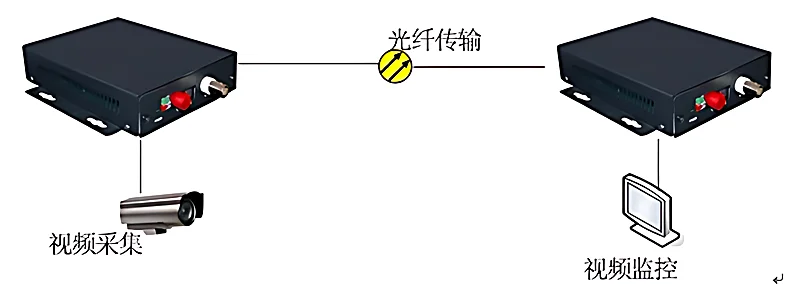
Figure 2: 1-channel video optical terminal security surveillance networking diagram, camera connects to fiber via optical terminal then to monitoring center
Video + Data: PTZ and Dome Camera Control Link
IDM-VDA110 provides 1 data channel in addition to 1 channel of video, with RJ-45 connector type supporting RS-232, RS422 (4-wire) and RS485 (2-wire). In security projects, the monitoring center sends control commands to on-site PTZ units, dome cameras and decoders through this data channel. Video and control are transmitted simultaneously over a single fiber, eliminating the need for separate control cables on site.
Video + Data + Two-Way Audio: On-Site Intercom and Loudspeaker Announcements
IDM-VDA111 adds 1 two-way audio channel in addition to video and data, with audio sampling resolution of 16bit, sampling frequency of 32KHz, audio bandwidth of 20Hz~20KHz and SNR ≥90dB, achieving CD-grade audio quality. This configuration is suitable for scenarios requiring two-way communication between the monitoring center and the site, such as remote loudspeaker announcements and intercom for gate posts, platforms and unattended equipment rooms.
Lossless Video Regenerative Repeating to Extend Surveillance Links
The 1-channel video optical terminal supports lossless video regenerative repeating and can serve as a repeater node in long links, regenerating the video signal losslessly for continued transmission without introducing additional compression loss. For projects spanning multiple surveillance areas where link length exceeds single-segment transmission capability, links can be organized through segment-by-segment repeating while maintaining the video channel's distortion specifications unchanged.
How Far Can a Video Optical Terminal Transmit? Transmission Distance and Fiber Configuration
The standard transmission distance for the 1-channel video optical transceiver is 20 km, based on single-mode fiber, 1310nm/1550nm wavelength, and FC optical connector as the standard configuration. For projects requiring longer distances, an optional long-distance optical module can be installed to achieve extended fiber transmission. To determine whether the link is viable, compare the transmitter output power (-15~-8dBm) with the receiver sensitivity (better than -32dBm) to calculate the available optical power margin; actual projects should also account for fiber attenuation, splice losses, and connector losses in a separate calculation.
Both fiber mode and connector type affect link configuration: single-mode is the standard configuration, while multi-mode is optional — the selection must match the optical modules at both ends and the fiber already installed on site. The optical connector type is FC (SC and others available on request); if the project uses SC patch cords or fiber cable termination, customization can be specified at the time of ordering.
How to wire the video optical transceiver? BNC, RJ45, and optical port connections
The 1-channel video optical transceiver is wired according to factory configuration; on site, only the service cables need to be connected per port labels, with no electrical or optical adjustments required. For connection sequence, first connect the service equipment such as cameras and monitors to the corresponding ports, then connect the fiber patch cords, and finally power on — this reduces the risk of end-face contamination from repeated plugging/unplugging of optical ports.
| Port | Connected Device | Wiring Notes |
|---|---|---|
| BNC video port | Camera / Monitor | 75Ω unbalanced, input/output voltage 1VP-P (typical), use 75Ω video coaxial cable |
| RJ45 data port | PTZ controller / Control keyboard / Decoder | Select RS-232, RS422 (4-wire), or RS485 (2-wire) wiring per device interface type |
| RJ45 audio port | Intercom microphone / Speaker | Input impedance ADC:100KΩ, output impedance DAC:10KΩ, connect per port label |
| FC optical port | Fiber patch cord / Fiber cable | Single-mode (multi-mode optional), SC and other connector types available on request, ensure wavelength pairing at both transmit and receive ends |
| Power port | AC220V / DC-48V | Select per site power supply conditions, total power consumption ≤6W |
Conclusion
The IDM-VDA100/110/111 1-channel video optical transceiver integrates 1 video channel, 1 data channel, and 1 bidirectional audio channel onto a single fiber for transmission. Featuring all-digital uncompressed video technology, video quality reaches broadcast-grade standards and audio quality reaches CD-grade standards. It supports SNMP network management and lossless video regeneration relay, with dimensions of 144×138×30mm, suitable for various security surveillance and remote video transmission projects. For specific model configurations, optical module distance, and connector customization requirements, please confirm with the manufacturer based on the actual project site conditions.
FAQs
What Are the Functions and Advantages of Video Optical Terminals?
The function of a video optical terminal is to convert one or multiple channels of analog video signals into optical…
View answerWhat is the difference between a Video Optical Terminal and a Network Video Server?
Composition and Function of Video Optical Terminal and Network Video Server An optical terminal is a device used to…
View answerWhat are common issues when using optical terminals in security surveillance?
Fiber optic technology is increasingly used in security surveillance projects to transmit images, audio, data…
View answer