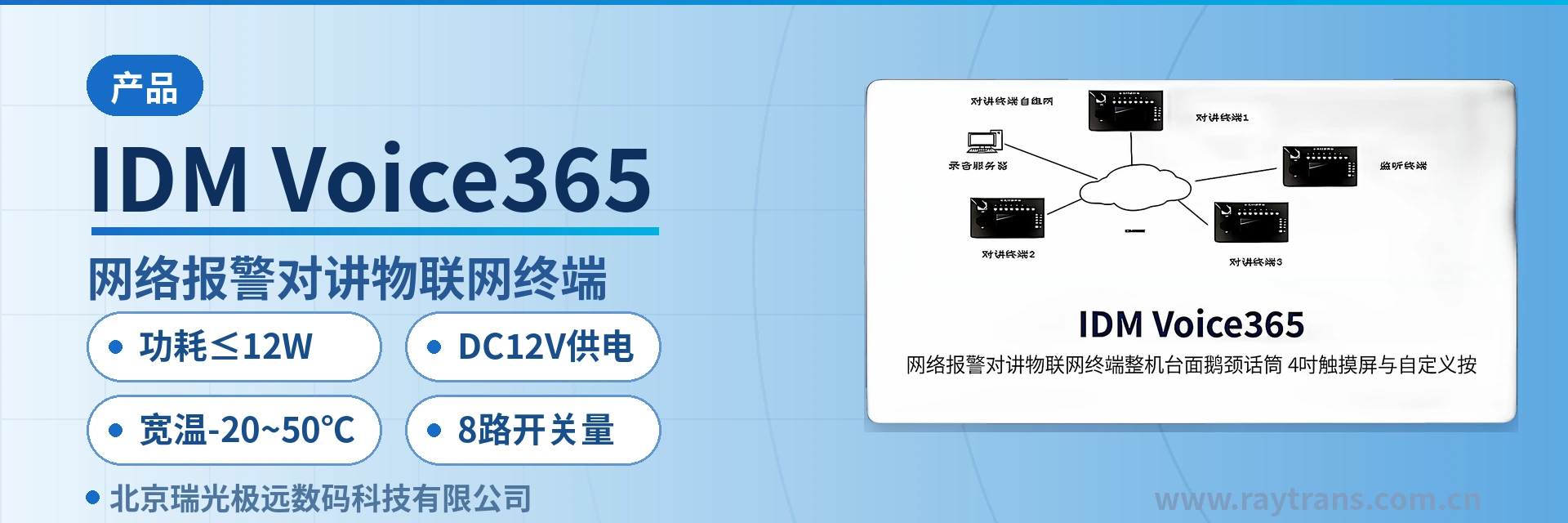
IDM Voice365 Network Alarm Intercom IoT Terminal
MQTT audio intercom, 8-channel on/off signal linkage, one unit replaces three devices: intercom, PA, and alarm
The IDM Voice365 network alarm intercom IoT terminal provides audio intercom based on the IoT MQTT protocol, as well as on/off signal input and output interfaces. It is a comprehensive IoT operating terminal. It can use IoT
The IDM Voice365 networked alarm intercom IoT terminal is an IoT intercom terminal developed by Beijing Ruiguang Jiyuan Digital Technology Co., Ltd. (Raytrans). It carries audio intercom over the IoT MQTT protocol and comes with on/off signal input and output interfaces, serving voice intercommunication and on-site device linked control in industrial private networks, unattended sites and field industrial sites. It can act as the end voice node in the overall solution of a command and dispatch system manufacturer, and also applies to underground and surface voice linkage scenarios in smart mining communication solutions.
The terminal integrates intercom, PA, alarm button and status indication into one desktop unit, so duty personnel face a single device rather than an assembly of multiple devices. It works once connected to the existing IP network, with no need to lay separate cabling for voice, and no need to modify existing cabling during site renovation. In a government private network optical fiber communication solution, it can be connected as a voice terminal on the IP access gateway side, working with SIP telephones and trunking intercom systems, and completing end-to-end connectivity together with network equipment provided by an industrial Ethernet switch manufacturer. In intrinsically safe mining communication scenarios, it can also serve as on-site voice alarm and linked control equipment.
Key Specifications at a Glance: Adaptive 10M/100M · MQTT audio intercom · 8 on/off signal inputs · Sampling rate 8K96K · Signal-to-noise ratio -93dB · Overall power consumption ≤12W · Operating temperature -20℃+50℃
What are the components of the networked alarm intercom IoT terminal?
The networked alarm intercom IoT terminal consists of four parts: audio processing, key operation, status display and network access. The operating surface is concentrated on the top panel of the unit, so no separate control box is needed on site. The top-panel components are arranged according to the operating habits of duty personnel, with frequently used intercom and PA keys within reach, so there is no need to look down for key positions during night-shift duty. As an IP access gateway type device, the terminal can be connected directly to the existing IP network, and when used with the Raytrans command and dispatch system, it can take on the role of front-end voice access and linked execution.
4-inch touchscreen: displays the configuration status of the terminal and also the working status during intercom, including PA, multicast, point-to-point communication, monitoring and speaking, and shows the name of the current speaker and the terminal position.
Gooseneck microphone and 3W speaker: audio pickup and playback at close range, so no external SIP telephone and speaker are needed in desktop scenarios.
5 function keys: intercom, mode, VOD, multicast, PA, switching the operating mode with one touch.
8 user-defined keys and 8 LED indicators: key functions are defined by the user, and the indicators echo the current status accordingly.
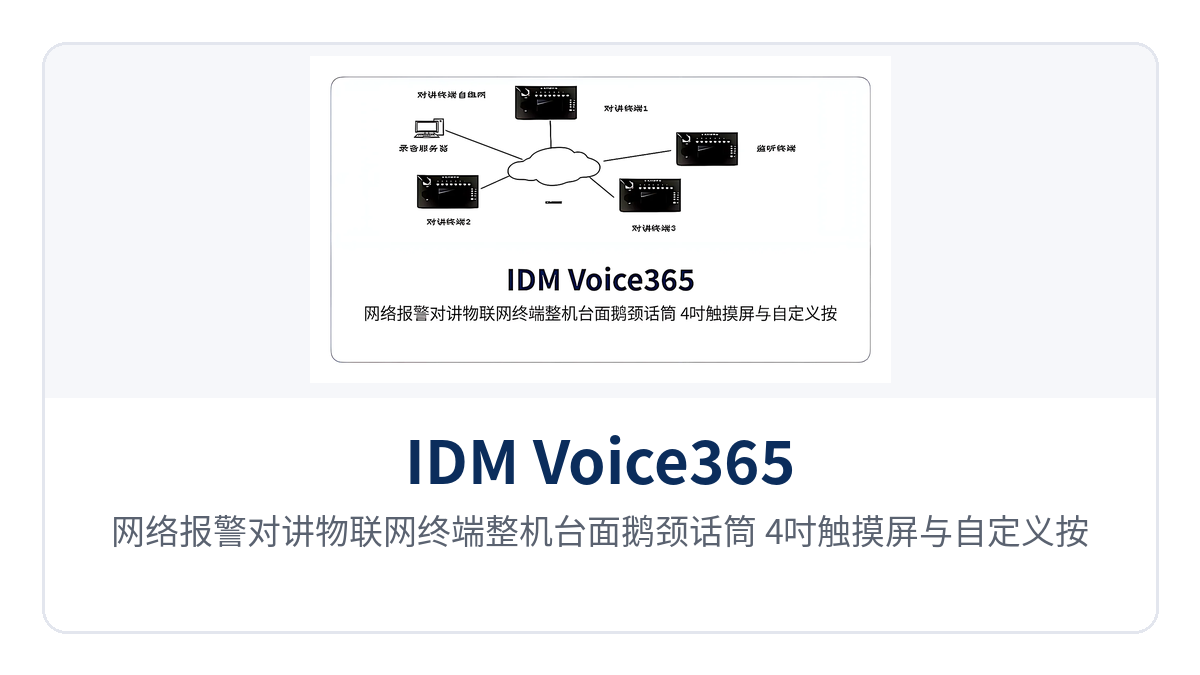
Figure 1: Close-up of the gooseneck microphone, 4-inch touchscreen and user-defined keys on the top panel of the networked alarm intercom IoT terminal
The audio interfaces cover three types of on-site requirements: telephone, PA and intercom, so one terminal can perform both the transmission device and the intercom device functions. The interface configuration is grouped by service type, and the wiring terminals are concentrated on the rear of the chassis, which facilitates cabling inside the cabinet and routine maintenance.
Telephone interfaces (FXO, FXS): connect to telephone exchange trunks or ordinary telephones.
HIFI high-fidelity PA interface: connects to a PA power amplifier or powered speaker, for zone announcements.
Intercom PTT hand microphone interface: connects to a PTT hand microphone for half-duplex intercom.
Gooseneck microphone and speaker interfaces: local audio pickup and playback.
Wireless trunking gateway interface: interconnects with the wireless trunking intercom system to extend voice to handheld radios.
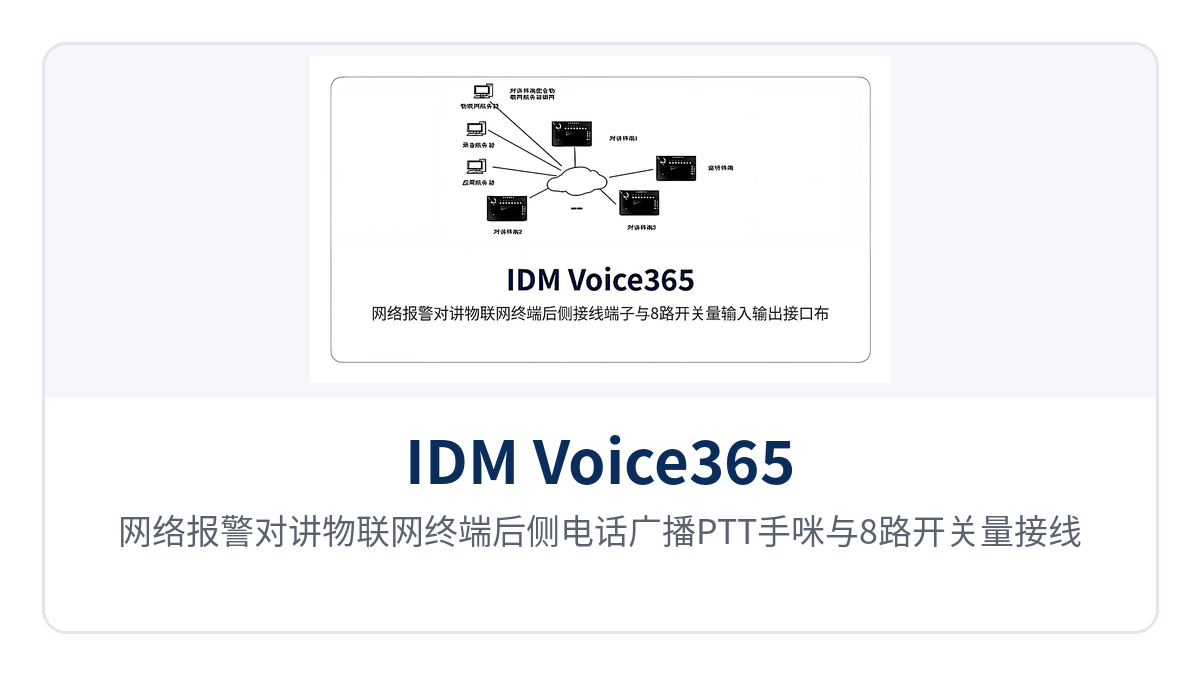
Figure 2: Layout of the telephone, PA, PTT hand microphone and 8-channel on/off signal wiring terminals on the rear of the networked alarm intercom IoT terminal
Core Functions and Interface Capabilities at a Glance
The functions cover five areas: intercom, PA, alarm, linked control and voice announcement. The number and purpose of the interfaces are listed item by item in the table below, making it easy to check the configuration against on-site requirements. The left column of the table lists the function items, and the right column explains the practical use of each function in engineering, so that selection can be checked item by item against the commercial list; as a companion terminal of a command and dispatch system manufacturer, its function items can also be mapped item by item to the platform-side dispatch functions.
Function | Description |
|---|---|
IoT audio intercom | Transmits voice over the MQTT protocol, supports registration and management by an IoT server, and also supports two modes: self-organizing masterless networking |
On/off signal input and output | 8 key input switches with indicator LEDs and 8 independent status indicator LEDs, for one-touch alarm or IoT scenario selection |
Multiple audio interfaces | Five types of interfaces: telephone, HIFI high-fidelity PA, PTT hand microphone, gooseneck microphone and speaker, and wireless trunking gateway |
Intercom modes | Four modes: PTT intercom, recorded intercom, monitoring and speaking, switched according to the on-site command approach |
Text-to-speech | Supports Chinese, English and digit announcements, played together with alarm messages and prompts |
Wake word recognition | Supports 200 wake words, using voice to trigger alarms and scenario actions |
Status display | The 4-inch touchscreen displays configuration status, communication status, speaker name and terminal position |
Message display | Receives and displays message information delivered by the command center |
What are the audio and network performance specifications?
The specifications are listed in groups by interface category, with values taken from the product specifications. During selection, focus on checking three items: audio interface type, power supply mode and environmental conditions. The indicators listed in the table below are nominal values of the unit under rated power supply conditions, and the test basis is subject to the manufacturer's accompanying documentation.
Item | Parameter/Specification | Description/Applicable Conditions |
|---|---|---|
Ethernet interface | 10M/100M adaptive | Single RJ45 connector, directly connected to the existing IP network |
Standard protocol | Supports IEEE802.3 | Interoperates with general switches and industrial Ethernet switches |
Operating mode | Adaptive half-duplex/full-duplex | Automatically negotiated according to the capability of the opposite-end equipment |
FXO and FXS audio range | 300 Hz to 3400 Hz | Voice frequency band of the telephone interface |
Compression | ITU G.711 A-law | Compatible with mainstream telephone switching equipment |
Impedance | Three-element complex impedance 200 Ω + 560 Ω//0.1 μF | Telephone interface impedance matching |
Loop current | 20 mA per channel | Loop current in the off-hook state |
EM 2/4-wire audio range | 300 Hz to 3400 Hz | Frequency band of the 4-wire audio interface |
EM 2/4-wire impedance | Balanced 600 Ω | Balanced connection, suppressing common-mode interference |
Return loss | Return loss ≥18 dB (no less than 18 dB) | 4-wire interface specification, reducing echo and howling |
HIFI bandwidth | 20 Hz to 20 kHz | Frequency response of the high-fidelity PA interface |
Sampling frequency | Supports 8K to 96K | Selected according to service requirements; voice uses a low value to save bandwidth |
Signal-to-noise ratio (SNR) | SNR -93 dB | Low voice noise floor; calls remain clear over long links |
Audio AD/DA | 24-bit/16-bit | Acquisition and playback precision |
ALC function | Supported | Automatic level control, consistent volume in near and far fields |
Volume adjustment | Supported | Adjusted separately at the local and remote ends |
Text-to-speech | Supports Chinese, English and digit announcements | Voice announcement of alarm and prompt messages |
Wake words | Supports 200 wake words | Voice-triggered scenario actions and alarms |
The three specifications of SNR -93 dB, sampling rate 8K to 96K and return loss ≥18 dB jointly determine voice audibility. Writing these three into the acceptance conditions at a private network site is more reliable than testing continuity alone. SNR determines the noise floor in a quiet environment, sampling rate determines the frequency response width, and return loss determines whether echo occurs at the 4-wire interface; all three are processed inside the unit.
Can the power supply and wide-temperature design support field sites?
Yes. With overall power consumption ≤12 W, DC 12 V power supply and a wide-temperature design of -20 to 50 ℃, the terminal is suitable for long-term online operation in industrial private networks and for field sites equipped with solar panels and storage batteries. In a smart mining communication solution, it can serve as a voice node linking underground and above-ground operations. The direct benefit of low power consumption is sufficient heat dissipation margin: no fan is needed inside the enclosure, which is more reliable together with protection considerations for high-humidity environments.
Item | Parameter/Specification | Description/Applicable Conditions |
|---|---|---|
Power supply mode | DC 12 V | Suited to long-term online operation and solar power supply scenarios in industrial private networks |
Overall power consumption | ≤12 W | Low power consumption, suitable for long-term operation at unattended sites |
Operating temperature | -20 ℃ to +50 ℃ | Wide-temperature design, adapting to field and outdoor industrial sites |
Relative humidity | 0 to 95% (non-condensing) | Usable in high-humidity environments; avoid direct condensation airflow during installation |
An operating temperature of -20 ℃+50 ℃ and humidity of 095% non-condensing, together with a power budget of ≤12 W, allow the terminal to be installed in distribution rooms without air conditioning, field cabinets and unattended sites. Two points require attention during installation: leave heat dissipation clearance around the chassis, and route the power supply on a separate protected DC 12 V circuit. If used in intrinsically safe mining communication scenarios, associated equipment and cabling must be provided according to intrinsically safe requirements.
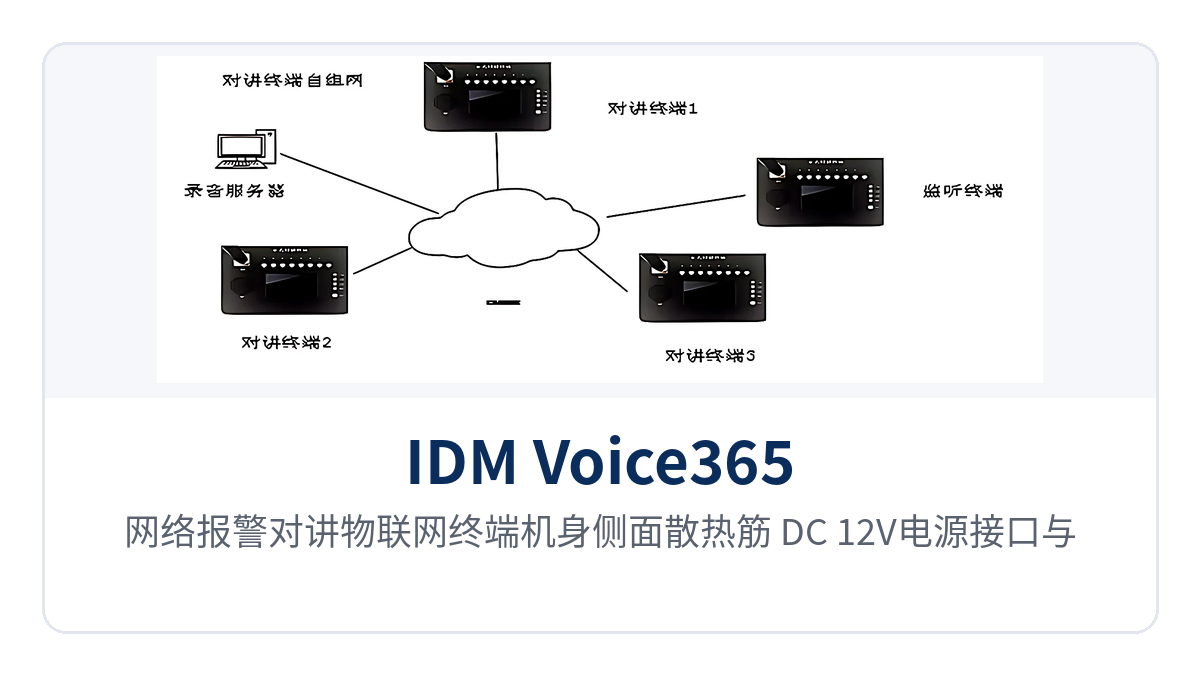
Figure 3: Close-up of the heat dissipation fins, DC 12V power connector, and Ethernet port on the side of the network alarm intercom IoT terminal chassis
How to Network MQTT Audio Intercom: Server Management or Masterless Ad-Hoc Networking?
Both approaches work; the choice depends on whether a stable central server is available on site. When a central equipment room and a fixed IP are available, use server-based registration and management, with terminal configurations delivered centrally. When there is no central node or the link is intermittent, use self-organizing masterless networking, with terminals communicating directly with one another. In a government private network optical fiber communication solution, terminals can backhaul to the equipment room over optical fiber links and be placed under centralized management by the platform.
MQTT audio intercom encapsulates voice into IoT packets for transmission, sharing the same link as on/off signals and status values, so one network carries both voice and IoT data. In the server mode, the platform centrally manages terminal registration, intercom groups, and permissions, and terminals load their configuration from the server after being powered on. As a command and dispatch system manufacturer, Raytrans can provide a complete product showcase and commissioning support from terminals to platform, making it easy for projects to select products uniformly under a smart mining communication solution.
Server-based registration and management: terminals are under centralized management, and intercom groups, permissions, and scenario policies are delivered centrally by the platform, suitable for plants and industrial parks with a fixed equipment room.
Self-organizing masterless networking: does not depend on a central node; a failure of any terminal does not affect calls among the others, giving greater survivability.
Hybrid deployment: when the center is online, terminals run according to server policies; after a link interruption, terminals continue working with the intercom information in local storage.
What Intercom Modes Are Available, and How to Choose on Site?
The four modes correspond to four types of command actions: PTT intercom for immediate announcement, recording intercom to avoid missed listening, monitoring for the center to keep abreast of the site, and speaking for conferences and zone broadcasts. Modes are switched with one key on the chassis, so on-duty personnel do not need to remember complex menus.
PTT intercom: press the PTT key to obtain the talk right and send voice; release it to give up the talk right, suitable for immediate calls in a command and dispatch system.
Recording intercom: press the talk key to record first, then send after releasing the key; the receiver plays it back completely in order and supports replaying the previous message, avoiding missed or misheard messages.
Monitoring mode: used together with the dispatch console; the console shows which terminals are speaking and can designate monitoring targets, and the speaker of the monitored terminal stays muted.
Speaking mode: press the talk key once to start broadcasting and press again to end; during this period other terminals can only listen, so it can serve as a conference network microphone.
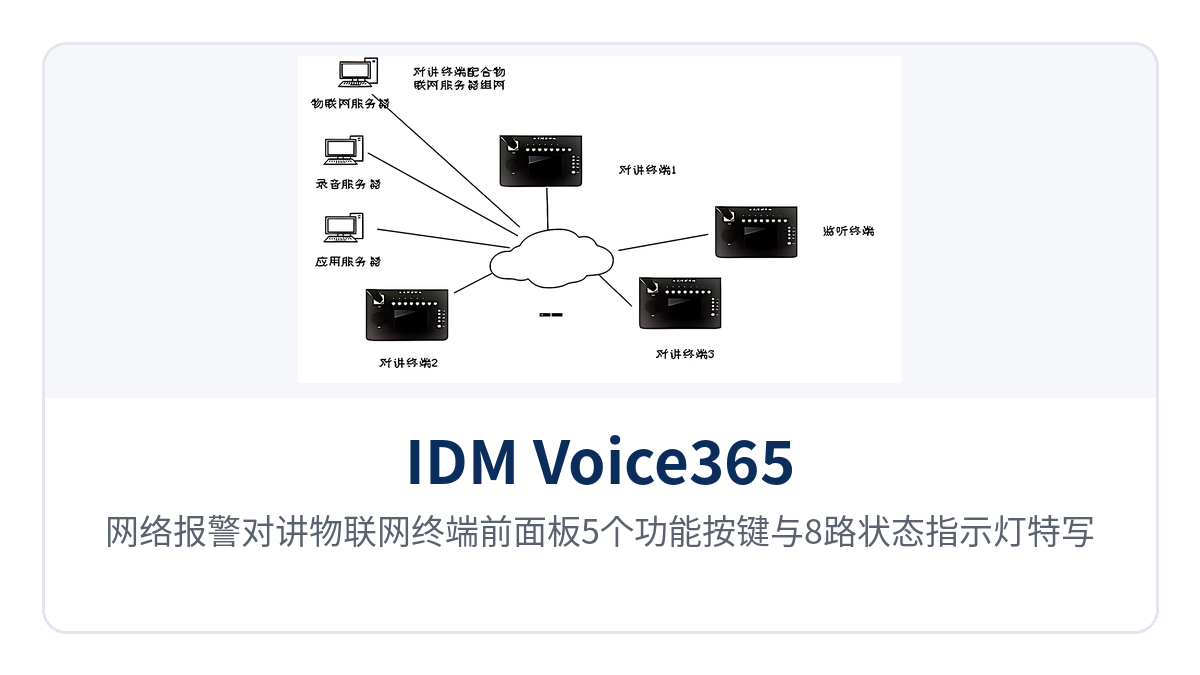
Figure 4: Close-up of the five function keys and eight status indicator LEDs on the front panel of the network alarm intercom IoT terminal
What On-Site Devices Can On/Off Signal Linked Device Control Connect To?
The eight on/off signal inputs and eight status outputs can handle two types of tasks: alarm triggering and scenario selection. The input side connects to keys or dry contacts, and the output side drives indicator LEDs or linked relays. A common engineering practice is to connect dry contact signals such as one-touch alarms, door sensors, water immersion sensors, and smoke detectors to the on/off signal inputs, and then have the platform perform linked actions according to rules.
One-touch alarm: pressing a custom key reports an alarm, and an indicator LED confirms whether the alarm has been sent.
Scenario selection: lighting, curtains, air conditioning and fresh air, and other scenarios are assigned to fixed keys, and one press switches to the corresponding state.
Status feedback: eight independent indicator LEDs show the current status of devices at the remote end or of local channels.
Linked device control: on/off signal outputs work with other execution terminals to perform local or remote linked actions.
Typical Application Scenarios
Industrial Private Network Communication: Voice Intercommunication Between Workshop and Central Control Room
Multiple production lines often run in parallel between workshop operator positions and the central control room, and voice instructions relayed level by level over the telephone are prone to distortion. As an industrial private network intercom terminal, the IDM Voice365 runs over the existing industrial Ethernet, connecting the dispatch console in the central control room and the terminals at each workstation into one intercom group, with point-to-point and group calls completed within the same network. The 10M/100M adaptive interface connects directly to the workshop switch, so no separate cabling is needed for voice; for plants requiring larger-scale networking, the aggregation solution of an industrial Ethernet switch manufacturer can be used to plan voice and data channels uniformly.

Figure 5: Schematic of the network alarm intercom IoT terminal deployed on a desktop, connected to the workshop industrial Ethernet and linked with the dispatch console
On the dispatch console side, historical intercom records can be viewed, members can be muted or put under listen inhibit, work orders can be filled in, and alarm events automatically pop up a work order of the corresponding category for manual confirmation. This closed loop of "voice + work order" gives every announcement a traceable record, so post-shift reviews do not rely on verbal recollection.
Unattended Sites: Low-Power Terminals Online for the Long Term
The O&M difficulty of unattended sites lies in limited power supply and heat dissipation conditions; once a device goes down, a site visit is required. With overall power consumption ≤12W and DC 12V power supply, the terminal can stay online for the long term on a circuit of a small solar panel plus a storage battery. With an operating temperature of -20℃+50℃ and humidity of 095% non-condensing, it can be installed in box-type substations, pump rooms, and field cabinets without air conditioning.
At the site side, the dry contacts of water immersion sensors, door sensors, and smoke detectors are connected to the eight on/off signal inputs; on alarm, the terminal reports actively and the platform pops up a work order, and duty personnel can make an announcement to the site directly to confirm the situation. The O&M party does not need an industrial PC for each site; one terminal handles both voice and status acquisition.
Field and Outdoor Industrial Sites: Reliable Intercom in Wide-Temperature and High-Noise Environments
Sites such as mining areas, pipelines, and water conservancy gate stations are noisy with large temperature differences, where ordinary office intercom devices struggle to run stably over the long term. The terminal processes voice over a HIFI high-fidelity channel with an adjustable sampling rate of 8K~96K; a noise floor of -93dB signal-to-noise ratio together with ALC automatic level control makes announcement volume more consistent between near and far fields. The four-wire interface has a return loss ≥18dB, so long-distance links are less prone to echo and howling.
The site can also connect a wireless trunking gateway interface to extend intercom to handheld radios, so inspection personnel can talk both at the tower base and inside the station. Text-to-speech supports Chinese, English, and digit announcements, so alarm information can be shown on the 4-inch screen and also broadcast directly, with no need to look down at the screen while working with gloves on. When deployed in a mining area, this terminal can serve as the voice node of an intrinsically safe mining communication system, sharing one industrial Ethernet with the positioning and monitoring subsystems in a smart mining communication solution; in government private network scenarios, it can likewise be incorporated into a government private network optical fiber communication solution, interworking with existing SIP telephones and trunking intercom systems through an IP access gateway and placed under centralized management by a command and dispatch system manufacturer, with Raytrans providing product showcase and selection support from terminals to platform.
Conclusion
The network alarm intercom IoT terminal brings voice, alarms, and on/off signal linked device control into one unit, reusing the existing IP network with the MQTT protocol and eliminating dedicated line laying and the assembly of multiple devices. The common requirements of the three scenarios—industrial private networks, unattended sites, and field sites—are long-term online operation, low maintenance, and linked control, and the DC 12V power supply, overall power consumption ≤12W, and -20℃~+50℃ wide-temperature design match exactly these three points.
When selecting, confirm the configuration by three items—"audio interface type + number of on/off signal channels + networking approach"—then check power consumption, temperature, and humidity specifications against the on-site power supply conditions and installation position, and a network alarm intercom IoT terminal can be deployed to a specific site; before delivery, the parameter table in this article can be used for item-by-item comparison.