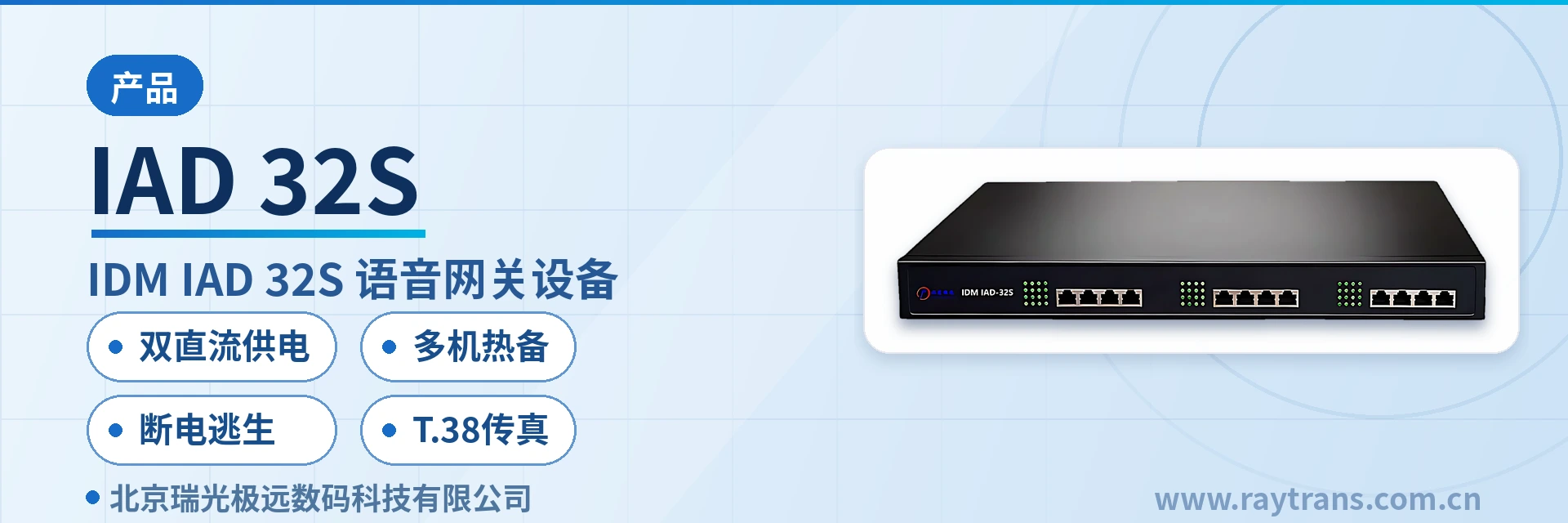
IDM IAD-32S Private Network Dispatching Voice Gateway
SIP/MGCP/IMS three protocols coexist, softswitch, no need for complete unit replacement when upgrading
The IDM IAD-32S is a voice gateway device / integrated access device that supports multiple call control protocols such as SIP, MGCP, and IMS, and provides functions including voice encoding and decoding, fax, QoS, security, reliability, and remote management.
The IDM IAD-32S private network dispatching voice gateway is a voice gateway device designed for private network scenarios such as electric power and energy, rail transit, and military and government, developed by Beijing Ruiguang Jiyuan Digital Technology Co., Ltd., known in the industry as Raytrans. It connects ordinary telephones, fax machines, and computer terminals to the IP voice network and bridges the traditional PSTN telephone network and the IP voice network, providing an uninterrupted voice channel for private network dispatching seats. As a mature IP access gateway, the IDM IAD-32S adopts the standard SIP protocol and is compatible with various IP-PBX and VoIP voice platforms. It supports three call control protocols: SIP/UDP, SIP/TCP (RFC3261), IMS platform (3GPP), and MGCP (RFC3435). The unit is rack-mounted in a 1U form factor and offers single/dual AC power supply or single/dual DC power supply, so it can be deployed directly in DC power supply equipment rooms of industries such as electric power and rail transit. With its stable SIP radio gateway capability, the device can work with terminals such as SIP telephones and serves a wide range of projects undertaken by command and dispatch system manufacturers. Whether for a government private network optical fiber communication solution, a military emergency communications vehicle solution, or a smart mining communication solution, it provides reliable voice access and dispatch support.
Key specifications at a glance: 1 GHz processor · DSP 200 MHz (2 to 6 chips configurable) · SIP/MGCP/IMS call control · single/dual DC -36 to -72V · 128 MB DDR3 + 32 MB Flash · 1U rack-mounted 44×440×260 mm
What kind of device is it?
The IDM IAD-32S private network dispatching voice gateway is a 1U rack-mounted voice access device with multiple interfaces. It can connect ordinary telephones, computers, fax machines, broadband networks, and outside telephone lines, converting analog voice and fax services into IP voice streams and bridging three types of networks: the traditional telephone network (PSTN), the IP voice network, and traditional telephone terminals. In a private network dispatch system, it sits at the access layer: downward it connects telephones and fax machines, and upward it registers with a softswitch platform, IP-PBX, or IMS network through SIP, MGCP, or IMS protocols, with calls dialed in and out uniformly through the dispatch console. As a key model in the product showcase of Raytrans, the IDM IAD-32S bridges the IP access gateway and the SIP radio gateway and can work with SIP telephones to deliver end-to-end voice dispatching access.
The IDM IAD-32S supports dozens of office and dispatch telephone features, including call forwarding, call transfer, three-party call, caller ID, do not disturb, ringback tone, and simultaneous ringing, and also supports distinctive features such as programmable routing and number bitmap, meeting the routing and number management needs of different private networks. The device is rack-mounted (1U, 44×440×260 mm) and can be placed in a standard communications cabinet. Both AC 100 to 240 V and DC -36 to -72 V power supply support dual power supply configuration, making it easy to add directly to an existing private network equipment room without changing the power distribution conditions.
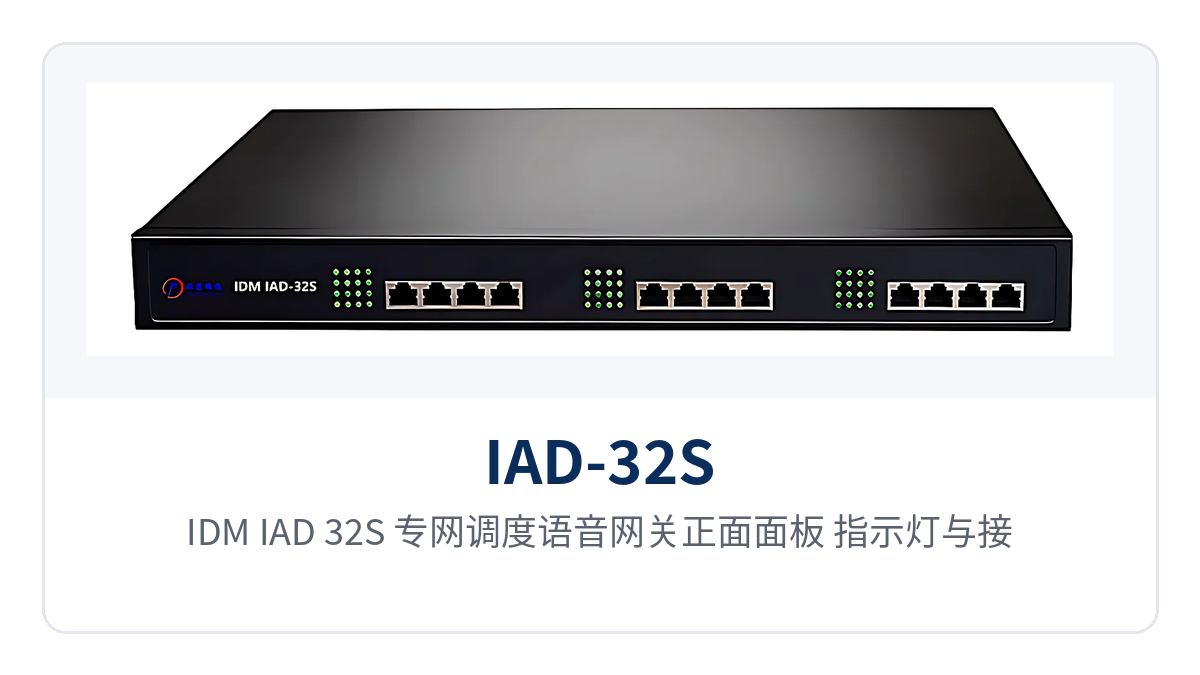
Figure 1: Close-up of the indicator LED and interface layout on the front panel of the IDM IAD-32S private network dispatching voice gateway
Which call control protocols does the voice gateway support?
Which call control protocols a voice gateway supports directly determines whether it can interconnect with an existing dispatching platform. The IDM IAD-32S supports three types of call control protocols at the same time: SIP/UDP and SIP/TCP (RFC3261), IMS platform (3GPP), and MGCP (RFC3435). SIP-based softswitch and IP-PBX platforms use the SIP channel; service provisioning on carrier or government IMS networks uses the IMS platform channel; and some early softswitch devices still use MGCP, which the IDM IAD-32S can also register and interconnect with, so a private network does not have to replace all voice access devices at once during a platform upgrade.
At the network bearer layer, the IDM IAD-32S supports SSH, HTTP, HTTPS, DHCP client, PPPoE client, Radius, DNS, and STUN, adapting to common private network deployment modes such as fixed IP assignment, RADIUS billing and authentication, and NAT traversal. For caller ID, it supports four formats: Bellcore/Teleordia, ETSI, BT, and DTMF, matching caller number transparent transmission when connected to PSTN outside lines.
Overview of functions and protocol parameters
Function | Description |
|---|---|
Call control | SIP/UDP and SIP/TCP (RFC3261), IMS platform (3GPP), MGCP (RFC3435) |
Network protocols | SSH, HTTP, HTTPS, DHCP client, PPPoE client, Radius, DNS, STUN |
Caller ID | Bellcore/Teleordia, ETSI, BT, DTMF |
Voice encoding and decoding | G.711, G.729A, G.723.1, GSM, iLBC |
DTMF | In-band voice transmission, RFC2833, SIP-INFO |
Hook-flash reporting | Local processing, RFC2833, SIP-INFO |
Fax | G.711 fax transparent transmission, T.38 fax automatic switchover (rate 9.6kbps, supporting V.21/V.27ter/V.29 protocols) |
Line release | Busy tone detection, reverse polarity detection, line release on power failure |
QoS | DiffServ, TOS, 802.1P/Q VLAN |
Audio quality enhancement technologies | Echo cancellation (G.168-2004), jitter buffer, silence suppression (VAD, CNG), PLC |
Call conversion | Blind transfer, consultative transfer |
Call forwarding | Unconditional call forwarding, call forwarding on no reply, call forwarding on busy |
Recording storage | Remote recording |
Dispatch and office features | Programmable routing, number bitmap, three-party call, abbreviated dialing, do not disturb, simultaneous ringing, ringback tone, hunt group, distinctive ringing, etc. |
Routing and number conversion | Supports 500 routing and number conversion rules |
Lightning protection | Provides 3.5kV lightning protection |
Security protection and centralized O&M capabilities
Function | Description |
|---|---|
Security protocols | HTTPS, SSH, TLS, SRTP |
Encryption | SIP signaling encryption, encrypted configuration file import/export, password/PIN encryption |
Anti-intrusion | Malicious IP locking, access whitelist, firewall (dynamic defense, static defense, Ping disabled), SIP trusted address, alarms and notifications |
VLAN | DHCP automatic discovery, manual configuration |
VPN client | L2TP, OpenVPN |
NMS platform | Network management system |
Automatic management | File download via TFTP, FTP, HTTP or HTTPS; ACS address obtained through DHCP option 66 or redirection |
Logs | 8-level log management, Syslog |
Data capture | Port voice capture, packet capture |
Status and statistics | Call status and statistics, system status monitoring and statistics |
Version upgrade | Completed through the device Web interface or a configured remote automatic management system |
The capabilities in the table address the actual actions of private network O&M: SIP signaling encryption (TLS) and media stream encryption (SRTP) protect the content of dispatching calls, malicious IP locking, access whitelist and SIP trusted address counter brute-force attacks and SIP attacks, while 8-level logs and Syslog, port voice capture and packet capture provide the basis for fault tracing. During batch deployment, the device can download configuration files via TFTP, FTP, HTTP or HTTPS, and obtain the ACS address through DHCP option 66 or redirection, so that it is configured as soon as it is powered on. As a command and dispatch system manufacturer, Raytrans incorporates the centralized O&M capability of this device into a unified network management system, facilitating large-scale deployment in scenarios such as government private network optical fiber communication solutions, military emergency communications vehicle solutions and smart mining communication solutions.
Private Network Reliability Design: Active/Standby Switchover, Multi-Unit Hot Standby, Load Balancing
The reliability design of the IDM IAD-32S is organized around "uninterrupted dispatching calls" and consists of three parts: power supply, device redundancy and escape.
Reliability item | Implementation | Applicable conditions |
|---|---|---|
Power supply configuration | Single/dual AC power supply (100 | Dual power supply is a redundant configuration; failure of either path does not affect operation |
Network port redundancy | Dual network port redundancy protection | Calls are not interrupted in the event of a local network failure |
Disaster recovery mechanism | Active/standby switchover, multi-unit hot standby, load balancing | Active/standby or cluster parameters need to be configured on the dispatching platform |
Escape mode | Network failure escape, power failure escape | Calls can still be completed when the network or power supply fails |
Line release protection | Line release on power failure, busy tone detection, reverse polarity detection | Interworks with the connection status of PSTN outside lines or telephones |
Active/standby switchover and multi-unit hot standby address "device-level" risks: when a device fails or needs to be shut down for maintenance, registration relationships and calls can be taken over by the backup equipment, and dispatching seats do not need to redial and confirm. Load balancing addresses "traffic-level" risks: multiple devices distribute concurrent calls, preventing a single device from becoming a bottleneck under high call handling. Network failure escape and power failure escape address "extreme failure-level" risks: when the network is interrupted or mains power and DC power supply fail at the same time, the voice channel is still reachable, safeguarding the last call.
Core Performance and Hardware Parameters
Item | Parameter/Specification | Description/Applicable Conditions |
|---|---|---|
Processor (CPU) | 1 GHz | Unit control and call handling |
Voice processor array (DSP) | 200 MHz, 2~6 units configurable | Number of units configured according to traffic |
System memory (RAM) | 128 MB, DDR3 | — |
Flash memory (Flash) | 32 MB | — |
Dimensions (H×W×D) | 44×440×260 mm | 1U, rack-mounted installation |
Weight (net weight) | Within 3 kg | — |
Single/dual AC power supply | 100~240 V, 50/60 Hz, within 1.2 A | Direct power supply access in AC equipment rooms |
Single/dual DC power supply | -36~-72 V, 2 A | Matches industrial private network DC equipment rooms |
Installation method | Rack-mounted | Standard communications cabinet |
Operating environment | Temperature 0~40℃; relative humidity 10%~90% (non-condensing) | Equipment room environment |
Storage environment | Temperature -40~70℃; relative humidity 5%~90% (non-condensing) | Warehousing and transportation |
Typical application scenarios of the private network dispatching voice gateway
Electric power and energy private network: dual DC -36~-72V direct access to the DC equipment room
Communications equipment rooms in the electric power and energy industry generally use a -48 V DC power supply system, and AC distribution is not available everywhere. As an IP access gateway for private network scenarios, the IDM IAD-32S supports single/dual DC power input, with a voltage range of -36~-72 V and a current of 2 A, and can draw power directly from the DC distribution panel in the equipment room without additional inverter equipment. In this scenario, the SIP radio gateway undertakes the connection task between duty telephones at substations and power plants and the dispatching platform, and the dual power supply configuration ensures that calls are not interrupted when either DC circuit fails; SIP signaling encryption and SRTP media encryption meet the private network's requirements for protecting call content, and 8-level logs and port voice capture can be used to review the process of issuing dispatch orders afterwards.
Rail transit and dispatch private network: multi-unit hot standby keeps dispatching seats alive
Rail transit and dispatch private networks are characterized by scattered seats and concentrated traffic, with strict timeliness requirements for call setup. The IDM IAD-32S supports active/standby switchover, multi-unit hot standby and load balancing, and multiple units can form the same voice access resource pool: when a single unit fails, the backup equipment takes over registration and calls, and during high-traffic periods multiple units distribute the concurrent load, so the call setup process between the dispatch console and duty telephones remains transparent to the duty operator. On the equipment room side, the network management system provides unified management of device status and call statistics, and combined with logs and data capture it locates connection anomalies, reducing on-site troubleshooting trips.
Military and government private network: network failure escape and power failure escape preserve the last call
The communication requirement of military and government private networks is "there must still be a means under failure". The IDM IAD-32S provides two mechanisms, network failure escape and power failure escape: when the network link is interrupted, the voice channel can still complete calls; when the power supply fails, the line release on power failure mechanism maintains the line in a usable state, preventing an entire area from being completely cut off by a single failure. The device also supports L2TP, OpenVPN client, and protection measures such as malicious IP locking, access whitelist and Ping prohibition, balancing "reachability under failure" and "security in normal times". When deployed in a private network DC equipment room, the combination of dual DC -36~-72V power supply and network failure escape and power failure escape forms a fallback voice channel under extreme failures.
How to select a private network voice gateway?
For how to select a private network voice gateway, it is recommended to check item by item in the order of "protocol first, then power supply, then disaster recovery", and compare peripheral functions only after the four hard constraints are met.
Selection dimension | Suggested items to check | Basis for judgment |
|---|---|---|
Protocol interfacing | Whether the platform uses SIP, IMS or MGCP | The three protocols must be consistent with the existing dispatching platform; the IDM IAD-32S supports all of them |
Power supply format | Whether the equipment room uses an AC 220 V or DC -48 V system | For DC equipment rooms, select the single/dual DC -36~-72V model |
Disaster recovery level | Standalone unit, active/standby or multi-unit hot standby | Hot standby is recommended for dispatching seats and important duty telephones |
Escape capability | Whether calls must still be possible under network failure and power failure | For emergency dispatching private networks, both escape mechanisms are recommended |
Fax requirements | Whether fax services are carried | Select equipment that supports T.38 fax automatic switching |
O&M approach | Whether centralized network management and batch configuration are required | Check the network management system, ACS automatic configuration and log capabilities |
The specialized nature of fax services is easily overlooked: G.711 fax transparent transmission tends to fail under packet loss and jitter, while the IDM IAD-32S uses T.38 fax automatic switching (rate 9.6kbps, supporting V.21/V.27ter/V.29 protocols), converting fax signals into T.38 messages for transmission on the IP side, which improves the success rate of fax sending and receiving over private networks. During selection, operating environment specifications should also be checked: the device's operating temperature is 0~40℃ and relative humidity is 10%~90% (non-condensing); outdoor cabinet scenarios beyond this range require separate confirmation of installation conditions.
Summary: Selection and Deployment Points for Private Network Dispatch Voice Gateways
The IDM IAD-32S private network dispatch voice gateway does three things in one 1U rack-mounted device: first, protocol interfacing, with SIP, MGCP, and IMS call control modes compatible with both existing and new dispatch platforms; second, private network power supply adaptation, with single/dual DC -36~-72V feeding directly into industrial private network DC equipment rooms; third, failure fallback, combining active/standby switchover, multi-unit hot standby, load balancing, and network outage and power failure escape to ensure dispatching calls are not interrupted. As a professional command and dispatch system manufacturer, Raytrans serves private network users in electric power and energy, rail transit, and military and government sectors, providing complete support from product showcase to solution implementation. During selection, first confirm whether the protocol and power supply format match the on-site conditions, then determine the hot standby level and escape requirements according to the importance of the dispatching seat; for fax services, centralized network management, and batch configuration requirements, verify T.38, the network management system, and ACS automatic configuration capabilities respectively. Whether for a government private network optical fiber communication solution, a military emergency communications vehicle solution, or a smart mining communication solution, overall planning can be carried out in combination with devices such as SIP radio gateways, SIP telephones, and IP access gateways to ensure stable and reliable dispatching calls.