IDM MEETING1000R Conference Management Device
16 IP directions, dual-unit cascading for 32-party full-duplex · VAD/PTT speaking · Conference room and member recording
The IDM MEETING1000R IP conference management device manages conferences over an IP network and provides 16 IP directions of full-duplex conference rooms, with each IP direction supporting up to 4 channels of audio access. By cascading two units, it can provide 32 IP directions of full-duplex IP audio conferencing.
The IDM MEETING1000R IP audio conference management device is an IP conference management device developed by Beijing Ruiguang Jiyuan Digital Technology Co., Ltd. It consists of two parts: the conference management end MCU and the conference terminal, and organizes and manages conferences over an IP network. As a professional IP conference management device, the IDM MEETING1000R standalone unit can provide 16 IP-direction full-duplex conference rooms, with up to 4 channels of audio access per IP direction; when two devices are used in parallel, it can be expanded to 32 IP-direction full-duplex IP audio conferences. Raytrans has long been deeply engaged in the field of IP access gateways and command and dispatch system manufacturers, and this product can also serve as a core component of a domestic operating system conference dispatching solution, widely adapting to scenarios such as government private network optical fiber communication solutions and military emergency communications vehicle solutions.
Key Specifications at a Glance: 16 IP directions · up to 4 channels of audio access per direction · 32-party full-duplex with two units in parallel · VAD/PTT speaking · conference room and member recording · domestic OS + API secondary development
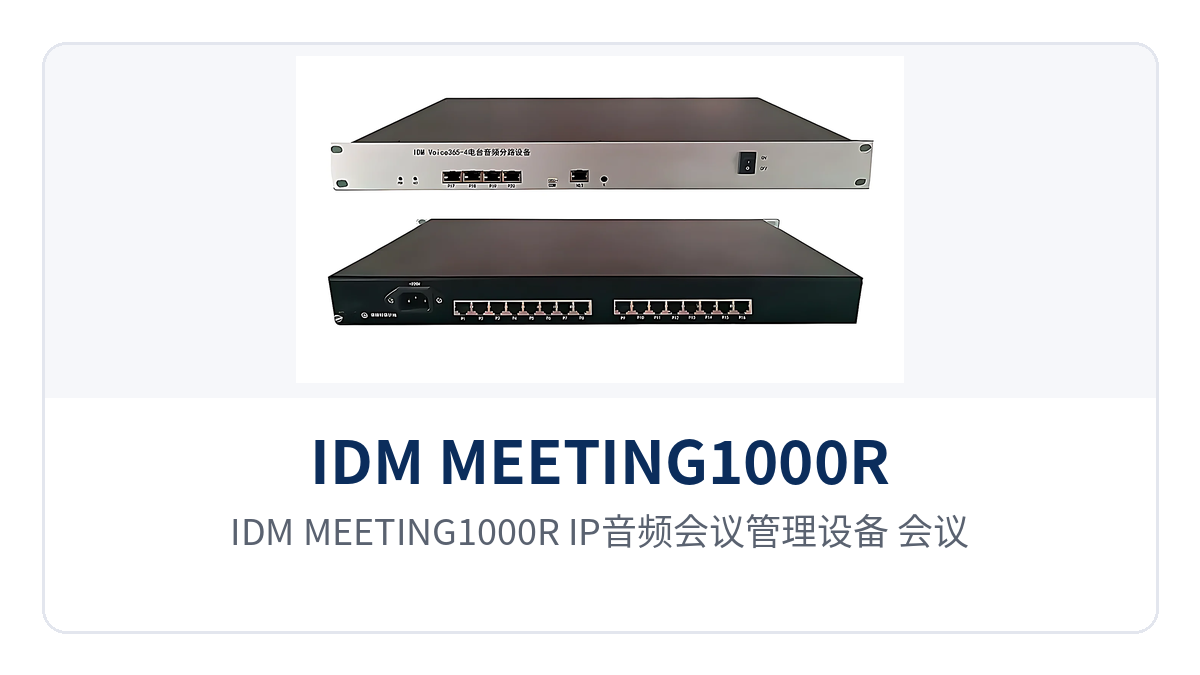
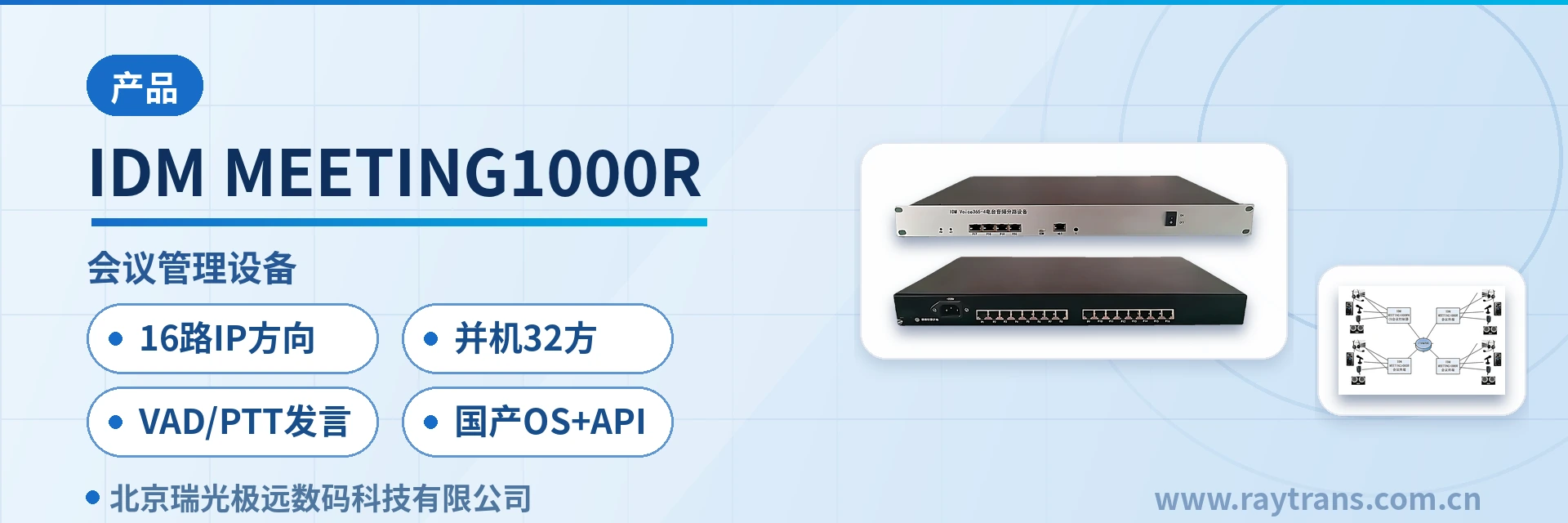
Figure 1: IDM MEETING1000R IP audio conference management device (conference management end MCU) overall front view with close-ups of indicator LEDs and interfaces
What is an IP audio conference management device? How do 16 IP directions on a standalone unit and 32 parties with two units scale up
An IP audio conference management device is a device that completes conference organization and speech synthesis over an IP network, determining which members join a conference, who is speaking, and how conference voice is recorded and retained. As a core category among IP conference management devices, it is often deployed in conjunction with overall solutions provided by IP access gateway and command and dispatch system manufacturers, for scenarios such as government private network optical fiber communication solutions and military emergency communications vehicle solutions.
The IDM MEETING1000R consists of two parts, the conference management end MCU and the conference terminal, which have different roles. The conference terminal supports 4 IP directions and has relatively small conference control capability, making it suitable for audio access on the conference room and duty point side; the MCU can support 32 IP directions and undertakes the speech synthesis and centralized control of a 32-party full-duplex conference.
A single IDM MEETING1000R can provide 16 IP-direction full-duplex conference rooms, with up to 4 channels of audio access per IP direction. When a larger scale is required, two devices are used in parallel to expand to a 32 IP-direction full-duplex IP audio conference; during capacity expansion, the conference terminals are not replaced, and one additional device is simply added in parallel mode. Raytrans provides a complete product showcase and technical documentation for this product series, making it easy to compare during project selection.
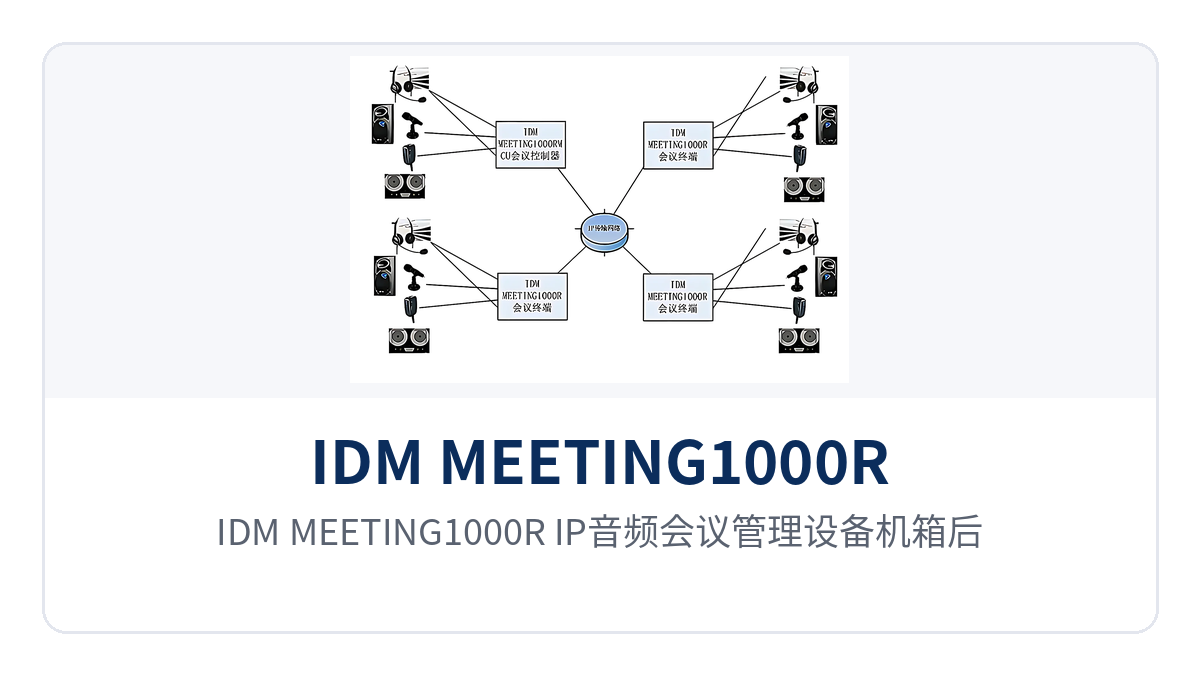
Figure 2: Close-up of the rear panel interfaces and cable connections of the IDM MEETING1000R IP audio conference management device enclosure
What are the core functions? From conference pre-defined plans to recording retention
The functions of the IDM MEETING1000R revolve around three threads: conference organization, speaking control, and voice retention. Conference members and recording can both be adjusted as required through the dispatch console.
Function | Description |
|---|---|
Conference pre-defined plan | Members participating in different conferences are stored separately in different conference pre-defined plans. When holding a conference, first select "Start Conference" and then select the plan name to send a call tone to the participating parties and quickly convene the conference |
Adding and removing participating members | After a conference is started, participating members can still be added and removed; after modification, the system prompts whether to retain the changes in the pre-defined plan |
Listen inhibit and mute | Members in a conference room can be set to listen inhibit and mute, and the configuration can also be set in the pre-defined plan; the default value is that all can speak and listen |
VAD and PTT speaking | Conference members can be set to VAD voice activation mode or PTT mode; members can speak in the corresponding way as long as they are not muted |
Conference room recording | The dispatch console issues a recording command for the entire conference room; the recording result is stored on the server and can be retrieved by the dispatch console at any time |
Member recording | The dispatch console can issue a recording command to an individual member; the recording result is stored on the server and can be retrieved at any time |
Channel volume adjustment | The channel volume of a member can be adjusted on the dispatch console |
Secondary development interface | The system adopts a BS programming architecture and a cross-platform programming mode, provides API functions, and supports secondary development |
Running on a domestic operating system | The dispatch server and dispatch console interface can run on a domestic operating system |
Local member access | Local user members can use a handset with PTT, or configure a headset with a PTT socket function; ordinary headsets need to be modified with an RJ45 connector |
Technical Specifications
Item | Parameter/Specification | Description/Applicable Conditions |
|---|---|---|
Standalone unit IP directions | 16 | A single device can provide full-duplex conference rooms in 16 IP directions |
Audio access per IP direction | Up to 4 channels | Each IP direction supports up to 4 channels of audio access |
Dual-unit cascaded IP directions | 32 | Two cascaded devices can provide full-duplex IP audio conferences in 32 IP directions |
Conference management MCU | Supports 32 IP directions | Supports 32-party full-duplex conference capability |
Conference terminal | 4 IP directions | Provides limited conference control capability |
Full-duplex conference room | Anyone can speak at will | Full-duplex means everyone can speak at will without taking turns to request the right to speak |
Speech synthesis parties | Usually 4 or 8 parties (configurable) | To ensure conference voice quality, the number of parties involved in speech synthesis can be configured per project |
System architecture | BS programming architecture, cross-platform | The dispatch server and dispatch console interface can run on domestically produced operating systems, with API functions provided for secondary development |
Recording storage | Stored on the server | The dispatch console issues a recording command, and the recording is stored on the server for retrieval at any time |
Local access peripherals | PTT hand microphone / PTT headset with connector | Ordinary headsets require modification to an RJ45 connector |
How to hold a full-duplex IP audio conference? Conference pre-defined plans and member management
The key to holding a full-duplex IP audio conference lies in saving frequently held conferences in advance as "conference pre-defined plans." To start a conference quickly, members attending different conferences can be stored in different conference pre-defined plans; when holding a conference, first press "Start Conference," then select the required conference pre-defined plan name, and the system sends a call tone to the participating parties, which enter the full-duplex conference room after answering.
A full-duplex conference room allows everyone to speak at will without taking turns to request the right to speak. To ensure conference voice quality, the number of parties involved in speech synthesis is usually configured as 4 or 8 parties; this parameter can be adjusted per project, and the fewer the parties involved in synthesis, the easier it is to maintain the clarity of each voice channel.
After a conference is started, participating members can also be added and deleted. After modification, the system prompts whether to save the changes to the pre-defined plan, turning temporary adjustments into a fixed pre-defined plan. Members in the conference room can be set to "listen inhibit" and "mute," and these configurations can also be set in the pre-defined plan; the default value is that all can speak and listen. In dispatching scenarios, the main dispatcher unit remains able to listen and speak while the other members are set to listen only, using mute to concentrate the right to speak at the command end. This capability is particularly common in dispatch platform integration by command and dispatch system manufacturers, and can interconnect with an IP access gateway to be incorporated into a government private network optical fiber communication solution or a military emergency communications vehicle solution.
How to configure VAD and PTT speaking? Usage of the two speaking modes
How to configure VAD and PTT speaking depends on whether the site requires hands-free speaking or push-to-talk speaking. Conference members can be set to VAD voice activation mode or PTT mode, and members can speak in these ways when they are not muted.
VAD voice activation mode automatically occupies the speaking channel when valid voice is picked up, making it suitable for desktop conferences and hands-free speaking occasions. PTT mode requires holding down the talk key to speak, making it suitable for command positions and sites with high ambient noise, and it prevents ambient noise from mistakenly occupying the speaking channel.
When local user members use these two modes, matching peripherals are required: local members can use a hand microphone with PTT, or a headset configured with a PTT connector function; ordinary headsets require modification to an RJ45 connector before they can be connected. To adjust the listening volume of a member during a conference, the volume of that member's channel can be adjusted on the dispatch console.
How is recording retained? Conference room recording and member recording
Recording capability has two granularities: the dispatch console can record an entire conference room or a single member. When recording a conference room, the dispatch console issues a recording command, and the voice of the entire conference room is synthesized into one record; when recording a member, only the voice of that member's channel is recorded.
Recording results are stored on the server for retrieval by the dispatch console at any time. Consultation content, instruction delivery and personnel speech during dispatching can all be retained, for traceability of dispatch orders, meeting minutes review and responsibility determination.
BS architecture and domestically produced operating systems: how to make the conference system independently controllable
The entire system adopts a BS programming architecture and a cross-platform programming model. The dispatch server and dispatch console interface can both run on domestically produced operating systems, facilitating independently controllable deployment within a private network. Raytrans provides a complete product showcase and technical support for conference dispatching solutions on domestically produced operating systems, and can be incorporated together with IP conference management devices and full-duplex IP audio conference systems into the overall design of a government private network optical fiber communication solution or a military emergency communications vehicle solution.
The system provides API functions for secondary development, enabling capabilities such as conference start, member management and recording retrieval to be integrated into existing dispatching platforms or service systems, without the need to repeatedly develop conference functions for each service system.
Typical application scenarios
Electric power/energy dispatching private network
Electric power and energy dispatching private networks have many voice channels and scattered duty sites, and substations, centralized control stations and the dispatch center need both point-to-point calls and multi-party consultation. As professional IP conference management equipment, the IDM MEETING1000R IP audio conference management device provides full-duplex conference rooms in 16 IP directions as a standalone unit, with up to 4 channels of audio access per direction, and can organize dispatch desks, maintenance teams and on-site PA terminals into the same full-duplex IP audio conference system. Before a conference, participating members from different disciplines are stored separately as conference pre-defined plans; in an emergency, press "Start Conference" and select a plan, and the conference is established as soon as the call tone is sent. When a larger consultation scale is required, two cascaded devices expand to a 32-party full-duplex conference, and the conference scope expands with the number of sites.
Rail transit/airport command and dispatch
The dispatching targets of rail transit and airports are distributed along lines, stations and yards, with few on-duty personnel but frequent collaboration, requiring remote consultation, emergency announcement and traceability of the process in daily operations. The IDM MEETING1000R IP audio conference management device carries full-duplex conferences over the IP network, so stations do not need to lay a dedicated conference line for a single consultation. Conference members can be set to VAD voice activation mode, so duty operators can speak as soon as they sit down; command positions use PTT push-to-talk to speak, preventing ambient noise from mistakenly occupying the channel. After the conference, the dispatch console records the conference room or key members, and the recording results are stored on the server for retrieval and verification at any time.
National defense/emergency command communications
Military and emergency command scenarios require the conference system to be enabled quickly and to allocate the right to speak according to the command hierarchy. The IDM MEETING1000R IP audio conference management device places conference organization, recording retention and secondary development interfaces in the same system: members attending different conferences are stored in conference pre-defined plans in advance and enabled with one touch during assembly; conference room members can be set to listen inhibit and mute, concentrating the right to speak and the listening scope of the main dispatcher unit to the required party; the entire system adopts a BS cross-platform architecture, and the dispatch server and dispatch console interface can run on domestically produced operating systems, facilitating deployment in an independently controllable environment.
Differentiated value: standalone capacity expansion, speaking control and recording retention
Differentiated Selling Points | Implementation | Value to Users |
|---|---|---|
16 IP directions in a standalone unit, expandable to a 32-party full-duplex IP audio conference by stacking two units | A single unit provides 16 IP-direction full-duplex conference rooms, each supporting up to 4-channel audio access; two stacked units expand this to 32 IP directions | Conference scale expands as required: start with a standalone unit for 16 parties, then stack to 32 parties without replacing conference terminals |
Supports VAD voice activation and PTT speaking modes, with configurable listen inhibit and mute, suitable for private network command | Members can be set to VAD voice activation or PTT mode; listen inhibit and mute can be saved to conference pre-defined plans, and by default all can speak and listen | Hands-free conferencing and push-to-talk command habits are both supported by the same system, and speaking rights converge according to the command hierarchy |
The dispatch console can record a conference room or an individual member and store the recording on the server for retrieval at any time | The dispatch console issues a recording command, and the recording is stored on the server | Conference and key member voice is fully retained, and dispatch orders can be traced back |