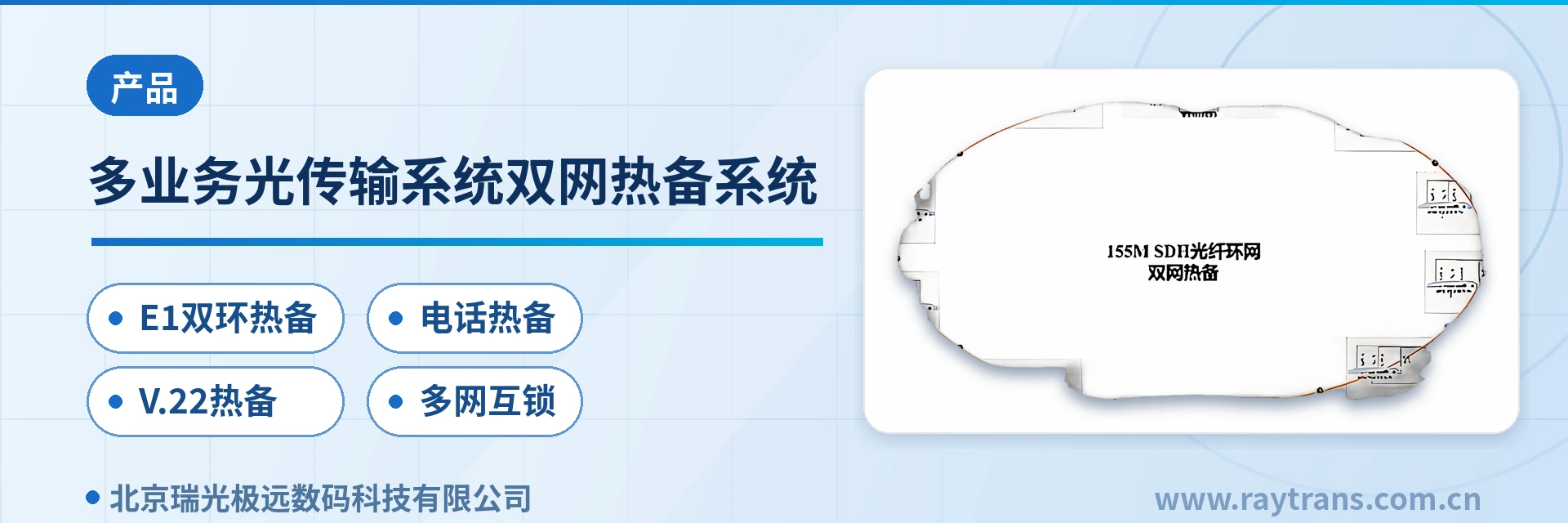
Multi-Service Optical Transmission System Dual-Network Hot Standby System
E1, telephone, V.22, channel-level switchover, multi-network interlock, alarm switchback to standby
In some important remote dispatch and control sites (such as subways, airports, and military), very high system reliability is often required. Services are frequently transmitted over two or more networks, and subscriber terminals can automatically select a normal transmission network.
The dual-network hot standby system for multi-service optical transmission systems is a service-level hot standby protection system developed by Beijing Ruiguang Jiyuan Digital Technology Co., Ltd. for remote dispatch and control sites. It carries services such as E1, telephone and V.22 simultaneously over two or more transmission networks. When a primary ring device fails or a service channel generates an alarm, the corresponding channel service is automatically switched to the backup ring transmission equipment, and the receiver automatically selects the normal transmission network and channel, so subscriber terminals do not need to care which ring the service is currently using. As a professional SDH equipment manufacturer, Raytrans deeply integrates SDH technology into this system, making it perform well in government private network optical fiber communication solutions, military emergency communications vehicle solutions and dual-network hot standby solutions for subway dispatch and control private networks. The system is suitable for subway/metro dispatch and control private networks, airport/air traffic control remote dispatch private networks, military/national defense remote command private networks and other sites with high requirements for system reliability, with design goals of high reliability, strong maintainability and independent control by the network management of multiple networks. For scenarios requiring multi-service optical multiplexers, the system also provides comprehensive product showcase and technical support, fully demonstrating the R&D strength of an optical multiplexer manufacturer.
Key Specifications at a Glance: E1 dual-ring hot standby · Telephone hot standby · V.22 hot standby · Multi-network interlock · Channel-level automatic switchover · Independent control by the network management of multiple networks
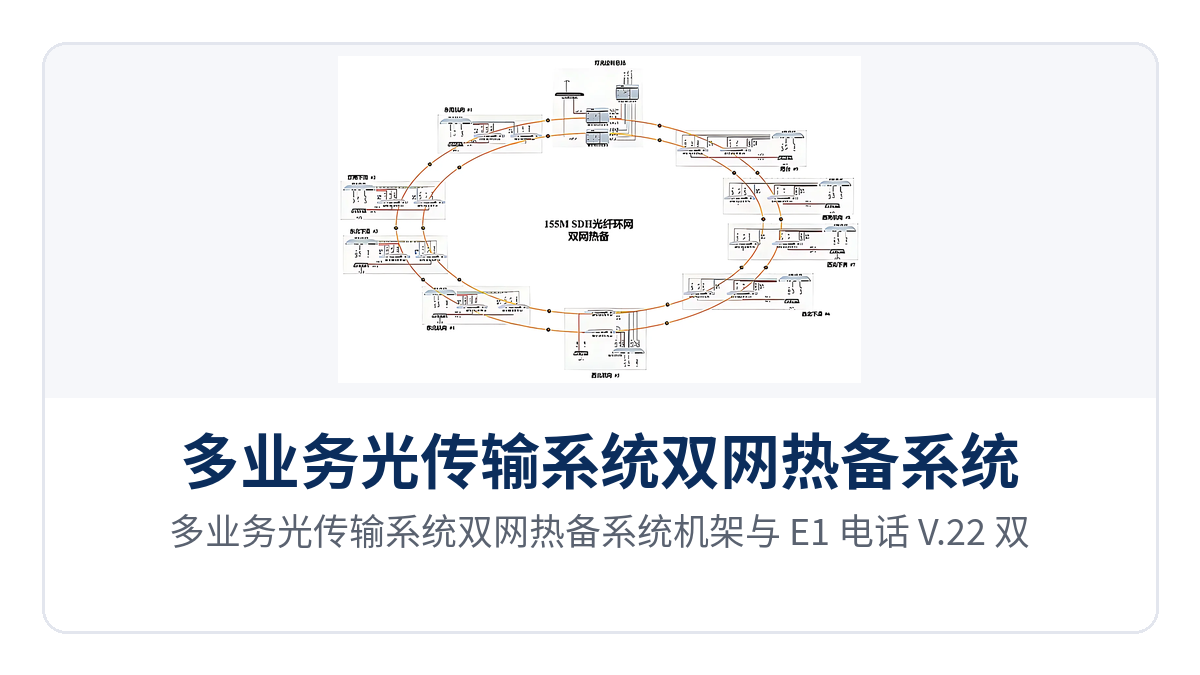
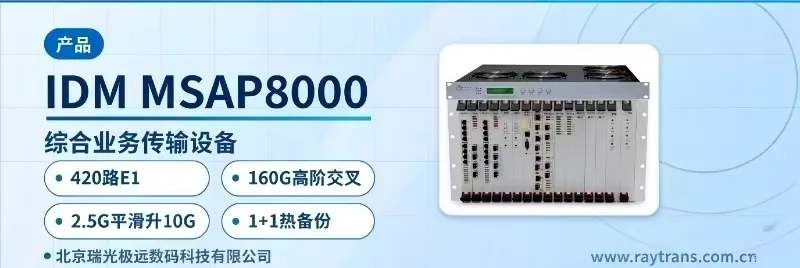
Figure 1: Close-up of the rack of the dual-network hot standby system for multi-service optical transmission systems and the E1, telephone and V.22 dual-ring switching interfaces
What Is the Dual-Network Hot Standby System for Multi-Service Optical Transmission Systems?
The dual-network hot standby system for multi-service optical transmission systems is a service automatic switchover system installed on the receiving and aggregation side of service traffic, providing dual-ring hot standby protection for services such as E1, telephone and V.22. As a professional SDH product showcase solution, the system does not change the networking approach of existing transmission equipment, but inserts a switching stage between the subscriber interfaces and the two transmission networks: the same service is transmitted over both the primary ring and the backup ring simultaneously, and the alarm status of the equipment and channels on both rings is continuously monitored to decide which side's service is actually delivered to the user.
Remote dispatch and control sites such as subways, airports and military sites often require services to be transmitted over two or more networks, with subscriber terminals able to automatically select the normal transmission network and channel. Such systems require the switching system itself to have high reliability and strong maintainability, to be able to receive independent control from the network management of several networks, and to switch automatically according to service interface status. To reduce the probability of failure in the switching stage itself, the system is designed to use as few active components as possible and is equipped with a multi-network switching interlock function to prevent multiple networks from being bypassed at the same time. SDH equipment manufacturers represented by Raytrans have incorporated such dual-network hot standby capabilities into the standard configuration of government private network optical fiber communication solutions, military emergency communications vehicle solutions and dual-network hot standby solutions for subway dispatch and control private networks in the R&D of multi-service optical multiplexers and optical multiplexer manufacturer products.
How Are E1, Telephone and V.22 Services Automatically Switched to the Backup Ring When the Primary Ring Fails?
The dual-network hot standby switching device is mainly driven by alarms: it collects the alarm status of primary ring equipment and service channels and uses the alarm status as the switching criterion. When a primary ring device fails, or a service (E1, telephone and V.22) generates a channel alarm, the dual-network hot standby switching device automatically switches the corresponding channel service to the backup ring transmission equipment according to the monitored alarm status.
Channel-level automatic switchover is the basic granularity of dual-network hot standby: whichever service fails or generates an alarm is switched, while the other unaffected channels keep their original paths, avoiding switchover of all services in the unit at once. The judgment is completed on the digital line, and the switching action is transparent to upper-layer services, so subscriber terminals do not need to redial or reconnect.
Knowledge Block: Automatic Alarm Switchover and Standby for Switchback
Automatic alarm switchover means the switching criterion comes from the alarm status of equipment and channels — as soon as a primary ring device fails or an E1, telephone or V.22 service channel alarm appears, the system switches the corresponding channel to the backup ring without manual commands. Standby for switchback means that after the original primary equipment failure is cleared or the service channel alarm disappears, that side no longer forcibly occupies the service but stands by as backup equipment, reserving resources for the next failure switchover. Together, the two keep dual-network hot standby behavior predictable across multiple failure and recovery processes.
What Is the Difference Between Dual-Network Hot Standby and Dual-Interface, Dual-Board and Dual-Unit Mutual Backup?
Common methods for enhancing system reliability include dual-interface (such as dual optical ports, or optical-electrical mutual backup) mutual backup, dual-board mutual backup, dual-unit mutual backup and dual-network mutual backup, and dual-network hot standby belongs to the dual-network mutual backup approach. Dual-interface mutual backup means one device has two optical ports or optical-electrical mutual backup; dual-board mutual backup is mostly used inside equipment, such as dual power cards and dual main control cards; dual-unit mutual backup is divided into cold standby and hot standby; dual-network hot standby lets every service be transmitted over both the primary ring and the backup ring networks, with optimal selection at the receiving end.
Backup Method | Protected Object | Typical Use |
|---|---|---|
Dual-interface mutual backup | Optical ports or optical-electrical interfaces of the device | One device provides dual optical ports or optical-electrical mutual backup |
Dual-board mutual backup | Individual boards inside the device | Dual power cards, dual main control cards, etc. |
Dual-unit mutual backup | The entire device | Cold standby or hot standby, replacement of the complete unit |
Dual-network hot standby | Service channels and transmission networks | E1, telephone and V.22 services are transmitted over both the primary and backup rings simultaneously, with optimal selection at the receiving end |
The four approaches can be used in combination: dual-network hot standby handles redundancy at the network and channel level, while dual-interface, dual-board and dual-unit mutual backup handle redundancy at the device and component level. Only together can they cover multi-level failure scenarios from optical ports to the complete unit. As an experienced SDH equipment manufacturer and optical multiplexer manufacturer, Raytrans supports the above backup mechanisms simultaneously in its multi-service optical multiplexer products, providing complete SDH product showcase and technical support for scenarios such as dual-network hot standby solutions for subway dispatch and control private networks.
How Are the Three Service Types E1, Telephone and V.22 Handled Respectively?
The same switching system adopts different optimal-selection criteria for different service types. E1 circuits use channel alarms as the main criterion, and a primary ring E1 channel alarm triggers switchover to the backup ring; telephone services prioritize signaling status, and when the signaling status is the same, whether there is voice data is judged next; if both signaling and data are the same, the default network is preferred; narrowband data services such as V.22 send the same content over both networks simultaneously, and the receiving end performs optimal selection.
These judgments are all implemented on the digital line, making the switching result consistent with the actual availability of the service rather than judging only by link continuity. Data channels are generally not switched directly due to line bit errors; when line bit errors occur, a switching command is issued through the network management system, handing the bit error risk to a human-controllable operation and maintenance process.
System Functions and Performance Specifications
Function | Description |
|---|---|
Dual-network hot standby protection | Services such as E1, telephone and V.22 are carried over both the primary and backup ring networks, and transmission continues on the backup side when the primary side fails |
Automatic alarm switchover | When a primary ring device fails or a service (E1, telephone, V.22) channel generates an alarm, the corresponding channel service is automatically switched to the backup ring according to the monitored alarm status |
Standby for switchback | After the original primary equipment failure is cleared or the service channel alarm disappears, the original primary side stands by as backup equipment, reserving resources for the next failure switchover |
Channel-level switchover | The switching action is performed per service channel, switching only the channel that fails or generates an alarm, without affecting other channels |
Transparent optimal selection for terminals | The receiving end automatically selects the normal transmission network and channel, and subscriber terminals do not need to manually specify which ring to use |
Independent control by the network management of multiple networks | Control and switching commands can be independently issued by the network management of several networks, enabling per-network management |
Multi-network switching interlock | Multi-network switching has an interlock function to prevent multiple networks from being bypassed at the same time or command conflicts causing mis-switching and network conflicts |
Few active components | As few active components as possible are used to reduce the failure rate of the switching system itself at the source |
Item | Parameter/Specification | Description/Applicable Conditions |
|---|---|---|
Carried service types | E1, telephone, V.22, etc. | Hot standby protection is implemented based on service channel alarms |
Number of transmission networks | Two or more networks (active ring, standby ring) | Services are transmitted over multiple networks simultaneously, and the receiver selects the better one |
Switchover trigger conditions | Active ring equipment failure, service (E1, telephone, V.22) channel alarms | Triggered by the monitored alarm status |
Switchover granularity | Channel level | Switchover is performed channel by channel for the channel where a failure or alarm occurs |
Reset mode | After the failure is cleared or the alarm disappears, the channel switches to standby | No manual intervention is required; the system waits for the next failure switchover |
Network management control | Independent control by multiple network management systems + switchover interlock | Each network management system issues orders independently, and the interlock prevents incorrect switchover |
Service interfaces | E1, telephone, V.22 | The specific interface type and quantity are subject to the manufacturer's technical documentation |
Equipment form factor and dimensions | Not yet recorded in the knowledge base | Subject to the manufacturer's technical documentation |
Power supply and power consumption | Not yet recorded in the knowledge base | Subject to the manufacturer's technical documentation |
Core Value of the Dual-Network Hot Standby System for Multi-Service Optical Transmission Systems
Three value lines run through the dual-network hot standby system for multi-service optical transmission systems: dual-ring hot standby for E1, telephone and V.22 services, with automatic switchover to the standby ring upon an active ring failure and transparent selection of the better path at the terminal; automatic switchback to standby after the alarm disappears, with no manual intervention and strong maintainability; and support for independent control by multiple network management systems, with a multi-network switchover interlock function.
Differentiation Point | Value Description |
|---|---|
Dual-ring hot standby for E1/telephone/V.22 services, with automatic switchover to the standby ring upon an active ring failure | E1, telephone and V.22 channels are transmitted over both the active ring and the standby ring simultaneously. When the active ring is unavailable, the channels are switched to the standby ring based on the alarm status, and the receiver completes the selection of the better path, so subscriber terminals do not need to care which ring the service is currently using |
Automatic switchback to standby after the alarm disappears, with no manual intervention and strong maintainability | Switchover is triggered as soon as an active ring equipment failure or service channel alarm occurs. After the failure is cleared and the alarm disappears, the original active side automatically becomes standby equipment. The whole process is completed channel by channel, so O&M personnel do not need to operate on each channel on site |
Support for independent control by multiple network management systems, with a multi-network switchover interlock function | The system can receive orders issued independently by the network management systems of multiple networks. The multi-network switchover interlock constrains the switchover actions of each network, preventing incorrect switchover caused by simultaneous bypassing of multiple networks or conflicting orders |
As a professional SDH equipment manufacturer, Raytrans provides multi-service optical multiplexers that have been widely used in critical fields such as government private network optical fiber communication solutions, military emergency communications vehicle solutions and dual-network hot standby solutions for subway dispatch control private networks. With reliable SDH product showcase and deep technical accumulation, Raytrans continues to build high-reliability optical transmission networks for customers across industries.
Typical Application Scenarios
Subway/Urban Rail Dispatch Control Private Network
The dispatch control private network of subways and urban rail carries voice and E1 channel services such as train dispatch, power dispatch and environment control dispatch. Lines are laid underground and on elevated sections, and a link or system failure directly affects train command. As a professional SDH equipment manufacturer and optical multiplexer manufacturer, Raytrans has launched the dual-network hot standby solution for subway dispatch control private networks for this scenario. It uses multi-service optical multiplexers and SDH equipment to build a multi-service optical transmission system, placing dispatch voice and E1 channel services in hot standby over two transmission rings. When an active ring equipment failure or channel alarm occurs, the system automatically switches to the standby ring. Channel-level switchover affects only the faulty channel, while other dispatch channels keep their original paths, helping the dispatch center continue to monitor the operating status of the entire line under a single point of failure.
Airport/ATC Remote Dispatch Private Network
The remote dispatch private network of airports and air traffic control carries control tower and ground voice, air traffic control data and timing information, and channel continuity is directly related to operational safety. The dual-network hot standby system for multi-service optical transmission systems, built by Raytrans with multi-service optical multiplexers and SDH equipment, implements dual-network hot standby for services such as telephone and V.22. When the active ring is unavailable, the system automatically switches to the standby ring transmission equipment based on the alarm status, and the receiver completes the selection of the better path, so the transmission paths of control tower voice and air traffic control data are redundantly protected when a single network fails. Multiple network management systems can be controlled independently and feature a switchover interlock, avoiding mutual interference between multi-network management actions.
Military/National Defense Remote Command Private Network
Military and national defense remote command private networks have high requirements for both redundancy and controllability, and communication links need to operate stably at fixed sites and under mobile conditions. Raytrans' military emergency communications vehicle solution relies on multi-service optical multiplexers and SDH equipment to form a dual-network hot standby system for multi-service optical transmission systems. Its design minimizes the use of active components to reduce its own failure rate, implements dual-network hot standby for E1, telephone and V.22 services, switches upon an alarm and switches back to standby once the alarm disappears, with channel-level automatic switchover requiring no manual intervention. Independent control by multiple network management systems and the switchover interlock keep an available path for the command link even when the active network fails.
FAQs
What are the features of SDH technology and MSTP products?
I. Development Directions of Next-Generation SDH Technology and Products Regarding the development direction of…
View answerWhat is the difference between PDH and SDH?
I. PDH PDH is the Plesiochronous Digital Hierarchy, which is divided into the European standard and the…
View answerWhat is an E1 line? What are the core knowledge points?
E1 Basics Frame Structure of the E1 Channel In an E1 channel, 8 bits form one timeslot (TS)…
View answerLow-Cost SDH Is an Inevitable Choice for Access Network Construction in the Near to Medium Term
The current status of metropolitan optical networks is that SDH/MSTP (DWDM) optical networks have become the mainstream…
View answerIntroduction to Ethernet Over SDH Technology
Interface specifications: On the SDH side, provides 1 x 155.52Mbps LVDS interface, supporting STM-1.
View answer