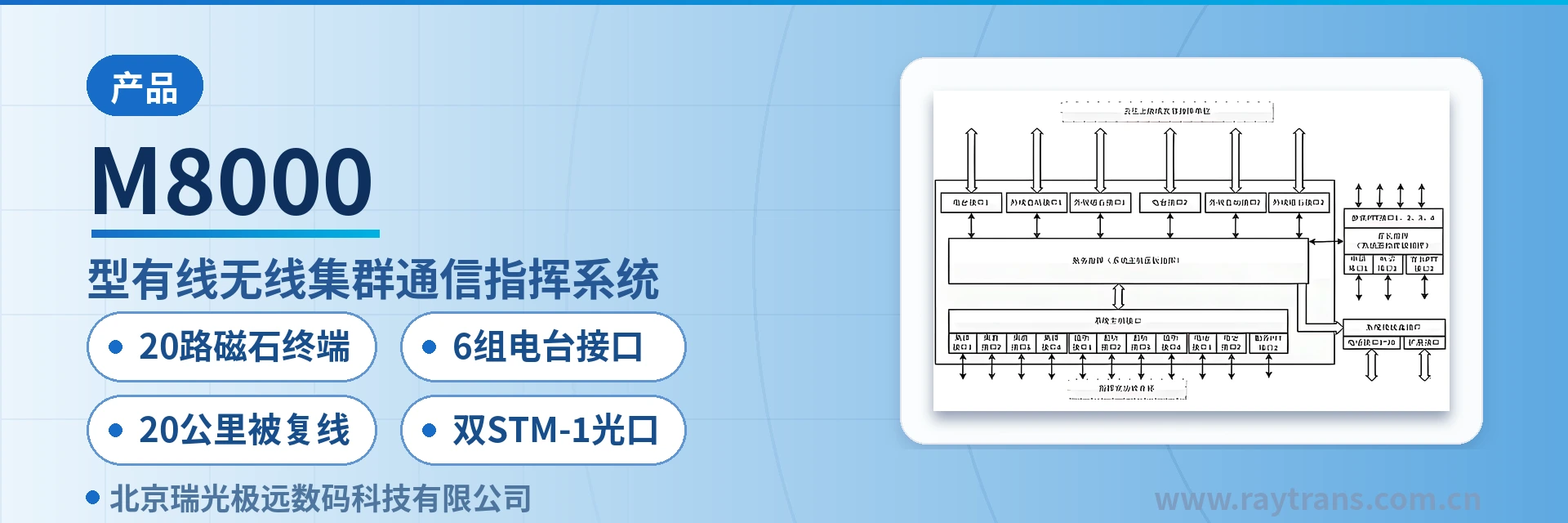
M8000 Wired and Wireless Trunking Command System
20 magneto terminals, 6 radio sets with onboard intercommunication, dual STM 1 optical ports, 4 conference groups and 4 subgroup monitoring groups
The M8000 wired and wireless trunking communication command system is a voice dispatch system suited to group command, featuring dedicated command, group command, skip-level command and conference command functions. It also offers standard SDH-based expansion capabilities for high-bandwidth information transmission, and can be extended with the digital signaling standards of various telephone switches. It provides a wide range of narrowband and broadband voice and data interface capabilities. It can be used for position command in combat, training and exercises, counter-terrorism and stability maintenance, and disaster relief.
The 20-channel magneto terminal trunking command system, i.e., the M8000 wired and wireless trunking communication command system, is an audio and video dispatching system suited to group command. Developed by command and dispatch system manufacturer Beijing Ruiguang Jiyuan Digital Technology Co., Ltd. (Raytrans), it is used for combat, training and exercise, counter-terrorism and stability maintenance, and disaster relief in position command. The system connects wired magneto terminals, radio sets, and higher-level trunks to the same main unit, so a commander can complete calls, grouping, and skip-level command for multiple groups from one location, achieving efficient audio and video dispatching and product showcase.
The complete system consists of a main unit, a wiring box, a remote command box, and an iPad command terminal. The main unit uses a man-pack structure, can accept standard batteries, and enters the command state with one-touch operation after power-on. The command main unit and the remote command box each have 2 call handsets, so the commander can make calls and transfers even away from the operator seat. As a converged communication command and dispatch system, it is also suitable for mobile scenarios such as military emergency communications vehicle solutions, with core transmission relying on the dual STM-1 optical port capability provided by SDH equipment manufacturers.
Key Specifications at a Glance: 20 magneto terminals · 6 radio set interfaces · dual STM-1 optical ports · 20 km field wire · 4 conference groups and 4 group monitoring channels · -20~+55℃ operating temperature
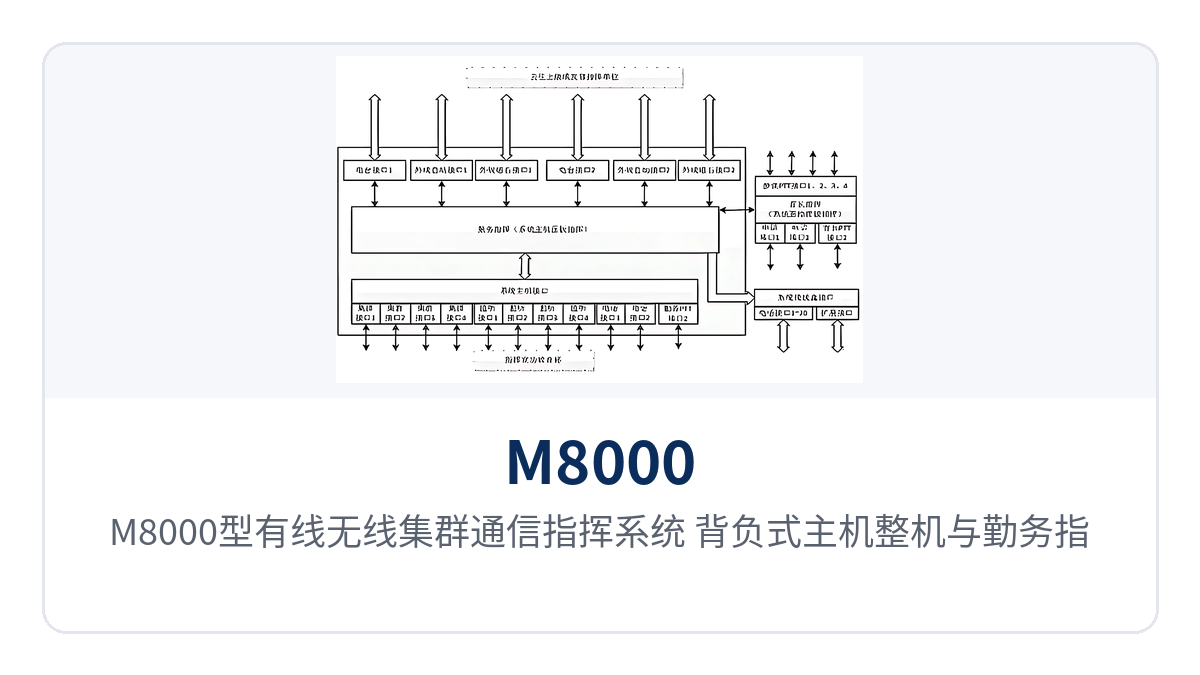
Figure 1: M8000 wired and wireless trunking communication command system — close-up of the man-pack main unit and the service command panel
How many wired terminals and radio sets can the 20-channel magneto terminal trunking command system connect?
The wired side provides 20 subscriber ports for multi-function magneto standalone units, covering 20 position voice terminals; there are also 2 higher-level magneto trunk ports and 2 automatic trunk ports (FXO) for connecting to higher-level units or the telephone network. Subscriber ports and trunk ports are set separately, so position calls and higher-level calls do not contend for the same voice channel, and audio and video dispatching and voice command do not crowd each other's channels.
The wireless side provides 4 wireless subscriber ports for wireless trunking and 2 radio set subscriber ports for remote HF radio sets, totaling 6 radio set interfaces, which are assigned to 4 groups through configuration. 4 loudspeaker terminals can simultaneously provide voice monitoring of 4 subgroups, and the commander can hear replies from each direction clearly by switching groups, meeting the demonstration need for simultaneous listening from multiple directions in product showcase scenarios.
The system's external interfaces are grouped into three categories: subscriber lines, trunk lines, and monitoring. During configuration, first check the number of subscriber ports against the on-site position terminal list, then confirm the number of higher-level trunk and subgroup monitoring channels. The number and purpose of each channel are listed item by item in the table below, so the site and commercial teams can check against the same table. This series of converged communication command and dispatch systems is developed by command and dispatch system manufacturer Raytrans, with interface arrangement and command and dispatch logic designed around field position usage habits.
Function | Description |
|---|---|
Trunking command | Provides four communication methods: centralized command, group command, dedicated command, and skip-level command; connection is controlled by a microprocessor and supports manual and automatic reconnection |
Magneto terminal access | 20 wired subscriber ports connect multi-function magneto standalone units, covering 20 position voice terminals; numbers are preset by the control unit |
6 radio set interfaces | 4 wireless subscriber ports connect wireless trunking and 2 radio set subscriber ports connect remote HF radio sets; the 6 interfaces are assigned to 4 groups through configuration |
Higher-level trunk access | 2 higher-level magneto trunk ports and 2 automatic trunk ports (FXO) for intercommunication with higher-level units or the telephone network |
Subgroup monitoring | 4 loudspeaker terminals connect, with 4 monitoring speaker ports and 4 staff monitoring handset ports, enabling simultaneous monitoring of 4 subgroups |
Conference command | Provides 4 conference rooms; conferences 1 to 4 are indicated in blue, cyan, magenta, and red, and conferences can be started or canceled at any time |
Recording and monitoring | Provides recording and monitoring functions; the command process can be kept on file, and staff operator seats listen in through monitoring handset ports |
Dial-up mode | Multi-function magneto standalone unit dialing, main unit service panel dialing, command box panel dialing, iPad command terminal or PC software dialing |
SDH and signaling expansion | Dual STM-1 optical port expansion; digital signaling standards such as E1 SS7, No.1, PRI, and V5.2 can be expanded |
Status indication | 7-color panel indication of subscriber status: off when idle, green for subscriber call, white for service command call, yellow for ringing, flashing red for alarm |
Key specifications: port count, operating environment, and power supply
The key specifications center on four parts: port count, communication distance, environmental adaptability, and power supply. The values in the table are taken from product documentation, with operating temperature and storage temperature given for field position conditions. Power supply is listed in AC and battery modes, and battery capacity determines the duty duration after mains power is lost. As the basis for main unit selection in military emergency communications vehicle solutions, these specifications can be used directly for vehicle-mounted space and power supply budget calculations.
Item | Parameter/Specification | Description/Applicable Conditions |
|---|---|---|
Wired subscriber port | 20 | Connects multi-function magneto standalone units, covering voice terminals at 20 positions |
Wireless subscriber port | 4 | Typically connects wireless trunking |
Radio set subscriber port | 2 | Typically connects remote HF radio sets |
Automatic trunk port (FXO) | 2 | Connects to a higher-level unit or the telephone network |
Higher-level magneto trunk port | 2 | Interfaces with the magneto trunk of a higher-level unit |
Service/command panel telephone port | 2 | One for the service operator seat and one for the command operator seat |
Service/command panel handset port | 1 | Panel call handset access |
Monitoring speaker port | 4 | Voice monitoring for the 4 subgroups |
Command panel staff monitoring handset port | 4 | Staff seat listening |
Number of conference groups | 4 | Conference 1 to Conference 4, indicated on the panel in blue, cyan, magenta and red |
Communication distance | Not less than 20 km when the magneto interface uses field wire | Wire diameter, number of connectors and line insulation affect the actual distance |
Connection method | Microprocessor-controlled, manual and automatic reconnection | The control unit completes the connection after dialing |
Communication method | Wired, wireless and radio | The three types of channels intercommunicate within the same main unit |
Optical port expansion | Dual STM-1 optical ports | Used for high-bandwidth information transmission expansion |
E1 signaling expansion | No.1, SS7, PRI, V5.2, etc. | Optional according to the signaling standard of the opposite-end switch |
Operating temperature | -20~+55℃ | Field positions and vehicle-mounted environment |
Storage temperature | -40~+65℃ | Transport and storage conditions |
Relative humidity | (95±3%) (+35℃) | Hot and humid environment |
AC power supply | 220V, 50Hz | Mains power or generator supply; permissible deviation is subject to the manufacturer's technical documentation |
Battery power supply | 12V 10A | Connects a standard battery and continues operation after mains power is disconnected |
Configuration method | PC software, iPad command terminal, panel keys | Service unit and command unit; the service unit contains the control and interface units |
How are the four command modes—dedicated, group, override and conference—used?
Centralized command connects all groups into the same call, so the commander can cover all terminals with a single transmission; dedicated command establishes a separate channel only between the commander and one terminal, and the remaining groups neither occupy a voice channel nor hear the content of this call. The two modes are switched on the same panel without rewiring, and switching the command and dispatch mode does not interrupt existing voice channels.
Group command assigns the 20 position terminals and 6 radio groups to 4 groups by task; each group communicates independently and does not interfere with one another, and group membership is set by the control unit. Override command bypasses intermediate levels, letting the commander call an end position or a single radio set directly and saving the time of level-by-level relay.
Conference command provides 4 conference rooms; Conference 1 to Conference 4 are indicated on the panel in blue, cyan, magenta and red respectively, and once any party initiates, the remaining members join the same call. A conference can be started or canceled at any time; after cancellation, the terminals return to the group state without occupying additional voice channels.
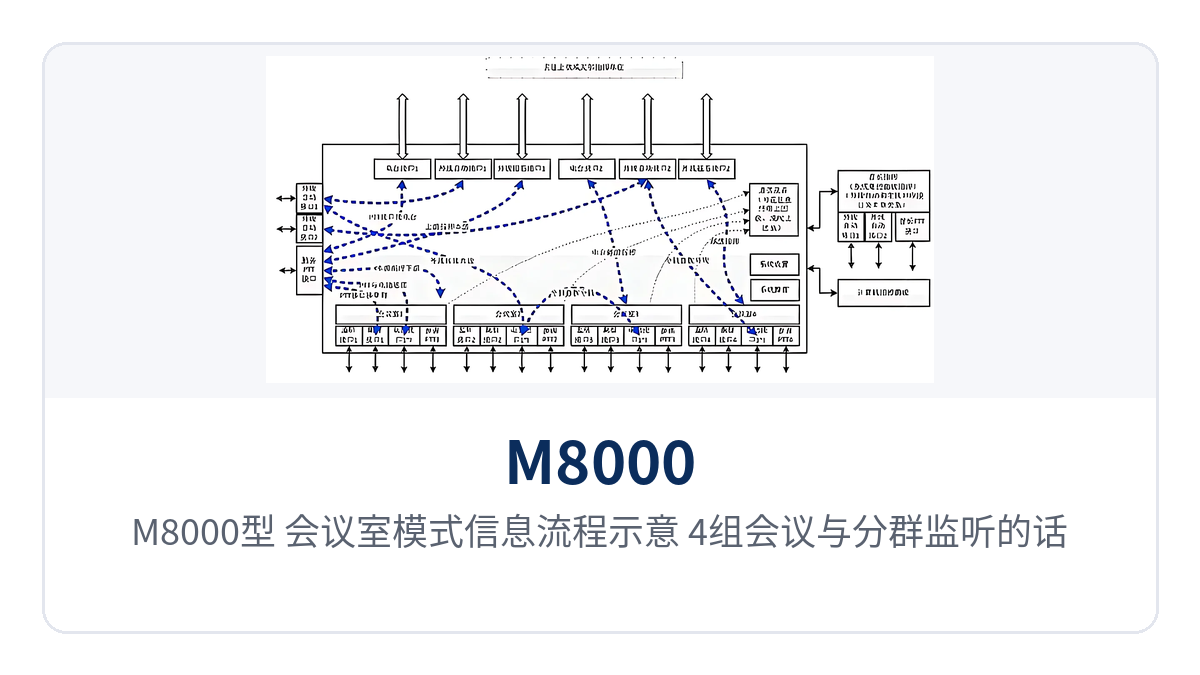
Figure 2: M8000 conference room mode information flow schematic—voice channel routing for 4 conference groups and subgroup monitoring
The panel indicator LEDs are the direct basis for judging voice channel status on site: off when idle, green for a subscriber call, white for a service and command call, yellow for ringing, and flashing red for an alarm. System function keys are white when pressed and the LED goes out after confirmation, so the duty operator can judge whether a given channel is connected just by looking at the LEDs.
How is the system networked: main unit, wiring box, remote command box and expansion channels
The system has three deployment forms: a main unit plus a wiring box forming a fixed command post, the main unit carried on a man-pack to a forward command post to work standalone, and a remote command box with an iPad command terminal extending the command operator seat to a shelter or observation point. All three forms share the same number and group settings, and this also makes it easy to choose flexibly according to the cabin layout in a military emergency communications vehicle solution.
Expansion channels extend along the SDH direction: dual STM-1 optical ports are used for high-bandwidth information transmission, and E1 signaling can interface with digital signaling standards such as No.1, SS7, PRI and V5.2. When intercommunicating with an existing telephone exchange, the option is selected according to the signaling of the opposite end; before selection, confirm the trunk mode and signaling type at both ends. Raytrans also has the supporting capability of an SDH equipment manufacturer, so optical transmission and signaling expansion can be interfaced within the same supply system.
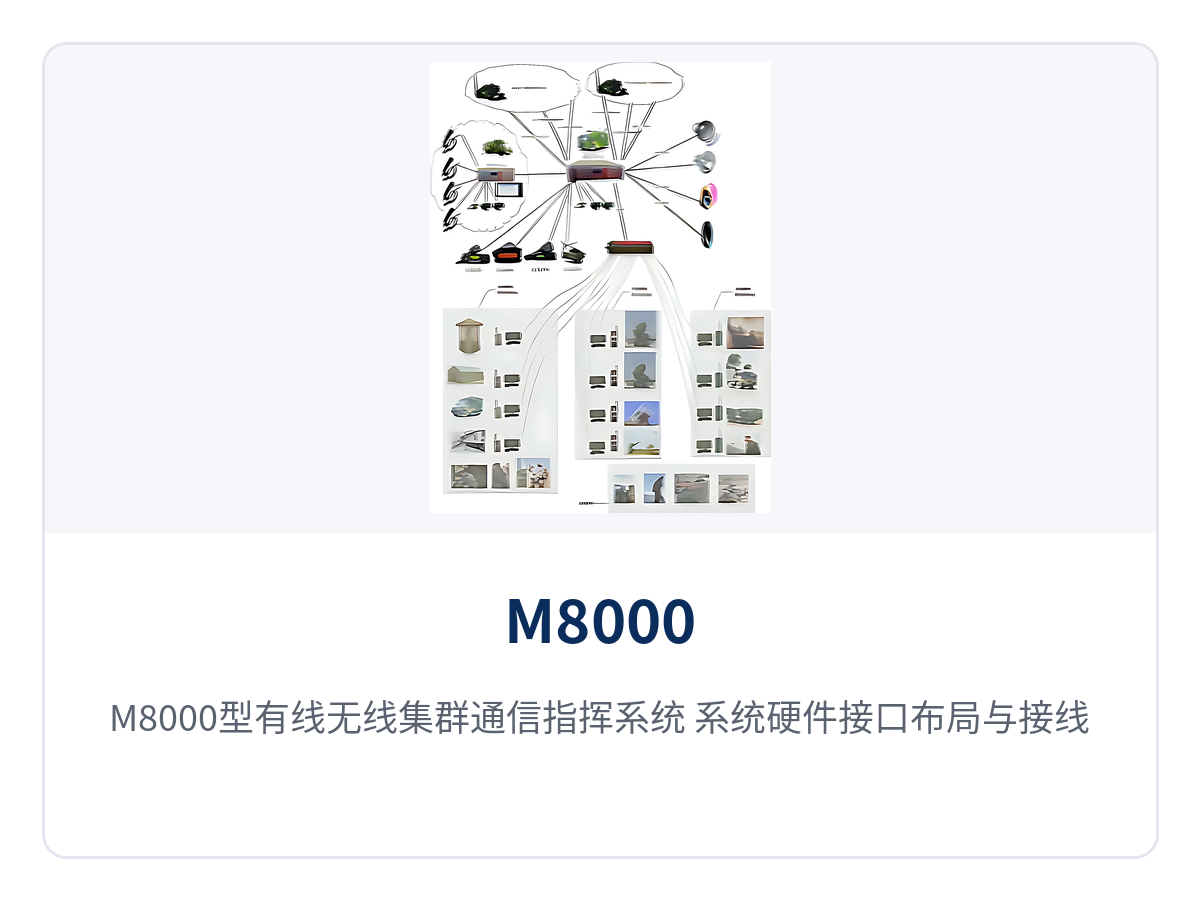
Figure 3: M8000 wired and wireless trunking communication command system—system hardware interface layout and wiring box/remote command box interfaces
On the interface side, connect each channel according to the labels on the wiring box: subscriber lines go to magneto standalone units, trunk lines go to the higher-level unit, and handsets and monitoring speakers are assigned by operator seat. The silkscreen on the wiring box corresponds one-to-one with the front panel indicator numbers. After wiring is complete, use the front panel indicators to check continuity channel by channel, so as to avoid reversing subscriber ports and trunk ports and causing busy lines.
How a 20 km field wire carries voice to position terminals
The magneto interface is a two-wire voice interface: both speech and ringing are carried on this pair of wires, and no centralized feeding from an SPC exchange is required. A position terminal and the main unit are connected by just one field wire, so the amount of cabling and the number of points of failure are both markedly lower than with multi-wire interfaces.
The product documentation gives a communication distance of no less than 20 km for the magneto interface when field wire is used; this is a rating under rated conditions. The actual achievable distance depends on wire diameter, number of connectors and line insulation. Oxidized or damp connectors will make voice weaker and, in severe cases, cause ringing failure.
During deployment, make connectors waterproof, keep away from power lines and reduce intermediate connectors; after laying the wire, confirm each channel by ringing and test calls. When the distance approaches the rated value, first measure the line loop resistance. Excessive loop resistance indicates a problem with connectors or wire diameter; then decide whether to strengthen line maintenance or switch to an optical port channel.
Typical Application Scenarios
Emergency rescue command: one main unit at a site with power and network outage
A rescue site often has no mains power and no available voice network. The command post carries the M8000 main unit onto the position and enables it by connecting a standard battery. 20 magneto terminals are deployed along the embankment section, mine entrance or resettlement point and run to each observation position over field wire. No separate switch or power supply is needed between positions, and the on-site voice channels required for audio and video dispatching are in place together with the main unit.
6 radio set interface groups connect the vehicle-mounted radios of on-site firefighting, medical and engineering vehicles into the same command system, and the commander issues evacuation and emergency repair orders by group. For positions that need to be grasped directly, use leapfrog command to call the end team, avoiding relay level by level. The dispatch logic of this converged communication command and dispatch system remains fully usable under power and network outage conditions.
Counter-terrorism and stability maintenance operations: multi-force grouping and leapfrog calls
Operations involve many participating units and dense call demand. Group command assigns 20 position terminals and 6 radio set groups to 4 groups, with the command group, containment group and maneuver group each occupying one channel without interfering with one another. 4 loudspeaker terminals and monitoring speakers let the command post follow the on-site dynamics of each subgroup at the same time.
When the commander needs to grasp a certain position directly, leapfrog command is used without relay through intermediate levels; cross-group consultation goes through conference command, with 4 conference rooms set up by task, so the response plan is aligned in a single call, and afterwards each terminal returns to its group state. A command and dispatch system manufacturer can reserve groups according to the number of forces at the solution design stage; the M8000 main unit provided by Raytrans already has these grouping capabilities built in.
Military field training: group command of position terminals and radios
Field training sites are dispersed. The magneto interface transmits over field wire at a distance of no less than 20 km, so each position terminal does not need a separate switch or power supply, and connections are concentrated on the main unit side. With the man-pack structure and standard battery configuration, the unit can be carried along when relocating and continue to be enabled, meeting the requirements of the military emergency communications vehicle solution for rapid setup and vehicle-mounted relocation.
The device has an operating temperature of -20 to +55°C and a storage temperature of -40 to +65°C, so no additional insulation or heat dissipation measures are needed during transport and training deployment. The dual STM-1 optical ports are enabled when data needs to be transmitted to the higher level or the rear; voice and data services share one channel, and the optical port standard of Raytrans as an SDH equipment manufacturer is directly followed here.
Differentiated value: 20 magneto terminals, 6 radio set interface groups and 20 km field wire
Differentiation Point | Description and Customer Value |
|---|---|
20 magneto terminals: one standalone unit accesses 20 position voice terminals | The number of terminals required for group command is met within one man-pack main unit; no multiplexing equipment needs to be cascaded on the position side, and setup time and accompanying equipment are reduced accordingly |
6 radio set interface groups: 4 wireless subscriber ports plus 2 radio subscriber ports | Wireless trunking and long-range HF radio sets are accessed on the same unit; the 6 interface groups are assigned to 4 groups by configuration, and cross-format calls are completed within one connection |
20 km field wire: magneto interface no less than 20 km | Only one field wire is laid between a position terminal and the main unit, so long-distance positions do not need additional trunk equipment |
Dual STM-1 optical ports: standard SDH expansion capability | The high-bandwidth channel between the command post and the higher level or the rear is extended over optical ports, with voice and data services sharing one transmission channel |
-20 to +55°C operating temperature, -40 to +65°C storage temperature | Normal setup under high and low field temperatures, with no additional temperature control measures for transport and storage |