IP-based Audio and Video Intercom Terminal
Video and data multiplexed into a 2.048Mb/s PCM stream, direct IP delivery saves separate encoding and decoding
>-
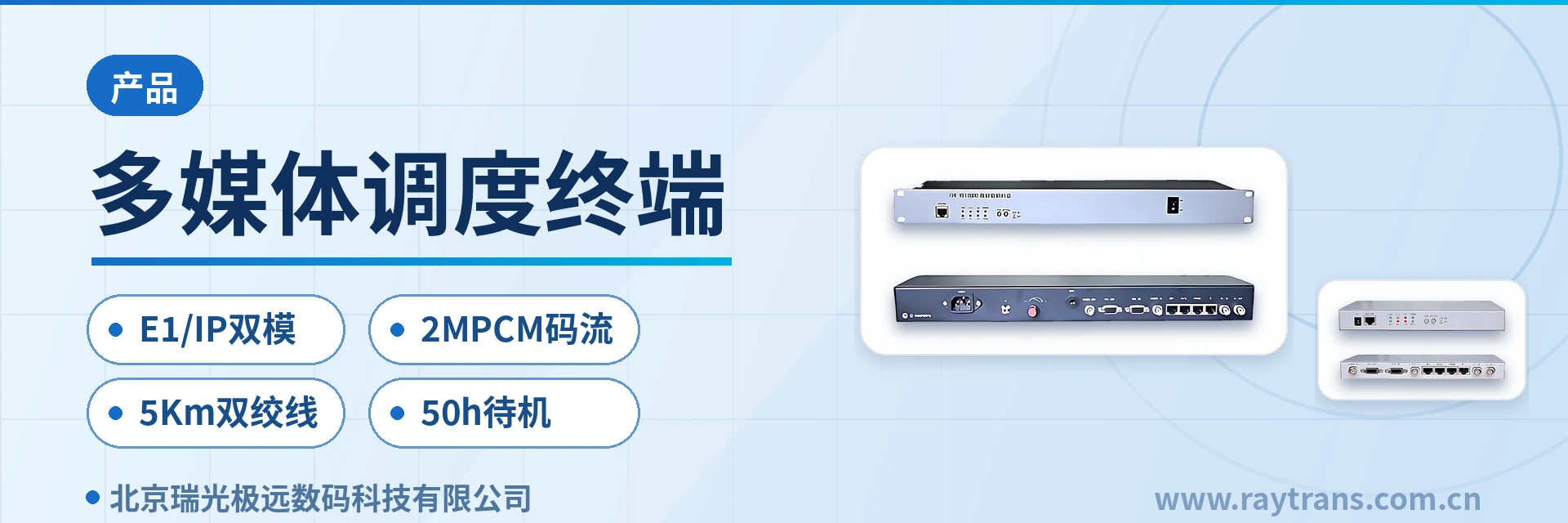
The IP-based audio and video intercom terminal is an integrated audio and video intercom device developed by Beijing Ruiguang Jiyuan Digital Technology Co., Ltd. It is designed around an IP transmission channel and adopts H.264 encoding, with real-time image capture and image compression capabilities. The device compresses and multiplexes input video and data into a 2.048Mb/s PCM stream and delivers it to the transmission equipment through the IP interface for long-distance transmission, meeting the needs of systems such as remote video surveillance. The unit adopts an integrated multi-function design, with capture, compression, multiplexing and network delivery all completed inside the same device, so no separate codec is required on site; it is suitable for scenarios such as electric power private networks, rail transit and unattended sites along oil and gas pipelines, and also serves as a front end for capture and intercom in audio and video dispatching and product showcase applications.
Key specifications at a glance: H.264 encoding · 2.048Mb/s stream · long-distance IP transmission · integrated design · video and data combined into a PCM stream
What Kind of Device Is the IP-based Audio and Video Intercom Terminal?
The IP-based audio and video intercom terminal is a device that compresses on-site video and data into a fixed-rate stream and sends it over the IP interface into the transmission network for long-distance transmission. It consists of a video acquisition and compression unit, a data multiplexing unit and an IP network interface, uses a 19-inch 1U chassis, and can be placed in an attended equipment room or an unattended cabinet. As an audio and video dispatching device produced by a professional command and dispatch system manufacturer, the terminal is based on the IP transmission channel: any site where an IP network has already been deployed, or which can be connected to IP transmission equipment, can send on-site pictures and data with a single terminal to a dispatch room at the remote end, achieving efficient audio and video dispatching and remote video surveillance. Compared with devices that carry only a single service, this terminal performs service aggregation of video and data into the same PCM stream, so a single channel can carry multiple services and the links and supporting devices it occupies are reduced accordingly.
With the Stream Fixed at 2.048Mb/s After H.264 Compression, How Is Private Network Bandwidth Calculated?
A fixed 2.048Mb/s stream means that the bandwidth occupied by each terminal is constant, so the private network link capacity can be budgeted directly by the number of units, without reserving fluctuation margin for burst traffic. The device encodes and compresses input video using H.264 and then combines it with data into a PCM stream; the stream rate after compression is fixed at 2.048Mb/s, consistent with the 2048kbps bandwidth of one E1 channel. In engineering practice, dividing the available link bandwidth by 2.048Mb/s gives the number of terminals the link can carry; when a new site is added, first confirm the bandwidth margin and then deploy the equipment. H.264 encoding achieves a high compression ratio while keeping the picture identifiable, and the stream rate remains constant after video and data are multiplexed, making it easy to allocate limited private network bandwidth to more sites. This is also an important reason why Raytrans recommends this type of audio and video intercom terminal in government private network optical fiber communication solutions and smart mining communication solutions.
What Functions Does the Device Provide?
The IP-based audio and video intercom terminal organizes its functions around image capture, encoding and compression, service multiplexing and network delivery; the function items and their roles are shown in the table below.
| Function | Description |
|---|---|
| H.264 video encoding and compression | Performs H.264 encoding on input video, with real-time image capture and image compression capabilities; the stream rate after compression is fixed |
| Video and data hybrid multiplexing | Compresses and multiplexes input video and data, outputs a single PCM stream, and carries both video and data services on the same channel |
| Constant stream output | Forms a 2.048Mb/s PCM stream after multiplexing; the occupied bandwidth is fixed and private network bandwidth can be budgeted |
| IP interface long-distance transmission | Delivers the stream to the transmission equipment through the IP interface, and uses the transmission network to achieve long-distance audio and video intercom and remote video surveillance |
| Integrated multi-function design | Capture, compression, multiplexing and network delivery are completed by the same device, so no separate codec is required on site |
| Standard chassis structure | 19-inch 1U chassis, facilitating rack installation in a communications cabinet and subsequent capacity expansion |
Key Specifications
| Item | Parameter/Specification | Description/Applicable Conditions |
|---|---|---|
| Transmission channel | IP transmission channel | Designed around the IP channel; the stream is sent out through the IP interface |
| Video encoding format | H.264 | Provides real-time image capture and image compression capabilities; the stream rate is fixed after compression |
| Stream rate | 2.048Mb/s PCM stream | Fixed at this rate after H.264 compression, equal to the 2048kbps of one E1 channel, making it easy to budget private network bandwidth by the number of units |
| Service multiplexing | Video and data hybrid multiplexing | Video and data are compressed and combined into a single PCM stream, so one channel carries multiple services |
| Transmission interface | IP interface | Delivers the stream to the transmission equipment for long-distance transmission |
| Equipment form factor | 19-inch 1U chassis | Facilitates in-cabinet installation in a communications cabinet |
| Power supply mode, overall power consumption, operating temperature, ingress protection (IP) rating, dimensions and weight | Not yet recorded in the knowledge base | Subject to the manufacturer's technical documentation and commercial confirmation |
What the Three Differentiated Selling Points Mean on Site
| Differentiated selling points | What it means on site |
|---|---|
| A fixed 2.048Mb/s stream after H.264 compression, so private network bandwidth can be budgeted | The bandwidth occupied by each terminal is constant, link capacity is calculated directly by the number of units, and the margin is worked out before equipment is added during capacity expansion |
| Direct delivery to the transmission equipment through the IP interface for long-distance audio and video intercom | The stream output by the terminal is fed directly into the transmission equipment through the IP interface, with no additional series connection of codecs in between, so the duty room at the remote end can see the on-site picture and talk to the site, meeting the dual needs of remote video surveillance and audio and video dispatching |
| Video and data combined into a PCM stream, with a single channel carrying multiple services | Video and data are aggregated into the same 2.048Mb/s PCM stream, so one link and one channel carry pictures and data at the same time |
Typical application scenarios
Electric power private network: substations and sites along transmission lines
For substations, switching stations and sites along transmission lines, site distribution is scattered, and dispatch telephones and remote video surveillance run year-round on the electric power self-built private transmission network, so bandwidth must be calculated site by site. The IP-based audio and video intercom terminal is deployed at the site side, compresses on-site video and data into a single PCM stream, and sends it through the IP interface to the transmission equipment for backhaul to the centralized control station, so on-duty personnel can both see the picture and make announcements to the site, completing reliable audio and video dispatching. The bandwidth occupied by the terminal is constant, so the centralized control station budgets bandwidth directly by the number of sites when planning links, and adding a site only requires checking the margin, with no need to reserve redundancy for traffic fluctuations. Raytrans adopts the same approach in government private network optical fiber communication solutions, providing electric power users with mature audio and video dispatching and product showcase solutions.
Rail transit: platforms, depots and substations along the line
Sites such as rail transit platforms, depots and substations along the line are far apart and noisy, and duty posts need to maintain audio and video contact with train dispatch or the control center. After the terminal is connected to the station IP network, it sends the platform picture together with data to the control center, and dispatchers view pictures and make intercom announcements on the same platform. At the site side the terminal is rack-mounted in a 19-inch 1U chassis and laid out together with the existing communications cabinets; when sites are added along the line, the section link bandwidth is calculated at the fixed occupation per unit, so the capacity expansion plan becomes clear.
Oil and gas pipelines and unattended sites
Valve chambers, pumping stations and unattended sites in the field along oil and gas pipelines usually have no public network, and attendance on site by maintenance personnel is infrequent, so once an abnormality occurs on site, it is desirable to see the picture as early as possible. The IP-based audio and video intercom terminal connects to on-site equipment at the site side, compresses video and data into a PCM stream and sends it onto the transmission link through the IP interface, so the pipeline dispatch and control center can view the site remotely and talk to line inspection personnel, achieving unified carriage of remote video surveillance and audio and video intercom. The terminal has an integrated design, so a single device at the site completes capture and remote transmission; the fixed stream makes bandwidth planning for long-distance links along the pipeline calculable site by site.
Conclusion
The IP-based audio and video intercom terminal concentrates real-time image capture, H.264 encoding and compression, hybrid multiplexing of video and data and long-distance IP interface transmission in one integrated device: the fixed 2.048Mb/s stream after compression lets private network bandwidth be budgeted by the number of units, direct delivery through the IP interface saves the codec in between, and aggregating video and data into the same PCM stream enables a single channel to carry multiple services. As a command and dispatch system manufacturer, Raytrans provides users such as electric power private networks, rail transit and unattended sites along oil and gas pipelines with audio and video intercom terminals and supporting product showcase covering intrinsically safe mining communication, smart mining communication solutions and government private network optical fiber communication solutions, so users can complete selection and deployment in line with on-site IP network conditions and link bandwidth margin.