IEEE802.11an Multi-Mode Multi-Frequency Wireless AP Bridge
Dual-Band 6-Channel N-Type RF, One Unit with Four Modes, Multi-Sector Concurrency Saves Equipment
>-
What Kind of Device Is a Multi-Mode Multi-Frequency Wireless AP Bridge?
The multi-mode multi-frequency wireless AP bridge is the IDM 5800NAT developed by Beijing Ruiguang Jiyuan Digital Technology Co., Ltd. It is compatible with multiple wireless network standards including IEEE 802.11 a/b/g/n, and is an outdoor carrier-class wireless network device designed specifically for enterprise and public access. As a professional SDH equipment manufacturer, Raytrans integrates wireless coverage, wireless trunking, and broadband data access into a single outdoor unit, making it particularly suitable for ultra-high-traffic, high-bandwidth data networking and wireless access. It also provides a flexible means of wireless extension for government private network optical fiber communication solutions and military emergency communications vehicle solutions.
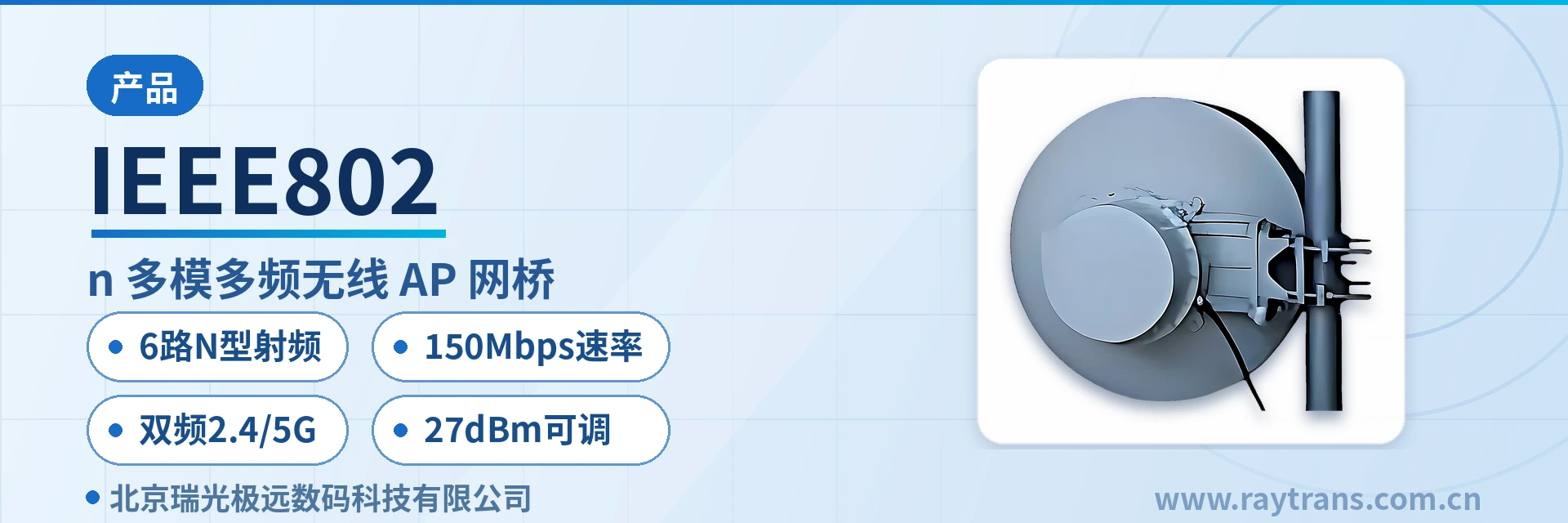
Key specifications at a glance: Dual-band 2.4/5G · 6 N-type RF interfaces (2.4GHz×3, 5GHz×3) · 150Mbps rate · 27dBm adjustable transmit power · AP/bridge/AP Client/Gateway multi-mode · Compatible with IEEE 802.11 a/b/g/n
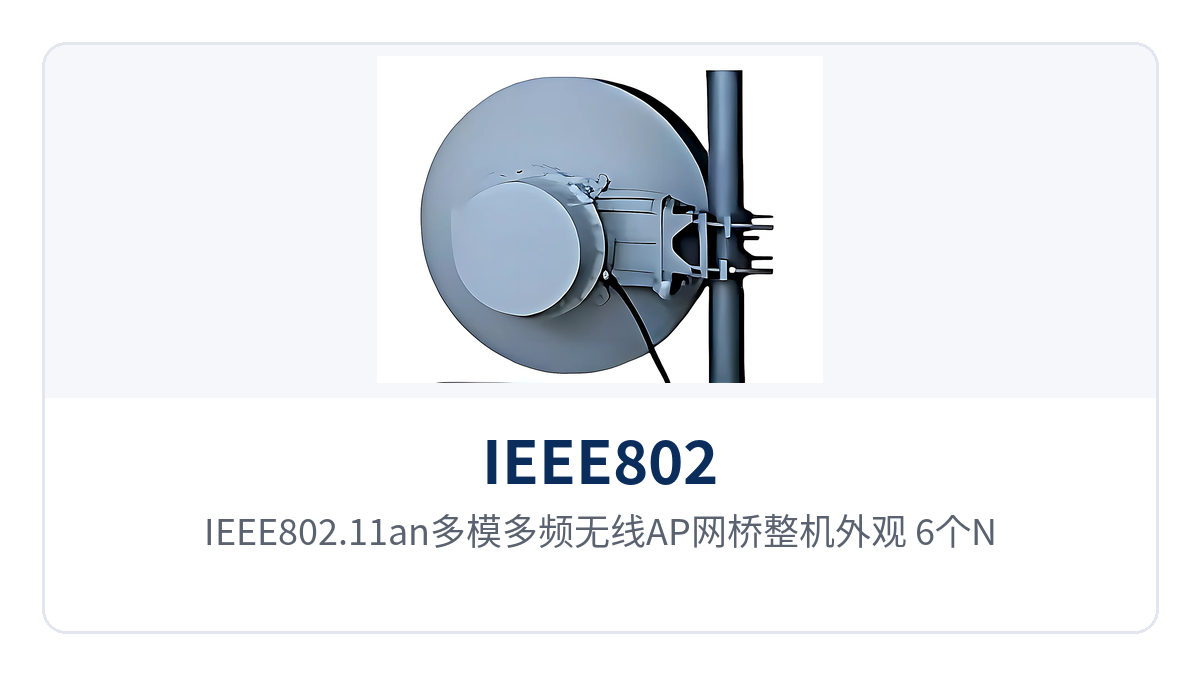
Figure 1: Overall appearance of the IEEE802.11an multi-mode multi-frequency wireless AP bridge, close-up of 6 N-type RF interfaces and the outdoor protective housing
The IDM 5800NAT can operate in multiple modes such as AP, bridge, AP Client, and Gateway. It can both establish network connections with products of the same series and provide broadband wireless access for wireless network users. The data transmission rate can reach up to 150Mbps. A site does not need to deploy separate devices for coverage, trunking, and access; a single unit can handle the wireless coverage and high-bandwidth data backhaul of an industrial private network. As an industrial Ethernet switch manufacturer, Raytrans fully demonstrates its networking capability of wireless and wired convergence in the product showcase of the multi-mode multi-frequency wireless AP bridge.
What Kind of Networking Can Dual-Band 6 N-Type RF Interfaces Support?
Dual-band 6 N-type RF interfaces means the IDM 5800NAT provides 6 N-type RF interfaces, of which 3 are in the 2.4GHz frequency band and 3 are in the 5GHz frequency band, and the two bands can work simultaneously. The number of RF interfaces determines how many antennas a site can connect, and thus how many directions a single device can cover.
- 2.4GHz RF interfaces (3 channels): Operating frequency band 2.4GHz-2.483GHz, with a longer wavelength and better diffraction conditions, suitable for directions requiring a large coverage radius.
- 5GHz RF interfaces (3 channels): Operating frequency band 5.725GHz-5.850GHz, with wide available bandwidth and relatively less same-frequency interference, suitable for directions with high bandwidth requirements.
- Dual-band parallel operation: With both bands enabled simultaneously, one device can perform multi-sector concurrent networking, reducing the number of site devices and tower installation workload.
The approach to multi-sector networking is to assign coverage and trunking tasks in different directions to different RF interfaces, avoiding multiple directions sharing one RF path and constraining each other. With 6 N-type interfaces and 27dBm adjustable transmit power, a site can adjust power per path according to link distance and on-site electromagnetic environment—increasing power for long-distance links and reducing power for short-range coverage. This flexible networking approach of the multi-mode multi-frequency wireless AP bridge is in line with Raytrans's technical accumulation in product lines such as SDH and industrial Ethernet switches, and can be seamlessly incorporated into government private network optical fiber communication solutions and military emergency communications vehicle solutions.
What Are the Core Functions?
The functions of the IDM 5800NAT are organized around four threads: wireless coverage, wireless trunking, broadband access, and dual-band concurrent operation. The table below lists each function item and its purpose, making it easy to compare and select according to the on-site service list.
| Function | Description |
|---|---|
| AP access mode | Acts as a wireless access point to provide wireless network access for on-site terminals |
| Bridge mode | Configured in pairs to form a wireless link, replacing on-site wired trunking where cabling is difficult |
| AP Client mode | Acts as a wireless client to access a higher-level wireless network, used for uplink of remote stations |
| Gateway mode | Accesses and forwards data in the gateway role, used for station egress and service aggregation |
| Dual-band concurrent operation | 2.4GHz and 5GHz bands work simultaneously, with coverage and bandwidth requirements carried by separate bands |
| Multi-sector networking | 6 N-type RF interfaces connect antennas separately, allowing one device to cover multiple directions |
| High-bandwidth data transmission | 150Mbps transmission rate, used for ultra-high-traffic data networking and wireless access |
| OFDM modulation | BPSK@6/9Mbps, QPSK@12/18Mbps, 16-QAM@24Mbps, 64-QAM@48/54Mbps |
| DSSS modulation | DBPSK@1Mbps, DQPSK@2Mbps, CCK@5.5/11Mbps |
| MIMO-OFDM modulation | BPSK, QPSK, 16QAM, 64QAM, with multi-antenna concurrent operation improving link throughput |
| Adjustable transmit power | 27dBm adjustable, adjusted per path according to link distance and on-site conditions |
Technical Specifications: RF, Frequency Band, and Modulation Indicators
During selection and bidding, antenna interfaces, operating frequency bands, and modulation methods are usually checked first. The table below lists the technical specifications of the IDM 5800NAT item by item. For items not listed, the manufacturer's technical documentation and commercial confirmation shall prevail.
| Item | Parameter/Specification | Description/Applicable Conditions |
|---|---|---|
| Device model | IDM 5800NAT | Outdoor carrier-class wireless network device |
| Wireless standard | IEEE 802.11 a/b/g/n | Compatible with multiple wireless network standards |
| Operating mode | AP, bridge, AP Client, Gateway | One unit adapts to multiple networking scenarios |
| Antenna interface | 6 N-type RF interfaces (2.4GHz×3, 5GHz×3) | Dual-band 6 N-type RF interfaces, supporting multi-sector concurrent networking |
| Operating frequency band | 5.725GHz-5.850GHz (China); 2.4GHz-2.483GHz (China) | Dual-band 2.4/5G, configured according to local frequency regulations |
| Data transmission rate | 150Mbps transmission rate | Used for ultra-high-traffic, high-bandwidth data networking and wireless access |
| Transmit power | 27dBm adjustable | Adjusted per path according to link distance and on-site conditions |
| Modulation technology (OFDM) | BPSK@6/9Mbps, QPSK@12/18Mbps, 16-QAM@24Mbps, 64-QAM@48/54Mbps | Orthogonal frequency division multiplexing, adaptively adjusted according to link quality |
| Modulation technology (DSSS) | DBPSK@1Mbps, DQPSK@2Mbps, CCK@5.5/11Mbps | Direct sequence spread spectrum, used for low-speed stable links |
| Modulation technology (MIMO-OFDM) | BPSK, QPSK, 16QAM, 64QAM | Multi-antenna concurrent operation, improving link throughput |
| Power supply mode, overall power consumption, operating temperature, ingress protection (IP) rating | not yet recorded in the knowledge base | Subject to the manufacturer's technical documentation and commercial confirmation |
How Do the Dual Bands 2.4G and 5G Divide Their Roles?
The principle for dividing roles between the dual bands 2.4/5G is to separate tasks according to requirements: the 2.4GHz band, 2.4GHz-2.483GHz, has a longer wavelength and relatively good connectivity conditions at coverage edges and for non-line-of-sight (NLOS) links, making it suitable for directions requiring a large coverage radius; the 5GHz band, 5.725GHz-5.850GHz, has wide available bandwidth and relatively less same-frequency interference, making it suitable for directions with high bandwidth requirements and controllable link conditions. When both bands are enabled simultaneously, they do not squeeze each other's spectrum, and terminal and backhaul services can be carried separately by band.
What Can the 150Mbps Transmission Rate Carry in a Private Network?
The 150Mbps transmission rate can be used for services such as video surveillance backhaul, production data acquisition, and office data, consolidating data volumes that previously required multiple devices into a single wireless link. The actual link throughput is affected by distance, antenna gain, frequency band, and interference conditions. In engineering practice, the bandwidth margin should be calculated based on on-site actual measurement results, and the number of cameras that can be carried should not be simply converted from the nominal rate.
Differentiated Value: What Problems Does the Dual-Band Multi-Mode Wireless AP Bridge Solve in Industrial Private Networks?
| Differentiation Point | What It Means in Industrial Private Networks |
|---|---|
| 6 N-type RF interfaces | 3 channels each for 2.4G and 5G, supporting multi-sector concurrent networking; one device covers multiple directions, reducing both the number of site devices and tower installation workload |
| 150Mbps rate | Meets high-bandwidth data backhaul requirements of industrial private networks; video, production data, and office services can be carried on the same wireless link |
| Dual-band 2.4/5G | Coverage and bandwidth requirements are carried by separate bands, with both bands working simultaneously without squeezing each other |
| 27dBm adjustable | Adapts to long-distance field links, with power adjusted per path according to link distance, balancing long-distance connectivity and short-range interference control |
As a multi-mode multi-frequency wireless AP bridge product under Raytrans, the IDM 5800NAT works in coordination with devices such as SDH and industrial Ethernet switches, and can be incorporated as a whole into government private network optical fiber communication solutions and military emergency communications vehicle solutions, presenting a complete private network communication solution capability in the wireless AP bridge product showcase.
Typical Application Scenarios
Power and Energy Transmission and Distribution Networks
Substations, switching stations, and transmission line corridors are mostly in rural areas, with long distances between stations and poor cabling conditions along the line. The IDM 5800NAT is configured in pairs in bridge mode to establish wireless links for inter-station data backhaul, reducing investment in pole routes and optical cables along the line; in AP mode it covers the station area, providing wireless access for inspection terminals and mobile operation devices. The 6 N-type interfaces can connect antennas according to coverage directions, allowing one station to cover both the station area and the line direction simultaneously, with video and production data of heavy-load lines backhauled to the centralized control end via the 150Mbps transmission rate. In government private network optical fiber communication solutions for the electric power industry, such wireless links often serve as a supplement and backup to wired optical fiber.
Communication Along Rail Transit Lines
Stations, depots, and section equipment points along rail transit lines are scattered, and trackside cabling approval and construction cycles are long. The IDM 5800NAT is deployed point by point along the line, using bridge mode to relay data from section equipment points back segment by segment, and AP mode to cover platforms and maintenance work faces. The 5GHz band carries services with high bandwidth requirements, while the 2.4GHz band carries directions requiring large coverage distances. With both bands working simultaneously, video and operation data can be carried separately on the same set of wireless links.
Oil and Gas Pipelines and Mining Area Field Private Networks
Long-distance oil and gas pipelines and mining operation faces span large areas and have no fixed equipment rooms, and communication sites are often in field environments without mains power or wired resources. The IDM 5800NAT connects valve chambers, pumping stations, and mining operation points along the line by means of industrial wireless private network backhaul, using bridge mode to establish point-to-point and point-to-multipoint links, and using 27dBm adjustable transmit power to configure power per path according to spacing between stations—increasing power for long-distance sections and reducing power for short-distance sections to control interference, reducing dependence on wired resources. In military emergency communications vehicle solutions, similar multi-mode multi-frequency wireless AP bridge devices can also rapidly set up temporary links to ensure communication continuity in emergency scenarios.
Selection and Deployment Recommendations
Selection starts with the networking role: choose bridge mode for inter-station trunking, AP mode for multi-terminal coverage, AP Client mode for remote uplink, and Gateway mode for station egress and service aggregation. One device can switch modes at different stages, reducing the variety of spare parts and operation and maintenance training costs accordingly.
- Antenna and RF interface planning: First determine the number of antennas according to coverage directions and link directions, then assign them to the two groups of RF interfaces, 2.4GHz and 5GHz, avoiding multiple directions sharing one RF path.
- Power configuration: Set power per path according to spacing between stations and measured signal field strength, and reduce transmit power as much as possible on the premise of meeting link margin, to reduce same-frequency interference.
- Frequency band planning: First investigate the occupancy of existing wireless systems on site, then determine the usage of 2.4GHz and 5GHz. For links with large spans, frequency bands with controllable link conditions should be selected.
- Installation, lightning protection, and power supply mode: not yet recorded in the knowledge base. Before on-site installation, please refer to the manufacturer's technical documentation and commercial confirmation, and carry out lightning protection and grounding design.
How to Choose the AP Bridge Operating Mode
How to choose the AP bridge operating mode depends on the role of the site in the link: sites that need to provide access for on-site terminals choose AP mode, sites that need to establish a link across sections where cabling is difficult choose bridge mode, remote stations that need to access a higher-level wireless network choose AP Client mode, and sites that need to serve as the site egress for data forwarding choose Gateway mode. The same IDM 5800NAT supports multiple modes, so when site responsibilities change, it can be reconfigured without replacing the device.
Conclusion
With dual-band 6-port N-type RF interfaces, a 150Mbps transmission rate, and multi-mode AP/bridge/AP Client/Gateway capabilities, the multi-mode multi-band wireless AP bridge IDM 5800NAT consolidates wireless coverage, link trunking, and broadband access for industrial private networks into a single outdoor unit, supporting multi-sector concurrent networking and per-link power adjustment. For sites such as electric power and energy transmission and distribution grids, rail transit along-the-line communications, and oil and gas pipeline and mining area field private networks, a site can complete high-bandwidth data backhaul with fewer devices. When selection and configuration plans are needed, networking design and commercial quotation support for the multi-mode multi-band wireless AP bridge can be provided.