IDM Wi-Fi HaLow Audio and Video Dispatching System
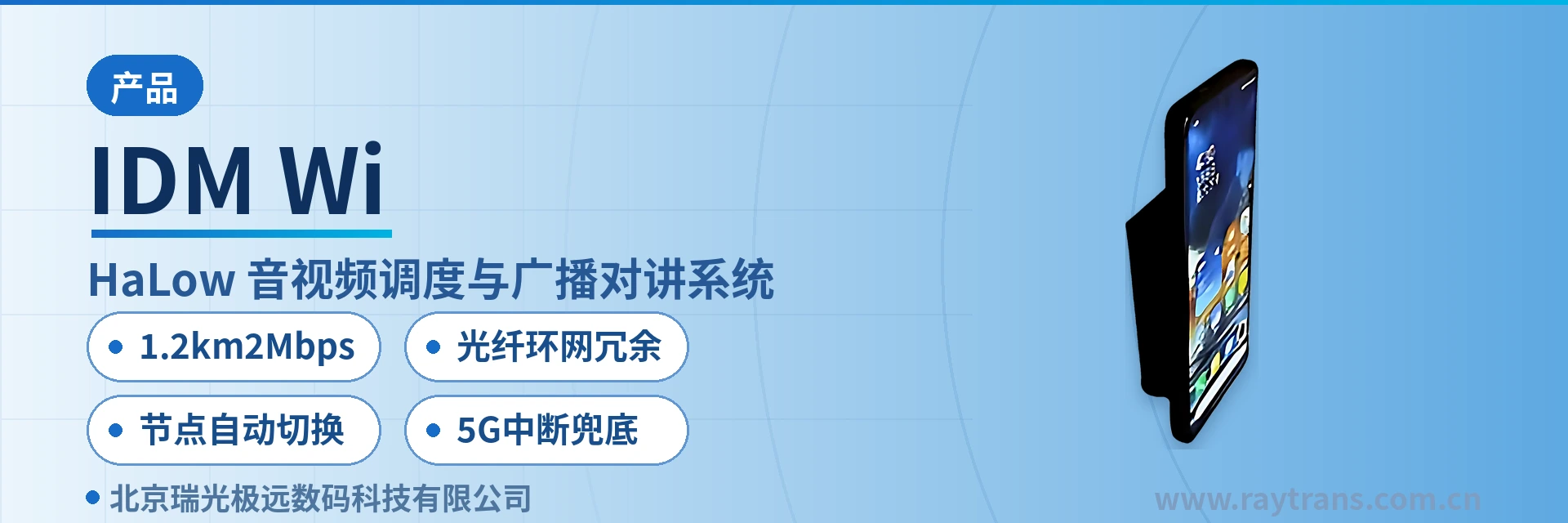
Optical fiber ring network redundancy, 1.2 km 2 Mbps, 1080P HD transmission, automatic roaming across 31 APs
The Wi-Fi HaLow audio and video dispatching and broadcast intercom system is designed for scenarios such as mountain amusement parks, river management, farmland management, power line inspection management, and forest farm management, providing efficient audio and video dispatching and broadcast intercom functions. The system adopts advanced Wi-Fi HaLow technology to ensure stable and efficient wireless communication in complex environments.
The IDM Wi-Fi HaLow audio and video dispatching and broadcast intercom system is a fiber ring network redundant audio and video dispatching system. It consists of three parts: central-end audio and video dispatching software, Wi-Fi HaLow wireless bridges and routers, and an optical fiber ring network backbone deployed along the line. It meets the audio and video dispatching and product showcase requirements of scenarios such as mountain amusement parks.
The system is developed by command and dispatch system manufacturer Beijing Ruiguang Jiyuan Digital Technology Co., Ltd. (Raytrans). It targets areas with weak public network signal such as cableway, power line inspection, river, forest farm and farmland sites in mountainous areas, and carries audio and video intercom, PA announcement and alarm intercom on one dedicated network, forming a complete audio and video dispatching solution for mountain amusement parks.
Key specifications at a glance: 1.2 km 2 Mbps · 1080P HD video transmission · fiber ring network redundancy · automatic node switchover · 31-AP roaming · 5G outage fallback
Figure 1: IDM Wi-Fi HaLow audio and video dispatching and broadcast intercom system — networking along a mountain cableway and central-end dispatching
What parts make up this fiber ring network redundant audio and video dispatching system?
The fiber ring network redundant audio and video dispatching system is organized in three layers: backbone, edge and center. The layers are interconnected over standard Ethernet, and edge devices access the network over IP. Optical fibers deployed along power lines or cable car supports form the ring network backbone; Wi-Fi HaLow wireless bridges on the supports extend to cable car cabins, alarm points and broadcast speakers; the central end runs IDM series audio and video dispatching software, which handles broadcast, intercom and alarm services in a unified way, forming a complete audio and video dispatching system.
Wi-Fi HaLow is a wireless technology based on the IEEE 802.11ah standard. It operates in the license-free band below 1 GHz, with a carrier frequency lower than conventional 2.4 GHz/5 GHz Wi-Fi, a longer wavelength and stronger diffraction and penetration capability, so single-hop coverage can extend from the hundred-meter range to the kilometer range. Mountainous areas with heavy blockage from hillsides, trees and buildings are exactly where this technical approach fits, and it is also the common access method for audio and video dispatching solutions in mountain amusement parks.
Link capability verification focuses on three items: whether single-hop coverage distance covers the support spacing along the line, whether single-link bandwidth is sufficient to carry the services, and whether the backbone can be formed into a ring. The table below lists wireless link and backbone capabilities item by item; on site, they can be checked against node spacing, service type and blockage conditions. Power supply, operating temperature and ingress protection (IP) rating not given in the table are subject to the manufacturer's technical documentation and commercial confirmation.
Item | Parameter/Specification | Description/Applicable Conditions |
|---|---|---|
Wireless format | Wi-Fi HaLow (IEEE 802.11ah) | Operates in the license-free band below 1 GHz; diffraction and penetration capability is better than conventional 2.4 GHz/5 GHz Wi-Fi |
Single-hop coverage distance | 1.2 km | Suited to along-the-line deployment where supports, towers and pipe gallery nodes are spaced about 1 km apart |
Single-link bandwidth | 2 Mbps | Carries one channel of 1080P HD image, with voice intercom and broadcast audio overlaid |
Wireless roaming | One Wi-Fi HaLow router supports roaming across 31 APs | Mobile carriers such as cable cars automatically switch connections across nodes |
Backbone transmission | Optical fiber ring network | Optical fibers deployed along power lines; the ring is formed with backup optical fiber lines or remote wireless bridges |
Video capability | 1080P HD image transmission | Used for audio and video alarm backhaul from cable car cabins and for video consultation |
Is a 1.2 km 2 Mbps wireless link enough for 1080P and voice?
1.2 km 2 Mbps is the wireless edge specification of the fiber ring network redundant audio and video dispatching system: 2 Mbps bandwidth within a 1.2 km range, one channel of 1080P HD image per link, with voice intercom and broadcast audio overlaid. Cable car supports, towers and pipe gallery nodes are spaced about 1 km apart, so adjacent nodes can be connected with a single Wi-Fi HaLow link, without laying optical cables point by point and without relying on carrier public networks.
Compared with conventional wireless solutions, the difference of this link lies in coverage distance and adaptability to blockage. Conventional Wi-Fi transmission distance is generally within 200 m, which makes it hard to span the 1 km support spacing; when the spacing exceeds conventional coverage, adding more APs still struggles to provide stable coverage along mountain routes.
MESH ad-hoc networks can extend over multiple hops, but equipment cost is higher and the operating frequency is higher, so links are easily affected by blockage from hillsides and trees. Wi-Fi HaLow strikes a balance among coverage distance, adaptability to blockage and deployment cost. This is why private networks in mountainous areas choose this technical approach, and it is also the basic basis for link selection in audio and video dispatching solutions for mountain amusement parks.
How is the fiber ring network built: how do redundant links keep calls up during a network outage?
To build the fiber ring network, the conclusion is to let optical fibers run on the backbone, wireless run at the edge, and make the backbone a ring. Optical fibers laid along power lines or cable car supports form the ring network as the backbone Ethernet channel; ring nodes then extend to cable car cabins, alarm points and broadcast speakers through Wi-Fi HaLow wireless bridges. If any optical fiber is cut, the Ethernet channel can still be carried by the other side of the ring, and voice and image services do not stop due to a single point of failure.
Redundancy is ensured by three things together: the ring structure itself, backup optical fiber lines, and remote wireless bridges. Where optical fiber resources are insufficient or laying cables across rivers and valleys is inconvenient, remote wireless bridges connect the nodes on both sides into a ring; once the ring is closed, the link still has a path in the other direction. When the public 5G network goes down, the self-built private communication network runs independently, and dispatch intercom, alarm intercom and PA announcement do not depend on carrier signal.
On-site conditions are not demanding. Take along-the-line facilities such as cable car supports: the supports are spaced about 1 km apart and are equipped with lighting, uplink and downlink surveillance cameras and broadcast speakers, with power and optical fiber connection conditions, which falls exactly within Wi-Fi HaLow coverage. For larger spans, additional nodes along the line can be added for zone coverage, extending the whole route section by section.
Cable car communication automatic switchover: how does the link stay up while moving?
Cable car communication automatic switchover relies on paired roaming between bridges and routers. The Wi-Fi HaLow wireless bridges on the supports are paired with the Wi-Fi HaLow routers on the cable cars; as a cable car passes each node, it automatically switches to the nearest node, with no manual intervention throughout.
One Wi-Fi HaLow router supports roaming across 31 Wi-Fi HaLow APs, so continuous coverage over multiple sites can be chained link by link. As the cable car travels back and forth along the whole route, the call link continues with its position and does not need to be re-established.
The impact on services is continuous. Audio and video intercom in the cabin, alarm button backhaul and along-the-line broadcast stay online while moving, and the dispatch center still sees the same call, without redialing or re-establishing the link. Continuously moving carriers such as cableway cabins, power line inspection vehicles and shuttle vehicles all access this network through the same roaming mechanism.
Core functions
System functions cover four categories: alarm backhaul, broadcast intercom, centralized scheduling and interworking with the system. Each corresponds to a specific on-site action rather than a nominal function on a software menu. The table below describes each function item and its applicable conditions, making it easy to check the configuration against the service list; extended capabilities not listed are subject to the manufacturer's technical documentation and commercial confirmation.
Function | Description |
|---|---|
Wireless transmission of audio and video alarms | In environments such as mountain amusement parks, wireless transmission of audio and video alarms from cable car cabins and other emergency points |
Broadcast audio intercom | Alarm audio intercom added beneath broadcast utility poles, with audio signals transmitted over wireless links |
Private communication network | A private communication network built in areas with poor carrier signal coverage, meeting emergency communications needs when public network 5G signals are interrupted in extreme cases |
Wi-Fi HaLow wireless transmission | 2Mbps bandwidth within 1.2 km, meeting 1080P HD image transmission requirements |
Optical fiber ring network | Optical fiber deployed along power lines, with backup optical fiber lines or long-distance wireless bridges forming an optical fiber ring network to improve system reliability |
Automatic switchover connection | Wi-Fi HaLow wireless bridges paired with Wi-Fi HaLow routers on cable cars, with automatic switchover of connections as a cable car passes each node |
Audio and video dispatching software | IDM series audio and video dispatching software deployed at the central end, providing IP voice broadcast services and supporting broadcast, multicast and on-demand, as well as loop broadcast, scheduled broadcast and manual insertion |
Alarm intercom and monitoring | The IP broadcast system supports alarm intercom and monitoring; after pressing the alarm button, users can conduct voice intercom with the central end |
Audio and video intercom | Audio and video intercom with each cable car cabin and management point, and video consultation with surveillance cameras |
Interworking with wireless trunking intercom systems | Supports interworking with wireless trunking intercom systems, and interconnection with carrier mobile phones through a telephone gateway |
Technical Specifications and System Composition
Technical specifications are listed in five groups: wireless link, video capability, backbone, central end and interworking, with parameters taken from the product documentation and solution documentation of this system. Power supply, operating temperature, ingress protection (IP) rating and overall power consumption are installation conditions; no corresponding values are not yet recorded in the knowledge base, and construction and site selection plans shall be determined after confirmation with the manufacturer.
Item | Parameter/Specification | Description/Applicable Conditions |
|---|---|---|
Wireless format | Wi-Fi HaLow (IEEE 802.11ah) | License-free band below 1 GHz, suitable for long-distance wireless access in the field |
Single-hop coverage distance | 1.2 km | When the spacing between nodes along the line is about 1 km, adjacent nodes can be connected in a single hop |
Single-link bandwidth | 2Mbps | Carries one channel of 1080P HD image transmission, and can be overlaid with voice intercom and broadcast audio |
Video capability | 1080P HD image transmission | Used for audio and video alarm backhaul and video consultation |
Wireless roaming capability | A single Wi-Fi HaLow router supports roaming of 31 APs | Suitable for continuous cross-node communication of mobile carriers such as cable cars |
Backbone transmission mode | Optical fiber ring network | Optical fiber deployed along power lines, with backup optical fiber lines or long-distance wireless bridges forming the ring |
Central-end software | IDM series audio and video dispatching software | Provides IP voice broadcast (broadcast/multicast/on-demand, loop/scheduled/manual insertion), alarm intercom and monitoring, audio and video intercom and video consultation |
Interworking capability | Interworking with wireless trunking intercom systems; interconnection of telephone gateways with carrier mobile phones | Used to connect voice communications inside and outside the private network |
Power supply mode | Not yet recorded in the knowledge base | Subject to the manufacturer's technical documentation and commercial confirmation |
Operating temperature | Not yet recorded in the knowledge base | Subject to the manufacturer's technical documentation and commercial confirmation |
Ingress protection (IP) rating | Not yet recorded in the knowledge base | Subject to the manufacturer's technical documentation and commercial confirmation |
Overall power consumption | Not yet recorded in the knowledge base | Subject to the manufacturer's technical documentation and commercial confirmation |
Differentiated Value: On-Site Benefits of Four Selling Points
Each of the four capabilities corresponds to a type of on-site problem, and the value judgment can start directly from the problem: links that cannot reach, loss of contact when the backbone is cut at one point, connections that go down when the carrier moves, and nowhere to call for help after the public network is interrupted. These four types of problems recur in mountain cableways, power line inspection, river channel and forest farm management; the table below aligns capability, on-site problem and user value row by row.
Differentiated capability | On-site problem addressed | User value |
|---|---|---|
1.2 km 2Mbps | Nodes along the route in mountainous areas are about 1 km apart, beyond the coverage of public networks and conventional Wi-Fi | A single hop of 1.2 km and 2Mbps bandwidth carry 1080P video transmission and voice broadcast, so the mountain private network can transmit HD images directly |
Optical fiber ring network redundancy | A single-point optical cable break or a public network 5G interruption immediately cuts the site off | Optical fiber ring network plus wireless bridge redundancy: no network outage means no loss of voice, and the other side of the ring continues to carry services |
Automatic node switchover | Links need to be re-established when cable cars and line inspection vehicles move across nodes | Cable cars switch over automatically when passing nodes; communication continues on the move and ongoing intercom is not affected |
5G interruption fallback | In areas with weak carrier signals, the public network cannot be relied on as an emergency channel | The dedicated communication network runs independently; after a public network interruption, alarm intercom and PA announcement remain available |
Typical Application Scenarios
Mountain Amusement Parks and Cableway Operations: Cabin Alarms and Broadcasts Along the Line
Cableways in mountain amusement parks often span several kilometers, carrier signals are weak, and cabins are moving enclosed spaces. The system installs audio and video alarm points inside cabins; pressing the alarm button triggers a direct intercom with the central end, which can retrieve camera images along the line and hold a video consultation. The alarm audio intercom terminals added beneath broadcast utility poles handle announcements along the line and visitor notices. This audio and video dispatching solution for mountain amusement parks is built around audio and video dispatching and covers both product showcase and on-site emergency needs.
Cable car supports are spaced about 1 km apart; the Wi-Fi HaLow bridges on the supports are paired with cabin routers, and cabins switch connections automatically when passing nodes. Optical fibers are laid along the cableway to form a ring, and when a single-point optical cable fails, the other side of the ring continues to carry traffic. The mountain private network can therefore run 1080P images and voice intercom at the same time without relying on public network 5G signals.
Power Line Inspection Management: Communication Along the Line and Emergency Reporting
Power line inspection work faces unfold along the line, towers are far apart, and inspection personnel are often out of signal range with the back office. The system deploys an optical fiber ring network along the power line and uses Wi-Fi HaLow links to connect intercom terminals and broadcast speakers among towers, inspection points, and substations; when inspection personnel carry terminals and move along the line, connections switch automatically between nodes.
Services fall into two categories: routine inspection uses PA announcement and point-to-point intercom to confirm work progress, while emergencies use the alarm button to call the dispatch center directly, with alarm audio and on-site images reported back at the same time. When public network 5G is interrupted, the self-built private network still maintains this channel, so emergency reporting is not affected by carrier network status.
River Course, Forest Area, and Farmland Management: Wide-Area Low-Speed Service Carrying
River courses, forest areas, and farmland share the same characteristics: large areas, sparse sites, and few wired resources, with services dominated by voice broadcast, alarm intercom, and a small amount of images. The system deploys wireless bridges and broadcast speakers at management points, sluice gates, forest area entrances, and field boundaries; the central end can broadcast by zone group and can also make on-demand announcements to a single site.
Service bandwidth requirements in such scenarios are not high; a single-link bandwidth of 2Mbps is enough to carry one 1080P image and voice stream. When node spacing exceeds 1.2 km, coverage is extended section by section by adding repeater nodes or zoning coverage. Scheduled broadcast and loop broadcast during river flood control and forest fire prevention periods are executed automatically by central-end software according to the timetable.
Selection and Deployment Recommendations
Selection starts with three confirmations: whether node spacing along the line is within 1.2 km, whether on-site optical cable resources are available for forming a ring, and whether the load is a single 1080P image or multiple concurrent services. For lines with about 1 km spacing and available supports and power conditions, the combination of Wi-Fi HaLow and an optical fiber ring network can be adopted directly; for sites that still need intercom after a public network interruption, the dedicated communication network is primary and the public network secondary.
The optical fiber ring network redundancy audio and video dispatching system puts long-distance wireless access, redundant backbone, and mobile roaming into one architecture: a 1.2 km single hop and 2Mbps bandwidth support 1080P video transmission and voice broadcast, cable cars switch connections automatically when passing nodes, and the self-built private network provides fallback when public network 5G is interrupted. For scenarios such as mountain amusement park cableways, power line inspection, river courses, forest areas, and farmland management, the number of wireless nodes and the central-end configuration can be determined according to node spacing along the line and service concurrency. As a command and dispatch system manufacturer, Raytrans provides complete support from solution design to equipment configuration, and both audio and video dispatching and product showcase needs can be implemented on the same platform.
Antenna selection, power supply mode, and installation position are determined according to on-site survey results: node spacing, blocked conditions, and power supply conditions differ along the same line, so antenna gain and installation height need to be adjusted accordingly. The specific number of nodes, antenna configuration, and system parameters are subject to the manufacturer's technical documentation and commercial confirmation.