IDM VoiceCable
IDM VoiceCable
The IDM VoiceCable Online Monitoring Equipment is a central office service platform for online monitoring and management of telephone line cables. It was initially used for 112 online testing services in central offices, and is now widely used for telephone line monitoring in private network communication rooms. Test items include line breaks, mixed lines, poor insulation, cross-voltage, and noise. This equipment is used for manual or automatic testing in private network rooms and records line status. The equipment performs corresponding parameter tests on lines according to configuration. Tests can be automatic or manual, with various telephone test audio output modes and test modes, and a test telephone interface. The system transmits test data to the network management system in real time and establishes a parameter database. A storage cycle is set, and data is automatically overwritten after expiration. The equipment's network management system supports connection to the central office operation and maintenance intelligent agent via the MCP protocol, enabling arbitrary display of operational data through ChatBI, line analysis and summarization through the central office and line database, and predictive analysis of future line conditions based on historical trends and physical characteristics.
I. Overview
The IDM VoiceCable Online Monitoring Equipment is a central office service platform for online monitoring and management of telephone line cables.
It was initially used for 112 online testing services in central offices, and is now widely used for telephone line monitoring in private network communication rooms. Test items include line breaks, mixed lines, poor insulation, cross-voltage, and noise.
This equipment is used for manual or automatic testing in private network rooms and records line status.
The equipment performs corresponding parameter tests on lines according to configuration. Tests can be automatic or manual, with various telephone test audio output modes and test modes, and a test telephone interface.
The system transmits test data to the network management system in real time and establishes a parameter database. A storage cycle is set, and data is automatically overwritten after expiration.
The equipment's network management system supports connection to the central office operation and maintenance intelligent agent via the MCP protocol, enabling arbitrary display of operational data through ChatBI, line analysis and summarization through the central office and line database, and predictive analysis of future line conditions based on historical trends and physical characteristics.
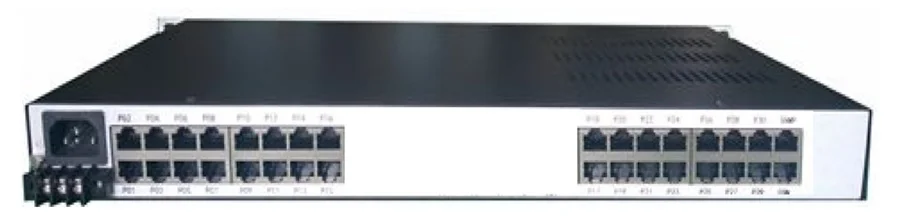
IDM VoiceCable Online Monitoring Equipment
II. Product Features
(1). 19-inch 1U equipment with 30 voice inputs and 30 voice outputs;
(2). Through the equipment's cascade bus, additional expansion chassis can be cascaded to provide more channels for cable testing;
(3). Supports online detection mode, internal line testing (PBX side), and external line testing (cable side). The input and output ends feature power-off bypass functionality. Equipment power failure, faults, power-on/off, or upgrade processes do not affect calls.
III. Online Monitoring Support
(1). Supports online identification of line status: off-hook, on-hook, and ringing;
(2). Supports online detection of faults such as unconnected lines, poor insulation, prolonged off-hook, and short circuits, with alarm notifications;
(3). Supports cable break and short circuit fault detection, with fault location capability;
(4). Supports cable insulation performance testing, identifying line-to-line and line-to-ground insulation resistance, and determining line insulation performance;
(5). Supports real-time monitoring of voice channel status, proactively identifying abnormal channel conditions, and supporting automatic fault analysis triggered by abnormal conditions, with alarm notifications for analysis results.
IV. Internal Line Test Mode Support
(1). Detects ringing, dial tone, signal tone, busy tone, and howler tone;
(2). Detects DTMF dialing, call transfer, call pickup, and other PBX functions;
(3). Supports switching any voice channel on the PBX side to the internal line interface, assisting internal line-side line testing, and enabling FXS and FXO conversion testing.
V. External Line Test Mode Support
(1). Supports sending test audio to lines to assist manual line tracing;
(2). Supports switching any voice channel on the telephone side to the external line interface, assisting external line-side line testing, and enabling external line hotline testing.
VI. Equipment Support
(1). Supports LED indicators for line status and fault alarms; the status and fault conditions of any voice channel can be identified through indicator lights;
(2). Supports automatic line parameter learning functionality, providing reference basis for monitoring and detection judgments;
(3). Supports voice channel bypass; equipment power failure, faults, power-on/off, or upgrade processes have no impact on voice channels;
(4). Supports WEB-based network management for equipment administration, including equipment information display, viewing of login logs, operation logs, alarm logs, and network connection logs, user management, network settings, service management, and software upgrades;
(5). Can provide serial port network management or Ethernet SNMP network management, supporting remote operation and maintenance;
(6). Can provide dual AC 220V power supplies, or dual DC -48V power supplies, or hybrid dual power supplies with 1+1 mutual backup.
VII. Test Functions
The audio circuits support the following types of tests:
7.1 FXO, FXS Interfaces
Audio Range | 300Hz~3400Hz | Compression Rate | ITU G.711 A-law |
Impedance | Three-element complex impedance 200Ω+560Ω//0.1μF | Loop Current | 20mA/channel |
7.2 EM 2/4-Wire Interface
Audio Range | 300Hz~3400Hz | Impedance | Balanced 600Ω |
Companding | A-law per ITU G.711 | Return Loss | ≥18dB |
7.3 Magneto Interface
Audio Range | 300Hz~3400Hz | Impedance | Balanced 600Ω |
Companding | A-law per ITU G.711 | Return Loss | ≥18dB |
7.4 Power Supply and Consumption
Power Supply | AC220V/DC-48V | Power Consumption | ≤10W |
7.5 Environmental Conditions
Operating Temperature | -10°C~+50°C | Relative Humidity | 0~95% (Non-condensing) |
7.6 Product Dimensions
Length × Depth × Height | 482×309×44(mm) |
FAQs
What is the working principle and function of a media converter?
The rapid advancement of informatization has led to growing demand for multimedia communications such as data, voice…
View answerWhat is the difference between optical fiber and optical cable? What are the common optical fiber connectors?
Optical fiber is a medium that transmits information from one end to another. It is a glass or plastic fiber that…
View answer