
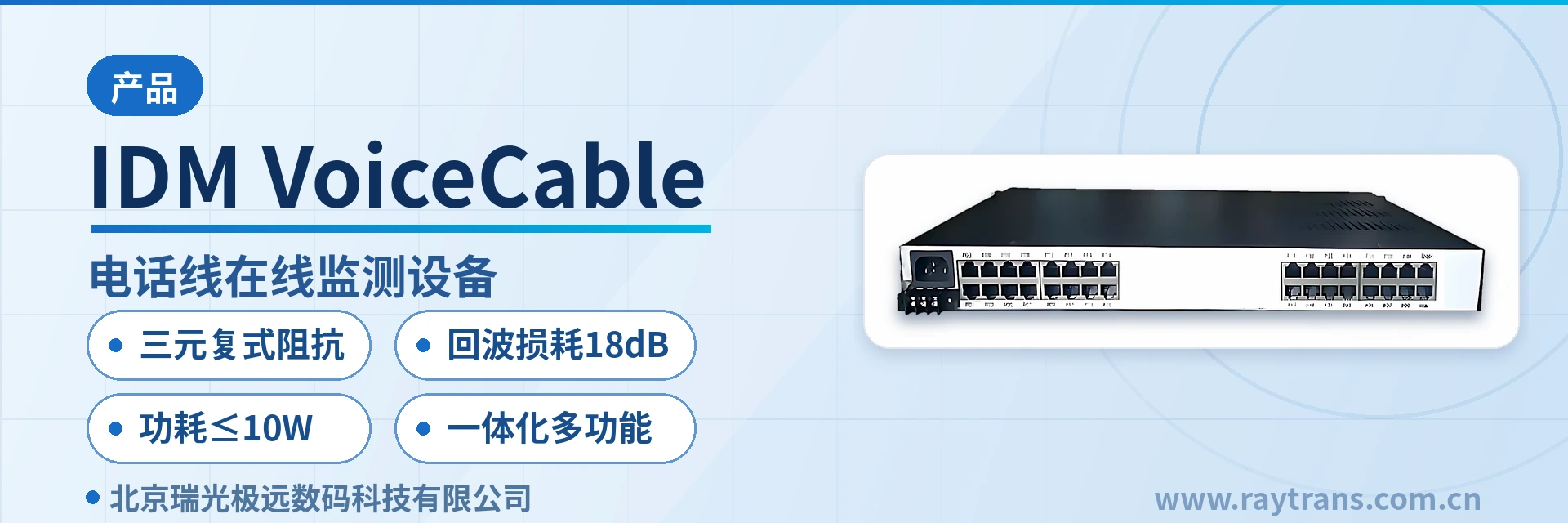
IDM VoiceCable Telephone Line Online Monitoring Equipment
30-channel voice online monitoring, line break and short circuit fault location, power failure pass-through without call interruption
The IDM VoiceCable telephone line online monitoring equipment is used in the product showcase field, targeting industry customers' communication/transmission/dispatch equipment (to be further detailed based on documentation)
What Is a Telephone Line Audio Online Monitoring Device?
The IDM VoiceCable telephone line audio online monitoring device is an equipment room service device for online monitoring, supervision, and management of telephone cables. Developed by Beijing Ruiguang Jiyuan Digital Technology Co., Ltd., it is used for telephone line status monitoring, fault identification, and audio channel testing in private network communications equipment rooms and unattended sites. As one of the product showcase items under Raytrans, the device integrates line testing, status recording, and network management reporting into a single 19-inch 1U rack-mounted device: on one side, it connects to telephone lines through 30 voice inputs and 30 voice outputs; on the other side, it transmits test data to the network management system in real time and builds a line parameter database.
Early devices of the same class were used for 112 online testing services in equipment rooms. Today, the telephone line audio online monitoring device is mostly used for telephone line monitoring in private network communications equipment rooms, with test items covering common line problems such as line breaks, mixed lines, poor insulation, cross-voltage, and noise. The device supports both automatic and manual testing, performs corresponding parameter tests on lines according to the configuration, offers multiple telephone test audio output modes and test modes, and provides a test telephone interface for O&M personnel to verify lines on the equipment room side.
The specifications of the audio circuit directly determine how closely test results approach real calls. Telephone voice energy is concentrated in the 300 Hz to 3400 Hz range, and the device achieves an audio range of 300 Hz to 3400 Hz, fully covering the telephone voice frequency band. The FXO and FXS interfaces use a three-element complex impedance of 200 Ω + 560 Ω // 0.1 μF to precisely match telephone lines and reduce signal reflection. The EM2/4-wire interface and magneto interface use a balanced 600 Ω impedance with a return loss of no less than 18 dB, effectively suppressing echo and improving private network call quality. These audio specifications also reflect the technical capabilities that Raytrans has accumulated over the long term in government private network optical fiber communication solutions and military emergency communications vehicle solutions.
Key Specifications at a Glance: 19-inch 1U rack · 30 voice inputs/30 voice outputs · audio 300–3400 Hz · three-element complex impedance · return loss 18 dB · power consumption ≤10 W
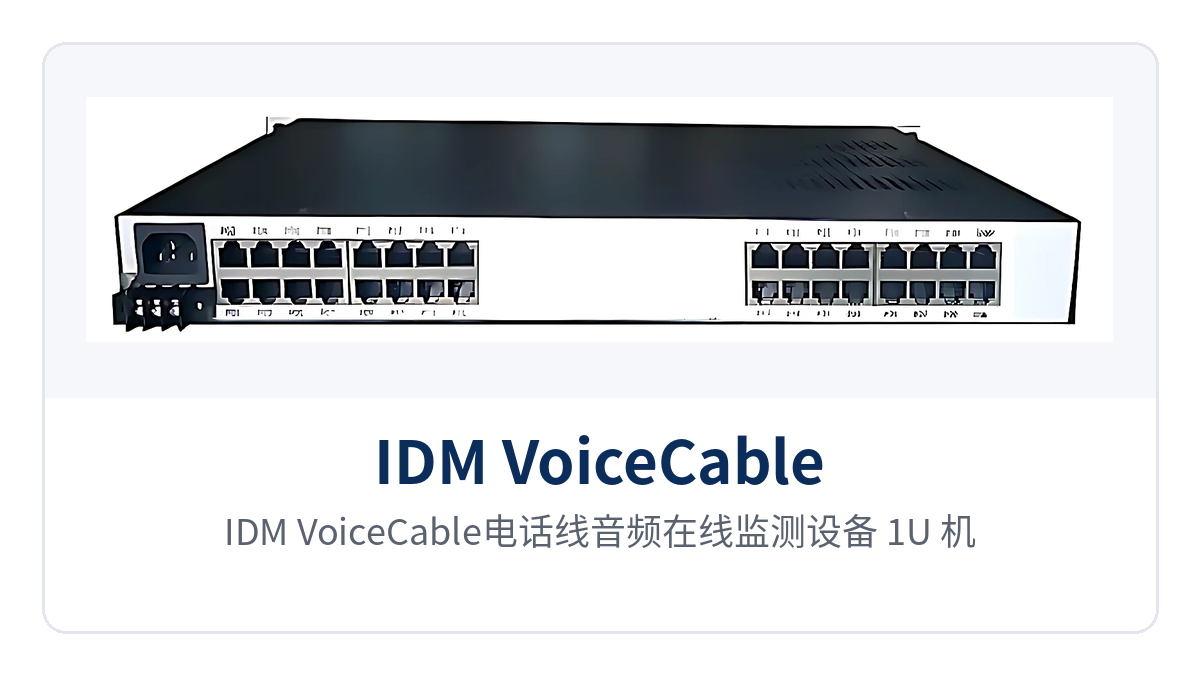
Figure 1: Close-up of the 1U rack chassis and voice channel status indicator LEDs of the IDM VoiceCable telephone line audio online monitoring device
What Problems Do the 300 Hz–3400 Hz Audio Range and Three-Element Complex Impedance Solve?
Let us state the conclusion first: the intelligibility of telephone voice is concentrated in the 300 Hz–3400 Hz range. By building the audio circuit to this range and matching interface impedance to telephone lines, the device aims to make test conditions on the equipment room side close to real call conditions, so that measured results can directly reflect the call performance of the line.
- Audio range 300 Hz–3400 Hz: fully covers the telephone voice frequency band, so test signals fall within the voice band and results match what users actually hear during calls.
- Three-element complex impedance 200 Ω + 560 Ω // 0.1 μF: the FXO and FXS interfaces use a three-element complex impedance to match telephone lines, reducing signal reflection and measurement error.
- Balanced 600 Ω impedance: the EM2/4-wire interface and magneto interface use a balanced 600 Ω impedance, adapting to balanced audio circuits and magneto telephone lines.
- Return loss no less than 18 dB: less audio energy is reflected back to the device, effectively suppressing echo and improving private network call quality.
The complete parameters of the audio interfaces are listed by interface type for easy cross-checking against on-site interfaces before wiring.
| Item | Parameter/Specification | Description/Applicable Conditions |
|---|---|---|
| Audio range | 300 Hz–3400 Hz | Audio circuits of FXO and FXS interfaces, EM2/4-wire interface, and magneto interface |
| Compression | ITU-T G.711 A-law | Same as above; voice encoding follows ITU-T G.711 |
| Impedance (FXO, FXS interfaces) | Three-element complex impedance 200 Ω + 560 Ω // 0.1 μF | Precisely matches telephone lines and reduces signal reflection |
| Loop current | 20 mA/channel | FXO and FXS interfaces |
| Impedance (EM2/4-wire interface, magneto interface) | Balanced 600 Ω | EM2/4-wire interface and magneto interface |
| Return loss | No less than 18 dB | EM2/4-wire interface and magneto interface; a return loss of 18 dB effectively suppresses echo |
Which Line States and Faults Can Online Monitoring Identify?
In one sentence: the telephone line audio online monitoring device identifies voice channel states such as off-hook, on-hook, and ringing online, and raises alarms when conditions such as no connection, poor insulation, long off-hook, short circuit, or line break occur. Among these, line break and short circuit faults can be further located. The value of online monitoring is turning after-the-fact repair requests into on-site alarms: before the line affects calls, the O&M side has already seen the abnormality in the test data.
| Function | Description |
|---|---|
| Line state identification | Identifies voice channel states such as off-hook, on-hook, and ringing online |
| Fault identification and alarming | Identifies faults such as no connection, poor insulation, long off-hook, and short circuit online, and raises alarms |
| Line break and short circuit detection | Supports cable line break and short circuit fault detection and completes fault location |
| Insulation performance detection | Supports cable insulation performance detection, identifies line-to-line and line-to-ground insulation resistance, and determines line insulation performance |
| Real-time monitoring and automatic analysis | Monitors voice channel states in real time, proactively identifies abnormal voice channel states, and triggers automatic fault analysis on abnormal states, with analysis results reported as alarms |
Which Three Test Modes Are Supported?
The telephone line audio online monitoring device supports three operating modes: online detection mode, inside line test (PBX side), and outside line test (cable side). A power failure pass-through function is provided between the input and output ends, so power failure, faults, power on/off, or upgrades of the device do not affect calls. The difference among the three modes lies in the test point location: the inside line test is performed on the switch side, the outside line test on the cable side, and the online detection mode while voice channels are in operation.
What Can the Inside Line Test (PBX Side) Measure?
The inside line test targets the PBX side and can detect ringing, dial tone, signal tone, busy tone, and howler tone, as well as PBX functions such as DTMF number detection, transfer, and call pickup. The device supports switching any voice channel on the PBX side to the inside line interface to assist inside line testing and implement FXS/FXO conversion tests, making it easy to determine whether a fault lies at the switch port or on the line.
How Does the Outside Line Test (Cable Side) Support Manual Troubleshooting?
The outside line test targets the cable side. The device supports sending detection audio to the line to assist manual line tracing, and supports switching any voice channel on the telephone side to the outside line interface to assist outside line testing and implement outside line hotline tests. Together with reference data formed by the automatic line parameter learning function, O&M personnel can verify the wiring sequence and actual routing.
Device Functions and Performance Specifications at a Glance
Device Functions
| Function | Description |
|---|---|
| Voice channel access capacity | 19-inch 1U device with 30 voice inputs and 30 voice outputs |
| Cascading expansion | More expansion enclosures can be cascaded through the device cascade bus to provide more channels of cable testing |
| Three test modes | Supports online detection mode, inside line test (PBX side), and outside line test (cable side) |
| Power failure pass-through | A power failure pass-through function is provided between the input and output ends, so power failure, faults, power on/off, or upgrades of the device do not affect calls |
| Status indicator LEDs | Supports LED indication of line states and fault alarms; the status and fault condition of any voice channel can be identified through the indicator LEDs |
| Automatic line parameter learning | Supports automatic line parameter learning to provide a reference for monitoring and detection decisions |
| Telephone line audio testing | Offers various telephone test audio output modes and test modes, and provides a test telephone interface |
| WEB network management | Supports device information display, viewing of login logs, operation logs, alarm logs, and network connection logs, as well as user management, network settings, service management, and software upgrade |
| Network management access | Provides serial port network management or Ethernet SNMP network management, and supports remote O&M |
| Data and intelligent analysis | Test data is transmitted to the network management system in real time and a parameter database is built; supports connection to the equipment room operation and maintenance intelligent agent through the MCP protocol |
Power, Environmental, and Mechanical Parameters
| Item | Parameter/Specification | Description/Applicable Conditions |
|---|---|---|
| Power supply mode | AC 220 V/DC -48 V | Both AC power supply in private network equipment rooms and DC power supply in communications equipment rooms can be connected directly |
| Overall power consumption | ≤10 W | The unit in online operation |
| Operating temperature | -10 ℃ to +50 ℃ | Attended equipment rooms and unattended sites |
| Relative humidity | 0–95% (non-condensing) | Same environmental conditions as the operating temperature |
| Dimensions (length × depth × height) | 482 × 309 × 44 (mm) | 19-inch 1U rack installation |
Differentiated Value
| Differentiation Point | Corresponding Capability and Value |
|---|---|
| Audio 300–3400 Hz: fully covers the telephone voice frequency band | Audio range 300 Hz–3400 Hz fully covers the telephone voice frequency band, ensuring clear private network calls |
| Three-element complex impedance: precisely matches telephone lines | Three-element complex impedance 200 Ω + 560 Ω // 0.1 μF precisely matches telephone lines and reduces signal reflection |
| Return loss 18 dB: effectively suppresses echo | Return loss no less than 18 dB effectively suppresses echo and improves private network call quality |
| Power consumption ≤10 W: low power consumption for long-term online operation | With 30 voice inputs and 30 voice outputs in online operation, the overall power consumption is ≤10 W, adding no power supply burden to the equipment room over the long term |
Typical Application Scenarios
A common problem in private network telephone line monitoring is that sites are scattered and cable aging is hard to notice. Equipment rooms of electric power, rail transit, and military and government private networks all need to find line hazards before calls are interrupted. As a manufacturer focused on command and dispatch systems, Raytrans adapts its telephone line audio online monitoring device to these scenarios with a working approach centered on online monitoring and supplemented by manual testing, and presents in its product showcase complete supporting capabilities for government private network optical fiber communication solutions and military emergency communications vehicle solutions.
Electric Power Dispatch Private Network: Online Monitoring of Dispatch Telephone Lines
Dispatch telephones on electric power dispatch private networks carry the issuance of commands. Once noise, cross-voltage, or degraded insulation occurs on a line, it often shows up first in call quality. The Raytrans telephone line audio online monitoring device connects 30 voice inputs and 30 voice outputs in online detection mode, identifies off-hook, on-hook, and ringing states in real time, and raises alarms for abnormalities such as poor insulation, long off-hook, and short circuit; line break and short circuit faults can be located. The 300 Hz–3400 Hz audio range and 18 dB return loss specification bring test conditions close to real calls. Both AC power supply in communications equipment rooms and -48 V DC power supply can be connected directly, and dual power supply 1+1 redundancy reduces monitoring interruptions caused by single power supply failure.
Rail Transit Communications Private Network: Status Monitoring of Telephone Lines Along the Line
Telephone sites on rail transit communications private networks are distributed across stations, sections, and depots. Lines are long and nodes are numerous, so troubleshooting relies on checking section by section. In outside line test mode, the Raytrans telephone line audio online monitoring device sends detection audio to the line to assist manual line tracing, and can also switch any voice channel on the telephone side to the outside line interface to implement outside line hotline tests; the inside line test mode is used to verify PBX-side functions such as ringing, dial tone, and DTMF number detection, transfer, and call pickup, helping determine whether the problem lies on the switch side or the cable side. The device supports cascading more expansion enclosures, so the number of channels can be increased section by section according to site scale without replacing all wiring facilities at once.
Military and Government Private Networks: Telephone Line Monitoring in Unattended Equipment Rooms
The equipment rooms of military and government private networks are mostly under closed management and unattended, and the cost of sending O&M personnel on site is high. For telephone line monitoring in unattended equipment rooms, this telephone line audio online monitoring equipment adapts to the site environment with an operating temperature of -10℃+50℃ and 095% non-condensing humidity, and the unit's overall power consumption is ≤10W, so long-term online operation does not add to the power supply load of the equipment room; the power failure pass-through function ensures that voice channels are not affected during power failure, faults, power on/off or upgrades, so confidential communications are not interrupted by maintenance actions on the monitoring device. Test data is uploaded for network management reporting through serial port network management or Ethernet SNMP network management, and can also be connected to the equipment room operation and maintenance intelligent agent via the MCP protocol, with line operating status presented through ChatBI.
Summary
This telephone line audio online monitoring equipment puts telephone line online monitoring and audio channel testing into a single 19-inch 1U rack-mounted device: 30 channels of voice input and 30 channels of voice output carry the line access, online detection, inside line test and outside line test cover the test requirements on both sides of the equipment room, faults such as line break, short circuit and poor insulation are identified online and alarmed, and the 300Hz3400Hz audio range, three-element complex impedance and a return loss of not less than 18dB bring the test conditions close to those of a real call. With AC220V/DC-48V dual power supply, an overall power consumption of ≤10W, an operating temperature of -10℃+50℃ and 0~95% non-condensing humidity, this telephone line audio online monitoring equipment can be deployed directly in private network equipment rooms and remote unattended sites; together with the power failure pass-through function, long-term online operation does not affect normal calls.