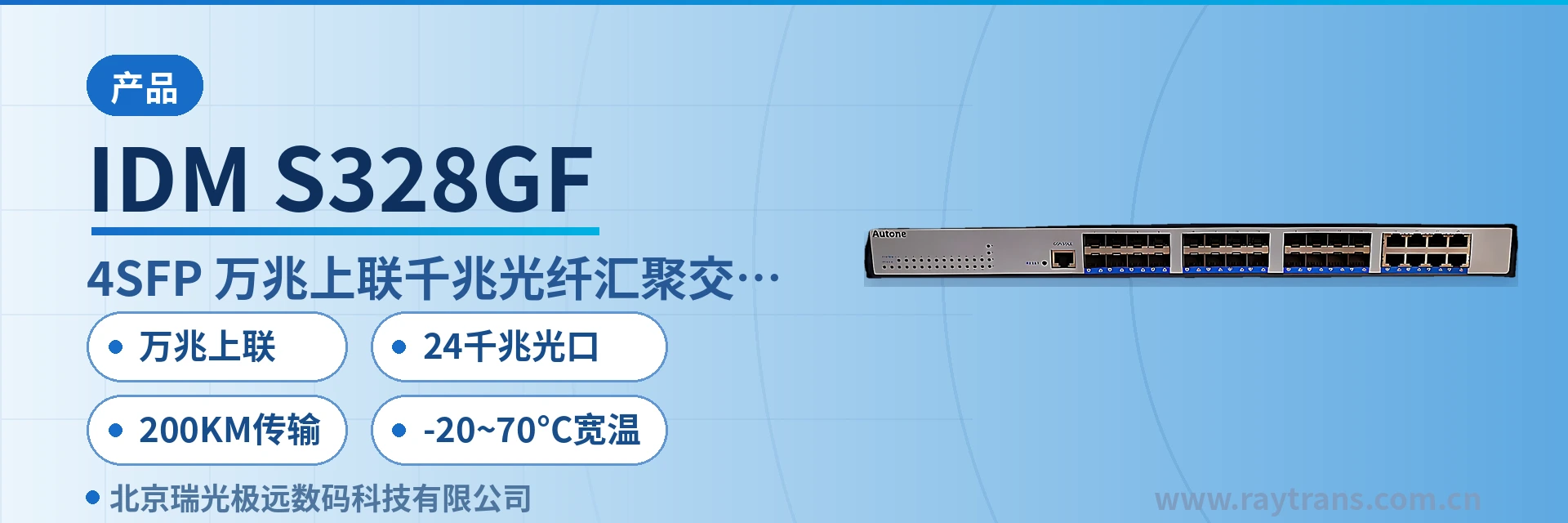
IDM S328GF-24SFP 10G Uplink Aggregation Switch
24 optical ports aggregated at once, 1~4 10G uplinks, 200KM wide temperature
The S328GF series fiber optic Ethernet switch is a switch product specially developed by our company for application environments such as building automation, security surveillance, smart city, Tianwang system, electronic police and factory automation. The S328GF fiber optic Ethernet switch provides 1~4 10G SFP Plus ports, offering maximum convenience for high-speed uplinks and stacking. The S328GF fiber optic Ethernet switch series provides 24 1000Mbps SFP optical ports with single-mode/multi-mode and single-fiber/dual-fiber options. The single-mode model comes standard with a 20KM optical fiber transmission distance, and 40KM/60KM are also available
The IDM S328GF-24SFP 200KM wide-temperature aggregation switch is an optical fiber Ethernet switch developed by Raytrans for building automation, security surveillance, smart city, Tianwang system and factory automation. It is used for network aggregation at the central equipment room side, providing 24 Gigabit SFP optical ports, 1~4 10G SFP Plus uplink ports and 8 Gigabit RJ45 electrical ports in a single unit. It complies with the IEEE 802.3 standard and can serve as an aggregation node device in a government private network optical fiber communication solution.
Key Specifications at a Glance: 24 Gigabit optical ports · 10G uplink · 200KM transmission · -2070°C wide temperature · 8 Gigabit RJ45 electrical ports · AC 90264V input / 70W power consumption
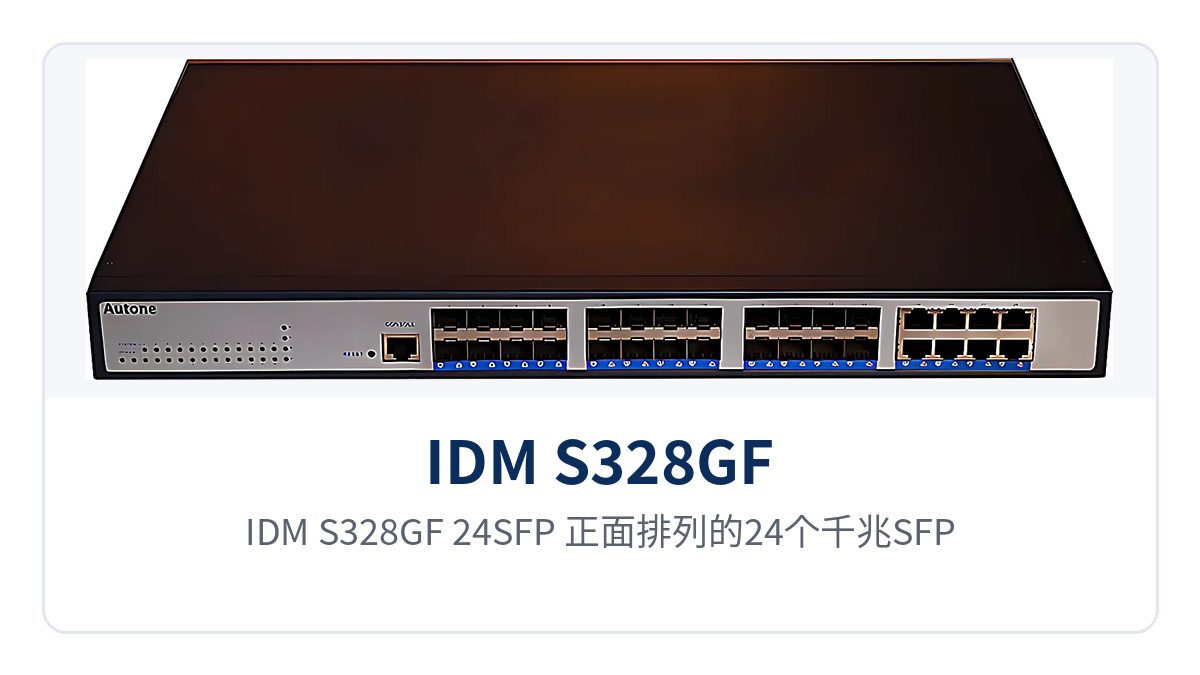
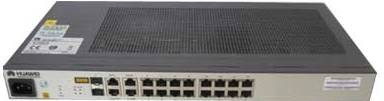
Figure 1: Close-up of the 24 Gigabit SFP optical ports and 1~4 10G SFP Plus uplink ports arranged on the front panel of the IDM S328GF-24SFP
As a 10G uplink aggregation switch designed for the aggregation layer, the IDM S328GF-24SFP 200KM wide-temperature aggregation switch operates between the access layer and the core layer: after front-end cameras, access control, PLCs and measuring instruments are uplinked over optical fiber, a single device at the equipment room side aggregates them all at once, and then uplinks to the core through the 10G ports. Replacing multiple small-port fiber optic switches plus standalone media converters with 24 Gigabit SFP optical ports is a direct way to reduce the number of devices and cabinet space usage on the aggregation side of the equipment room; for users focused on product showcase and selection comparison, this 24-port Gigabit optical port switch also intuitively reflects the product approach of a media converter manufacturer and an industrial Ethernet switch manufacturer in terms of port density and uplink capability, and Raytrans continues to provide stable and reliable aggregation-side choices for various industrial Ethernet switch applications.
What kind of device is the IDM S328GF-24SFP 200KM wide-temperature aggregation switch?
The IDM S328GF-24SFP 200KM wide-temperature aggregation switch is a rack-mounted all-optical port aggregation-type fiber optic Ethernet switch that integrates 24 1000Mbps SFP optical interfaces, 1~4 10G SFP Plus uplink interfaces and 8 10/100/1000BaseT(X) electrical interfaces in the same device, with a store-and-forward data switching mechanism and switching latency of less than 1us. As a product showcase designed for the aggregation layer, the device offers a higher-integration choice between the functional boundaries of media converters and fiber optic switches, and also reflects the technical accumulation of Raytrans in the fields of media converter manufacturers and industrial Ethernet switch manufacturers.
The device has dimensions of 440mm (W) × 43.6mm (H) × 285mm (D) and a weight of 4.6KG. It adopts a metal enclosure and a GB standard D-type power connector, supports rack-mounted installation, and a single installer can complete the rack installation, with the termination points of 24 front-end optical fibers concentrated within one rack unit.
The front panel and interface side are provided with LED indicators. Power status is indicated by the Power LED, and the link and speed of each interface are displayed by the Link/Act and Speed indicators respectively, so that during equipment room inspection, port connectivity and whether modules are fully inserted can be judged without logging in to each device one by one.
How do 24 Gigabit SFP optical ports aggregate the front-end optical fibers in the equipment room at once?
The 24 front-end optical fiber links are aggregated and forwarded within the IDM S328GF-24SFP 200KM wide-temperature aggregation switch, so the equipment room no longer needs to configure a separate media converter or small switch for each optical fiber. The device provides 24 1000Mbps SFP optical interfaces, with single-mode/multi-mode and single-fiber/dual-fiber options, and SC or LC interface form; all ports are non-blocking and forward packets at wire speed.
For projects requiring a 24-port Gigabit optical port switch, the optical ports, electrical ports and 10G uplink are integrated in the same rack-mounted device, with one device corresponding to the optical fiber termination points of one cabinet layer, which simplifies the operation and maintenance list and spare parts models accordingly. Concentrating 24 Gigabit links in one device also makes it easy to divide the optical fibers of different areas into different services by port, reserving a clear port ledger for aggregation layer optical fiber networking. For a government private network optical fiber communication solution, this high-density optical port aggregation capability can effectively reduce the number of stacked devices from media converter manufacturers in the equipment room and simplify the cabling hierarchy of the government private network optical fiber communication solution.
Why can 1~4 10G SFP Plus uplinks keep 24 burst traffic streams from congesting?
The uplink side of the device provides 14 10G SFP Plus interfaces, facilitating high-speed uplink and stacking. These 14 ports can be directly connected to the core switch, and can also be used for interconnection and stacking between multiple aggregation switches. The port rates cover 10/100/1000Mbps and 10000Mbps, aligning with the 10G planning on the core side in one step. As the core capability of a 10G uplink aggregation switch, this uplink configuration is particularly critical in a government private network optical fiber communication solution, ensuring bandwidth matching between the aggregation layer and the core layer.
When 24 Gigabit links generate burst traffic at the same time, the 10G uplink ports still have margin to forward to the core layer, so the aggregation layer is unlikely to become a bandwidth bottleneck for the entire network. Calculated by port ratio, the forwarding capability of one 10G uplink is equivalent to 10 Gigabit links at full rate, and 2~4 10G uplinks can leave room for superimposing video, control and network management traffic.
How to choose between 20KM and 200KM distances for SFP optical modules?
The optical port transmission distance is determined by the inserted SFP optical module; the device itself does not come with a fixed distance. The IDM S328GF-24SFP 200KM wide-temperature aggregation switch offers six transmission distance grades: 20KM, 40KM, 60KM, 80KM, 120KM and 200KM. The single-mode model comes standard with 20KM, and single-mode/multi-mode and single-fiber/dual-fiber are all selected by module.
- For deployment within the same building or industrial park, 20KM single-mode modules can meet the backbone and inter-building link requirements, with relatively low cost and power consumption;
- For cross-plant or cross-site links of 40KM~80KM, select modules one grade higher based on the actual optical fiber length to leave margin for splice point and patch cord losses;
- For distributed sites such as electronic police and Tianwang checkpoints requiring 120KM~200KM, use the corresponding long-distance modules and check the link budget;
- Where single-fiber bidirectional links already exist, use single-fiber modules in pairs, with the TX of one end connected to the RX of the opposite end, avoiding transmit/receive on the same frequency.
What cabinets are the -20~70°C wide temperature and metal enclosure suitable for?
The device has an operating temperature of -20°C ~ 70°C, a storage temperature of -40°C ~ 85°C, and an operating humidity of 5%~95% (non-condensing). The metal enclosure provides both heat dissipation and mechanical strength, and can be installed in an attended equipment room, as well as in field cabinets, roadside enclosures and unattended sites. This wide-temperature design meets the harsh environment adaptation requirements of industrial Ethernet switch manufacturers, and also enables the device to be deployed at outdoor nodes of a government private network optical fiber communication solution.
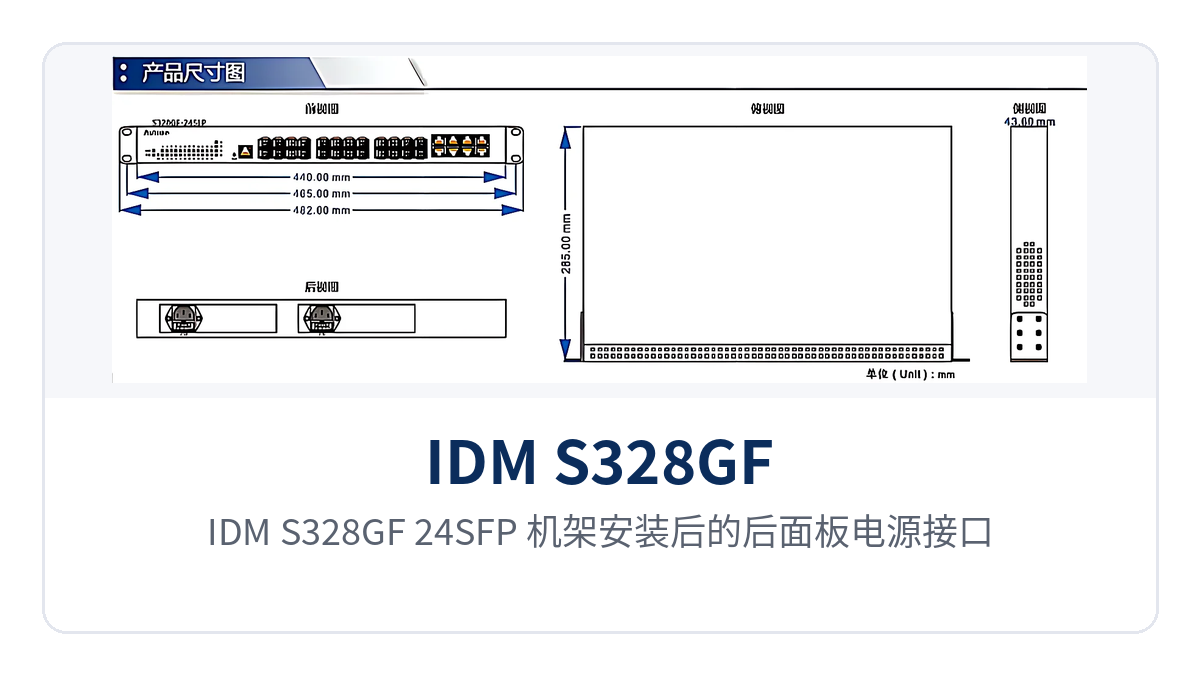
Figure 2: Layout of the rear panel power connector and link status indicators of the IDM S328GF-24SFP after rack installation
The power supply side adopts an AC 90~264V wide-range input, with power consumption of the unit at 70W, a GB standard D-type power connector and overload protection, so there is no need to configure a separate voltage stabilizer for the device in the cabinet. During rack installation, secure the device to the front of the rack, leave heat dissipation space at the air inlets and outlets, and then insert the front-end optical fibers into the SFP optical ports one by one according to the port ledger.
Core Functions
| Function | Description |
|---|---|
| 24 Gigabit optical port aggregation | 24 1000Mbps SFP optical ports aggregate 24 front-end optical fibers at once, with single-mode/multi-mode and single-fiber/dual-fiber options |
| 10G uplink | 1~4 10G SFP Plus interfaces for uplinking to the core switch or interconnecting and stacking multiple aggregation devices |
| Gigabit electrical port access | 8 10/100/1000BaseT(X) RJ45 electrical ports for local devices in the equipment room, rate adaptive |
| Layer 2/Layer 3 switching | Supports VLAN, STP, QOS, ACL, routing and other Layer 2/Layer 3 switching functions, enabling network segment division at the aggregation layer |
| VLAN division | Supports 802.1Q standard VLAN, with the number of VLANs up to 4096, isolating different areas by VLAN |
| QOS priority | Supports 802.1p QOS data priority transmission service, allowing real-time services such as video to be forwarded first |
| Spanning tree protocol | Supports STP, RSTP and MSTP, automatically aggregating in link redundancy scenarios and avoiding loops |
| Access control | The access control list (ACL) supports Layers 2, 3 and 4 and multiple protocols, restricting access by port and address |
| Broadcast storm suppression | Adjustable broadcast, multicast and unicast suppression, suppressing the impact of flood traffic on aggregation links |
| Overload protection | Supports overload protection, reducing the risk of damage to the device and services when the AC input is abnormal |
| Wide-temperature metal enclosure | Metal enclosure combined with -20°C~70°C operating temperature, suitable for field cabinets and unattended equipment rooms |
Technical Specifications and Interface Indicators
| Item | Parameter/Specification | Description/Applicable Conditions |
|---|---|---|
| 10G uplink interface | 1~4 10G SFP Plus interfaces | For uplinking to the core or interconnection and stacking between aggregation devices |
| Gigabit optical interface | 24 1000Mbps SFP interfaces | Single-mode/multi-mode and single-fiber/dual-fiber options, SC or LC |
| Gigabit electrical interface | 8 10/100/1000BaseT(X) RJ45 | Rate adaptive, for local access in the equipment room |
| Port rate | 10/100/1000Mbps, 10000Mbps | Electrical ports adaptive, optical ports at the rate of the inserted module |
| Communication standard | Complies with the IEEE 802.3 standard | Interoperable with mainstream switches and network cards |
| MAC address table | 32Kbps | As stated in the original product documentation |
| Packet buffer | 32Mbps | As stated in the original product documentation |
| Switching latency | Less than 1us | Forwarding latency under the store-and-forward mechanism |
| Data switching mechanism | Store-and-forward | All ports non-blocking, wire-speed forwarding |
| Optical port transmission distance | 20KM, 40KM, 60KM, 80KM, 120KM, 200KM | Determined by the inserted SFP optical module; the single-mode model comes standard with 20KM |
| Indicator LED | Power LED; Link/Act, Speed | Indicate power, link and port rate respectively |
Electrical, Mechanical and Environmental Specifications
| Item | Parameter/Specification | Description/Applicable Conditions |
|---|---|---|
| Power input | AC 90~264V | Wide-range input, suitable for both equipment rooms and field cabinets |
| Power consumption | 70W | Rated power consumption of the unit |
| Overload protection | Supported | Power supply side protection |
| Enclosure | Metal enclosure | Provides both heat dissipation and mechanical strength |
| Dimensions | 440mm × 43.6mm × 285mm | W×H×D; check the cabinet clear depth before rack installation |
| Weight | 4.6KG | Can be rack-mounted by one person |
| Installation method | Rack-mounted installation | Secure according to the on-site rack profile |
| Operating temperature | -20°C ~ 70°C | Wide temperature operation, suitable for field cabinets and unattended sites |
| Storage temperature | -40°C ~ 85°C | Transportation and storage conditions |
| Operating humidity | 5% ~ 95% (non-condensing) | Cabinet ventilation must be ensured in hot and humid environments |
| Warranty period | 3 years | Subject to the manufacturer's warranty terms |
Differentiation Point
| Differentiation Point | Corresponding Capability and Value |
|---|---|
| 10G uplink | 1~4 10G SFP Plus uplinks are directly connected to the core switch, leaving margin for backhauling the burst traffic of 24 Gigabit links, and suit high-bandwidth aggregation in private networks |
| 24 Gigabit optical ports | 24 Gigabit SFP optical ports aggregate 24 front-end fibers in one rack-mounted device, saving multiple small-port switches and standalone media converters in the equipment room |
| 200KM transmission | SFP optical modules start at 20KM, with a long-distance grade selectable up to 200KM, so private network networking across plants and sites over long distances needs no additional repeater equipment |
| -20~70°C | The metal enclosure, together with a -20°C |
Typical Application Scenarios
Smart City and Tianwang System
The front-end checkpoints, speed domes and electronic police sites of the Tianwang system are scattered along the roads of an urban area, and after the optical fibers are aggregated through ducts and poles to the area equipment room, they need centralized termination on the equipment room side. The IDM S328GF-24SFP 200KM wide-temperature aggregation switch takes in 24 front-end fibers on one device and then backhauls to the district-level core over a 10G uplink, so the equipment room only needs to keep one uplink outlet. Such deployments also commonly plan this switch as the aggregation node in government private network optical fiber communication solutions, together with Raytrans transmission products.
Video service traffic fluctuates noticeably with the morning and evening peaks; when the 24 Gigabit links burst at the same time, the 10G uplink port handles forwarding toward the core and reduces queuing at the aggregation layer. When a remote checkpoint is more than 20KM away, an optional long-distance module is selected, so urban and suburban sites can be planned uniformly under the same device model.
Security Surveillance and Electronic Police
Surveillance sites in industrial parks, plants and along roads are often distributed in a chain following the perimeter and the roadway, and the optical fibers run uplink from the fiber optic switches of each area to the surveillance center. The IDM S328GF-24SFP 200KM wide-temperature aggregation switch completes fiber aggregation on the surveillance center side, its 24 Gigabit optical ports are allocated by area, and its 8 Gigabit electrical ports connect the storage servers and network management terminals in the center.
Once the video streams of different areas or different management units are isolated by VLAN, cross-region access is controlled by ACL, and the surveillance center no longer needs a separate access switch for each area. The device supports 802.1p priority, so when alarm video and routine video recordings are uploaded over the same link, real-time streams can be forwarded first.
Factory Automation and Building Automation
PLCs, visual inspection devices and energy meters on factory production lines are distributed across several workshops, while the DDCs, access control and lighting controllers of building automation are distributed on each floor, and the optical fiber aggregation point is usually located in the power distribution room or the weak-current shaft. The IDM S328GF-24SFP 200KM wide-temperature aggregation switch is rack-mounted in the cabinets at these locations, and its 24 Gigabit optical ports take in the fibers from each workshop and each floor.
Workshop ambient temperature fluctuation is large and cabinet ventilation varies, so the -20°C~70°C operating temperature and the metal enclosure of the device suit such sites; the 8 Gigabit electrical ports can connect nearby production line fiber optic switches or industrial PCs, avoiding one more small switch for a few electrical port devices. When selecting for industrial scenarios, the protection and installation requirements of industrial Ethernet switches can be checked at the same time, and on-site adaptation details confirmed with the industrial Ethernet switch manufacturer.
How Does a 10G Uplink Aggregation Switch Connect to an Existing Private Network?
When the IDM S328GF-24SFP 200KM wide-temperature aggregation switch is connected to an existing private network, first determine the 10G module according to the uplink port form of the existing core in the equipment room, then insert the front-end fibers one by one into the 24 Gigabit SFP optical ports, and finally divide VLANs by area and check the indicator LED status. Aligning the device port records, the module distance grade and the cabinet power supply in one pass avoids repeated adjustment after commissioning.
As a 200KM wide-temperature aggregation switch, the IDM S328GF-24SFP serves as the aggregation node on the equipment room side through the combination of a 10G uplink and 24 Gigabit optical ports, provides coverage for links from the industrial park to the remote end through module selection from 20KM to 200KM, and brings -20~70°C wide temperature operation and a metal enclosure into field cabinets and unattended sites, making it suitable for long-term operation of the aggregation layer in smart city, security surveillance and factory automation projects.