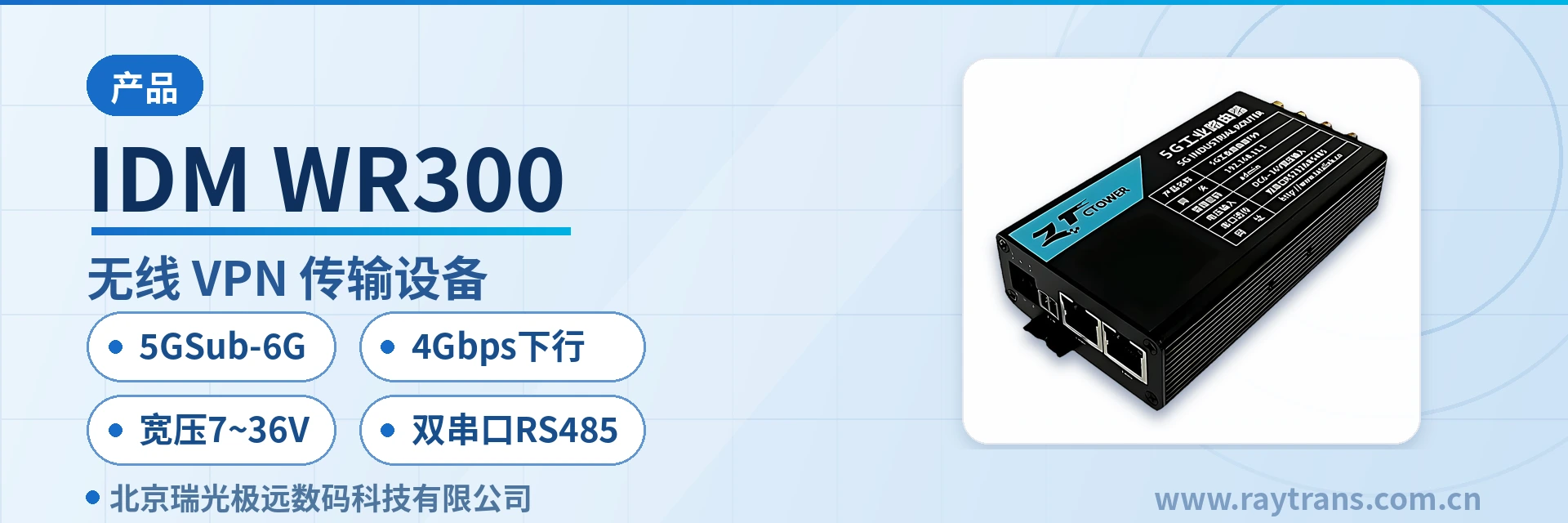
IDM WR300 5G Private Network Industrial Router
Dual serial ports RS232, RS485, transparent transmission, 7~36V wide voltage
The IDM WR300 5G wireless VPN transmission device is a high-speed 5G terminal based on a 5G NR/LTE-FDD/LTE-TDD/HSPA+ cellular modem. It integrates a dual-core 880MHz CPU, provides 2 x 10/100/1000M network ports, 1 SIM card slot and an inserted LAN port, and receives 5G high-speed networks. Its small size and aluminum alloy housing provide excellent heat dissipation. The product has also undergone wide-temperature, wide-voltage input and electromagnetic compatibility (EMC) testing. It has been widely used in M2M applications across the Internet of Things (IoT) industry chain.
IDM WR300 5G Private Network Industrial Router (full model name: IDM WR300 5G Wireless VPN Transmission Device) is a high-speed 5G terminal based on a 5G NR/LTE-FDD/LTE-TDD/HSPA+ cellular modem. Developed by Beijing Ruiguang Jiyuan Digital Technology Co., Ltd. (Raytrans), it connects on-site terminals in scenarios such as smart grid, industrial automation and intelligent transportation to upper-level service platforms over a 5G private network, and is one of Raytrans's representative product showcases in the industrial communications field. The unit integrates an MTK dual-core 880MHz CPU, 1Gbit RAM, 256MB NandFlash and the LINUX operating system, and provides 2 10/100/1000M adaptive network ports, 1 SIM card slot, 4 5G antenna interfaces, and RS232 and RS485 dual serial ports. The aluminum alloy housing, with compact dimensions of 6627125mm, fits easily into on-site cabinets.
Key Specifications at a Glance: 5G Sub-6G frequency band · 4Gbps theoretical downlink · 2×10/100/1000M network ports · wide voltage 7~36V · wide temperature -40℃~85℃ · dual serial ports RS232/RS485
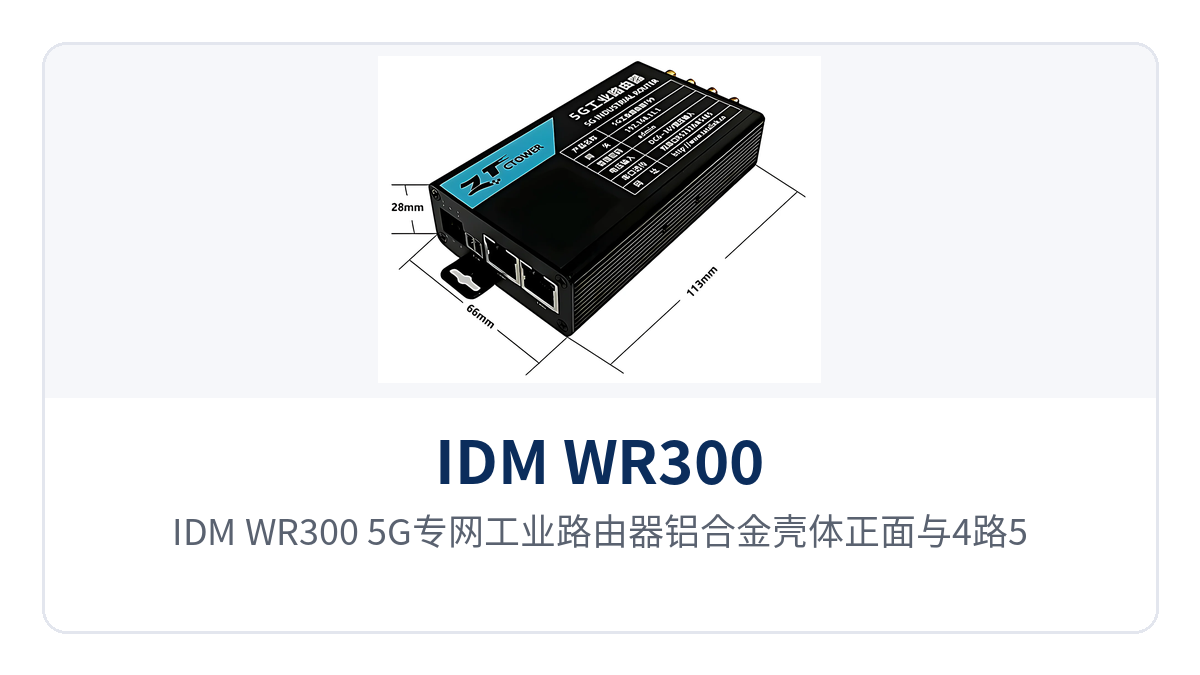
Figure 1: Front of the IDM WR300 5G Private Network Industrial Router aluminum alloy housing and 4 5G antenna interfaces
What Kind of Device Is the IDM WR300 5G Private Network Industrial Router?
The IDM WR300 5G Private Network Industrial Router is a compact 5G wireless VPN transmission device for industrial sites launched by Raytrans, designed to connect RS232/RS485 serial port terminals and Ethernet terminals to a 5G network or 5G private network. The device relies on the aluminum alloy housing for natural heat dissipation without a fan. Its operating temperature and storage temperature are both -40℃~85℃, with relative humidity 95% non-condensing, and it has passed wide-temperature, wide-voltage input and electromagnetic compatibility (EMC) tests, making it suitable for unattended locations such as outdoor cabinets, trackside equipment rooms and distribution rooms.
The 4 5G antennas of the IDM WR300 use 50Ω SMA interfaces, and external antennas or extension feeders can be selected according to on-site conditions; installation supports both mounting bracket installation and DIN-rail installation, facilitating deployment inside existing cabinets. The unit supports 7~36V wide voltage input with power consumption of 10W, and can draw power directly from an on-site DC distribution panel cabinet without an additional power conversion module.
Core Functions
Function | Description |
|---|---|
5G/4G/3G multi-mode access | Supports 5G NR, LTE-FDD, LTE-TDD and WCDMA networks; access is available once a SIM card is inserted, with no need to deploy a wired dedicated line |
Gigabit routing and switching | Provides 2 10/100/1000M adaptive network ports usable as LAN or WAN, and supports NAT network address translation |
Firewall and access control | Built-in NAT and SPI stateful packet inspection; media access control uses CSMA/CA with ACK |
VPN tunnel | Supports PPTP, L2TP, OpenVPN Client, p2p and other VPN protocols to meet private network encrypted backhaul requirements |
DHCP and routing protocols | Built-in DHCP dynamic host configuration protocol, and supports PPP, PPPoE, DDNS, ICMP, VRRP and other protocols |
Dual serial port server | Both RS232 and RS485 support transparent transmission, and MQTT data reporting can be customized as required |
SIM card access | 1 SIM card slot, supporting 1.8V/3.3V SIM cards |
Fanless heat dissipation structure | Aluminum alloy housing with compact dimensions of 6627125mm; heat is dissipated through the housing, adapting to wide-temperature and dusty environments |
Installation and maintenance | Supports mounting bracket installation and DIN-rail installation; the front panel provides SYS---5G indication and 1 reset button |
Wireless Frequency Bands and Theoretical Bandwidth
Item | Parameter/Specification | Description/Applicable Conditions |
|---|---|---|
5G frequency band | Sub-6G: n1, n2, n3, n5, n7, n8, n12, n20, n25, n28, n40, n41, n66, n71, n77, n78, n79 | Covers frequency bands commonly used by 5G private networks; the specific available bands are determined by the local carrier network |
4G frequency band (LTE-FDD) | B1/B2/B3/B4/B5/B7/B8/B12/B13/B14/B17/B18/B19/B20/B25/B26/B28/B29/B30/B32/B66/B71 | Serves as a fallback channel when 5G coverage is insufficient |
4G frequency band (LTE-TDD) | B34/B38/B39/B40/B41/B42/B48 | Serves as a fallback channel when 5G coverage is insufficient |
3G frequency band (WCDMA) | B1/B2/B3/B4/B5/B8 | Fallback channel for low-bandwidth services and extreme coverage conditions |
Sub-6G theoretical bandwidth | Uplink 300Mbps, downlink 4Gbps | Theoretical values; actual rates are affected by the local network environment and carrier configuration |
LTE CAT20 theoretical bandwidth | Uplink 150Mbps, downlink 2.4Gbps | Theoretical values, used for bandwidth estimation during 4G fallback |
HSPA+ theoretical bandwidth | Uplink 5.76Mbps, downlink 42.0Mbps | Theoretical values, used for bandwidth estimation during 3G fallback |
Frequency bands are the prerequisite for whether the IDM WR300 5G Private Network Industrial Router can access the local network. The 5G part of the device operates in Sub-6G bands, covering n1, n2, n3, n5, n7, n8, n12, n20, n25, n28, n40, n41, n66, n71, n77, n78, n79; the 4G part supports both LTE-FDD and LTE-TDD, and the 3G part supports WCDMA. When on-site 5G signals are insufficient, the device can fall back to a 4G or 3G network to continue carrying services, avoiding direct link interruption.
Theoretical bandwidth varies by network format: Sub-6G downlink theoretical value 4Gbps, uplink theoretical value 300Mbps; LTE CAT20 downlink theoretical value 2.4Gbps, uplink theoretical value 150Mbps; HSPA+ downlink theoretical value 42.0Mbps, uplink theoretical value 5.76Mbps. The above are theoretical values; actual rates are affected by the local network environment, base station load and carrier configuration, and project selection shall be based on on-site actual measurement results.
Interface and Hardware Parameters
Item | Parameter/Specification | Description/Applicable Conditions |
|---|---|---|
CPU | MTK dual-core 880MHz | Handles routing and forwarding, VPN tunnels and serial port data processing |
RAM | 1Gbit | Depends on the unit configuration |
NandFlash | 256MB | Stores the system and configuration |
Operating system | LINUX | Supports DHCP, VPN and protocol stack related functions |
Network interface | 2 × 10/100/1000M adaptive network ports | Can be used as LAN or WAN |
Antenna interface | 4 × 5G antennas (50Ω SMA interface) | Supports external antennas and feeder extension |
SIM card slot | 1, supports 1.8V/3.3V SIM card | Plug and play; the card type must match the slot voltage |
Dual serial port | RS232 & RS485 | Supports transparent transmission; MQTT mode customized as required |
Indicators and buttons | LED: SYS---5G; 1 × reset button | For operating status viewing and configuration reset |
Power connector | 3.81*2pin terminal | DC input, terminal block type |
Environmental, Power Supply and Structural Parameters
Item | Parameter/Specification | Description/Applicable Conditions |
|---|---|---|
Input voltage | Wide voltage 7~36V | Can draw power directly from the on-site DC distribution panel cabinet |
Overall power consumption | 10W | Low power consumption operation, reducing heat inside the cabinet |
Operating temperature | -40℃ ~ 85℃ | Wide-temperature design, suitable for outdoor cabinets and equipment rooms without air conditioning |
Storage temperature | -40℃ ~ 85℃ | Same order of magnitude as the operating temperature |
Relative humidity | 95% non-condensing | For humid environment assessment; not applicable to condensation scenarios |
Dimensions | 6627125mm | Compact structure, easy to install in narrow cabinets |
Housing material | Aluminum alloy housing | Fanless natural heat dissipation |
How to Choose a 5G Industrial Router?
To choose a 5G industrial router, you can first clarify four hard metrics: whether the frequency band covers the local 5G private network, whether the power supply and temperature match the site, whether the number of interfaces is sufficient, and whether the installation method fits the cabinet. If these four do not match, the subsequent function discussions will all require rework.
The frequency band metric determines whether the device can be used. It is necessary to check whether the 5G frequency band used by the carrier or private network falls within the supported range of the device. The Raytrans IDM WR300 covers Sub-6G n1, n2, n3, n5, n7, n8, n12, n20, n25, n28, n40, n41, n66, n71, n77, n78 and n79, and is backward compatible with LTE-FDD, LTE-TDD and WCDMA, so it can fall back to 4G/3G when 5G coverage is insufficient.
The power supply and temperature metrics determine whether unattended operation is possible. A wide voltage and wide temperature 5G private network industrial router such as the IDM WR300 has an input range of 7~36V and an operating temperature of -40℃~85℃, can draw power directly from a DC distribution panel cabinet and be installed in an outdoor cabinet without air conditioning, with an overall power consumption of 10W, requiring no additional power conversion module or temperature control device. This is the basis for its long-term maintenance-free operation.
The interface metrics determine the upgrade cost. If the site already has RS232/RS485 serial port terminals such as electricity meters, PLCs and RTUs, choosing a model with dual serial ports can eliminate the need for a standalone RS485 serial port server; the 2 gigabit Ethernet ports can respectively handle uplink backhaul and local access, avoiding the addition of another industrial Ethernet switch. For the installation method, it is recommended to choose mounting brackets or DIN-rail installation according to the cabinet conditions.
In addition to the parameters listed on this page, other customized items are subject to the manufacturer's technical documentation and commercial confirmation.
Typical Application Scenarios
Smart Grid: Data Backhaul for Distribution Rooms and Distribution Area Terminals
Distribution rooms, ring main units and distribution area terminals usually only provide RS485 interfaces, and the site may not have available optical fiber resources. The Raytrans IDM WR300 5G private network industrial router can backhaul the collected data of these serial port terminals to the master station over the 5G network. The wide voltage 7~36V input can draw power directly from the DC distribution panel cabinet in the station, and the wide temperature specification of -40℃~85℃ covers the temperature difference between outdoor cabinets in northern winters and sealed cabinets in southern summers, reducing the workload of separately configuring power supply and temperature control for communication equipment.
Industrial Automation: Serial Port Cloud Upload for PLCs and Remote I/O
PLCs and remote I/O are commonly used as control units for equipment in factory workshops and at pumping stations and material silos outside the plant, and their serial port protocols vary. The RS232 and RS485 dual serial ports of the IDM WR300 can connect to both types of terminals in transparent transmission mode, or be customized as required for MQTT interconnection with the production management platform; the aluminum alloy housing with a fanless design is friendlier to dusty environments, and DIN-rail installation makes it easy to add the device inside existing control cabinets.
Intelligent Transportation: Video Data Backhaul for Intersections and Roadside Equipment
Video, signal controllers and roadside sensing equipment at intersections are sensitive to uplink bandwidth, and cabling is constrained by urban road conditions. The high-bandwidth 5G private network backhaul capability of the IDM WR300 is based on a theoretical downlink of 4Gbps and a theoretical uplink of 300Mbps over Sub-6G, providing a wireless channel for multiple video and sensing data streams; the 2 gigabit Ethernet ports can connect cameras and signal controllers separately, and the VPN tunnel is used for private network encryption, making it suitable for rapid coverage infill at intersections with limited upgrade budgets.
How does an RS485 serial port upload to the cloud through a 5G router?
To upload an RS485 serial port to the cloud through a 5G router, two modes are available: transparent transmission and MQTT. Transparent transmission forwards serial port data as-is between the device and a specified server side, so the existing on-site acquisition program and protocol need no modification; the MQTT mode publishes data to the cloud platform by topic, making it suitable for projects that need platform interconnection with an Internet of Things (IoT) platform.
During implementation, first verify the A/B differential wiring sequence, baud rate, data bits and parity bits of the RS485 to keep them consistent with the on-site terminal; then select transparent transmission or MQTT mode on the device side, and fill in the server side address and port or the subscription topic; finally, verify whether data is reported continuously through the front panel LED indications and the platform side logs. The RS232 and RS485 serial ports can connect to different types of terminals separately, and the same IDM WR300, while completing serial port cloud upload, can also handle network port data backhaul through its 2 gigabit Ethernet ports, eliminating the need for a separate RS485 serial port server.
Two limitations should be noted: the MQTT message format is a customized item, which should be confirmed with the manufacturer Raytrans before ordering; and in long-distance, multi-node scenarios, the RS485 bus must follow the existing on-site topology and terminating resistor requirements, with wiring carried out according to engineering practices.
Differentiated Value
Value | Corresponding Capability | Customer Value |
|---|---|---|
High-bandwidth 5G private network backhaul | Sub-6G theoretical downlink 4Gbps and theoretical uplink 300Mbps, covering 5G frequency bands such as n1~n79 | One 5G wireless VPN transmission device handles multi-service backhaul such as video and production data, reducing wired dedicated line investment and construction time |
Reliable operation at unattended sites | Wide voltage 7~36V input, -40℃~85℃ wide temperature, aluminum alloy housing with fanless heat dissipation, power consumption 10W | Long-term operation in outdoor cabinets and equipment rooms without air conditioning, reducing inspection frequency and temperature control costs |
Direct cloud access for legacy equipment | RS232/RS485 dual serial ports, supporting transparent transmission or customized as required MQTT | Existing serial port terminals can access the 5G private network and cloud platform without replacement, protecting existing investment |