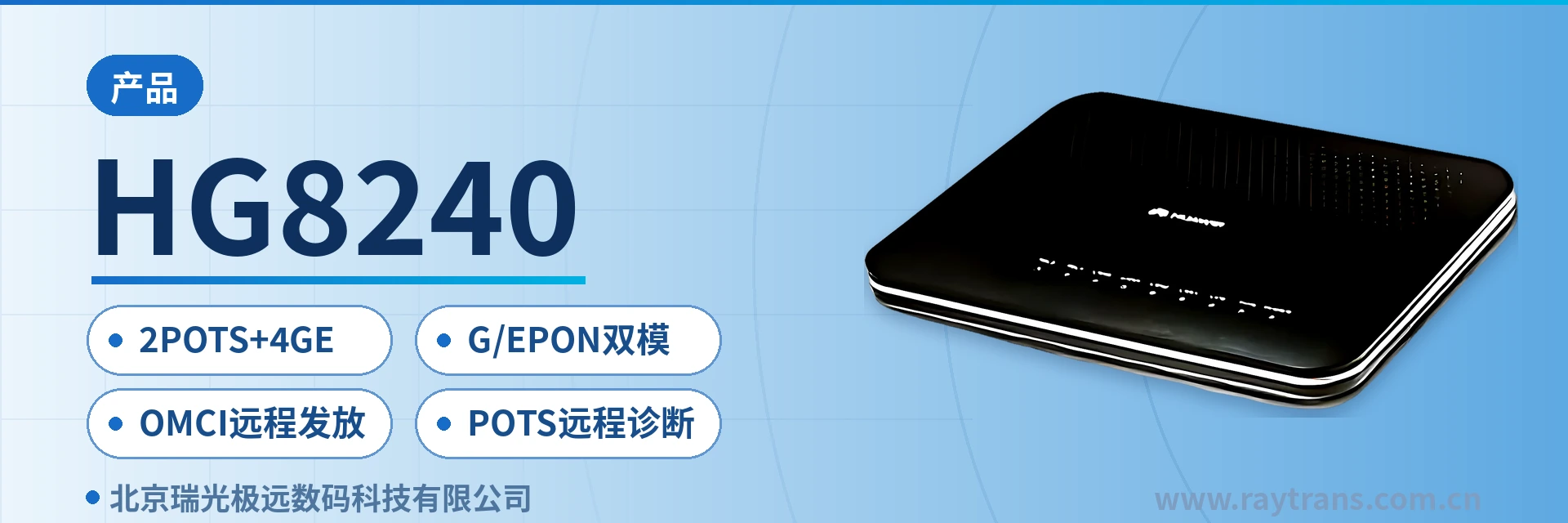
HG8240 Optical Network Terminal HG8240 Optical Network Terminal
['2POTS+4GE', 'G/EPON dual-mode', 'OMC
HG8240 optical network terminal, applied in the product showcase field, communication/transmission/dispatch equipment for industry customers (to be further detailed based on technical documentation)
EchoLife HG8240 is a bridge + voice user-side device in Huawei's FTTH solution, and also a 2POTS+4GE optical network terminal. It consists of a PON optical access unit, a voice processing unit, and an Ethernet switching unit, and is used to provide ultra-broadband access for home, SOHO, and industry users, carrying voice, data, and video services on the same device. In an FTTH network, the EchoLife HG8240 is deployed at the opposite end of the OLT and at the end of the ODN: the uplink connects to the PON network through an optical splitter, and the downlink provides users with 2 POTS voice interfaces and 4 GE/FE adaptive Ethernet ports, with voice and data carried by the same terminal. As one of the typical terminals in the optical access product showcase of the media converter manufacturer Raytrans, the HG8240 can work with SIP telephones to complete voice service termination, and is also commonly found at the edge access layer of government private network optical fiber communication solutions, military emergency communications vehicle solutions, and smart mining communication solutions, forming an end-to-end optical fiber communication link together with various media converters.
Key Specifications at a Glance: 2POTS+4GE · G/EPON dual-mode · OMCI/OAM remote management · POTS remote diagnosis · SIP/H.248 dual protocol · GE wire-speed forwarding
What Kind of Device Is the HG8240 2POTS+4GE Optical Network Terminal?
The EchoLife HG8240 is an optical network terminal (ONU) deployed on the user side. Its role is to convert the PON signal carried over the optical fiber into service interfaces such as telephone and Ethernet, and to establish communication with the central office OLT through the PON protocol. The EchoLife HG8240 adopts a bridge + voice architecture: it performs bridging and forwarding between the PON side and the user side at the link layer, and has a built-in voice processing unit that registers analog telephones on the POTS ports with the softswitch platform, so that a single optical fiber carries both voice and data services. For media converter manufacturers and system integrators, this type of optical network terminal is a key user-side device in government private network optical fiber communication solutions.
The 2POTS+4GE optical network terminal addresses the on-site requirement of providing voice ports and data ports on a single device. The 2 POTS voice interfaces and 4 GE/FE adaptive Ethernet ports are provided by the same terminal, so the user side no longer needs to add a voice gateway or small switch; as the number of devices decreases, cabinet space, power points, wiring workload, and the variety of spare parts all drop accordingly, which is especially evident in site access for electric power and energy, rail transit, and military and government private networks. In its media converter product showcase, Raytrans also lists this type of multi-interface optical network terminal as the recommended user-side device for government private network optical fiber communication solutions and smart mining communication solutions.

What Voice and Data Interfaces Does the HG8240 Provide?
The interfaces and service capabilities of the EchoLife HG8240 can be summarized in six items, all carried by the same terminal, covering the two types of on-site actions: service provisioning and fault handling.
| Function | Description |
|---|---|
| Interface configuration | 2 POTS voice interfaces + 4 GE/FE adaptive Ethernet ports, with voice and data interfaces provided on the same device |
| G/EPON dual-mode adaptation | Supports both GPON and EPON PON formats, meeting the needs of different FTTH network access scenarios |
| Voice protocol interfacing | Supports both SIP and H.248 protocols for interfacing with the softswitch platform |
| Remote service provisioning | Remotely and automatically provisions voice, broadband, multicast, and other services through OMCI/OAM protocols, with no on-site configuration required |
| Remote diagnosis | Supports outside line test and call simulation on POTS ports for remote fault location |
| Forwarding capability | GE wire-speed forwarding, with voice, data, and video services sharing the uplink fiber |
These six capabilities correspond to two types of on-site actions. On the service provisioning side, OMCI/OAM is used to remotely and automatically provision voice, broadband, and multicast services, and the site only needs to complete optical path connection and cable connection; on the fault handling side, outside line test and call simulation on POTS ports are used to first determine whether the problem lies in the outside line, the terminal, or the softswitch platform without sending personnel to the site. Neither type of action requires on-site maintenance personnel to have deep network configuration skills, making it easier to deliver private network projects with scattered sites in a unified manner. It should be noted that the terminal itself does not replace a media converter, but in government private network optical fiber communication solutions it works together with media converters to simultaneously carry SIP telephone registration and data backhaul.
Key Specifications and Performance Specifications
The following table lists the interface and capability specifications of the EchoLife HG8240 according to product documentation. For items not marked, the manufacturer's technical documentation shall prevail.
| Item | Parameter/Specification | Description/Applicable Conditions |
|---|---|---|
| Optical access format | G/EPON dual-mode adaptive | Compatible with existing EPON networks and newly built GPON private networks; the user-side terminal is not replaced when the central office format is adjusted |
| Voice interface | 2×POTS | Connects to analog telephones, fax machines, and other voice terminals |
| Ethernet interface | 4×GE/FE adaptive | Connects to computers, wireless APs, cameras, and other data terminals |
| Voice protocol | SIP, H.248 | Interfaces with the softswitch platform for easy access to existing voice networks |
| Remote management protocol | OMCI (GPON side), OAM (EPON side) | Remote automatic provisioning of voice, broadband, and multicast services |
| Voice diagnosis capability | Outside line test and call simulation on POTS ports | Remotely determines faults on the outside line, terminal, and platform side |
| Forwarding capability | GE wire-speed forwarding | Voice, data, and video share the uplink bandwidth |
| Optical port rate and wavelength | not yet recorded in the knowledge base | The manufacturer's technical documentation shall prevail |
| Split ratio and transmission distance | not yet recorded in the knowledge base | Related to ODN optical splitting design; the on-site design shall prevail |
| Power supply and power consumption | not yet recorded in the knowledge base | The manufacturer's technical documentation shall prevail |
| Operating temperature and dimensions | not yet recorded in the knowledge base | The manufacturer's technical documentation shall prevail |
How Do EPON and GPON Private Networks Share One Optical Network Terminal?
How EPON and GPON private networks share one optical network terminal: the conclusion is that when a private network has both an existing EPON network and a newly built GPON network, selecting a terminal that supports dual-mode adaptation is sufficient, and there is no need to purchase two batches of ONUs separately by format. EPON corresponds to the IEEE 802.3ah series of standards, and GPON corresponds to the ITU-T G.984 series of standards. The two types of networks have different technical approaches on the central office OLT side; the G/EPON dual-mode adaptation capability of the EchoLife HG8240 allows the same terminal to be compatible with both formats, so the terminal does not need to be replaced when connecting to an existing EPON network or a newly built GPON private network. In military emergency communications vehicle solutions and smart mining communication solutions, EPON and GPON links often coexist on site, and a dual-mode terminal can significantly reduce spare parts pressure.
From an engineering perspective, the benefits of dual-mode are concentrated in three areas. In private networks built in phases, such as those in electric power and energy and rail transit, existing sites and new sites can share the same model of terminal, reducing the variety of spare parts; during phased network upgrades, the user-side terminal is not replaced when the central office format is adjusted; and the same terminal configuration template can be used for both types of networks, keeping the service provisioning process consistent. The phased construction approach of using EPON for existing sites and GPON for newly built backbones is relatively common in private network FTTH network access, and is also a deployment mode often recommended by media converter manufacturers in government private network optical fiber communication solutions.
How Does One Optical Network Terminal Eliminate Both the Voice Gateway and the Switch?
How one optical network terminal eliminates both the voice gateway and the switch: the answer lies in providing the interfaces on the same device. The EchoLife HG8240 puts 2 POTS voice interfaces and 4 GE/FE adaptive Ethernet ports on the same device, so the original voice gateway and small switch on the user side no longer need to be configured separately. On-site wiring is completed in three directions: the uplink optical port connects to the ODN, the voice ports connect to telephones and fax machines, and the 4 GE ports connect to data terminals. If there is already a SIP telephone on site, it can also connect directly to the softswitch platform through a POTS port or a data port.
The deployment sequence is usually as follows: first complete optical path termination and connection to the optical splitter, then connect telephones to the POTS ports and computers or wireless APs to the GE/FE ports, after which the network management side remotely provisions voice, broadband, and multicast services through OMCI/OAM, with no on-site parameter configuration. The 4 GE/FE adaptive Ethernet ports can be allocated as follows in electric power and rail transit sites: one for a duty computer or monitoring host, one for a wireless AP, one for a video camera or environmental monitoring terminal, and the remaining ports reserved as spares; on the voice side, the 2 POTS ports can connect to a duty telephone and a fax machine respectively, or two dispatch telephones can be connected at the same site. In military emergency communications vehicle solutions, this one-device-multiple-port form is especially suitable for space-constrained vehicle-mounted environments.

How Does the POTS Port Outside Line Test Remotely Locate Voice Faults?
How the POTS port outside line test remotely locates voice faults: the answer is that the network management side remotely issues test and simulation commands, first testing the POTS outside line status and then initiating a call simulation, based on which it determines whether the fault lies in the outside line, the terminal, or the softswitch platform, without sending personnel to the site. The POTS port outside line test is used to check the outside line status between the terminal and the telephone, and call simulation is used to verify the signaling and voice channel between the terminal and the softswitch platform.
The two results correspond to two types of handling paths. If the simulated call can be established, it indicates that terminal registration and the uplink optical path are normal, and the problem is mostly in the outside line or on the telephone side; if the simulated call cannot be established, it indicates that the fault occurs in terminal registration, the PON uplink, or the platform side, and these three places need to be checked in sequence. For projects with scattered sites such as electric power and rail transit, the POTS remote diagnosis capability directly corresponds to O&M cost: when no voice service occurs at an unattended site, performing a remote outside line test and call simulation first can narrow down the faults requiring an on-site visit to the few cases that are indeed on site. In smart mining communication solutions, the cost of on-site visits to underground sites is higher, making the O&M benefit of this capability even more prominent.
How Are Voice and Broadband Services Remotely Provisioned at Electric Power and Rail Transit Sites?
How voice and broadband services are remotely provisioned at electric power and rail transit sites: the path is that after the EchoLife HG8240 at the site is powered on and completes optical path connection, the network management side remotely and automatically provisions voice, broadband, and multicast services through OMCI (GPON side) or OAM (EPON side), so site delivery does not depend on on-site commissioning personnel. Device registration and service configuration are completed uniformly by the network management side, and the same configuration template can be reused across multiple sites, keeping the provisioning process consistent at each site during phased commissioning.
Remote provisioning of voice services and remote diagnosis are two matching capabilities: provisioning handles service provisioning, while outside line test and call simulation on POTS ports handle runtime fault handling. For sites with scattered locations and high per-visit costs, such as electric power substations, pumping stations, and trackside equipment rooms, these two capabilities together determine the labor input required for a site from installation to availability. In its media converter product showcase, Raytrans also often includes this type of optical network terminal together with media converter manufacturer supporting solutions in the equipment lists of government private network optical fiber communication solutions, military emergency communications vehicle solutions, and smart mining communication solutions, facilitating unified selection and spare parts management for users.
Typical Application Scenarios
The target scenarios of the EchoLife HG8240 are concentrated in environments with many user-side sites and inconvenient on-site maintenance, where the same terminal uses 2 POTS ports for voice and 4 GE ports for data backhaul. For sites that require media converters for uplink aggregation, this terminal can coordinate networking with equipment provided by media converter manufacturers; for specific products, refer to the official product showcase page of Raytrans.
Electric Power and Energy Private Network
The communication sites of electric power and energy private networks include substations, pumping stations, and metering points, most of which are unattended or staffed only by on-duty personnel. Within a site, the EchoLife HG8240 handles both voice access and data backhaul: POTS ports connect to duty telephones or dispatch telephones, while GE ports connect to metering and acquisition devices, environmental monitoring terminals, and cameras. Voice and data share a single uplink fiber, reducing both the variety of cables and the number of devices at the site. When a voice channel fails, O&M personnel can first perform remote fault location through outside line tests and call simulation on the POTS ports, and arrange attendance on site only after confirming an on-site problem. In smart mining communication solutions, a similar deployment approach also applies to integrated voice and data access between underground and surface locations.
Rail Transit Communication
Access sites for rail transit communication are distributed along the line, including station duty rooms, trackside equipment rooms, and depot offices. The EchoLife HG8240 is deployed at these sites: 2 POTS ports connect to station telephones and fax machines, and 4 GE ports connect to ticketing terminals, wireless APs, and video surveillance devices, with the uplink aggregated through an optical splitter into the line-side PON network. Services at each site are remotely provisioned in batches via OMCI/OAM, so no on-site configuration is required site by site when new stations are added; when the line is extended in phases or a local network is upgraded from EPON to GPON, the user side continues to use the same model of terminal, and only one type of spare parts needs to be kept. If the line side requires standalone media converters for optical-to-electrical conversion, industrial-grade products from media converter manufacturers such as Raytrans can be selected.
Military and Government Private Networks
Access points of military and government private networks are scattered across camps, duty posts, and office locations, placing demands on both on-site configuration effort and O&M response speed. At these sites, the EchoLife HG8240 provides 2 voice channels and 4 data channels: POTS ports connect to duty telephones and fax machines, and GE ports connect to office terminals, wireless APs, and video devices. Service provisioning relies on remote automatic provisioning via OMCI/OAM, freeing sites from on-site configuration; voice failures are first diagnosed through remote testing and simulation on the network management side, and a decision is then made on whether to arrange attendance on site. In government private network optical fiber communication solutions and military emergency communications vehicle solutions, this terminal can work with SIP telephones to achieve unified bearing of voice dispatching and data backhaul.
Differentiated Value
The differentiated value of the EchoLife HG8240 centers on three aspects: 2POTS+4GE interfaces support concurrent access of voice and multiple GE data channels in industrial private networks; G/EPON dual-mode adaptation is compatible with different FTTH private network accesses without replacing the terminal; and OMCI/OAM remote automatic provisioning frees unattended sites in private networks from on-site configuration. The three selling points and their corresponding capabilities are shown in the table below.
| Differentiated Selling Point | Corresponding Capability | Customer Value |
|---|---|---|
| 2POTS+4GE interfaces | 2 POTS voice interfaces and 4 GE/FE adaptive Ethernet ports hosted on one device | Supports concurrent access of voice and multiple GE data channels in industrial private networks, eliminating the voice gateway and small switch with a single terminal |
| G/EPON dual-mode adaptation | The same terminal is compatible with both GPON (ITU-T G.984 series) and EPON (IEEE 802.3ah) formats | Compatible with different FTTH private network accesses without replacing the terminal, with existing networks and new private networks sharing one type of spare parts |
| OMCI/OAM remote management | Remote automatic provisioning of voice, broadband, and multicast services, together with outside line tests and call simulation on POTS ports | Unattended sites in private networks are provisioned without on-site configuration, and voice failures are first located remotely before deciding whether an on-site visit is needed |
Conclusion
In scenarios with scattered user-side sites, such as electric power and energy private networks, rail transit communication, and military and government private networks, the EchoLife HG8240, as a 2POTS+4GE optical network terminal, aggregates voice and data services by hosting 2 POTS channels and 4 GE channels on one device, reduces the variety of spare parts through G/EPON dual-mode adaptation, and moves service provisioning and fault handling forward to the network management side with OMCI/OAM remote provisioning and outside line tests on POTS ports, reducing the number of personnel trips to sites. In typical applications such as government private network optical fiber communication solutions, military emergency communications vehicle solutions, and smart mining communication solutions, this terminal can be flexibly combined with devices such as media converters and SIP telephones, and Raytrans, as a professional media converter manufacturer, can provide supporting product showcases and technical support.