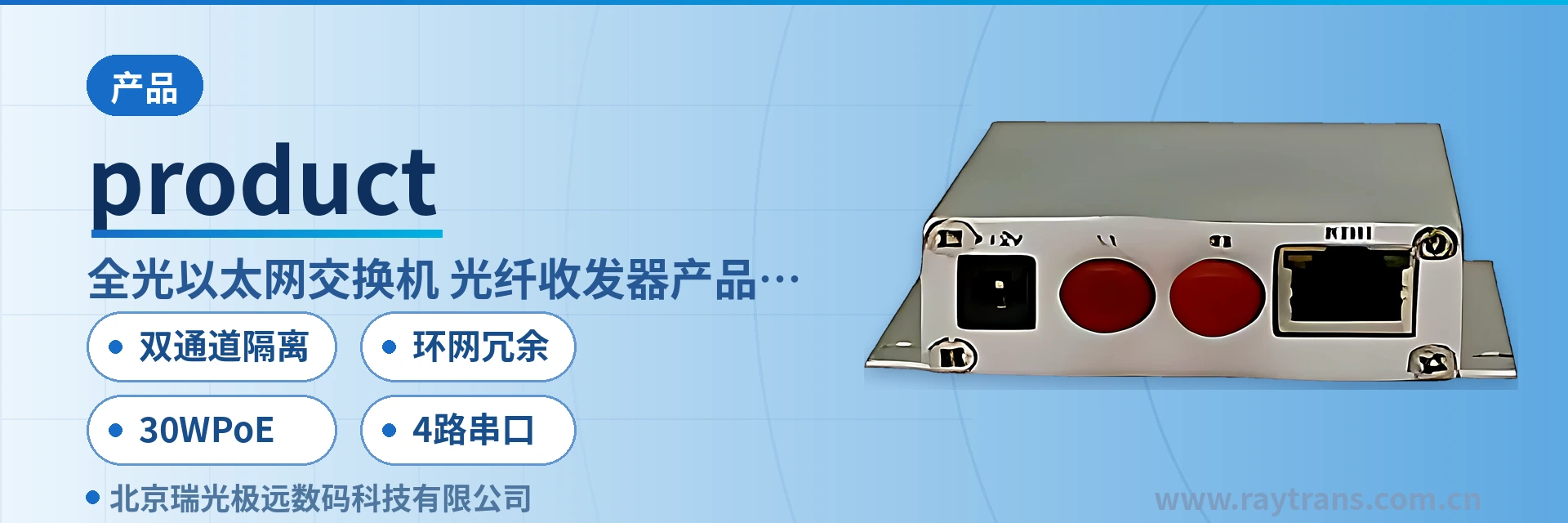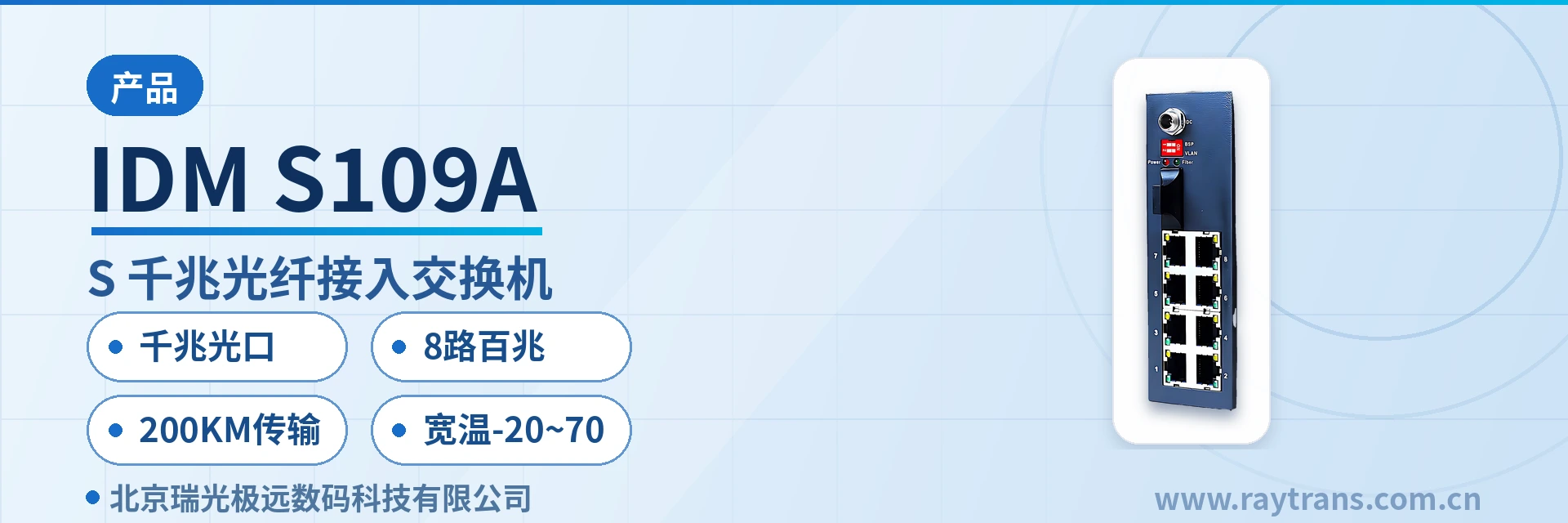
IDM S109A-GS Gigabit Fiber Access Switch
Gigabit optical port plus 8 Fast Ethernet electrical ports; a single unit connects 9 terminals; 200KM direct back to the equipment room
The S100A-GS series fiber optic Ethernet switch is a switch product specially developed by our company for application environments such as building automation, security surveillance, smart city, Tianwang system, electronic police, and factory automation. The S100A-GS series provides 1 100Mbps FX optical interface, SC connector, single-mode/multi-mode and single-fiber/dual-fiber options...
IDM S109A-GS Gigabit Optical Port Fiber Access Switch is an industrial-grade fiber optic Ethernet access device developed by Beijing Ruiguang Jiyuan Digital Technology Co., Ltd. for building automation, security surveillance, smart city and other application environments. It consists of 1 1000Base FX Gigabit optical port, 8 10/100Base T(X) Fast Ethernet electrical ports and a built-in high-performance network switching chip. It is used to backhaul terminal data scattered at front-end sites to the central equipment room over a single optical fiber, and serves as the edge access node in distributed network access solutions. As a professional media converter manufacturer, Raytrans has integrated a high-performance media converter module into this product, enabling it to handle data access in front-end product showcase as well as to function as an industrial Ethernet switch, meeting the stringent requirements of building automation network access solutions for stable communication.
Key Specifications at a Glance: 1 Gigabit optical port · 8 Fast Ethernet electrical ports · 200KM transmission · Wide temperature -2070 · DC 5V30V wide voltage · Power consumption of the unit 4.5W · Wall-mounted metal enclosure
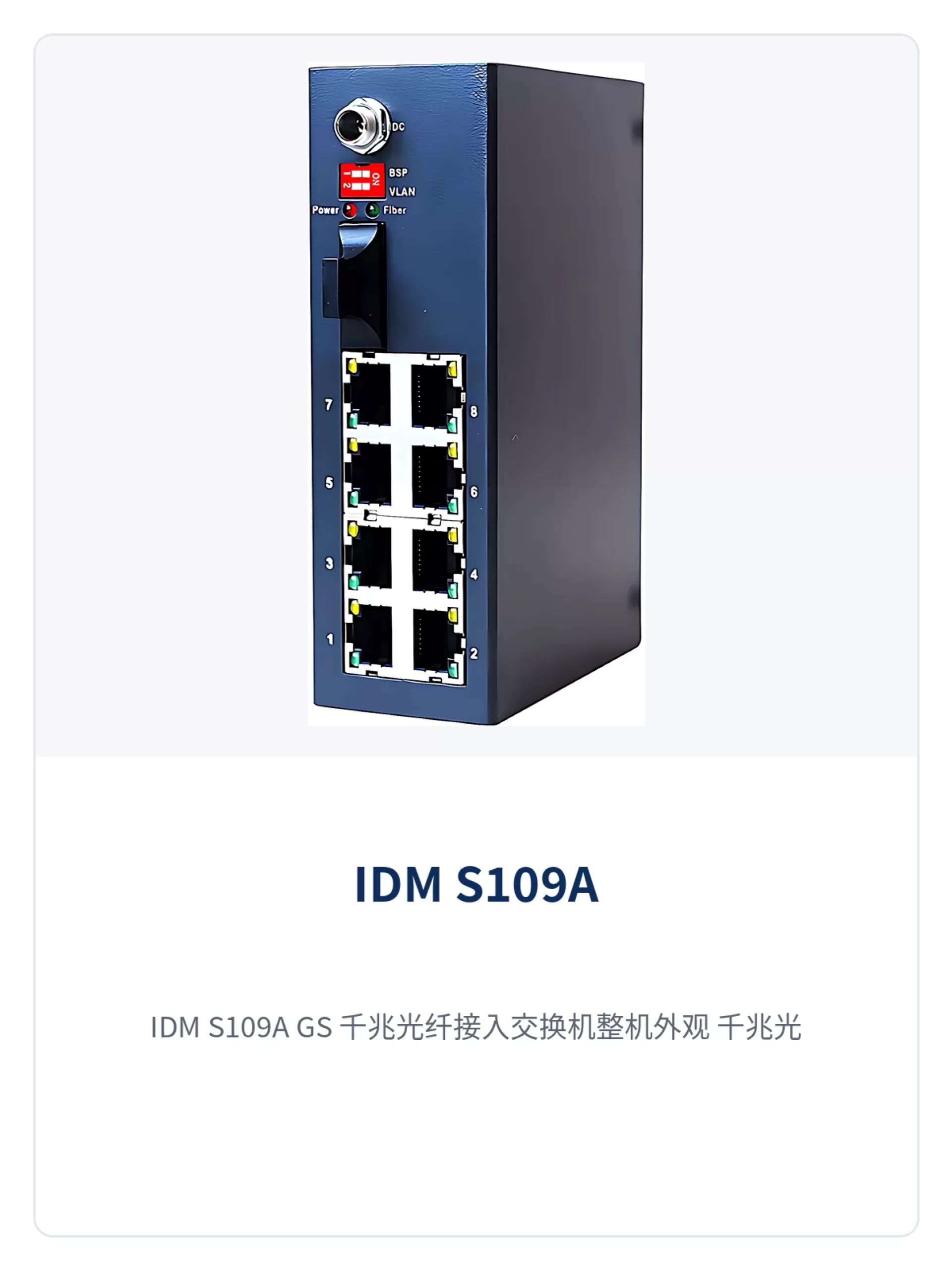
Figure 1: Overall appearance of the IDM S109A-GS Gigabit Fiber Access Switch, Gigabit optical port and 8 Fast Ethernet electrical ports
What Kind of Device Is a Gigabit Optical Port Fiber Access Switch?
The IDM S109A-GS Gigabit Optical Port Fiber Access Switch is a wall-mounted industrial Ethernet access device and a product showcase model that Raytrans offers for edge access scenarios: the uplink side provides 1 1000Base FX Gigabit optical interface, and the downlink side provides 8 10/100Base T(X) RJ45 electrical interfaces. The optical interface form is SC, it complies with the IEEE 802.3 standard, and the data switching mechanism is store-and-forward. The unit uses a metal enclosure, with dimensions of 132mm x 32mm x 86mm and a weight of 0.55KG. The power connector is a 2.1 x 5.5mm DC power connector, and it supports wall-mounted installation, making it suitable for installation in weak-current boxes, on the side of cabinets or on poles.
In networking, the Gigabit Optical Port Fiber Access Switch sits at the end of the optical fiber network: the 8 downlink Fast Ethernet electrical ports connect nearby Ethernet terminals such as cameras, access controllers, PLCs and sensors, while the uplink Gigabit optical port sends the aggregated data to the aggregation switch or core switch in the central equipment room over a single optical fiber. The entire copper cable run from the edge to the equipment room is replaced by a single optical fiber, so edge sites are no longer limited by the approximately 100-meter transmission distance of twisted pair. As a media converter manufacturer, Raytrans has carried over the mature optical port design approach of media converters in this model, so that edge access and optical fiber transmission are completed within the same device.
All ports of the Gigabit Optical Port Fiber Access Switch provide non-blocking, wire-speed packet forwarding, with switching latency less than 1us, a MAC address table capacity of 8Kbps and a packet buffer of 1Mbps, enabling concurrent forwarding of video streams and control commands at the edge.
How Does One Gigabit Optical Port and 8 Fast Ethernet Electrical Ports Connect 9 Terminals?
The Gigabit optical port and 8 Fast Ethernet electrical ports are a fixed configuration: the 8 Fast Ethernet electrical ports connect local terminals, and the 1 Gigabit optical port uplinks to the central equipment room. A single IDM S109A-GS Gigabit Optical Port Fiber Access Switch can connect 9 terminals, so no separate small-port switch needs to be cascaded at the edge.
The rate and wiring method of the 8 electrical ports are fully adaptive, supporting 10Mbps/100Mbps adaptive, full-duplex/half-duplex adaptive and MDI/MDIX polarity adaptive; terminals can be connected on site with either straight-through or crossover network cables, and there is no need to distinguish wiring sequence categories during cabling. The 8 terminals enter the switching chip through the electrical ports and are forwarded under the store-and-forward mechanism, then sent onto the network uniformly through the Gigabit optical port.
The total access bandwidth of the 8 Fast Ethernet electrical ports is approximately 800Mbps, which is less than the 1000Mbps uplink bandwidth of the Gigabit optical port, leaving margin on the uplink port when multiple terminals transmit concurrently; here, Fast Ethernet means the access rate of a single electrical port is 100Mbps, and the uplink optical port rate is 1000Mbps, so the edge generally does not become the bandwidth bottleneck of the entire network.
How Far Can a Fiber Access Switch Transmit? How Does 200KM Long-Distance Coverage Serve City-Level Private Networks?
The transmission distance of a fiber access switch depends on the SFP optical module installed: the optical port type of the IDM S109A-GS is an SFP optical module, and the transmission distance covers six grades of 20KM, 40KM, 60KM, 80KM, 120KM and 200KM. The single-mode model comes standard with 20KM, and other distances are selected according to the on-site link length. The interface form is SC, with single-mode/multi-mode and single-fiber/dual-fiber options.
Long-distance capability directly determines whether edge sites can be incorporated into the same private network. The distance from edge sites to the central equipment room varies greatly across projects: within a campus, coverage is usually achieved within a few kilometers, and a 20KM optical module is sufficient; sites across areas or across districts and counties are often tens to hundreds of kilometers away, and after selecting 40KM to 200KM optical modules according to link length, a single optical fiber can deliver data directly to the equipment room without inserting an additional relay or transmission device in between. This feature enables the model to meet the long-distance edge access requirements in government private network optical fiber communication solutions.
The optical interface form is SC, with single-mode/multi-mode and single-fiber/dual-fiber options. Single-fiber bidirectional modules use one fiber core for simultaneous receive/transmit, making them suitable for existing optical cables with tight fiber core resources; dual-fiber modules are used in pairs over two fiber cores, making them suitable for new optical cables. During selection, the number of fiber cores in the on-site optical cable, the link length, and the wavelength and distance grade of the optical modules at both ends should be checked together to determine the specific module specification.
Typical Application Scenarios
Building Automation
The front-end devices of a building automation system are scattered across floor electrical risers, rooftop equipment rooms and basement pump rooms, and cabling distances often exceed the reliable range of twisted pair. The IDM S109A-GS Gigabit Optical Port Fiber Access Switch is installed in the floor weak-current box, with 8 Fast Ethernet electrical ports connecting building control controllers, energy consumption collectors, air conditioning unit controllers and access control readers, and the Gigabit optical port uplinking to the building's central equipment room over a single optical fiber, bringing floor-edge data into the same network. The metal enclosure and -20°C ~ 70°C operating temperature adapt to temperature variations in electrical risers and equipment rooms, and wall-mounted installation takes up no additional cabinet space, making it a commonly used edge device in building automation network access solutions.
Security Surveillance
The front-end cameras in security surveillance projects are distributed along the campus perimeter, road poles and building entrances, with scattered sites far from the equipment room. The IDM S109A-GS Gigabit Optical Port Fiber Access Switch is deployed at camera aggregation nodes, with 8 Fast Ethernet electrical ports connecting nearby network cameras, and the Gigabit optical port backhauling video streams to the surveillance center over optical fiber, avoiding the intermediate cascading problems caused by the 100-meter limit of twisted pair. The configuration of connecting 9 terminals per unit is suitable for nearby aggregation by pole or by building; for longer links, SFP optical modules of 40KM to 200KM are selected according to on-site distance.
Smart City and Tianwang System
The edge sites of smart city and Tianwang system are distributed at intersections, communities and industrial parks, and the distance from each site to the nearest equipment room varies greatly. The IDM S109A-GS Gigabit Optical Port Fiber Access Switch accommodates this variation with optical port distances selectable from 20KM to 200KM: nearby sites use 20KM modules, while sites across areas or across districts and counties use 120KM or 200KM modules, so edge devices can be incorporated into the same equipment room network with the same set of SFP optical module selections. The Gigabit optical port uplink also leaves interface margin for future upgrades to the central-side aggregation specification.
Core Functions
| Function | Description |
|---|---|
| Gigabit optical port uplink | Provides 1 1000Base FX Gigabit optical interface, with SC interface form, connecting to the central equipment room over an optical fiber link |
| 8 Fast Ethernet electrical port access | Provides 8 10/100Base T(X) RJ45 electrical ports, supporting 10Mbps/100Mbps adaptive, full-duplex/half-duplex adaptive and MDI/MDIX polarity adaptive |
| Non-blocking wire-speed forwarding | Uses a high-performance network switching chip, with non-blocking, wire-speed packet forwarding across all ports and switching latency less than 1us |
| Store-and-forward switching mechanism | Fully receives and verifies data frames before forwarding, suppressing the spread of error frames across the network |
| Six optical port distance grades | The optical port type is an SFP optical module, with transmission distance covering six grades of 20KM, 40KM, 60KM, 80KM, 120KM and 200KM, with single-mode/multi-mode and single-fiber/dual-fiber options |
| Wide-voltage DC power supply | Power input DC 5V~30V, connected via a 2.1 x 5.5mm DC power connector, adapting to various on-site DC power supplies |
| Wide-temperature metal enclosure | Metal enclosure for wall-mounted installation, operating temperature -20°C ~ 70°C, storage temperature -40°C ~ 85°C |
| LED status indication | Power LED, and Link/Act and Speed indicator LEDs on interfaces, allowing intuitive on-site judgment of port and link status |
Technical Specifications and Performance Specifications
Port and switching parameters are listed as stated in the original product documentation, and the indicators related to port configuration and switching capability are shown in the table below.
| Item | Parameter/Specification | Description/Applicable Conditions |
|---|---|---|
| Optical interface | 1 x 1000Base FX | Gigabit optical port uplink |
| Electrical interface | S109A-GS: 8 x 10/100Mbps T(X) | RJ45 electrical ports, 10Mbps/100Mbps adaptive |
| Rate | 10/100/1000Mbps | Port adaptive |
| Communication standard | Complies with IEEE 802.3 standard | Ethernet switching standard |
| MAC address table | 8Kbps | As stated in the original product documentation |
| Switching latency | <1us | Under the store-and-forward mechanism |
| Packet buffer | 1Mbps | As stated in the original product documentation |
| Data switching mechanism | Store-and-forward | Non-blocking wire-speed forwarding across all ports |
Optical port distance and optical fiber specifications determine the range a project can cover, and SFP optical modules offer six selectable transmission distance grades.
| Item | Parameter/Specification | Description/Applicable Conditions |
|---|---|---|
| Optical port type | SC | Optical interface form |
| Optical port type | SFP optical module | Single-mode/multi-mode and single-fiber/dual-fiber options |
| Transmission distance | 20KM, 40KM, 60KM, 80KM, 120KM, 200KM | The single-mode model comes standard with 20KM, and other distances are selected according to link length |
Power supply, mechanical and environmental indicators determine whether the device can be deployed at unattended edge sites.
| Item | Parameter/Specification | Description/Applicable Conditions |
|---|---|---|
| Power input | DC 5V~30V | Wide-voltage DC input |
| Power connector | 2.1 x 5.5mm DC power connector | Used with the cable supplied with the device |
| Power consumption | S109A-GS: 4.5W | Power consumption of the unit |
| Enclosure | Metal enclosure | Wall-mounted installation |
| Dimensions | 132mm x 32mm x 86mm | As stated in the original product documentation |
| Weight | 0.55KG | Convenient for wall-mounted fixing |
| Installation method | Wall-mounted installation | Weak-current box, side of cabinet or pole |
| Operating temperature | -20°C ~ 70°C | Wide temperature operation |
| Storage temperature | -40°C ~ 85°C | Transportation and storage |
| Operating humidity | 5% ~95% (non-condensing) | Indoor and outdoor cabinet environments |
The IDM S109A-GS Gigabit Optical Port Fiber Access Switch meets the indicators of standards such as CCC, CE/FCC and EN 61000, and the relevant parameters can be incorporated into the technical response document for project tendering.
Differentiated Value
| Differentiation Point | Value for the Project |
|---|---|
| 1 Gigabit optical port + 8 Fast Ethernet electrical ports | A single unit accesses 9 terminals: 8 terminals such as cameras and controllers are connected nearby through Fast Ethernet electrical ports, and 1 uplink to the central equipment room through the Gigabit optical port. Edge access and uplink are completed with one cabling pass, eliminating the need for an additional standalone switch |
| Optical port transmission up to 200KM | Coverage for city-level private networks: six grades of SFP optical modules from 20KM to 200KM are available. Edge sites across areas and across districts and counties can be incorporated into the same central equipment room network, with no need to insert an additional level of trunk equipment in between |
| DC 5V~30V wide-range voltage input | Adapts to a variety of industrial power supplies: existing 5V, 12V, and 24V direct current power supplies on site can be connected directly, with no need to configure a separate voltage-stabilized power supply for the device |
In Which Environments Are Wide-Temperature Fiber Access Switches More Suitable?
Wide-temperature fiber access switches are more suitable for environments without air conditioning, such as power distribution rooms, hoistways, and field cabinets. The IDM S109A-GS has an operating temperature of -20°C ~ 70°C, a storage temperature of -40°C ~ 85°C, and an operating humidity of 5% ~ 95% (non-condensing). It keeps running in rooftop cabinets during high summer temperatures and in roadside pole boxes during low winter temperatures; the metal enclosure itself also provides auxiliary heat dissipation and mechanical protection.
Beyond temperature specifications, power supply conditions also affect the availability of edge sites. The DC 5V~30V wide-range voltage input gives the device greater tolerance for fluctuations in on-site direct current power supplies: building weak-current boxes often provide 12V or 24V direct current, while roadside and plant cabinets are often deployed with 24V direct current. The same model can draw power directly at these sites, reducing the need to replace devices for power supply adaptation. The power consumption of the unit is 4.5W, so the capacity requirements for small edge power supplies are not high.
How to Select a Fiber Access Switch?
To select a fiber access switch, simply check four items: port quantity, uplink rate, optical port distance, and installation environment. First, port quantity: the number of terminals to be accessed at the edge determines the number of electrical ports, and aggregation points nearby with 8 or fewer channels can choose a model with 8 Fast Ethernet electrical ports. Second, uplink rate: when the edge has video streams or high-concurrency services, choose a Gigabit optical port for uplink to avoid the uplink port becoming the bottleneck first. Third, optical port distance: select and configure SFP optical modules from the six grades between 20KM and 200KM according to the link length from the site to the equipment room, and determine single-mode/multi-mode and single-fiber/dual-fiber specifications at the same time. Fourth, installation environment: weak-current boxes, hoistways, and field cabinets need to be checked item by item against the -20°C ~ 70°C operating temperature, DC 5V~30V wide-range voltage input, and wall-mounted installation.
The IDM S109A-GS Gigabit optical port fiber access switch is configured according to the common conditions of edge site access in the above four items, and can serve as the starting point for selection at the edge access layer of building automation network access solutions, security surveillance and smart city projects, and government private network optical fiber communication solutions.