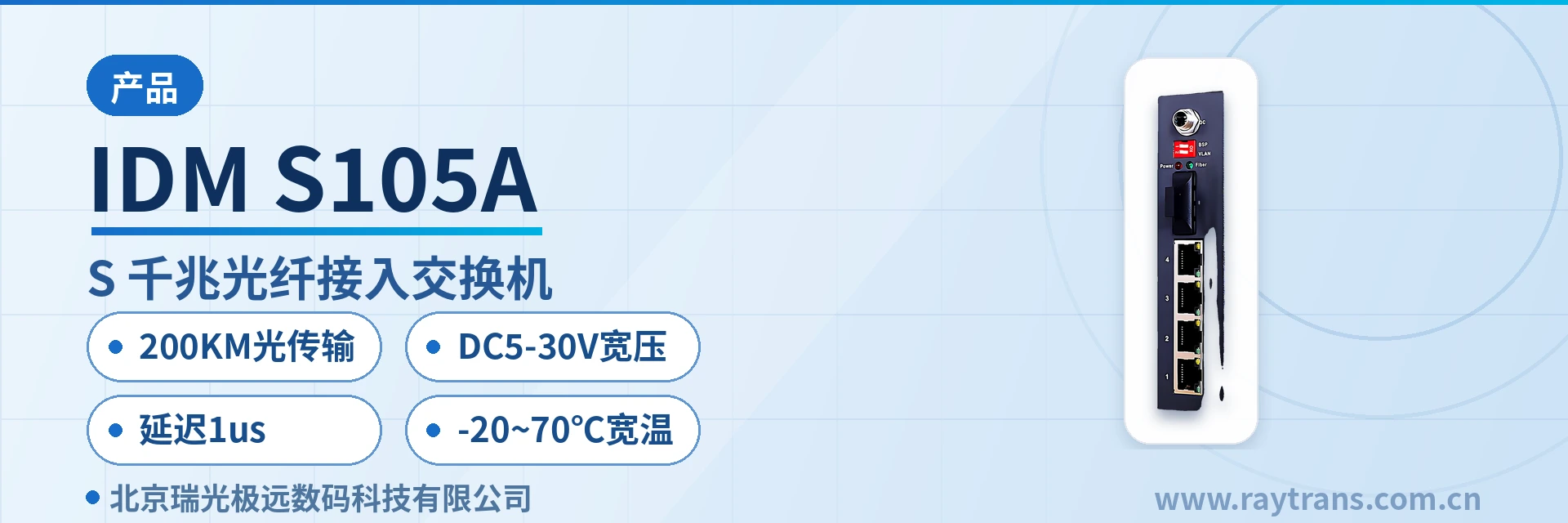
IDM S105A-GS Gigabit Fiber Access Switch
Single fiber 200KM six-level optional Gigabit optical port 4 Fast Ethernet electrical ports wall-mounted integrated latency
The S100A-GS series fiber optic Ethernet switch is a switch product specially developed by our company for application environments such as building automation, security surveillance, smart city, Tianwang system, electronic police, and factory automation. The S100A-GS series provides 1 100Mbps FX optical fiber port, SC connector, single-mode/multi-mode and single-fiber/dual-fiber options...
IDM S105A-GS 200KM single-fiber gigabit fiber access switch is a wall-mounted fiber optic Ethernet access device developed by Raytrans (Beijing Ruiguang Jiyuan Digital Technology Co., Ltd.) for building automation, security surveillance, smart city, Tianwang system, electronic police, factory automation and other application environments. As a professional fiber access switch, this product is quite representative in the product showcase of media converter manufacturers. The device integrates 1 1000Base FX gigabit optical port and 4 10/100Mbps RJ45 electrical ports in a 132mm×32mm×86mm metal enclosure, with a total weight of 0.42KG, and is used to uplink scattered front-end Fast Ethernet services to the central equipment room over a single optical fiber. The SC optical port uses an SFP optical module, and the single-mode single fiber specification is selected from six optical module options of 20KM, 40KM, 60KM, 80KM, 120KM and 200KM, allowing sites across districts and counties to be reached directly with one optical port; the device complies with the IEEE 802.3 standard, its data switching mechanism is store-and-forward, all ports are non-blocking with full wire-speed forwarding, and the switching latency is less than 1us. As a mature product of an industrial Ethernet switch manufacturer, this fiber optic switch works with media converters to efficiently support front-end access in scenarios such as smart city, security surveillance and electronic police.
Key Specifications at a Glance: 1 1000Base FX SC gigabit optical port · 4 10/100M RJ45 electrical ports · 200KM optical transmission · DC5-30V wide-range voltage · Latency <1us · -20~70℃ wide temperature · Wall-mounted metal enclosure
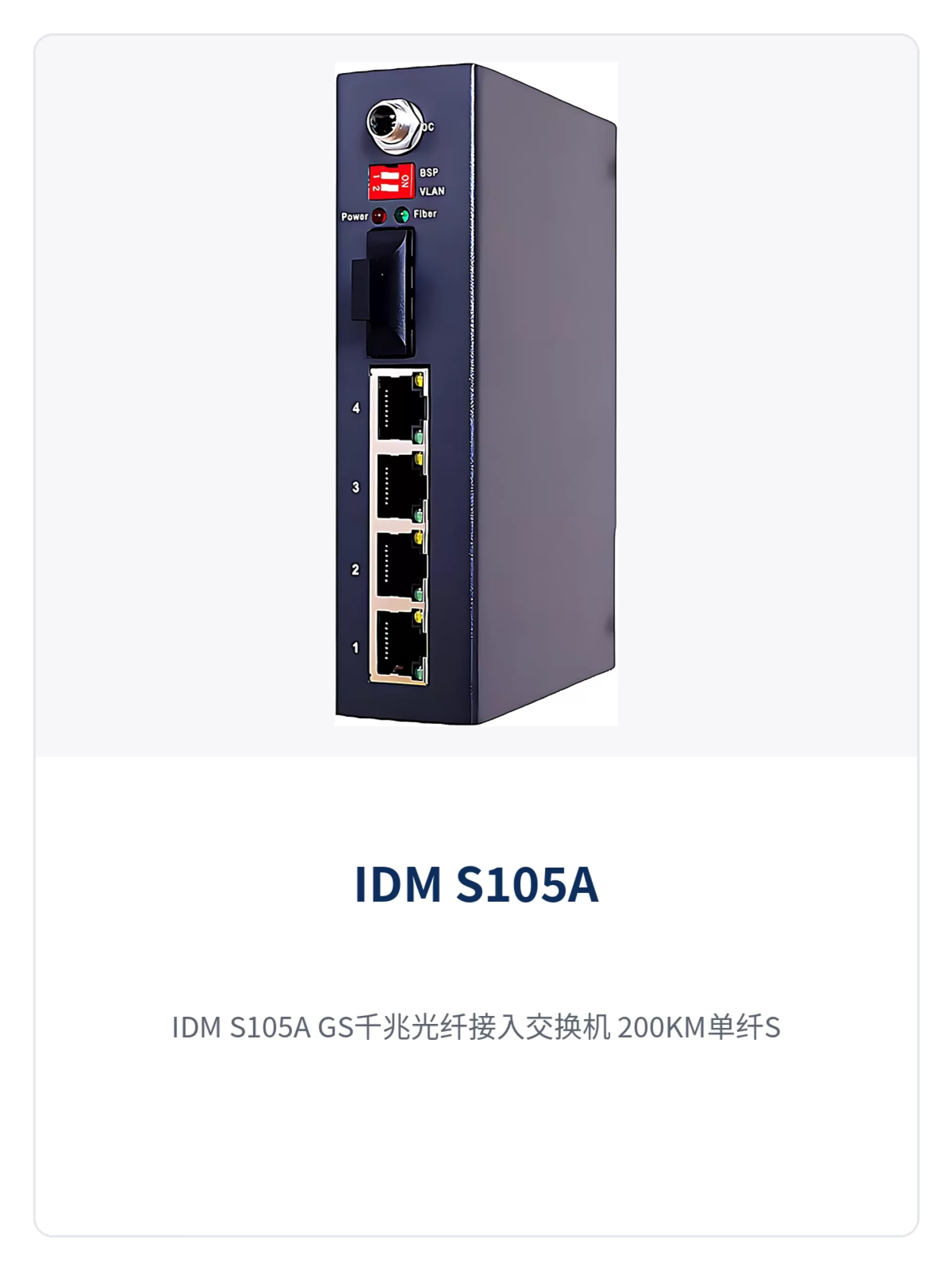
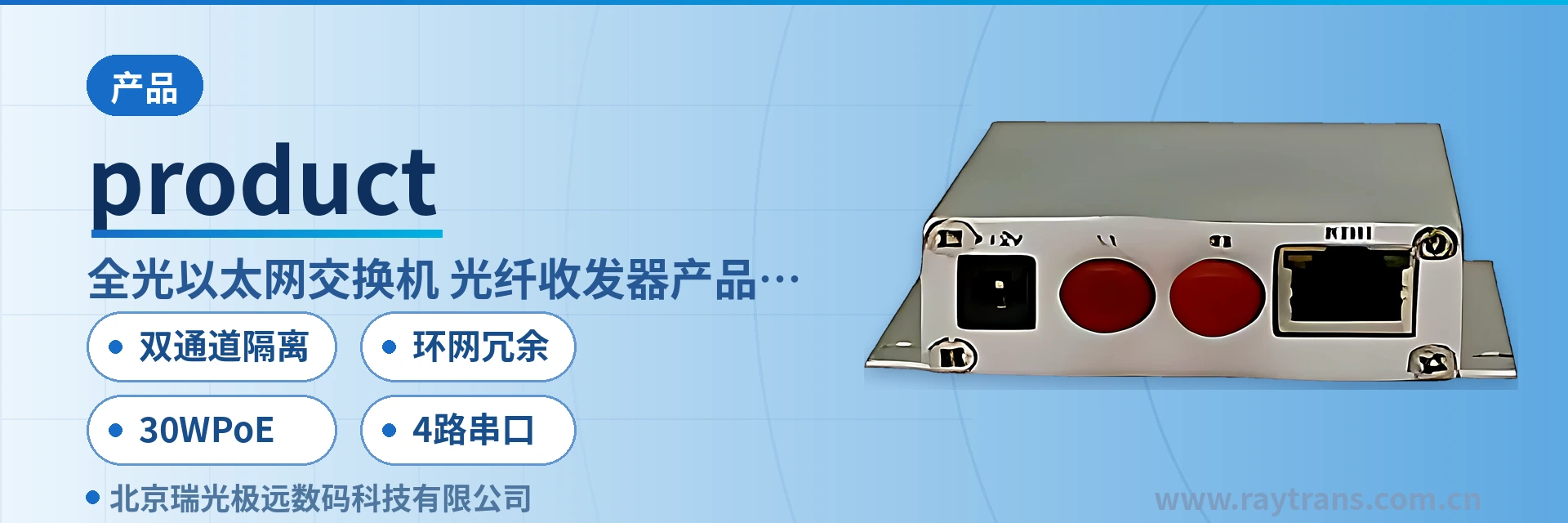
Figure 1: Close-up of the metal enclosure front panel of the IDM S105A-GS gigabit fiber access switch with a 200KM single-fiber SC optical port and 4 Fast Ethernet RJ45 electrical ports
What Kind of Device Is a 200KM Single-Fiber Gigabit Fiber Access Switch?
The IDM S105A-GS 200KM single-fiber gigabit fiber access switch is a wall-mounted access-type fiber optic Ethernet switch with "one gigabit optical port plus four Fast Ethernet electrical ports", positioned as a front-end collection node for distributed network access. As a professional fiber access switch, the device has 1 1000Base FX optical port in SC interface form, which requires an SFP optical module, with single-mode/multi-mode and single-fiber/dual-fiber options; the 4 electrical ports are 10/100BaseT(X) RJ45, connecting front-end devices such as cameras, access controllers, PLCs and measuring instruments, and support 10Mbps/100Mbps adaptive, full-duplex/half-duplex adaptive and MDI/MDIX polarity adaptive, so network cables can be connected either way without manual patch cords. All ports are non-blocking with full wire-speed forwarding, the switching latency is less than 1us, and the data switching mechanism is store-and-forward. The device weighs 0.42KG, measures 132mm×32mm×86mm, uses a metal enclosure and a 2.1×5.5mm DC power connector, and supports wall-mounted installation. This media converter-class product showcases Raytrans's technical accumulation in the access device field.
The device targets scenarios where "front-end sites are scattered, the data volume at a single point is not large, but the distance is long and power supply conditions are complex": access control and camera points on each floor of a building, surveillance poles in every corner of an industrial park, and electronic police front ends at intersections and checkpoints all need to send a small amount of Ethernet service over a long-distance optical fiber, rather than stacking multiple devices on site. In smart city and security surveillance projects, the S105A-GS uses a small wall-mounted box to simultaneously complete electrical port access and optical port uplink; there are no vulnerable moving parts such as fans inside the enclosure, and the 2.8W power consumption of the unit also keeps the power supply and heat dissipation pressure on the front-end box very low. As a media converter manufacturer, Raytrans incorporates industrial-grade design concepts into this fiber optic switch product.
Core Parameters and Performance Specifications
The functions and performance of the S105A-GS are organized below as stated in the original product documentation, starting with the function list and then the item-by-item specifications. The function list answers "what it can do", while the parameter table answers "to what extent it does it and under what conditions it holds true".
Function Overview
| Function | Description |
|---|---|
| Gigabit optical port uplink | Provides 1 1000Base FX optical fiber interface, with an SC interface and an SFP optical module, aggregating the Fast Ethernet services of the front-end electrical ports and uplinking them to the central equipment room |
| Fast Ethernet electrical port access | The S105A-GS provides 4 10/100BaseT(X) RJ45 electrical ports that can directly connect front-end devices such as cameras, access control, PLCs and measuring instruments |
| Port adaptive | The electrical ports support 10Mbps/100Mbps adaptive, full-duplex/half-duplex adaptive and MDI/MDIX polarity adaptive |
| Long-distance transmission | Single-mode/multi-mode and single-fiber/dual-fiber options, with transmission distance selected from six optical module options of 20KM, 40KM, 60KM, 80KM, 120KM and 200KM |
| Non-blocking wire-speed forwarding | Non-blocking, full wire-speed packet forwarding between all ports, with switching latency less than 1us, suitable for real-time services such as video |
| POE power supply (optional) | Optional 4 POE ports, compliant with IEEE 802.11af and IEEE 802.11at standards, with per-port power supply capability greater than 30W, and a non-standard POE version is also available |
| Wide-range voltage power supply | Power input DC 5V~30V, allowing the same device to operate under DC power supply conditions such as 5V, 12V and 24V |
| Wide temperature operation | Operating temperature -20°C |
| Status indication | Power LED, and Link/Act and Speed indicator LEDs for interfaces, allowing intuitive on-site judgment of port and link status |
| Standard compliance | Meets the indicators of standards such as CCC, CE/FCC and EN 61000, and the relevant parameters can be incorporated into the technical response document for project tendering |
Technical Specifications
| Item | Parameter/Specification | Description/Applicable Conditions |
|---|---|---|
| Optical port interface | 1 x 1000Base FX | SC interface, SFP optical module |
| Electrical port interface | S105A-GS: 4 x 10/100MbpsT(X) | 10/100BaseT(X) RJ45 |
| Port rate | 10/100/1000Mbps | Port adaptive |
| Communication standard | Complies with the IEEE 802.3 standard | Ethernet switching standard |
| MAC address table | 8Kbps | As stated in the original product documentation |
| Switching latency | <1us | Under the store-and-forward mechanism |
| Packet buffer | 1Mbps | As stated in the original product documentation |
| Data switching mechanism | Store-and-forward | Forwarding after per-packet verification |
| LED indicator | Power LED; Link/Act and Speed for interfaces | On-site judgment of port and link status |
| Optical port form | SC | Single-mode/multi-mode and single-fiber/dual-fiber options |
| Electrical port form | 10/100/1000BaseT(X) RJ45 | Electrical port adaptive |
| Power connector | 2.1 x 5.5mm DC power connector | DC power supply |
| Optical port type | SFP optical module | The optical module can be replaced according to link length |
| Transmission distance | 20KM, 40KM, 60KM, 80KM, 120KM, 200KM | The single-mode model comes standard with 20KM, and other distances are optional as required |
| Power input | DC 5V~30V | Wide-range voltage DC input |
| Power consumption | S105A-GS: 2.8W | Power consumption of the unit |
| Enclosure | Metal enclosure | Wall-mounted installation |
| Dimensions | 132mm x 32mm x 86mm | As stated in the original product documentation |
| Weight | 0.42KG | Convenient for wall mounting and front-end box installation |
| Installation method | Wall-mounted installation | Suitable for wall mounting and in-box installation |
| Operating temperature | -20°C ~ 70°C | Wide temperature operation |
| Storage temperature | -40°C ~ 85°C | Transportation and storage |
| Operating humidity | 5% ~95% (non-condensing) | Equipment room and front-end box environments |
What Do the Three Differentiation Points Mean for Projects?
The value of the three specifications only becomes meaningful when applied to specific engineering conditions. The table below maps the differentiation points to the corresponding project benefits one by one. For media converter manufacturers, these differentiation specifications are precisely the core competitiveness in the product showcase.
| Differentiation Point | Value to the Project |
|---|---|
| Up to 200KM single-fiber transmission | Covers city-level private network ultra-long-distance access: the SC optical port is equipped with an SFP optical module, single-mode single fiber is available in six options from 20KM to 200KM, and sites across districts and counties are reached directly with one optical port without adding repeaters or optical-to-electrical conversion equipment along the way |
| DC 5V~30V wide-range voltage input | Suits complex power supply at unattended sites: the same device can operate under DC power sources such as 5V, 12V and 24V, and can continue working despite voltage fluctuations in field cabinets and front-end boxes |
| Switching latency <1us | Meets millisecond-level snapshot backhaul for electronic police: under the store-and-forward mechanism the latency is less than 1us, so snapshot images and passing vehicle data can be uploaded to the central equipment room in real time |
How Far Can a Fiber Access Switch Transmit?
The transmission distance of the S105A-GS fiber access switch is determined by the selected optical module. The single-mode single fiber specification covers 20KM to 200KM, with an upper limit of 200KM. The single-mode model comes standard with a 20KM optical module, and for longer links, modules are selected step by step at 40KM, 60KM, 80KM, 120KM and 200KM; multi-mode optical modules suit short-distance links within buildings and industrial parks, while the single fiber specification completes receive/transmit over one fiber core, saving backbone optical cable resources. As an industrial Ethernet switch manufacturer, Raytrans always emphasizes in its product showcase of fiber optic switches and industrial Ethernet switches that the matching of transmission distance, optical fiber type and optical module budget directly determines whether front-end sites can be incorporated into the same private network: nearby sites use 20KM single-mode modules, and ultra-long-distance sites use 120KM or 200KM modules selected according to the actual link length, so that sites across districts and counties and urban sites can share one access device model, providing a reliable media converter solution for large-scale networking such as smart city, security surveillance and electronic police.
Why Is a Wide-Range Voltage Fiber Access Switch Suitable for Unattended Sites?
A wide-range voltage fiber access switch is suitable for unattended sites because it can operate stably over a wide DC voltage range and does not require changing the power supply due to different front-end power supply access methods. As a professional media converter manufacturer, Raytrans offers the S105A-GS with a power input range of DC 5V30V and a 2.1×5.5mm standard DC power connector, so it can be powered and operated directly from a 12V or 24V DC power supply, solar and storage battery power, or the DC output of an adapter drawing power from mains power. Common problems in front-end boxes include inconsistent power adapter specifications, large cable voltage drop, and storage battery voltage declining with charge level; wide-range voltage input keeps these fluctuations within the allowable range of the device; the power consumption of the unit is only 2.8W, so field sites powered by storage batteries for long periods are unlikely to run low on power. Together with the -20°C70°C operating temperature and metal enclosure, this industrial Ethernet switch can be installed in surveillance pole boxes and unattended cabinets exposed to summer sun and winter low temperatures.
What Does a Switching Latency <1us Mean for Electronic Police Snapshot Backhaul?
A switching latency of less than 1us means that snapshot data introduces virtually no queuing delay at the access stage, and the high-definition images and vehicle passage records of electronic police and checkpoints can be sent onto the optical fiber immediately. The snapshot action of electronic police requires recording the image and vehicle information at the instant of triggering and transmitting them back as quickly as possible. If the forwarding latency of the access switch is too large, a visible lag will appear between image upload and back-end comparison. The S105A-GS adopts a store-and-forward mechanism, with a switching latency of less than 1us, a packet buffer of 1Mbps, and a MAC address table of 8Kbps. There is no blocking between ports and full wire-speed forwarding is provided. When a single device simultaneously carries multiple channels of front-end video and snapshot data, the forwarding order and real-time performance are still guaranteed. The same specification also applies to the access of detection and control systems that require low-latency response in factory automation.
Typical Application Scenarios
Front-End Access for Smart Cities and Tianwang Systems
The front-end sites of smart city and Tianwang projects are distributed across intersections, communities, and industrial parks. The cameras and acquisition devices at each site aggregate their signals over optical fiber to the branch bureau or central equipment room. The S105A-GS is deployed on the site side in the form of 1 Gigabit optical port plus 4 Fast Ethernet electrical ports, connecting nearby cameras and access control terminals, and then uses optional optical modules of 20KM~200KM to send services directly to the center. Sites across districts and counties do not need an additional level of transmission equipment along the way. The same model can be used uniformly across all sites in the city, keeping spare parts and O&M practices consistent. During front-end upgrades, only the SFP optical module of the corresponding distance needs to be replaced.
Front-End Access for Security Surveillance and Electronic Police
Security surveillance and electronic police projects have requirements for both uplink distance and forwarding real-time performance. The SC optical port of the S105A-GS supports single-mode single fiber long-distance transmission, and checkpoint and intersection sites can be directly connected to nearby optical cables. A switching latency of less than 1us allows snapshot images and vehicle passage data to be transmitted back immediately, reducing the waiting time for back-end comparison. In industrial park surveillance scenarios, the site side uses 4 Fast Ethernet electrical ports to connect multiple cameras, and then uses one Gigabit fiber uplink, avoiding the need to lay long-distance copper cables separately for each camera.
Building Automation and Factory Automation
In building automation and factory automation scenarios, access controllers, air conditioning and lighting control modules, PLCs, sensors, and other devices extensively use Ethernet interfaces, and the distances between floors and between workshops often exceed the reliable transmission range of twisted pair. The S105A-GS replaces long-distance copper cables with optical fiber. Its metal enclosure and -20°C70°C operating temperature adapt to temperature fluctuations in workshops and power distribution rooms, and wall-mounted installation allows it to be fixed on the wall of a weak-current room or inside an equipment box. The unit's 2.8W power consumption and DC 5V30V wide-range voltage input make the choice of on-site power supply schemes more flexible.
How to Select a Fiber Access Switch?
When selecting a fiber access switch for a project, it is sufficient to check four items: the number of optical ports, the number of electrical ports, the link distance, and the operating environment. The number of optical ports determines the number of uplink channels. Single-optical-port models are suitable for site-side access, while multi-optical-port models are suitable for the aggregation side. The number of electrical ports determines how many front-end devices a single device can directly connect to, and 4-port models correspond to small-scale access on the site side. The link distance determines the optical module tier. Six tiers from 20KM to 200KM, together with single-mode/multi-mode and single-fiber/dual-fiber specifications, are selected according to the on-site optical cable conditions. The operating environment depends on the power supply mode and temperature range. Unattended sites and field cabinets must be checked item by item against the DC 5V30V wide-range voltage input and -20°C70°C operating temperature. The combination of the S105A-GS across these four items is suitable for site-side deployment with "a small number of electrical port accesses and a single long-distance optical port uplink." During selection, the tier can be determined simply by the number of front-end devices and the link length.
Key Specifications and Performance Specifications
The functions and performance of the S105A-GS are organized below as stated in the original product documentation. First look at the function list, then at the item-by-item specifications. The function list answers "what it can do," while the parameter table answers "to what extent it can do it and under what conditions it holds true."
Function Overview
| Function | Description |
|---|---|
| Gigabit optical port uplink | Provides 1 1000Base FX optical fiber interface, with an SC interface equipped with an SFP optical module, aggregating the Fast Ethernet services of the front-end electrical ports and uplinking them to the central equipment room |
| Fast Ethernet electrical port access | The S105A-GS provides 4 10/100BaseT(X) RJ45 electrical ports, which can directly connect to front-end devices such as cameras, access control, PLCs, and measuring instruments |
| Port adaptive | Electrical ports support 10Mbps/100Mbps adaptation, full-duplex/half-duplex adaptation, and MDI/MDIX polarity adaptation |
| Long-distance transmission | Single-mode/multi-mode and single-fiber/dual-fiber options are available, and the transmission distance is selected from six tiers of optical modules: 20KM, 40KM, 60KM, 80KM, 120KM, and 200KM |
| Non-blocking wire-speed forwarding | Non-blocking, full wire-speed packet forwarding between all ports, with a switching latency of less than 1us, suitable for real-time services such as video |
| POE power supply (optional) | Optional 4 POE ports, compliant with IEEE 802.11af and IEEE 802.11at standards, with per-port power supply capability greater than 30W, and a non-standard POE version is also available |
| Wide-range voltage power supply | Power input DC 5V~30V; the same device can operate under DC power supply conditions such as 5V, 12V, and 24V |
| Wide temperature operation | Operating temperature -20°C |
| Status indication | Power LED, interface Link/Act and Speed indicator LEDs, allowing on-site visual judgment of port and link status |
| Standards compliance | Meets the indicators in standards such as CCC, CE/FCC, and EN 61000; the relevant parameters can be incorporated into the technical response document for project tendering |
Technical Specifications
| Item | Parameter/Specification | Description/Applicable Conditions |
|---|---|---|
| Optical port interface | 1 x 1000Base FX | SC interface, SFP optical module |
| Electrical port interface | S105A-GS: 4 x 10/100MbpsT(X) | 10/100BaseT(X) RJ45 |
| Port speed | 10/100/1000Mbps | Port adaptive |
| Communication standard | Complies with IEEE 802.3 | Ethernet switching standard |
| MAC address table | 8Kbps | As stated in the original product documentation |
| Switching latency | <1us | Under the store-and-forward mechanism |
| Packet buffer | 1Mbps | As stated in the original product documentation |
| Data switching mechanism | Store-and-forward | Forwarding after packet-by-packet verification |
| LED indicator | Power LED; interface Link/Act, Speed | On-site judgment of port and link status |
| Optical port type | SC | Single-mode/multi-mode and single-fiber/dual-fiber options |
| Electrical port type | 10/100/1000BaseT(X) RJ45 | Electrical port adaptive |
| Power connector | 2.1 x 5.5mm DC power connector | DC power supply |
| Optical port type | SFP optical module | The optical module can be replaced according to link length |
| Transmission distance | 20KM, 40KM, 60KM, 80KM, 120KM, 200KM | The single-mode model comes standard with 20KM; other distances are optional as required |
| Power input | DC 5V~30V | Wide-range DC input |
| Power consumption | S105A-GS: 2.8W | Power consumption of the unit |
| Enclosure | Metal enclosure | Wall-mounted installation |
| Dimensions | 132mm x 32mm x 86mm | As stated in the original product documentation |
| Weight | 0.42KG | Convenient for wall mounting and front-end box installation |
| Installation method | Wall-mounted installation | Suitable for wall mounting and in-box installation |
| Operating temperature | -20°C ~ 70°C | Wide temperature operation |
| Storage temperature | -40°C ~ 85°C | Transportation and storage |
| Operating humidity | 5% ~95% (non-condensing) | Equipment room and front-end box environments |
What Do the Three Differentiation Points Mean for Projects?
The value of the three specifications only becomes meaningful when applied to specific engineering conditions. The table below maps each differentiation point to the corresponding project benefit one by one. For a media converter manufacturer, these differentiation points are precisely the core competitiveness in product showcase.
| Differentiation Point | Value to the Project |
|---|---|
| Up to 200KM single-fiber transmission | Covers ultra-long-distance access for city-level private networks: the SC optical port is equipped with an SFP optical module, and single-mode single fiber is available in six tiers from 20KM~200KM. A site across districts and counties is reached directly through one optical port, without adding repeaters or optical-to-electrical conversion equipment along the way |
| DC 5V~30V wide-range voltage input | Adapts to complex power supply at unattended sites: the same device can operate under DC power sources such as 5V, 12V, and 24V, and can continue working despite voltage fluctuations in field cabinets and front-end boxes |
| Switching latency <1us | Meets millisecond-level snapshot backhaul for electronic police: under the store-and-forward mechanism, the latency is less than 1us, and snapshot images and vehicle passage data can be uploaded to the central equipment room immediately |
How Far Can a Fiber Access Switch Transmit?
The transmission distance of the S105A-GS fiber access switch is determined by the selected optical module. Single-mode single fiber specifications can cover 20KM to 200KM, with an upper limit of 200KM. The single-mode model comes standard with a 20KM optical module; for longer links, modules are selected tier by tier at 40KM, 60KM, 80KM, 120KM, and 200KM. Multi-mode optical modules are suitable for short-distance links within buildings and industrial parks, while single-fiber specifications complete receive/transmit over one fiber core, saving backbone optical cable resources. As an industrial Ethernet switch manufacturer, Raytrans always emphasizes in its product showcase of fiber optic switches and industrial Ethernet switches that the matching of transmission distance, optical fiber type, and optical module budget directly determines whether front-end sites can be incorporated into the same private network: nearby sites use 20KM single-mode modules, while ultra-long-distance sites select 120KM or 200KM modules according to the actual link length. This allows sites across districts and counties to share one set of access device models with urban sites, providing a reliable media converter solution for large-scale networking such as smart cities, security surveillance, and electronic police.
Why Is a Wide-Range Voltage Fiber Access Switch Suitable for Unattended Sites?
A wide-range voltage fiber access switch is suitable for unattended sites because it can operate stably across a wide DC voltage range and does not require changing the power supply due to different front-end power supply access methods. As a professional media converter manufacturer, Raytrans offers the S105A-GS with a power input range of DC 5V30V and a 2.1×5.5mm standard DC power connector. It can be powered and operated directly whether connected to a 12V or 24V DC power supply, solar and storage battery power, or a DC output drawn from mains power through an adapter. Common problems in front-end boxes include inconsistent power adapter specifications, large cable voltage drop, and storage battery voltage declining with charge level. Wide-range voltage input keeps these fluctuations within the allowable range of the device. The unit's power consumption is only 2.8W, so field sites powered by storage batteries for long periods are unlikely to run low. Together with the -20°C70°C operating temperature and metal enclosure, this industrial Ethernet switch can be installed in surveillance pole boxes and unattended cabinets exposed to summer sun and winter low temperatures.
What Does a Switching Latency of <1us Mean for Electronic Police Snapshot Backhaul?
A switching latency of less than 1us means that snapshot data introduces virtually no queuing delay at the access stage, and the high-definition images and vehicle passage records of electronic police and checkpoints can be sent onto the optical fiber immediately. The snapshot action of electronic police requires recording the image and vehicle information at the instant of triggering and transmitting them back as quickly as possible. If the forwarding latency of the access switch is too large, a visible lag will appear between image upload and back-end comparison. The S105A-GS adopts a store-and-forward mechanism, with a switching latency of less than 1us, a packet buffer of 1Mbps, and a MAC address table of 8Kbps. There is no blocking between ports and full wire-speed forwarding is provided. When a single device simultaneously carries multiple channels of front-end video and snapshot data, the forwarding order and real-time performance are still guaranteed. The same specification also applies to the access of detection and control systems that require low-latency response in factory automation.
Typical Application Scenarios
Front-End Access for Smart Cities and Tianwang Systems
Front-end sites of Smart City and Skynet projects are distributed across intersections, communities, and industrial parks. At each site, cameras and acquisition devices aggregate signals over optical fiber to the branch bureau or central equipment room. The S105A-GS is deployed on the site side in the form of 1 Gigabit optical port plus 4 Fast Ethernet electrical ports, connecting nearby cameras and access control terminals, and then uses an optional 20KM~200KM optical module to send services directly to the center, so sites across districts and counties do not need an additional level of transmission equipment midway. The same model can be used uniformly across all sites in the city, with consistent spare parts and O&M practices, and front-end upgrades only require replacing the SFP optical module of the corresponding distance.
Front-End Access for Security Surveillance and Electronic Police
Security surveillance and electronic police projects have requirements for both uplink link distance and forwarding real-time performance. The SC optical port of the S105A-GS supports single-mode single fiber long-distance transmission, and checkpoint and intersection sites can be directly connected to nearby optical cables; a switching latency of less than 1us enables immediate backhaul of captured images and passing vehicle data, reducing the waiting time for back-end comparison. In industrial park surveillance scenarios, the site side uses 4 Fast Ethernet electrical ports to connect multiple cameras, and then uses one gigabit fiber for uplink, avoiding the need to lay long-distance copper cables separately for each camera.
Building Automation and Factory Automation
In building automation and factory automation scenarios, access controllers, air conditioning and lighting control modules, PLCs, sensors, and other devices extensively use Ethernet interfaces, and the distance between floors and between workshops often exceeds the reliable transmission range of twisted pair. The S105A-GS replaces long-distance copper cables with optical fiber. Its metal enclosure and -20°C70°C operating temperature adapt to temperature fluctuations in workshops and power distribution rooms, and wall-mounted installation allows it to be fixed on the wall of a weak-current room or inside an equipment box; the unit's 2.8W power consumption and DC 5V30V wide-range voltage input make the choice of on-site power supply solutions more flexible.
How to Select a Fiber Access Switch?
When selecting a fiber access switch for a project, simply check four items: the number of optical ports, the number of electrical ports, link distance, and operating environment. The number of optical ports determines the number of uplink links; single-optical-port models are suitable for site-side access, while multi-optical-port models are suitable for the aggregation side. The number of electrical ports determines how many front-end devices a single unit can directly connect; 4-port models correspond to small-scale access on the site side. Link distance determines the optical module tier; six tiers from 20KM to 200KM, together with single-mode/multi-mode and single-fiber/dual-fiber options, are selected according to the on-site optical cable conditions. Operating environment requires checking the power supply mode and temperature range; unattended sites and outdoor cabinets must be checked item by item against DC 5V30V wide-range voltage input and -20°C70°C operating temperature. The combination of the S105A-GS across these four items suits site-side deployment with "a small number of electrical ports for access and a single long-distance optical port for uplink." During selection, the tier can be determined simply by the number of front-end devices and the link length.