
Untitled Product
title: "IDM OSN Emergency Communications | Command and Dispatch | Converged Communications | Emergency Command Vehicle | Raytrans"
articleTitle: IDM OSN-5GE Emergency Multi-link Aggregation Device
slug: idm-osn-5ge
tags:
- "emergency communications"
- "multi-link aggregation"
- "link management device"
- "domestically produced equipment"
- "route link management"
keywords: "Bridge Converter,Product Showcase,Emergency Communications,Command and Dispatch,Converged Communications,Emergency Command Vehicle,Raytrans,Military Emergency Communications Vehicle Solution,Government Private Network Optical Fiber Communication Solution,Multi-link Aggregation,Disaster Emergency Rescue Communications"
brief: "The IDM OSN-5GE emergency multi-link aggregation device is a multi-link aggregation core device developed by Beijing Ruiguang Jiyuan Digital Technology Co., Ltd. It adopts a 19-inch 1U rack-mounted design and serves as a key component of the bridge converter and converged communications platform. It is used for voice, data, and high-definition video transmission in scenarios such as emergency command and disaster emergency rescue communications, and provides stable link support for emergency command vehicles and military emergency communications vehicle solutions. The device uses 3 Gigabit..."
coverAlt: "IDM OSN Emergency Communications | Command and Dispatch | Converged Communications | Emergency Command Vehicle | Raytrans main product image"
publishDate: "2026-10-18"
cover: /images/uploads/1792253407489_batch_banner_1792253428082.webp
faq: - "ptt-group-intercom-im-read-receipt-dispatch-scenarios"
- "idm-m9000b-communication-dispatch-system-terminal-interface-access"
- "radio-telephone-access-no-interworking-call-noise-troubleshooting"
- "idm-m9000b-tdm-command-dispatch-selection-scenarios-and-parameters"
- "sip-webrtc-dual-channel-interworking-scenarios"
model: "5 Gigabit WAN electrical/optical hybrid ports, millisecond-level switching, service continuity on link interruption, domestically produced core encryption"
category: 网桥转换器
specs:
Features: "Core functions; Disaster emergency rescue: when conventional communications are interrupted by disasters such as earthquakes, floods, and typhoons, satellite + microwave + SDR mesh multi-link backup ensures real-time voice, high-definition video, and data transmission between the command center and the rescue site, supporting emergency decision-making and dispatch"
Performance Specifications: "Rich interface configuration: equipped with 3 Gigabit RJ45 ports + 2 Gigabit optical Ethernet ports, building a dual basic link of "wired + optical fiber"; WAN ports can flexibly interface with diverse communication carriers such as satellite broadband, microwave broadband, SDR mesh broadband, and optical fiber broadband, completely eliminating the risk of single-channel dependency; Multi-mode expansion capability: supports integration of low-speed Ethernet modules such as LoRa transmission over low-speed serial ports and radio data transmission, adapting to emergency communications requirements of different rates and scenarios and achieving full-scenario communication coverage; 2. Intelligent scheduling + bandwidth aggregation, maximizing resource utilization**; Real-time status monitoring: a web-based visual configuration and operation monitoring system dynamically detects the up/down status, transmission bandwidth, and signal quality of each channel, with data updated in real time and link status clear at a glance; Core components domestically produced: adopts a domestically produced 9-port Gigabit switch + domestically produced CPU monitoring system, with no foreign chips or software embedded, fundamentally avoiding security risks and meeting security compliance requirements in key fields such as emergency response and government affairs; Data transmission encryption: supports the IPSec encryption protocol, with end-to-end encrypted transmission of critical communication data; combined with tactical-level frequency regulation capability, a "low-power / low-frequency" covert mode can be preset to adapt to secure communication requirements in special scenarios such as emergency rescue; WAN interfaces; Gigabit RJ45 ports, 2 Gigabit optical Ethernet ports; LAN interfaces; Gigabit gated RJ45 port or 1 Fast Ethernet RJ45 port; supports low-speed Ethernet integration such as LoRa transmission and radio data transmission; 4G/5G modules can be added; multi-link status monitoring, priority-based intelligent switching, multi-channel bandwidth aggregation, web-based visual O&M; operating temperature; domestically produced core components, IPSec encryption, low-power covert mode; Field emergency operations: for scenarios with weak communication infrastructure in remote areas, aggregates multi-path bandwidth to meet the high-definition data backhaul and collaborative communication requirements of geological exploration, forest fire prevention, field surveying, and other operations"
description: "The IDM OSN-5GE route link management device adopts a 19-inch 1U rack-mounted design and is a multi-link aggregation core device tailored for emergency communications scenarios. Centered on "redundant backup + intelligent scheduling + bandwidth aggregation", it integrates diverse communication paths, monitors link status in real time, and implements priority-based intelligent switching and multi-channel bandwidth stacking. It adapts to multiple communication scenarios such as satellite, microwave, and SDR mesh, providing stable, efficient, and secure communication assurance for emergency command and disaster rescue in extreme environments."
The IDM OSN-5GE emergency multi-link aggregation device is a multi-link aggregation core device developed by Beijing Ruiguang Jiyuan Digital Technology Co., Ltd. It adopts a 19-inch 1U standard rack-mounted design and serves as a key component of a bridge converter and converged communications platform. It is used for voice, data, and high-definition video transmission in scenarios such as emergency command and disaster emergency rescue communications, and provides stable link support for emergency command vehicles and military emergency communications vehicle solutions.
The device uses 3 Gigabit RJ45 ports and 2 Gigabit optical Ethernet ports to form 5 Gigabit WAN channels, integrating satellite broadband, microwave broadband, SDR mesh broadband, and optical fiber broadband into one available link, meeting the multi-link aggregation requirements of emergency communications and command and dispatch.
The design core of the IDM OSN-5GE emergency multi-link aggregation device is "redundant backup + intelligent scheduling + bandwidth aggregation": it monitors the status of each channel in real time, automatically switches over when the active channel fails according to the preset priority, and stacks the bandwidth of multiple channels before outputting it from the LAN side, so that the emergency site remains service-connected even when links are frequently interrupted. It is suitable for product showcase scenarios such as disaster emergency rescue communications and government private network optical fiber communication solutions.
Key Specifications at a Glance: 5 Gigabit WAN (3 Gigabit electrical + 2 Gigabit optical) · Millisecond-level switching · Multi-link aggregation · IP65 wide temperature (-10℃~65℃) · Fully domestic 9-port Gigabit switch + domestic CPU · 19-inch 1U rack-mounted
What Is an Emergency Multi-Link Aggregation Device? What Parts Make Up the Unit?
An emergency multi-link aggregation device (a typical form of bridge converter) is a network device that aggregates multiple communication channels of different formats into a single device, selects routes by priority, and outputs stacked bandwidth to the service side. It is widely used in emergency communications and command and dispatch scenarios.
The 5 Gigabit WAN channels of the IDM OSN-5GE simultaneously access satellite broadband, microwave broadband, SDR mesh broadband, and optical fiber broadband, while the internal monitoring system continuously detects the up/down status, transmission bandwidth, and signal quality of each channel. When links are normal, services travel over the preset primary channel; when the primary channel degrades or is interrupted, the device automatically switches to the backup channel, so the service side obtains a continuously available link from the LAN port.
The unit consists of three parts, each with different responsibilities:
- Fully domestic 9-port Gigabit switch: performs data switching between WAN and LAN;
- Fully domestic CPU monitoring system: handles channel detection, priority scheduling, and bandwidth aggregation policy execution;
- Web-based visualization system: provides a configuration interface and an operation monitoring interface.
The front panel also provides a Manual / Auto switch button, allowing direct intervention in channel selection without logging in to the web interface. Link redundancy backup is achieved by keeping 5 WAN channels online simultaneously; when any one channel exits, the remaining channels continue to carry services.
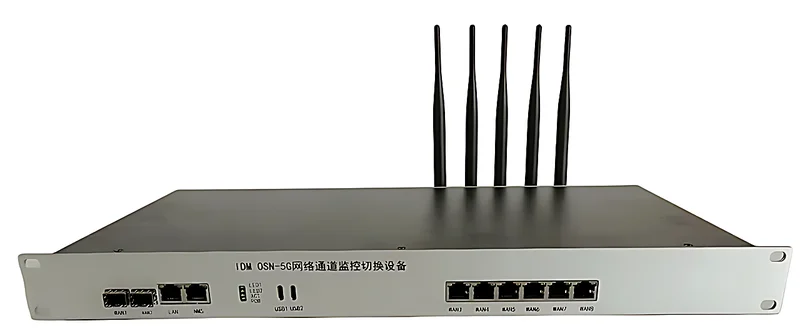
Figure 1: Front view of the IDM OSN-5GE emergency multi-link aggregation device and the layout of its 5 Gigabit WAN ports
What Are the Core Functions of the IDM OSN-5GE?
The functions of the IDM OSN-5GE are organized around five categories: multi-link access, status monitoring, intelligent scheduling, security hardening, and lightweight O&M. Each function and its role are listed in the table below.
| Function | Description |
|---|---|
| 5 Gigabit WAN ports | Provides 3 Gigabit RJ45 ports and 2 Gigabit optical Ethernet ports, building dual basic links of cable plus optical fiber; the WAN ports can interface with communication carriers such as satellite broadband, microwave broadband, SDR mesh broadband, and optical fiber broadband |
| Low-speed Ethernet module expansion | Supports integration of low-speed Ethernet modules such as LoRa transmission with low-speed serial ports and radio data transmission, and can be fitted with 4G/5G modules, covering both low-rate links and mobile network access |
| Real-time link status monitoring | Based on the web-based visual configuration and operation monitoring system, dynamically detects the up/down status, transmission bandwidth, and signal quality of each channel, with data updated in real time |
| Priority-based intelligent scheduling | Supports automatic channel switching by preset priority, with millisecond-level response switching when the primary channel fails; the front-panel Manual / Auto switch button and web-based remote operation form two operation paths |
| Multi-channel bandwidth aggregation | Through 1 Gigabit gated RJ45 LAN port or 1 Fast Ethernet RJ45 LAN port, integrates multi-link bandwidth resources to meet bandwidth-intensive needs such as high-definition video backhaul and concurrent multi-terminal communications |
| Domestically produced core components | Adopts a fully domestic 9-port Gigabit switch plus a domestic CPU monitoring system, with no foreign chips or software embedded, meeting the security compliance requirements of key fields such as emergency response and government affairs |
| Data transmission encryption and covert mode | Supports the IPSec encryption protocol, with end-to-end encrypted transmission of critical communication data; combined with frequency regulation capability, a low-power / low-frequency covert mode can be preset |
| Intelligent fault location | The web interface displays channel status, real-time traffic, and switching history, distinguished by red alarms and green normal status; intelligently locates the fault type within 10 seconds and generates troubleshooting guidance |
How Are the 5 Gigabit WAN Channels Connected? Which Links Does the IDM OSN-5GE Support?
The 5 Gigabit WAN channels are connected by first selecting a channel combination based on available on-site resources, then configuring a priority for each channel, and finally obtaining the aggregated service link from the LAN port. The two access paths have clear divisions of labor:
- 3 Gigabit RJ45 ports: connect cables, or wireless devices with Ethernet output such as microwave and SDR mesh;
- 2 Gigabit optical Ethernet ports: connect optical fiber links, or wireless transmission devices with optical port output;
- The 5 channels can be combined online in any way; they do not all need to be occupied.
The priority configuration determines the switching order. Emergency command scenarios usually set optical fiber or microwave as the primary channel and satellite as the fallback channel, with the satellite channel taking over services when both optical fiber and microwave are interrupted; field operations scenarios often set satellite or SDR mesh as the primary channel and reserve limited optical fiber resources for data backhaul. The real-time up/down status, transmission bandwidth, and signal quality of channels are all updated synchronously in the web interface, allowing O&M personnel to adjust the priority order directly based on this information.
Low-speed channels are supplemented by expansion modules. When only low-speed Ethernet links such as LoRa transmission or radio data transmission are available on site, they can be accessed through modules integrating low-speed serial ports, serving services with low bandwidth requirements such as position reporting, short messages, and sensor data backhaul.
Technical Specifications and Interface Standards of the IDM OSN-5GE
Device specifications, interface configuration, ingress protection rating, and security features are listed item by item in the table below. The parameters are subject to the product documentation.
| Item | Parameter/Specification | Description/Applicable Conditions |
|---|---|---|
| Device specifications | 19-inch 1U standard rack-mounted | Facilitates rack installation in the cabinets of emergency command vehicles and temporary command posts |
| WAN interfaces | 3 Gigabit RJ45 ports, 2 Gigabit optical Ethernet ports | 5 Gigabit WAN channels in total, capable of interfacing with satellite, microwave, SDR mesh, and optical fiber broadband |
| LAN interfaces | 1 Gigabit gated RJ45 port or 1 Fast Ethernet RJ45 port | Aggregated service-side output port; the two forms depend on project configuration |
| Expansion capability | Supports low-speed Ethernet integration such as LoRa transmission and radio data transmission; can be fitted with 4G/5G modules | Optional according to on-site link rates and scenario requirements |
| Core functions | Multi-link status monitoring, priority-based intelligent switching, multi-channel bandwidth aggregation, web-based visual O&M | Function policies are configured through the web interface |
| Supported links | Satellite broadband, microwave broadband, SDR mesh broadband, optical fiber broadband, etc. | The actual rate of each link is subject to the capability of on-site equipment |
| Ingress protection rating | Waterproof enclosure IP65, standard industrial enclosure IP30 | The waterproof enclosure supports outdoor installation; the standard industrial enclosure is suitable for equipment rooms or cabinets |
| Operating temperature | Waterproof enclosure: -10℃~65℃; standard industrial enclosure: 0℃~45℃ | Select the enclosure type according to the ambient temperature range of deployment |
| Anti-interference capability | Complies with GB/T 17626.2-2006 electrostatic discharge immunity level 3 (waterproof enclosure) | Used to evaluate immunity performance in strong electromagnetic interference environments |
| Security features | Domestically produced core components, IPSec encryption, low-power covert mode | Corresponds to the security compliance requirements of key fields such as emergency response and government affairs |
| Power supply mode and overall power consumption | Not yet recorded in the knowledge base | The manufacturer's technical documentation and commercial confirmation shall prevail |
How to Select a Multi-Link Aggregation Device? Selection Points
To select a multi-link aggregation device, first count the number of channels, then check the switching metrics, and finally verify the environmental and compliance conditions. The number of channels and interface forms are the primary items to verify: the number of communication carriers that need to be accessed simultaneously on site determines the number of WAN ports required.
The 3 Gigabit electrical ports plus 2 Gigabit optical ports of the IDM OSN-5GE cover common combinations of the four carrier types—satellite, microwave, SDR mesh, and optical fiber—and when interfaces are insufficient, 4G/5G and low-speed Ethernet channels can be added through expansion modules.
Switching metrics determine service continuity. Intelligent link switching capability is particularly critical for scenarios such as emergency command and disaster rescue that do not allow long service interruptions, and it is necessary to verify the switching response after a primary channel failure and the operation methods available on site. The two paths of the front-panel Manual / Auto switch button and web-based remote operation can reduce the number of on-site duty personnel.
Environmental and compliance conditions are easily overlooked. For outdoor deployment, calculate based on the IP65 waterproof enclosure and the -10℃~65℃ wide temperature range; for deployment in equipment rooms or inside cabinets, the standard industrial enclosure can be used. For projects involving key fields such as emergency response and government affairs, it should also be verified whether the core components use domestic chips and domestic software.
During selection, also verify the output method on the service side: the IDM OSN-5GE provides 1 Gigabit gated RJ45 LAN port or 1 Fast Ethernet RJ45 LAN port.
If the backend needs to carry high-definition video backhaul or concurrent multi-terminal communications, it is recommended to configure the Gigabit LAN port and confirm that the sum of available bandwidth of all on-site WAN channels can meet the service peak. The power supply mode and overall power consumption are not yet recorded in the knowledge base; before formal selection, the manufacturer's technical documentation and commercial confirmation shall prevail.
Differentiated Value: 5 Gigabit WAN Aggregation, Millisecond-Level Switching, and Domestically Produced Core Components
As a bridge converter designed for emergency communications scenarios, the differentiated capabilities of the IDM OSN-5GE come from four aspects: interfaces, aggregation, switching, and domestically produced components. Item-by-item descriptions are provided in the table below.
| Differentiation Point | Customer Value |
|---|---|
| 5 Gigabit WAN | 5 Gigabit WAN plus satellite, microwave, and mesh, with millisecond-level switching upon single-channel failure: 3 Gigabit RJ45 ports and 2 Gigabit optical Ethernet ports can be online simultaneously, with any combination of satellite broadband, microwave broadband, SDR mesh broadband, and optical fiber broadband; when any channel is interrupted, the remaining channels continue to carry services, providing multi-link aggregation assurance for emergency communications |
| Dual LAN gated | Dual LAN gated aggregation of multi-link bandwidth meets concurrent high-definition video backhaul: 1 Gigabit gated RJ45 LAN port or 1 Fast Ethernet RJ45 LAN port outputs the stacked bandwidth of multiple channels, so high-definition video backhaul and concurrent multi-terminal communications share one aggregated link, suitable for product showcase scenarios such as emergency command vehicles |
| Fully domestic core | Domestic CPU plus 9-port Gigabit switch, with no foreign chips and controllable compliance: both core components—data switching and operation monitoring—use domestic devices, with no foreign chips or software embedded, meeting the security compliance requirements of key fields such as emergency response and government affairs; Raytrans continues to deepen its work in the field of domestically produced converged communications |
| IP65 wide temperature | The waterproof enclosure reaches IP65 ingress protection and a wide temperature range of -10℃~65℃, resisting rain, dust, and strong electromagnetic interference, suitable for outdoor rescue and field operations environments |
Typical Application Scenarios
Emergency Command and Disaster Rescue
When disasters such as earthquakes, floods, and typhoons cause conventional communications interruptions, a link that does not depend on a single channel is needed between the command center and the rescue site, and disaster emergency rescue communications place particularly prominent requirements on link continuity.
IDM OSN-5GE connects satellite broadband, microwave broadband, and SDR mesh broadband simultaneously. When a conventional link is available, traffic goes through the primary channel; when the primary channel fails due to base station damage or optical cable interruption, it automatically switches to the satellite channel, ensuring real-time voice, high-definition video, and data backhaul between the command center and the rescue site, and supporting emergency decision-making and dispatch. This solution can serve as the core link device in the military emergency communications vehicle solution and the emergency command vehicle product showcase.
It locates the failure type within 10 seconds and generates troubleshooting guidance, reducing the number of trips emergency repair personnel must make to the site.
Energy and Geological Field Operations
Communication infrastructure in remote areas is weak, and the camps of geological exploration, forest fire prevention, field surveying, and other operations often have only satellite or radio set access available.
IDM OSN-5GE aggregates multi-path bandwidth, combining satellite links with the sensor and positioning data carried by low-speed Ethernet modules for backhaul, so the operating team can complete high-definition data backhaul and collaborative communication over a single aggregated link. The IP65 waterproof enclosure and the -10℃~65℃ wide temperature range suit field environments with rain and snow, dust, and large day-night temperature differences.
Government and Public Safety Private Networks
Government and public safety private networks have explicit requirements for the controllability of audio and video data, and critical data on the link must be encrypted end to end. The government private network optical fiber communication solution also has strict standards for domestically produced equipment and security.
The data switching and operation monitoring core components of IDM OSN-5GE both use domestically produced components, with no overseas chips or software embedded. Together with the IPSec encryption protocol for end-to-end encrypted transmission of critical communication data, it meets the security and compliance requirements of critical fields.
The device uses a 19-inch 1U rack-mounted structure and can be installed in a command vehicle or cabinet for rapid commissioning. Multiple terminals and systems interconnect through the aggregated LAN interfaces, providing stable link support for converged communication and command and dispatch.
Summary
The IDM OSN-5GE emergency multi-link aggregation device packs 5 gigabit WAN channels, composed of 3 Gigabit RJ45 ports and 2 Gigabit optical Ethernet ports, into a 19-inch 1U chassis. Through real-time status monitoring, priority-based intelligent switching, and multi-channel bandwidth aggregation, it integrates heterogeneous links such as satellite, microwave, SDR mesh, and optical fiber into one continuously available service link.
Primary channel failure triggers millisecond-level switching, and an emergency scenario completes switching in 1 second. The domestically produced 9-port gigabit switch and the domestically produced CPU form the core components, and the IP65 waterproof enclosure and -10℃~65℃ wide temperature range support outdoor deployment. The bridge converter solution provided by Raytrans balances multi-link aggregation capability with domestically produced compliance requirements in emergency communications and command and dispatch scenarios.
The IDM OSN-5GE emergency multi-link aggregation device is suitable for emergency communication link aggregation and private network link upgrade projects in scenarios such as emergency command and disaster rescue, energy and geological field operations, and government and public safety private networks.