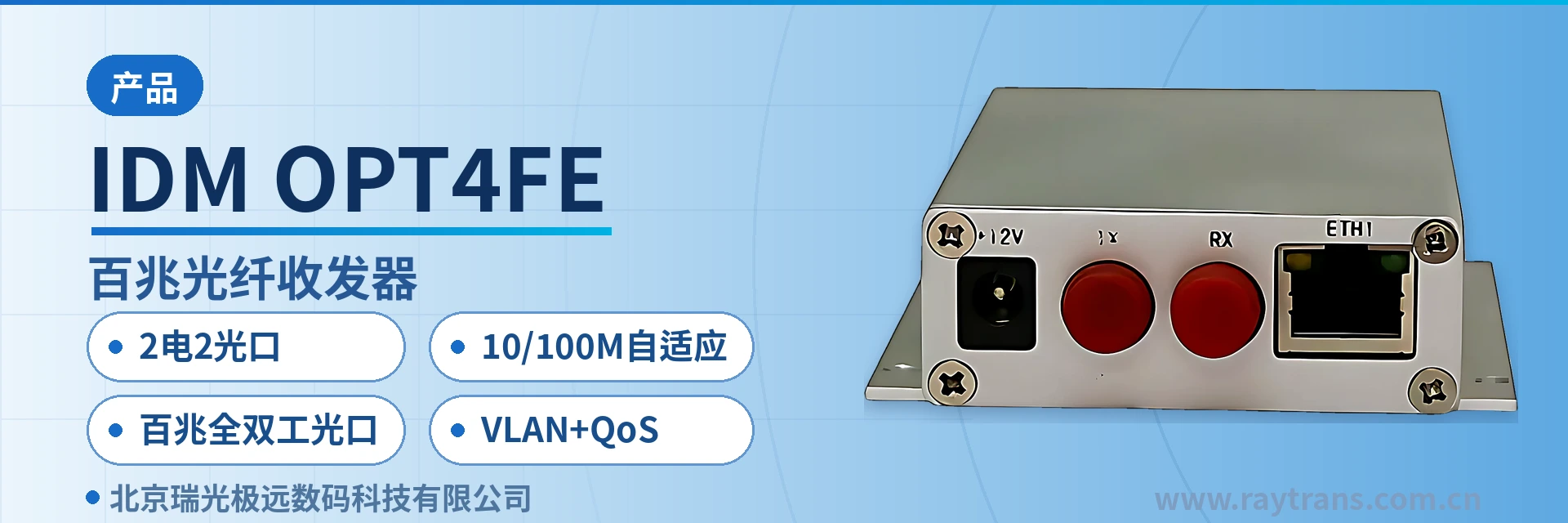
IDM-OPT4FE Fast Ethernet Media Converter
2 electrical ports and 2 optical ports, data and voice over the same fiber, dual optical port cascading capacity expansion, no network planning changes required
The IDM-OPT4FE Fast Ethernet media converter is an optical-to-electrical signal conversion device used to convert gigabit Ethernet electrical signals from computers into optical signals. It complies with the IEEE802.3z/AB standard. Its features include: the electrical port signal can be 10/100Base-T adaptive, and can operate in full-duplex or half-duplex mode; the optical port signal can only operate in 100Base-SX/LX full-duplex mode. It offers good stability and reliability.
The IDM-OPT4FE Fast Ethernet media converter is a 2-electrical-port, 2-optical-port Fast Ethernet media converter developed by Beijing Ruiguang Jiyuan, used to convert Ethernet electrical signals from computers and other terminals to optical signals on optical fiber and vice versa. As a professional media converter manufacturer, Ruiguang Jiyuan (Raytrans) highlights the practical design of this device in its product showcase: the device provides 2 RJ45 twisted pair interfaces and 2 optical fiber ports, used respectively to connect twisted pair and optical fiber; the electrical ports are 10/100Base-T adaptive, and the optical ports operate in 100Base-SX/LX full-duplex mode.
Key Specifications at a Glance: 2 electrical + 2 optical ports · 10/100M adaptive · Fast Ethernet full-duplex optical ports · VLAN+QoS
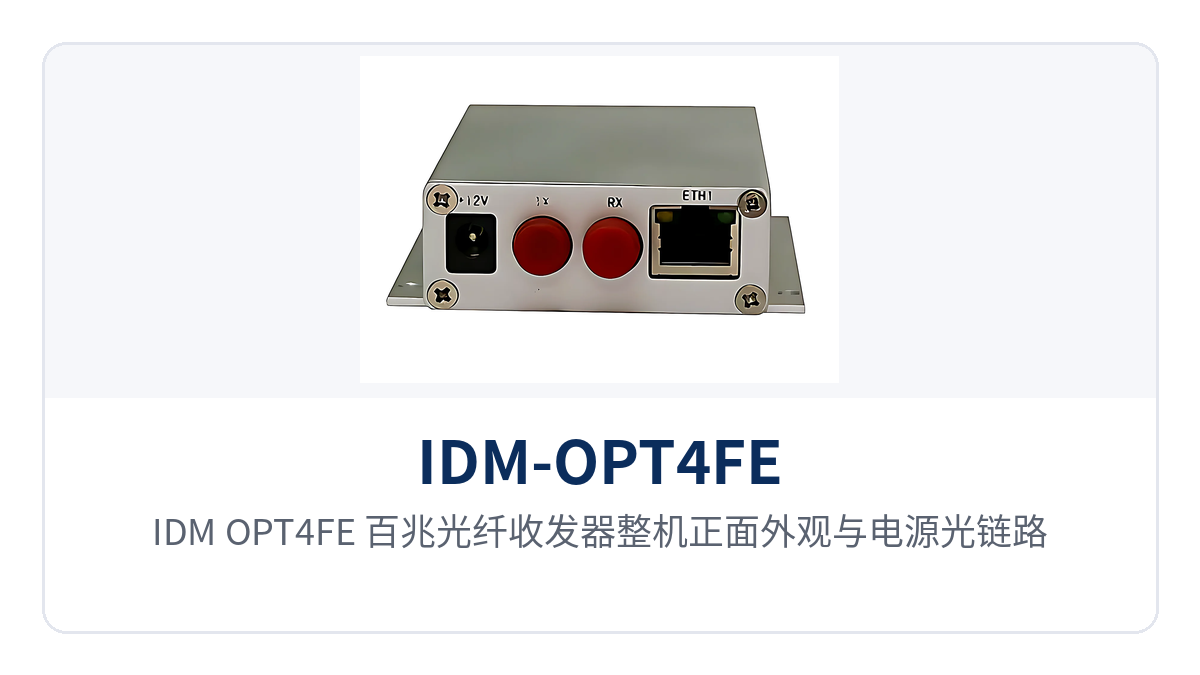
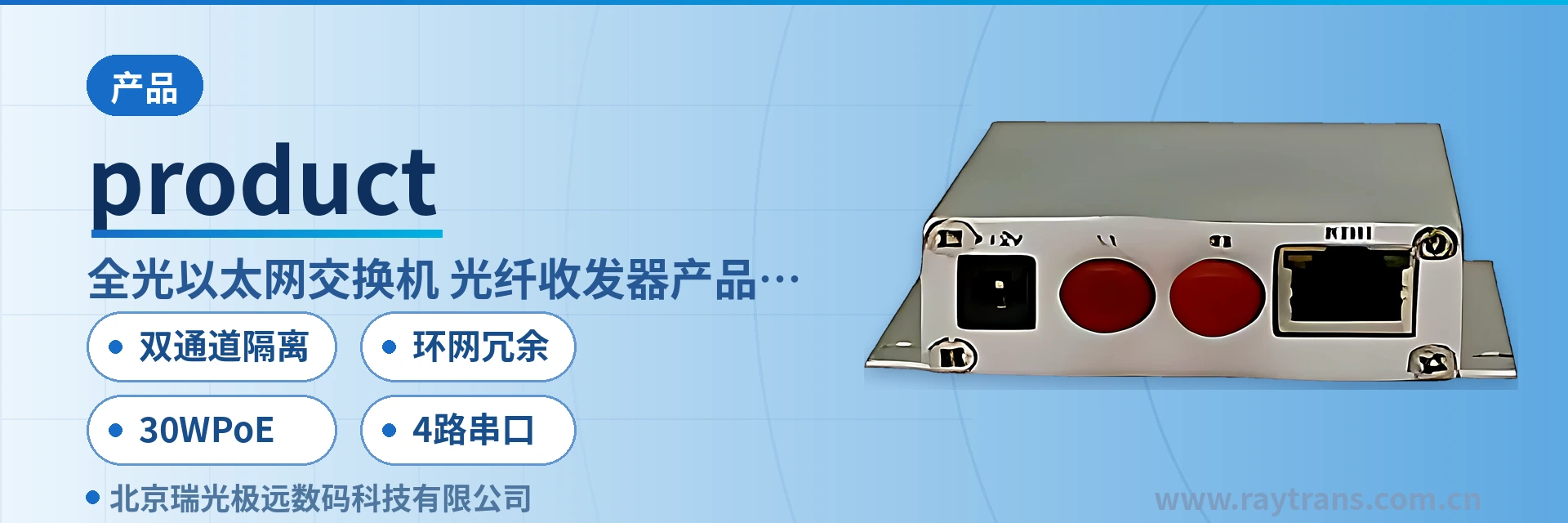
Figure 1: Front view of the IDM-OPT4FE Fast Ethernet media converter with power and optical link indicator LEDs
After service packets enter the device, only physical media conversion is performed; the encoding and address structure of Ethernet frames are not changed, so the existing network planning of edge cameras, industrial PCs, IP phones, and voice gateways requires no adjustment. One device provides 2 electrical ports and 2 optical ports at the same time, so data services and voice services can be accessed on the same media converter and then sent over optical fiber to the opposite-end equipment room or aggregation node. Raytrans media converters can coordinate networking with fiber optic switches, SIP telephones, and other devices, and are widely applicable to scenarios such as government private network optical fiber communication solutions, military emergency communications vehicle solutions, and smart mining communication solutions.
What Kind of Device Is the IDM-OPT4FE 2-Electrical-Port, 2-Optical-Port Fast Ethernet Media Converter
A 2-electrical-port, 2-optical-port Fast Ethernet media converter refers to an optical-to-electrical conversion device with two electrical ports and two optical ports, both at Fast Ethernet rates. The 2 RJ45 electrical ports of the IDM-OPT4FE face edge terminals, and the 2 optical fiber ports face the optical cable: one optical port serves as the uplink, and the other is used for device cascading or extension in a second direction, so the complete unit need not be replaced when service capacity is expanded. As a typical product showcase model, it balances port density and networking flexibility in the media converter category.
Edge sites of electric power, rail transit, and military private networks often carry both data and voice services: on the data side are cameras, acquisition terminals, and office computers, and on the voice side are IP phones or voice gateways. After the two electrical ports connect these two types of services respectively, voice is carried on the Ethernet side as IP packets and shares the same optical fiber link with data.
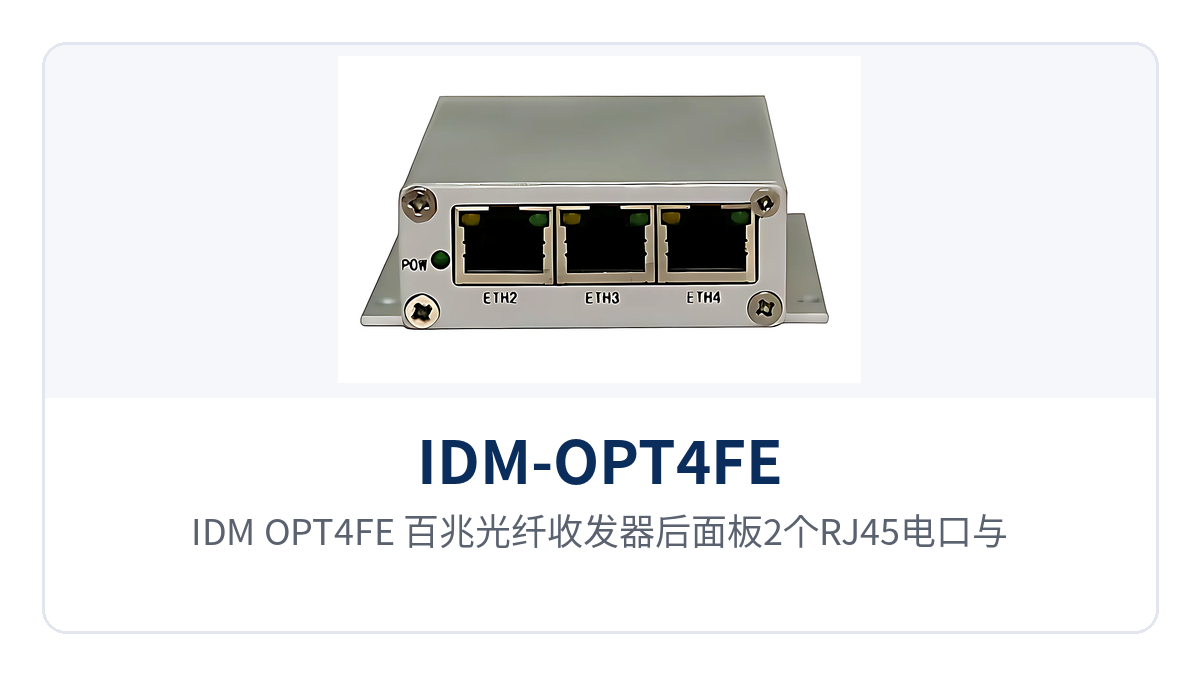
Figure 2: Rear panel layout of the IDM-OPT4FE Fast Ethernet media converter with 2 RJ45 electrical ports and 2 optical ports
Key Specifications and Interface Configuration
The functions of the IDM-OPT4FE center on 2 electrical ports and 2 optical ports; interface rates, duplex modes, and service differentiation capabilities are listed in the table below. For items not listed in the table, such as power supply, power consumption, enclosure dimensions, and operating temperature, not yet recorded in the knowledge base; during selection, technical documentation should be obtained from the media converter manufacturer and confirmed item by item.
| Function | Description |
|---|---|
| 2 electrical + 2 optical port access | 2 RJ45 twisted pair interfaces connect edge terminals, and 2 optical fiber ports connect the optical cable; one device completes optical-to-electrical conversion in two directions |
| 10/100M adaptive | The electrical ports automatically negotiate between 10M and 100M according to the rate of the opposite-end device, and the duplex mode can be full-duplex or half-duplex |
| Fast Ethernet full-duplex optical ports | The optical ports operate in 100Base-SX/LX full-duplex mode, transmitting and receiving simultaneously, and do not participate in rate auto-negotiation |
| VLAN+QoS | Supports VLAN partitioning and priority queues, distinguishing data streams from voice streams by service type |
| Device cascading | Supports device cascading; the second optical port can connect to the next-level media converter, and service capacity expands with the number of cascading levels |
| Multi-vendor intercommunication | In point-to-multipoint networking mode, Fast Ethernet media converters from different manufacturers can be used as connecting devices |
| Cooperation with optical switches | Can be used with Fast Ethernet fiber optic switches, with the uplink side connected to the optical port of the central equipment room |
| IP voice bearer | Supports MGCP/SIP/H.323 voice protocols and G.711, G.723.1, and G.729 voice codecs; voice is accessed through the electrical ports as IP packets |
| Address configuration | Supports static addresses and DHCP; address and other parameters can be automatically assigned by a DHCP server |
| Status indication | The front panel provides power, optical port link, and electrical port rate indications, allowing on-site personnel to make a preliminary judgment of link status based on the indicator LEDs |
| Item | Parameter/Specification | Description/Applicable Conditions |
|---|---|---|
| Model | IDM-OPT4FE | Fast Ethernet media converter |
| Device type | Optical-to-electrical signal conversion device | Performs interchange between twisted pair electrical signals and optical fiber signals without changing Ethernet frame encoding |
| Electrical ports | 2 RJ45 twisted pair interfaces | Connect twisted pair; can connect data terminals, IP phones, or voice gateways |
| Optical ports | 2 optical fiber ports | Connect optical fiber; one can serve as the uplink, and the other as cascading or a second direction |
| Electrical port rate and duplex | 10/100M adaptive, full-duplex or half-duplex | Rate and duplex mode are automatically negotiated according to the opposite-end device |
| Optical port rate and duplex | Fast Ethernet full-duplex optical ports, 100Base-SX/LX | The optical ports operate only in full-duplex mode and do not participate in auto-negotiation |
| Ethernet standard | IEEE 802.3, IEEE 802.3u | Correspond to 10BASE-T, 100BASE-TX, and 100BASE-FX; if the standard number marked in the accompanying documentation is inconsistent with the actual port rate, the port rate shall prevail |
| Service differentiation | VLAN+QoS | Distinguishes data services from voice services by VLAN and priority queue |
| Voice bearer | MGCP/SIP/H.323, G.711, G.723.1, G.729 | Voice is accessed through the electrical ports as IP packets; analog telephones require conversion through a voice gateway or IAD |
| Address configuration | Static address, DHCP | Supports automatic assignment of address and other parameters by DHCP |
| Networking topology | Point-to-point, point-to-multipoint, cascading | Can work with Fast Ethernet optical switches and Fast Ethernet media converters from different manufacturers |
| Power supply and power consumption | Not yet recorded in the knowledge base | The power supply format and overall power consumption are subject to the manufacturer's technical documentation |
| Enclosure dimensions and operating environment | Not yet recorded in the knowledge base | The installation method, operating temperature, and humidity are subject to the manufacturer's technical documentation |
How a 10/100M Adaptive Media Converter Works with Fast Ethernet Full-Duplex Optical Ports in Networking
The IDM-OPT4FE is a 10/100M adaptive media converter. The electrical ports determine the rate and duplex mode with the opposite-end device through auto-negotiation: if the opposite end is a 10M terminal, it operates at 10M; if the opposite end is a 100M terminal, it operates at 100M, so no manual configuration change is required on site. This is also why existing Fast Ethernet private network terminals can be directly connected without being replaced along with the media converter.
The negotiation method of the optical ports differs from that of the electrical ports. The 100Base-SX/LX optical ports operate in fixed Fast Ethernet full-duplex mode, with transmission and reception each occupying one direction and capable of sending and receiving simultaneously; both optical ports must be Fast Ethernet full-duplex to establish a link. The opposite-end device on the uplink side, the optical module type, and the wavelength need to be checked in advance, and the optical ports are not backward compatible with 10M links.
In point-to-multipoint networking, the Fast Ethernet optical switch or aggregation-type device at the central node can connect multiple IDM-OPT4FE units downstream, and each site accesses and backhauls services through its own optical port. In point-to-multipoint mode, the device supports Fast Ethernet media converters from different manufacturers as connecting devices, so other-brand media converters already installed at existing sites need not be replaced all at once. This model provided by Ruiguang Jiyuan (Raytrans) can adapt to the edge access segment of government private network optical fiber communication solutions, military emergency communications vehicle solutions, and smart mining communication solutions, and works with voice terminals such as SIP telephones to complete data and voice backhaul over the same fiber.
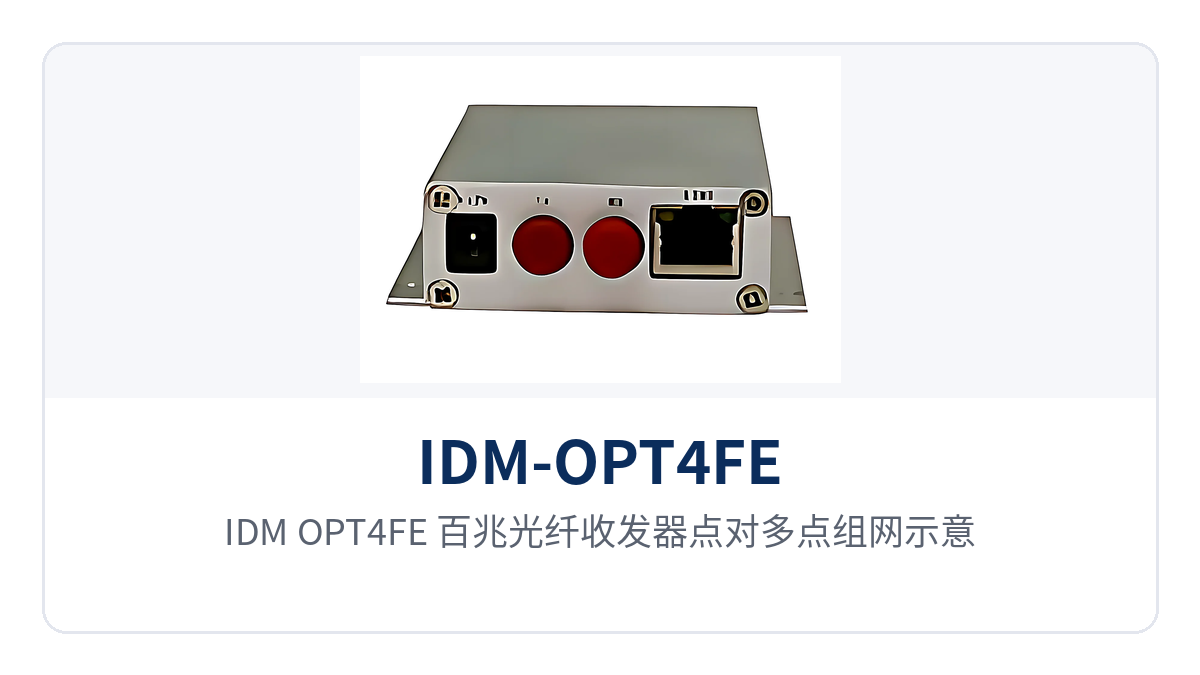
Figure 3: Point-to-multipoint networking schematic of the IDM-OPT4FE Fast Ethernet media converter
How VLAN and QoS Distinguish Data from Voice on One Media Converter
VLAN handles service assignment, and QoS handles the order of precedence during congestion. The IDM-OPT4FE supports both VLAN and QoS: data and voice are tagged with different VLAN tags, so the two types of services do not interfere with one another on the same optical fiber link; voice streams enter a high-priority queue and are forwarded first when the link is congested, which can reduce the impact of intermittent audio and packet loss on calls.
When data and voice are transmitted over the same fiber, address-side cooperation is also required. The device supports static addresses and DHCP, and address parameters can be uniformly assigned by a DHCP server, so a voice gateway or IP phone automatically obtains its configuration after going online without manual setup on each device; if subscriber line provisioning is handled uniformly by a softswitch platform on site, the voice protocol is interfaced via MGCP, SIP, or H.323, and the voice codec is selected among G.711, G.723.1, and G.729.
A boundary needs to be noted: the IDM-OPT4FE is a Layer 2 optical-to-electrical conversion device, and on the voice side it only provides Ethernet bearer and does not provide FXS analog telephone ports. If traditional analog telephones are still used on site, they must first be converted into IP voice streams through a voice gateway or IAD and then uploaded to the optical path through the electrical ports; the telephones themselves need not be replaced.
Typical Application Scenarios
Electric Power Private Network Fiber Access: Data and Voice Backhaul over the Same Fiber at Substations and Distribution Rooms
Data terminals and dispatch telephones in substations, distribution rooms, and switching stations belong to different systems, and in the past a separate link was often pulled for each. The IDM-OPT4FE uses its 2 electrical ports to connect the data terminal and the voice gateway respectively, and its 2 optical ports to backhaul to the communications equipment room on one path and cascade to the adjacent site on the other, so the two types of services in the station share one optical fiber, and the fiber core usage of electric power private network fiber access is reduced accordingly. As a professional media converter manufacturer, Ruiguang Jiyuan (Raytrans) clearly marks the dual-electrical, dual-optical structure of this model in its product showcase for easy comparison during selection.
Electric power sites have strong electromagnetic interference and large ground potential differences; the two ends of the optical fiber link are not commonly grounded, and there is no electrical path between edge terminals and in-station equipment. The 10/100M adaptive electrical ports can directly connect to existing Fast Ethernet protection, monitoring, and video terminals, so existing in-station equipment need not be modified, and the replacement and capacity expansion workload is concentrated on the media converter side.
Rail Transit Communication: Service Extension for Equipment Boxes at Stations and Along the Line
Cameras, PA terminals, and dispatch telephones are distributed in equipment boxes at station entrances and exits, depots, and along the line, and the distance from the boxes to the station communications equipment room often exceeds the reach of twisted pair. The IDM-OPT4FE is deployed in the equipment box; its electrical ports aggregate the data and voice terminals in the box, and its optical ports uplink to the communications equipment room along the existing optical cable, so no additional optical modules are needed in the box.
Rail transit has many sites along the line and scattered sites, and point-to-multipoint networking allows one Fast Ethernet fiber optic switch in the central equipment room to connect media converters at multiple sites downstream; when a site is expanded, devices can be added as required. When space and power points in the box are limited, one dual-electrical, dual-optical device replaces two single-port media converters, making cabling and power distribution in the cabinet simpler as well.
Military and Government Private Networks: Rapid Access for Fixed Sites and Temporary Command Posts
Fixed sites, duty rooms, and temporary command posts of military and government private networks often need data and voice channels opened within a short time. The IDM-OPT4FE is simple to wire: terminals are connected through the electrical ports and work immediately, and the optical ports connect to the existing private network optical cable; temporary sites can quickly form links in point-to-point mode, and after the task is completed the devices can be withdrawn and reused after relocation. The military emergency communications vehicle solutions and government private network optical fiber communication solutions provided by Ruiguang Jiyuan (Raytrans) both list this model as a standard option for edge access.
The private network requires clear service assignment. VLAN and QoS can carry the data streams of different departments and different services separately, and voice streams are prioritized when congestion occurs. The optical port works only in 100M full-duplex mode, and a link can be established once the rates at both ends are consistent; when interfacing with existing 100M private network equipment, the original network plan remains unchanged. In a smart mining communication solution, media converters of the same class with two electrical ports and two optical ports can also serve as underground and above-ground data and voice backhaul nodes.
Differentiated Value
| Selling Point | Corresponding Design | On-Site Value |
|---|---|---|
| 2 RJ45 electrical ports + 2 optical ports; a single device carries both data and voice access | The 2 electrical ports connect to data terminals and voice terminals respectively, and the 2 optical ports share uplink and cascading | Two types of services at a site share one media converter and one optical fiber link |
| Electrical ports are 10/100Base-T adaptive and compatible with existing 100M private network equipment, with no modification required | Electrical ports perform auto-negotiation according to the rate and duplex mode of the opposite end | Existing 100M terminals and fiber optic switches can be connected as-is, reducing replacement and capacity expansion costs |
| Optical ports are 100Base-SX/LX full-duplex, support point-to-multipoint networking, and are compatible with 100M media converters from different manufacturers | Optical ports are fixed at 100M full-duplex, and point-to-multipoint mode supports equipment from multiple manufacturers as connected devices | One fiber optic switch at the central node can connect multiple sites, and existing third-party media converters do not need to be replaced |
Conclusion
As a 2-electrical-port 2-optical-port 100M media converter, the IDM-OPT4FE brings data and voice services into the same device. The 2 100M full-duplex optical ports handle uplink and cascading respectively, the electrical ports are 10/100M adaptive and interface with existing 100M private network terminals, and VLAN + QoS keep the two types of services from interfering with one another over the same optical fiber. Raytrans also provides optical module selection and networking instructions for this model in its product showcase, making it easy for engineers to verify against on-site conditions.
The end sites of electric power private networks, rail transit communication, and military and government private networks are mostly scenarios with fixed service types, scattered sites, and limited cabinet space. One media converter carrying two electrical ports and two optical ports can reduce the number of devices and fiber core usage; the optical module type, transmission distance, power supply, and environmental indicators can be confirmed at the selection stage according to the media converter manufacturer's technical documentation.