IDM-OPT4FE 4-Channel 100M Media Converter
4-channel electrical port aggregation with single fiber uplink, saving 3 single-port media converters and 3 fiber cores, no configuration required
IDM-OPT4FE 4-Channel 100M Media Converter, applied in the product showcase field, communication/transmission/dispatch equipment for industry customers (to be detailed and improved according to the documentation)
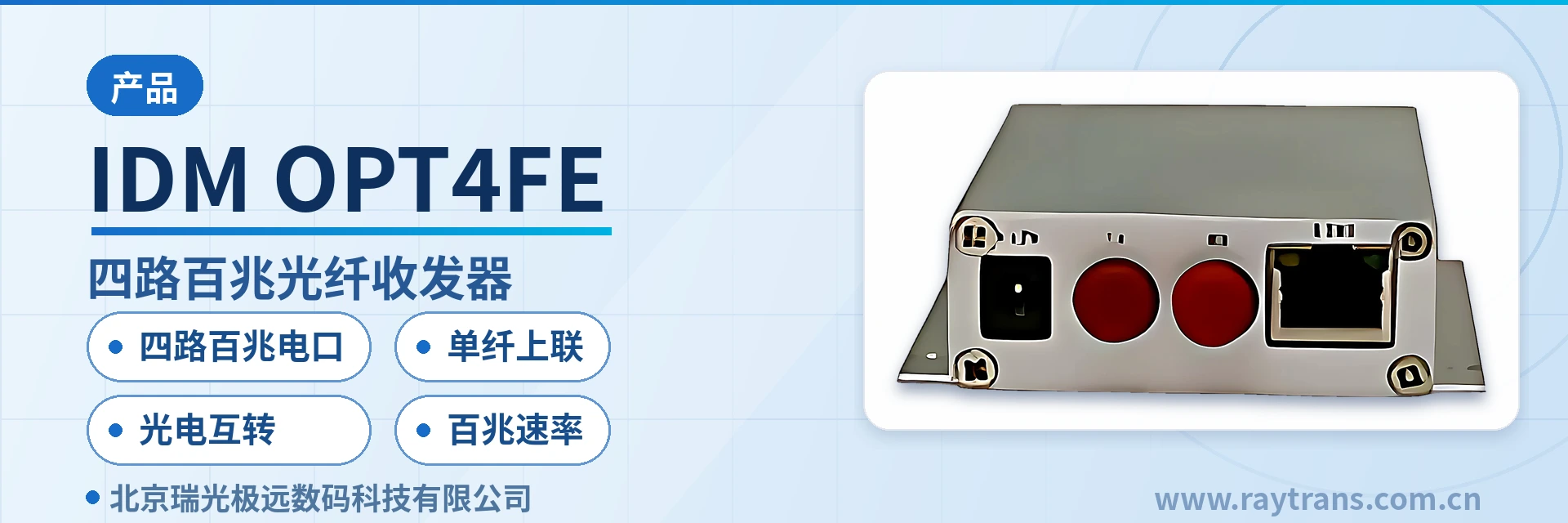
The IDM-OPT4FE single fiber uplink 4-channel 100M media converter is an optical-to-electrical signal conversion device developed by Beijing Ruiguang Jiyuan Digital Technology Co., Ltd., consisting of 4 RJ45 connector twisted pair interfaces and 1 optical fiber port, which are used to connect twisted pair cables and optical fibers respectively. On the twisted pair side, 4 channels of Fast Ethernet services are connected at the same time; on the optical fiber side, transmission and reception are completed over one fiber core in single fiber uplink mode, interchanging electrical signals and optical signals before transmitting them over distance.
As a professional media converter manufacturer, Raytrans presents this 4-channel 100M media converter, which addresses multi-industry communication scenarios in the media converter product showcase and can be flexibly used together with fiber optic switches; it is widely suitable for fields with high requirements on reliability and real-time performance, such as the government private network optical fiber communication solution, the military emergency communications vehicle solution and the smart mining communication solution.
Key specifications at a glance4-channel 100M electrical ports · single fiber uplink · optical-to-electrical conversion · 100M rate
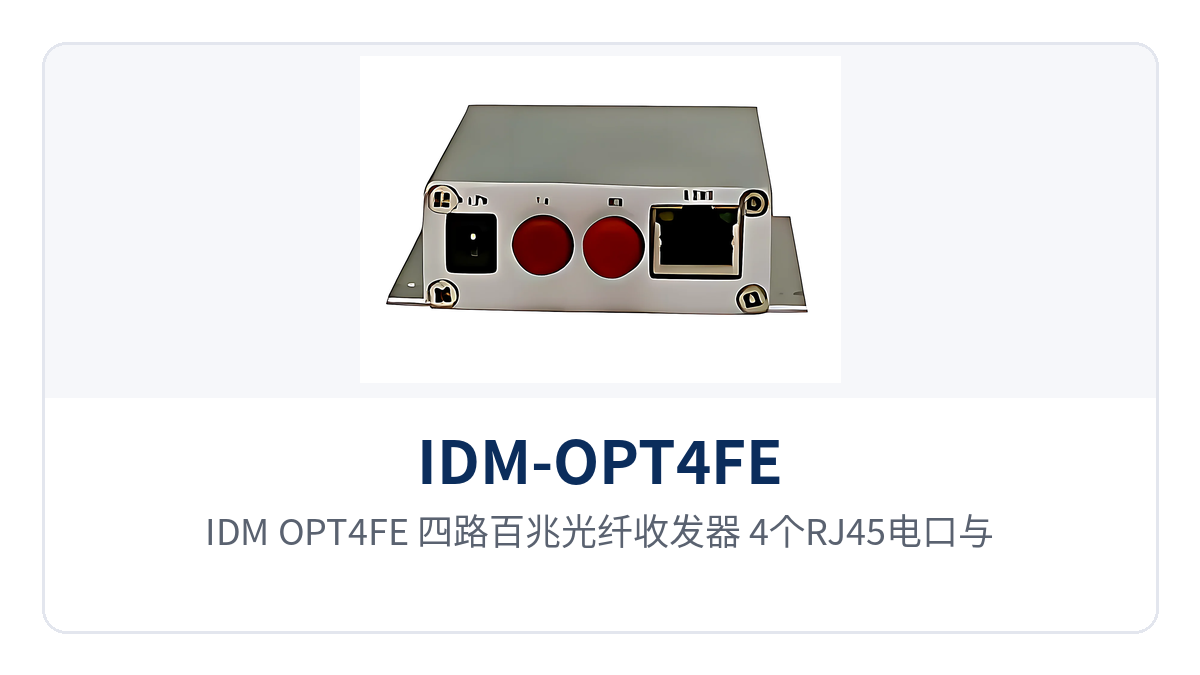
Figure 1: IDM-OPT4FE 4-channel 100M media converter with 4 RJ45 connectors used as electrical ports and 1 optical fiber port
What Kind of Device Is the Single Fiber Uplink 4-Channel 100M Media Converter?
The IDM-OPT4FE is a 4-channel 100M media converter. A single device provides 4 RJ45 connector interfaces for twisted pair and 1 optical fiber port, which are used to connect twisted pair cables and optical fibers respectively: 4 channels of Fast Ethernet services are connected from the electrical ports and, after aggregation, are transmitted over distance by 1 optical fiber port in single fiber uplink mode. As a mature product showcase, the media converter only interchanges electrical signals and optical signals without changing the encoding of Ethernet frames and remains transparent to upper-layer network protocols, so neither the edge devices nor the existing network planning need to be adjusted.
Cameras, industrial computers, acquisition terminals and office terminals at industrial sites and power distribution sites mostly provide only RJ45 connectors as electrical ports, while the usable distance of twisted pair on a 100M link is limited, so the services have to be converted into optical signals to reach the equipment room; an optical-to-electrical conversion device is therefore needed at the edge.
The IDM-OPT4FE provides 4 RJ45 connector interfaces for twisted pair and 1 optical fiber port on the same device, so the 4 channels of services at the edge do not have to be spread across 4 single-port media converters or each occupy a fiber core; they can be aggregated on the same device and then uplinked in single fiber uplink mode, reducing the number of devices in the box, the installation sites and the fiber core occupancy accordingly.
Key Specifications and Interface Configuration
The parameters of the IDM-OPT4FE are concentrated in two parts, interfaces and rate: 4 RJ45 connector twisted pair interfaces handle service access and 1 optical fiber port handles single fiber uplink transmission, with the electrical ports and the optical port both at the 100M level. The number of interfaces and the service types are subject to the product documentation; for items such as the optical module, power supply and environment for which the knowledge base has no data yet, the manufacturer's technical documentation should be requested from the media converter manufacturer for confirmation at the selection stage.
| Function | Description |
|---|---|
| 4-channel RJ45 connector twisted pair access | A single device provides 4 RJ45 connector twisted pair interfaces and can connect 4 channels of Fast Ethernet services at the same time, replacing the distributed deployment of multiple single-port media converters |
| 1-channel optical fiber port uplink | One optical fiber port converts the aggregated electrical port services into optical signals and transmits them over optical fiber to the switch in the control room or equipment room |
| Optical-to-electrical conversion | Twisted pair electrical signals and optical fiber signals are interchanged within the same device without changing the Ethernet frame encoding, so the edge devices and the upper-layer network planning remain unchanged |
| 100M rate forwarding | The 4 RJ45 connectors used as electrical ports and the 1 optical fiber port are both at the 100M level, and the 4 channels of services are forwarded at the 100M rate, with the link rate matching the rate of the edge terminals |
| Single Fiber Uplink | One optical fiber port completes uplink and downlink transmission and reception over a single fiber core, so the 4 channels of services at the edge occupy only 1 fiber core resource |
| Plug-and-play with no configuration required | Once the wiring on the twisted pair side and the optical fiber side is complete, the device works; the edge device addresses need not be changed, and extending the private network link does not modify the existing network configuration |
| Item | Parameter/Specification | Description/Applicable Conditions |
|---|---|---|
| Model | IDM-OPT4FE | 4-channel 100M media converter |
| Device type | Optical-to-electrical signal conversion device (media converter) | Interchanges twisted pair electrical signals and optical fiber signals |
| RJ45 connector twisted pair interface | 4 | Used to connect twisted pair cables and connect 4 channels of Fast Ethernet services at the same time |
| Optical fiber port | 1 | Used to connect optical fibers and serves as the uplink channel for the 4 channels of services |
| Interface rate | 100M (100 Mbps) | The electrical port and the optical port are both at the 100M level, with forwarding at the 100M rate |
| Interface standard on the twisted pair side | 10BASE-T / 100BASE-TX(IEEE 802.3、IEEE 802.3u) | General standard for Fast Ethernet twisted pair access; for the port adaptive mode, the manufacturer's technical documentation shall prevail |
| Optical fiber side interface standard | 100BASE-FX(IEEE 802.3u) | 100M optical fiber link standard; the optical module type, wavelength and transmission distance are subject to the selected optical module and the manufacturer's technical documentation |
| Uplink mode | Single Fiber Uplink | One optical fiber port completes uplink and downlink transmission and reception over a single fiber core |
| Working mode | Not yet recorded in the knowledge base | For the duplex mode and other working modes, the manufacturer's technical documentation shall prevail |
| Power supply and port power supply capability | Not yet recorded in the knowledge base | When port power supply is required on site, please confirm with the manufacturer the power supply configuration at the selection stage |
| Enclosure dimensions and installation method | Not yet recorded in the knowledge base | For dimensions, installation method and operating environment specifications, the manufacturer's technical documentation shall prevail |
What Is the Difference Between Single Fiber Uplink and Dual Fiber Uplink?
The difference between single fiber uplink and dual fiber uplink lies in the number of optical cable fiber cores occupied. Single fiber uplink uses one fiber core to complete both transmission and reception, with both directions transmitted over one fiber core, so the edge site occupies only 1 fiber core; dual fiber uplink uses two fiber cores to carry transmission and reception respectively, and the optical modules at both ends are used in pairs.
For existing optical cables with tight fiber core resources and private networks with densely distributed edge sites, single fiber uplink allows 4 channels of services to occupy only 1 fiber core, leaving the saved fiber cores for other sites. The uplink mode of the IDM-OPT4FE optical fiber port is single fiber uplink; the specific wavelength, transmission distance and optical module specifications are subject to the manufacturer's technical documentation and the on-site optical cable conditions.
Typical Application Scenarios
Industrial Automation Private Network: Multiple Terminals at the Workshop End Aggregated and Then Uplinked to the Control Room over an Optical Fiber Uplink
Industrial computers, PLC host computers, visual inspection terminals and human-machine interfaces in an industrial automation private network mostly provide only RJ45 connectors as electrical ports and are concentrated in the workshop equipment cabinet, and the distance from the workshop to the control room often exceeds the usable Fast Ethernet range of twisted pair.
The IDM-OPT4FE is deployed in the equipment cabinet, where the 4 RJ45 connector twisted pair interfaces connect 4 channels of 100M services nearby and 1 optical fiber port is connected to the control room fiber optic switch in single fiber uplink mode, so no separate optical module is needed at the edge; the optical fiber medium is immune to the electromagnetic interference (EMI) from variable-frequency drives and power cables in the workshop, and the 100M link between the control room and the production line is transmitted over an optical connection.
Electric Power and Rail Transit Communication: Services of Distribution Rooms and Equipment Boxes Along the Line Uplinked to the Aggregation Point in Single Fiber Uplink Mode
Distribution terminals, electricity meter reading equipment, environmental monitoring devices, cameras and broadcast terminals in distribution rooms, switching stations, ring main units and equipment boxes along the railway line are mostly connected through RJ45 connectors as electrical ports; the distance from the site to the distribution network aggregation point or the station communications equipment room often exceeds the capability of twisted pair, and strong electromagnetic interference and ground potential differences exist on site.
The IDM-OPT4FE connects 4 channels of 100M services in the cabinet on the site side, and 1 optical fiber port sends the services onto the optical path in one step; the site and the aggregation point are connected by optical fiber, the devices at both ends do not share a common ground and the edge terminals need no configuration changes; one device takes the place of multiple single-port media converters, reducing the installation space, power supply points and fiber core occupancy in distribution rooms and equipment boxes accordingly.
Unattended Field Surveillance: Multiple Video Channels in Field Cabinets Sent to the Surveillance Center over a Single Fiber
Cameras, meteorological and hydrological acquisition equipment, and access control and alarm terminals at unattended field surveillance sites are usually concentrated in the same field cabinet or surveillance pole box, and the 100M services at a single point are mostly around 4 channels, while the distance from the cabinet to the surveillance center far exceeds the range of twisted pair.
The IDM-OPT4FE aggregates the terminals in the box through 4 RJ45 connector twisted pair interfaces and then uses 1 optical fiber port to send them to the surveillance center along the existing optical cable in single fiber uplink mode; one device replaces multiple single-port media converters, saving both the scarce fiber cores and the space in the box at field sites, and capacity expansion at a site only requires adding devices without changing the edge terminal configuration.
Differentiated Value
The three points of differentiated value only make sense when applied to specific engineering conditions; the table below matches each differentiation point with its corresponding benefit.
| Differentiation Point | On-Site Value |
|---|---|
| 4-channel 100M electrical ports aggregated over a single fiber, saving space at the private network edge with one device carrying four channels | 4 RJ45 connector twisted pair interfaces connect 4 channels of 100M services at the same time, and 1 optical fiber port provides uplink over one fiber core; one device replaces 4 single-port media converters, reducing the space and power supply points in the cabinet and equipment box at the edge accordingly |
| 100M twisted pair and optical fiber interconversion, plug-and-play for private network link extension | Twisted pair electrical signals and optical fiber signals are interchanged within the same device without changing the Ethernet frame encoding; the edge devices need no configuration changes and work as soon as wiring is complete, so extending a private network link does not require modifying the edge network |
| Compact configuration with 4 RJ45 connector interfaces plus 1 optical port, high-density multi-channel access for private networks | 4 RJ45 connectors used as electrical ports and 1 optical fiber port are housed in the same enclosure, so a single site can provide high-density access for multiple terminals, with the cabling in the box, the installation sites and the O&M scope brought together in one device |
Conclusion
The Raytrans IDM-OPT4FE single fiber uplink 4-channel 100M media converter uses a compact configuration of 4 RJ45 connector twisted pair interfaces plus 1 optical fiber port to aggregate the 4 channels of 100M services at the edge and uplink them to the equipment room over one fiber core, with optical-to-electrical conversion and 100M rate forwarding completed within the same device, making it suitable for industrial private network optical fiber access applications such as industrial automation private networks, electric power and rail transit communication and unattended field surveillance; as a product showcase from a professional media converter manufacturer, this model can also serve the government private network optical fiber communication solution, the military emergency communications vehicle solution and the smart mining communication solution, and the optical module, transmission distance and power supply configuration can be determined at the selection stage together with the manufacturer's technical documentation.