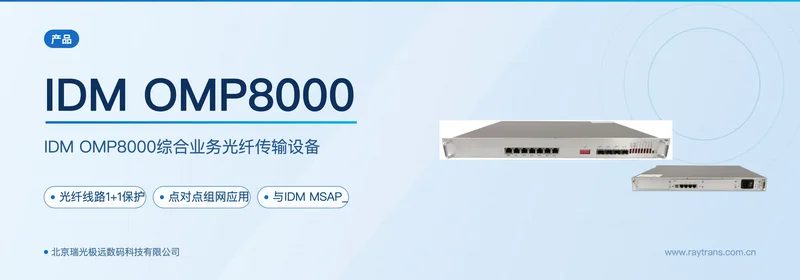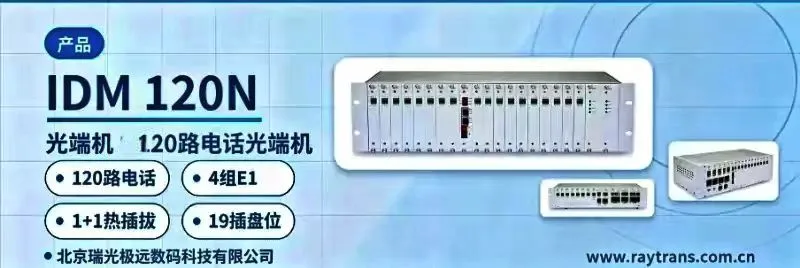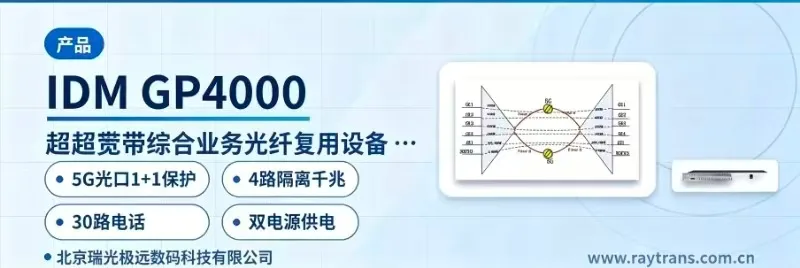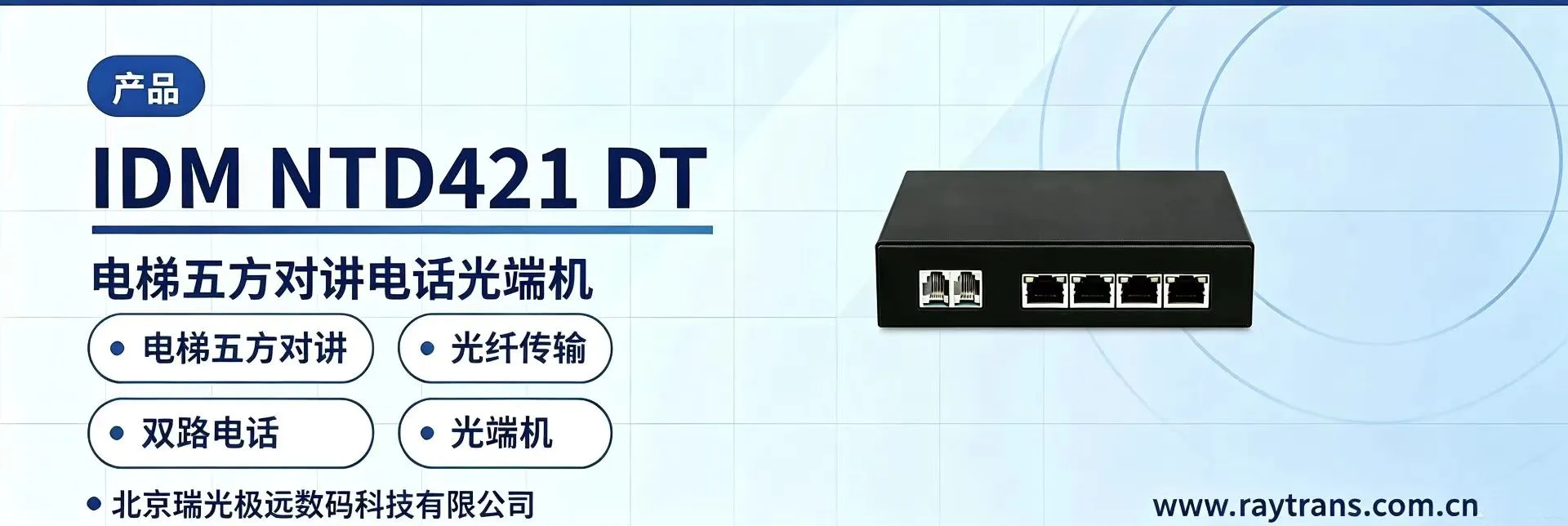
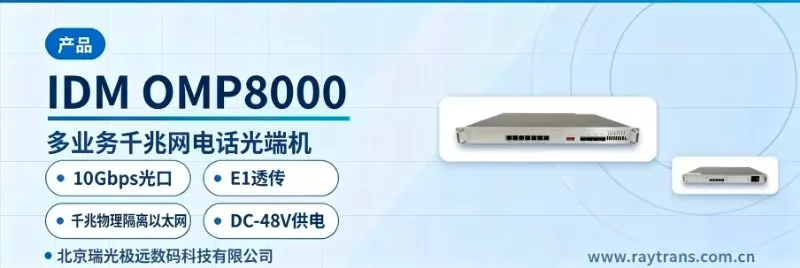
IDM OMP8000 Multi-Service Gigabit Network Telephone Optical Multiplexer
Transparent transmission of E1, 8 channels of physically isolated gigabit Ethernet, telephone, audio, V.35 and other services over one optical fiber at the same time
The IDM OMP8000 integrated service optical fiber transmission equipment supports SFP optical interfaces, a 10Gbps rate and single-mode/multi-mode optical fibers, and integrates multi-service transmission interfaces such as E1, Ethernet, telephone, audio, data and V.35, making it suitable for integrated service optical fiber transmission scenarios.
The IDM OMP8000 10Gbps multi-service optical multiplexer is an integrated service optical fiber transmission equipment introduced by Beijing Ruiguang Jiyuan Digital Technology Co., Ltd., used to carry E1, gigabit Ethernet (GE), telephone, audio, 64Kbps data and V.35 services simultaneously over a pair of optical fibers. As a typical multi-service optical multiplexer, the IDM OMP8000 10Gbps multi-service optical multiplexer (also commonly called a PDH optical multiplexer or PDH equipment) adopts an SFP pluggable optical port, a line rate of 10Gbps and single-mode as the standard configuration with multi-mode optional, and the service interfaces are connected separately and then multiplexed into the optical channel for transparent transmission to the opposite end, so that one device can take on the access work that previously had to be done by stacking multiple single-function optical multiplexers. As a professional optical multiplexer manufacturer, Raytrans has integrated the functions of a gigabit network optical multiplexer and a telephone optical multiplexer into this product, making it widely applicable to scenarios such as government private network optical fiber communication solutions and military emergency communications vehicle solutions, and providing reliable optical fiber communication support for the product showcase.
Key Specifications at a Glance: SFP optical interface · 10Gbps · single-mode (multi-mode optional) · wavelength 1310/1490/1550 nm · receiver sensitivity better than -24 dBm · power supply AC220V/DC-48V · operating temperature -20 °C to +50 °C
What Kind of Device Is the IDM OMP8000 10Gbps Multi-Service Optical Multiplexer?
The IDM OMP8000 10Gbps multi-service optical multiplexer is a multi-service optical multiplexing equipment at the customer-side access layer, aggregating broadband services (gigabit Ethernet) and narrowband services (E1, telephone, audio, 64Kbps data, V.35) onto a pair of optical fibers for transmission. As a typical multi-service optical multiplexer, the IDM OMP8000 10Gbps multi-service optical multiplexer provides service interfaces such as Ethernet, telephone, audio, data and V.35 on the user side and an SFP optical interface on the line side; when used in pairs at the two ends, it completes point-to-point service interworking, mainly serving industry private networks such as electric power and energy, rail transit, and military and government, and it is also an important product showcase of PDH optical multiplexers and gigabit network optical multiplexers in private network access scenarios.
The IDM OMP8000 10Gbps multi-service optical multiplexer adopts a card-based modular structure, so different types of service cards can be configured according to the service type and capacity of the site, making both the initial investment and later capacity expansion more flexible. The unit has a rack-mounted form factor, with dimensions of 480 mm × 308 mm × 131 mm, making it easy to install in a standard communications cabinet; the front panel of the device concentrates the optical ports and operating status indications, making it easy to determine the link status quickly during on-site inspection. As a professional optical multiplexer manufacturer, Raytrans has accumulated rich experience in implementing government private network optical fiber communication solutions and military emergency communications vehicle solutions on the telephone optical multiplexer and PDH product lines of this series.
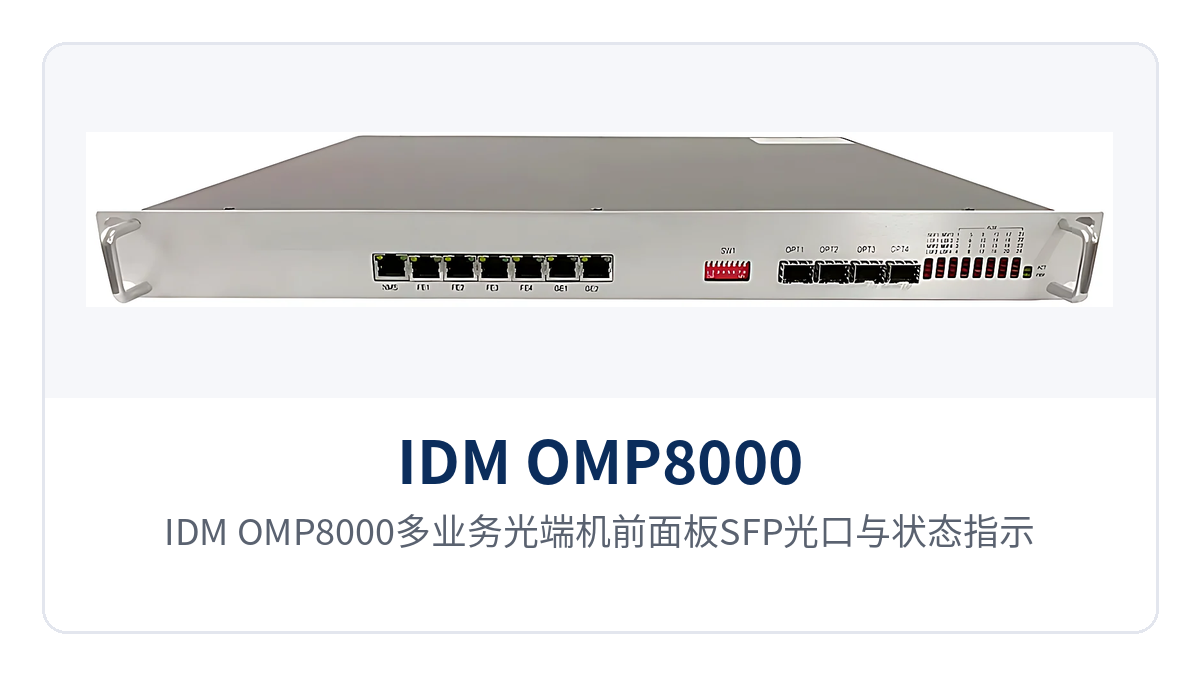
Figure 1: Layout of the SFP Optical Ports and Status Indicator LEDs on the Front Panel of the IDM OMP8000 Multi-Service Optical Multiplexer
What Services Can One Device Carry? Core Function Table
The IDM OMP8000 10Gbps multi-service optical multiplexer completes the access, multiplexing and optical fiber transparent transmission of broadband and narrowband services within a single device; the core functions are shown in the table below.
Function | Description |
|---|---|
SFP Optical Interface | The optical port is an SFP pluggable structure, so the optical module can be replaced according to distance and optical fiber type |
Single-Mode/Multimode Fiber Optional | Single-mode fiber is the standard configuration; a multi-mode optical module can be selected for short-distance cabling |
10Gbps Transmission Rate | Line-side rate of 10Gbps, providing a transmission channel for multi-service multiplexing |
E1 Interface Transparent Transmission | Provides an E1 interface transparent transmission channel, with a bit rate of 2.048Mbps, compliant with ITU-T G.703 |
10M/100M/1000M Ethernet Interface | Ethernet interface rate of 10M or 100M or 1000M, compliant with IEEE802.3, adaptive half-duplex/full-duplex |
Telephone Interface | Supports FXO/FXS voice channel interfaces; voice is compressed according to A-law in ITU G.711, with a loop current of 25 mA per channel |
Audio Interface | Audio range 300 Hz to 3400 Hz, balanced 600 Ω impedance, return loss no less than 18 dB |
64Kbps Data Interface | Data bit rate of 64Kbps, line coding compliant with the G.703 standard, balanced 120 Ω impedance |
V.35 Interface | RJ-45 interface type, compliant with ITU-T V.35, transmission rate n×64Kbps (n=0 to 31) |
AC220V/DC-48V Power Supply | 220 V AC and -48 V DC power supply modes are available, suitable for equipment rooms and DC power sites |
Network Management | Supports SNMP network management, facilitating remote monitoring and unified maintenance |
The types and quantities of service cards in the table above can be configured per project; the specific number of channels, slots and isolation methods are subject to the manufacturer's technical documentation and commercial confirmation.
Technical Specifications and Interface Standards
The electrical characteristics of the IDM OMP8000 10Gbps multi-service optical multiplexer follow international standards such as ITU-T and IEEE, and the parameters are listed in six parts, namely the optical interface, the E1 interface, the Ethernet interface, the telephone and audio interface, the data and V.35 interface, and the power supply and environment, for item-by-item verification during project selection. As a multi-service optical multiplexer product of the professional optical multiplexer manufacturer Raytrans, this model targets scenarios such as government private network optical fiber communication solutions and military emergency communications vehicle solutions in the PDH product showcase.
Optical Interface Parameters
Item | Parameter/Specification | Description/Applicable Conditions |
|---|---|---|
Interface Type | SFP | Pluggable optical module, optional according to distance and optical fiber type |
Fiber Mode | Single-mode (multi-mode optional) | Single-mode for medium and long-distance links, multi-mode for short-distance cabling |
Transmission Rate | 10Gbps | Line-side optical port rate |
Wavelength | 1310/1490/1550 nm | Determined by the optical module selected |
Transmit Optical Power | -1~-10 dB | Typical transmit specification of the optical module |
Receiver Sensitivity | Better than -24 dBm | Typical specification on the receive side, on which the link margin is calculated |
E1 Interface Parameters
Item | Parameter/Specification | Description/Applicable Conditions |
|---|---|---|
Bit Rate | 2.048Mbps | Standard E1 rate |
Line Coding | HDB3 | Line coding compliant with ITU-T G.703 |
Standard Protocol | ITU-T G.703 | E1 interface standard |
Impedance | 75 Ω/120 Ω | Optional according to line conditions |
Frame Structure | PCM30/31 | Consistent with the E1 equipment at the opposite end |
Mode | Transparent Transmission | End-to-end transparent transmission without changing the frame structure and signaling on the user side |
Ethernet Interface Parameters
Item | Parameter/Specification | Description/Applicable Conditions |
|---|---|---|
Transmission Rate | 10M or 100M or 1000M | Determined through negotiation with the peer device |
Standard Protocol | Supports IEEE802.3 | Compliant with the Ethernet standard |
Operating Mode | Adaptive half-duplex/full-duplex | Set automatically or manually according to the network environment |
Telephone and Audio Interface Parameters
Item | Parameter/Specification | Description/Applicable Conditions |
|---|---|---|
Telephone Audio Range | 300 Hz to 3400 Hz | Meets the voice frequency band requirements |
Telephone Compression Ratio | A-law in ITU G.711 | Voice codec |
Telephone Impedance | Three-element complex impedance 200 Ω + 560 Ω // 0.1 μF | FXO/FXS voice channel interface parameters |
Telephone Loop Current | 25 mA per channel | Voice channel feeding specification |
Audio Range | 300 Hz to 3400 Hz | Transmission frequency band for audio services |
Audio Impedance | Balanced 600 Ω | Audio interface parameters |
Audio Compression Ratio | A-law in ITU G.711 | Audio encoding method |
Audio Return Loss | No less than 18 dB | Reflects the impedance matching level of the audio interface |
Data and V.35 Interface Parameters
Item | Parameter/Specification | Description/Applicable Conditions |
|---|---|---|
Data Line Coding | G.703 standard | 64Kbps data channel |
Data Bit Rate | 64Kbps | Rate of a single data channel |
Data Impedance | Balanced 120 Ω | Data interface parameters |
Data Standard | Fully compliant with the ITU G.703 recommendation | Interconnecting with the existing 64 kbit/s service |
Serial Port Transmission Rate | Asynchronous ≤9600bps; synchronous 64Kbps | Serial port data service rate |
Serial Port Electrical Characteristics | Compliant with the CCITT V.28 protocol | Serial port electrical characteristics |
V.35 Interface Type | RJ-45 | Facilitates on-site cabling |
V.35 Electrical Characteristics | Compliant with ITU-T V.35 | V.35 interface specification |
V.35 Transmission Rate | n×64Kbps (n=0 to 31) | Configured according to service bandwidth requirements |
V.35 Terminal Interface | Compliant with ISO2593 | Interconnecting with V.35 terminal equipment |
Power Supply, Power Consumption and Environmental Parameters
Item | Parameter/Specification | Description/Applicable Conditions |
|---|---|---|
Power Supply Mode | AC220V/DC-48V | AC or DC power supply selectable |
Overall Power Consumption | ≤90 W | Upper limit of typical power consumption at full configuration |
Operating Temperature | -20 °C to +50 °C | Operating environment temperature range of the device |
Relative Humidity | 0 to 95% (non-condensing) | Conditions of use in equipment rooms and cabinets |
Product Dimensions | 480 mm × 308 mm × 131 mm | Length × depth × height |
The rear panel of the IDM OMP8000 10Gbps multi-service optical multiplexer concentrates the E1, Ethernet, telephone, audio, data and V.35 service interfaces as well as the power supply terminals, and the interfaces are arranged in zones by service type, making it easy to check the wiring positions against the installation drawing during on-site cabling.
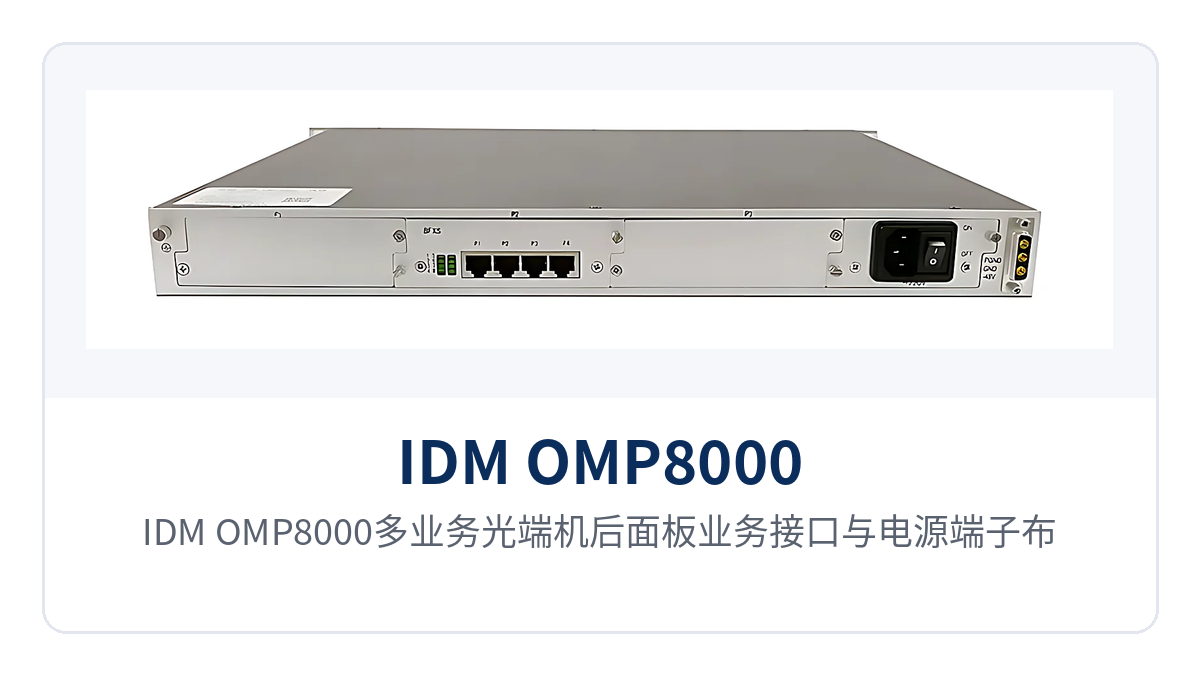
Figure 2: Layout of the Service Interfaces and Power Supply Terminals on the Rear Panel of the IDM OMP8000 Multi-Service Optical Multiplexer
What Does E1 Transparent Transmission Mean for an Optical Multiplexer?
E1 transparent transmission means that the optical multiplexer carries the 2.048Mbps E1 signal as a whole frame transparently to the opposite end without modifying the frame structure, signaling or time slot content of the E1 on the user side, and the effect between the devices at the two ends is equivalent to a direct connection with a single E1 coaxial cable. The E1 interface of the IDM OMP8000 10Gbps multi-service optical multiplexer has a bit rate of 2.048Mbps, HDB3 line coding, a PCM30/31 frame structure, transparent transmission as the operating mode and a standard protocol compliant with ITU-T G.703, with an impedance selectable between 75 Ω and 120 Ω.
The value of E1 transparent transmission lies in not changing the existing service configuration: the SPC exchanges (stored program control switching equipment), telecontrol equipment or PCM multiplexers connected at the two ends do not need to be configured again, and the engineering side only needs to connect the optical path and the E1 cables. The IDM OMP8000 10Gbps multi-service optical multiplexer multiplexes E1 together with gigabit Ethernet, telephone and V.35 services into the same 10Gbps optical channel, so the E1 telecontrol channel and the office data network share one pair of optical fibers and no separate laying of optical fibers is required for each type of service. For government private network optical fiber communication solutions that need to carry voice and data at the same time, telephone optical multiplexers and gigabit network optical multiplexers from Raytrans can be deployed in combination to reduce the occupation of optical fiber resources.
How Is Uninterrupted Transmission Ensured on Weak Optical Links and at Field Sites?
With a receiver sensitivity better than -24 dBm together with a transmit optical power of -1~-10 dB, the IDM OMP8000 10Gbps multi-service optical multiplexer can maintain stable reception on long-distance lines with high link attenuation and on construction sections with many connectors and fiber adapters, reserving a usable optical power margin for the project. Communication interruption in field private networks is often caused by an insufficient optical power margin, and the receiver sensitivity specification together with the transmit optical power range determines how much line loss can still be tolerated between the two ends; therefore, calculating these two specifications together with the line loss during selection costs less than repeated troubleshooting afterwards.
The IDM OMP8000 10Gbps multi-service optical multiplexer supports two power supply modes, AC220V and DC-48V: at equipment rooms with AC power, mains power can be used directly, and at communication sites with only DC power, -48 V DC can be connected without additional inverter equipment. The device has an operating temperature of -20 °C to +50 °C and a relative humidity of 0 to 95% (non-condensing), with an overall power consumption of no more than 90 W, adapting to environmental conditions such as unattended equipment rooms and field cabinets that lack air conditioning. In military emergency communications vehicle solutions, this multi-service optical multiplexer can be enabled quickly by relying on the mature PDH optical multiplexer architecture, and with the optical multiplexer product showcase and technical support of Raytrans, it provides integrated access capacity for voice, data and video at emergency sites.
Application Scenarios of the Multi-Service Optical Multiplexer: Electric Power, Rail Transit and Field Private Networks
Electric Power and Energy Industrial Private Network
Energy sites such as substations, wind farms and photovoltaic power stations need to backhaul dispatch telephones, telecontrol data and the office network to the management unit. The IDM OMP8000 10Gbps multi-service optical multiplexer uses one pair of optical fibers to carry the E1 telecontrol channel, telephones and gigabit Ethernet at the same time, so the site side no longer needs to set up a separate optical multiplexer for each type of service. The device supports DC-48V power supply and can directly draw on the existing DC power supply of the substation, and its operating temperature goes down to -20 °C, adapting to the operating conditions of outdoor cabinets and unattended field equipment rooms.
Rail Transit and Expressway Communications
Railways, metros and expressways have distributed sites along the line at intervals of several kilometers, and the inter-station communication services cover three types: telephone, data and network. The two SFP optical ports A and B of the IDM OMP8000 10Gbps multi-service optical multiplexer can be configured as required, and each station along the line accesses telephone and Ethernet services nearby and backhauls them to the central equipment room in a unified way, so that multiple sites share one trunk optical fiber in chain networking. The E1 transparent transmission channel can be used to carry the channel services of the existing dedicated communication system, reducing the workload of service cutover and modification along the line.
Military and Government Field Private Networks
Field command posts, temporary training sites and emergency communications sites usually have no ready-made transmission resources and need to establish telephone, data and network channels within a short time. The IDM OMP8000 10Gbps multi-service optical multiplexer concentrates telephone, audio, 64Kbps data, V.35 and gigabit Ethernet in a single device, and using it in pairs enables multi-service communication over one pair of optical fibers, which facilitates vehicle-mounted transport and quick deployment. The V.35 interface can connect to devices such as routers, and the n×64Kbps rate configuration makes it easy to allocate bandwidth flexibly according to availability.
How to Select a Multi-Service Optical Multiplexer: Configuration and Optical Module Recommendations
For the selection of a multi-service optical multiplexer, first look at the service types and quantities, then at the transmission distance and the power supply environment, and finally check whether the interface standards are consistent with the existing equipment at both ends. The IDM OMP8000 10Gbps multi-service optical multiplexer is configured by service cards: gigabit Ethernet service cards are configured when the site is dominated by the data network, FXO/FXS voice channel cards when voice dispatching is dominant, and the corresponding service cards according to the number of channels when E1 or V.35 dedicated line transparent transmission is required; the types and quantities of service cards are subject to the manufacturer's technical documentation and commercial confirmation.
Optical modules are selected according to the actual optical fiber length, optical fiber type and line attenuation; the optical port of the IDM OMP8000 10Gbps multi-service optical multiplexer is an SFP pluggable structure, single-mode optical modules cover the 1310/1490/1550 nm wavelengths, and multi-mode modules can be used for short-distance cabling. The power supply mode is chosen between AC220V and DC-48V according to the equipment room conditions, and the operating temperature must cover the local extreme temperatures; for large-scale multi-site deployment, it is recommended to connect to SNMP network management to monitor the link and service status in a unified way. If a site originally used multiple single-function optical multiplexers to handle Ethernet, E1 and telephone services separately, switching to one IDM OMP8000 10Gbps multi-service optical multiplexer can reduce the number of devices and the occupation of optical fibers.
Item | Parameter/Specification | Description/Applicable Conditions |
|---|---|---|
Bit Rate | 2.048Mbps | Standard E1 rate |
Line Coding | HDB3 | Line coding compliant with ITU-T G.703 |
Standard Protocol | ITU-T G.703 | E1 interface standard |
Impedance | 75 Ω/120 Ω | Optional according to line conditions |
Frame Structure | PCM30/31 | Consistent with the E1 equipment at the opposite end |
Mode | Transparent Transmission | End-to-end transparent transmission without changing the frame structure and signaling on the user side |
Ethernet Interface Parameters
Item | Parameter/Specification | Description/Applicable Conditions |
|---|---|---|
Transmission Rate | 10M or 100M or 1000M | Determined through negotiation with the peer device |
Standard Protocol | Supports IEEE802.3 | Compliant with the Ethernet standard |
Operating Mode | Adaptive half-duplex/full-duplex | Set automatically or manually according to the network environment |
Telephone and Audio Interface Parameters
Item | Parameter/Specification | Description/Applicable Conditions |
|---|---|---|
Telephone Audio Range | 300 Hz to 3400 Hz | Meets the voice frequency band requirements |
Telephone Compression Ratio | A-law in ITU G.711 | Voice codec |
Telephone Impedance | Three-element complex impedance 200 Ω + 560 Ω // 0.1 μF | FXO/FXS voice channel interface parameters |
Telephone Loop Current | 25 mA per channel | Voice channel feeding specification |
Audio Range | 300 Hz to 3400 Hz | Transmission frequency band for audio services |
Audio Impedance | Balanced 600 Ω | Audio interface parameters |
Audio Compression Ratio | A-law in ITU G.711 | Audio encoding method |
Audio Return Loss | No less than 18 dB | Reflects the impedance matching level of the audio interface |
Data and V.35 Interface Parameters
Item | Parameter/Specification | Description/Applicable Conditions |
|---|---|---|
Data Line Coding | G.703 standard | 64Kbps data channel |
Data Bit Rate | 64Kbps | Rate of a single data channel |
Data Impedance | Balanced 120 Ω | Data interface parameters |
Data Standard | Fully compliant with the ITU G.703 recommendation | Interconnecting with the existing 64 kbit/s service |
Serial Port Transmission Rate | Asynchronous ≤9600bps; synchronous 64Kbps | Serial port data service rate |
Serial Port Electrical Characteristics | Compliant with the CCITT V.28 protocol | Serial port electrical characteristics |
V.35 Interface Type | RJ-45 | Facilitates on-site cabling |
V.35 Electrical Characteristics | Compliant with ITU-T V.35 | V.35 interface specification |
V.35 Transmission Rate | n×64Kbps (n=0 to 31) | Configured according to service bandwidth requirements |
V.35 Terminal Interface | Compliant with ISO2593 | Interconnecting with V.35 terminal equipment |
Power Supply, Power Consumption and Environmental Parameters
Item | Parameter/Specification | Description/Applicable Conditions |
|---|---|---|
Power Supply Mode | AC220V/DC-48V | AC or DC power supply selectable |
Overall Power Consumption | ≤90 W | Upper limit of typical power consumption at full configuration |
Operating Temperature | -20 °C to +50 °C | Operating environment temperature range of the device |
Relative Humidity | 0 to 95% (non-condensing) | Conditions of use in equipment rooms and cabinets |
Product Dimensions | 480 mm × 308 mm × 131 mm | Length × depth × height |
The rear panel of the IDM OMP8000 10Gbps multi-service optical multiplexer concentrates the E1, Ethernet, telephone, audio, data and V.35 service interfaces as well as the power supply terminals, and the interfaces are arranged in zones by service type, making it easy to check the wiring positions against the installation drawing during on-site cabling.
Figure 2: Layout of the Service Interfaces and Power Supply Terminals on the Rear Panel of the IDM OMP8000 Multi-Service Optical Multiplexer
What Does E1 Transparent Transmission Mean for an Optical Multiplexer?
E1 transparent transmission means that the optical multiplexer carries the 2.048Mbps E1 signal as a whole frame transparently to the opposite end without modifying the frame structure, signaling or time slot content of the E1 on the user side, and the effect between the devices at the two ends is equivalent to a direct connection with a single E1 coaxial cable. The E1 interface of the IDM OMP8000 10Gbps multi-service optical multiplexer has a bit rate of 2.048Mbps, HDB3 line coding, a PCM30/31 frame structure, transparent transmission as the operating mode and a standard protocol compliant with ITU-T G.703, with an impedance selectable between 75 Ω and 120 Ω.
The value of E1 transparent transmission lies in not changing the existing service configuration: the SPC exchanges (stored program control switching equipment), telecontrol equipment or PCM multiplexers connected at the two ends do not need to be configured again, and the engineering side only needs to connect the optical path and the E1 cables. The IDM OMP8000 10Gbps multi-service optical multiplexer multiplexes E1 together with gigabit Ethernet, telephone and V.35 services into the same 10Gbps optical channel, so the E1 telecontrol channel and the office data network share one pair of optical fibers and no separate laying of optical fibers is required for each type of service. For government private network optical fiber communication solutions that need to carry voice and data at the same time, telephone optical multiplexers and gigabit network optical multiplexers from Raytrans can be deployed in combination to reduce the occupation of optical fiber resources.
How Is Uninterrupted Transmission Ensured on Weak Optical Links and at Field Sites?
With a receiver sensitivity better than -24 dBm together with a transmit optical power of -1~-10 dB, the IDM OMP8000 10Gbps multi-service optical multiplexer can maintain stable reception on long-distance lines with high link attenuation and on construction sections with many connectors and fiber adapters, reserving a usable optical power margin for the project. Communication interruption in field private networks is often caused by an insufficient optical power margin, and the receiver sensitivity specification together with the transmit optical power range determines how much line loss can still be tolerated between the two ends; therefore, calculating these two specifications together with the line loss during selection costs less than repeated troubleshooting afterwards.
The IDM OMP8000 10Gbps multi-service optical multiplexer supports two power supply modes, AC220V and DC-48V: at equipment rooms with AC power, mains power can be used directly, and at communication sites with only DC power, -48 V DC can be connected without additional inverter equipment. The device has an operating temperature of -20 °C to +50 °C and a relative humidity of 0 to 95% (non-condensing), with an overall power consumption of no more than 90 W, adapting to environmental conditions such as unattended equipment rooms and field cabinets that lack air conditioning. In military emergency communications vehicle solutions, this multi-service optical multiplexer can be enabled quickly by relying on the mature PDH optical multiplexer architecture, and with the optical multiplexer product showcase and technical support of Raytrans, it provides integrated access capacity for voice, data and video at emergency sites.
Application Scenarios of the Multi-Service Optical Multiplexer: Electric Power, Rail Transit and Field Private Networks
Electric Power and Energy Industrial Private Network
Energy sites such as substations, wind farms and photovoltaic power stations need to backhaul dispatch telephones, telecontrol data and the office network to the management unit. The IDM OMP8000 10Gbps multi-service optical multiplexer uses one pair of optical fibers to carry the E1 telecontrol channel, telephones and gigabit Ethernet at the same time, so the site side no longer needs to set up a separate optical multiplexer for each type of service. The device supports DC-48V power supply and can directly draw on the existing DC power supply of the substation, and its operating temperature goes down to -20 °C, adapting to the operating conditions of outdoor cabinets and unattended field equipment rooms.
Rail Transit and Expressway Communications
Railways, metros and expressways have distributed sites along the line at intervals of several kilometers, and the inter-station communication services cover three types: telephone, data and network. The two SFP optical ports A and B of the IDM OMP8000 10Gbps multi-service optical multiplexer can be configured as required, and each station along the line accesses telephone and Ethernet services nearby and backhauls them to the central equipment room in a unified way, so that multiple sites share one trunk optical fiber in chain networking. The E1 transparent transmission channel can be used to carry the channel services of the existing dedicated communication system, reducing the workload of service cutover and modification along the line.
Military and Government Field Private Networks
Field command posts, temporary training sites and emergency communications sites usually have no ready-made transmission resources and need to establish telephone, data and network channels within a short time. The IDM OMP8000 10Gbps multi-service optical multiplexer concentrates telephone, audio, 64Kbps data, V.35 and gigabit Ethernet in a single device, and using it in pairs enables multi-service communication over one pair of optical fibers, which facilitates vehicle-mounted transport and quick deployment. The V.35 interface can connect to devices such as routers, and the n×64Kbps rate configuration makes it easy to allocate bandwidth flexibly according to availability.
How to Select a Multi-Service Optical Multiplexer: Configuration and Optical Module Recommendations
For the selection of a multi-service optical multiplexer, first look at the service types and quantities, then at the transmission distance and the power supply environment, and finally check whether the interface standards are consistent with the existing equipment at both ends. The IDM OMP8000 10Gbps multi-service optical multiplexer is configured by service cards: gigabit Ethernet service cards are configured when the site is dominated by the data network, FXO/FXS voice channel cards when voice dispatching is dominant, and the corresponding service cards according to the number of channels when E1 or V.35 dedicated line transparent transmission is required; the types and quantities of service cards are subject to the manufacturer's technical documentation and commercial confirmation.
Optical modules are selected according to the actual optical fiber length, optical fiber type and line attenuation; the optical port of the IDM OMP8000 10Gbps multi-service optical multiplexer is an SFP pluggable structure, single-mode optical modules cover the 1310/1490/1550 nm wavelengths, and multi-mode modules can be used for short-distance cabling. The power supply mode is chosen between AC220V and DC-48V according to the equipment room conditions, and the operating temperature must cover the local extreme temperatures; for large-scale multi-site deployment, it is recommended to connect to SNMP network management to monitor the link and service status in a unified way. If a site originally used multiple single-function optical multiplexers to handle Ethernet, E1 and telephone services separately, switching to one IDM OMP8000 10Gbps multi-service optical multiplexer can reduce the number of devices and the fiber usage.