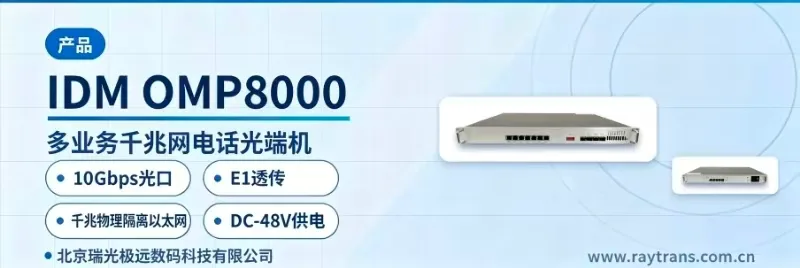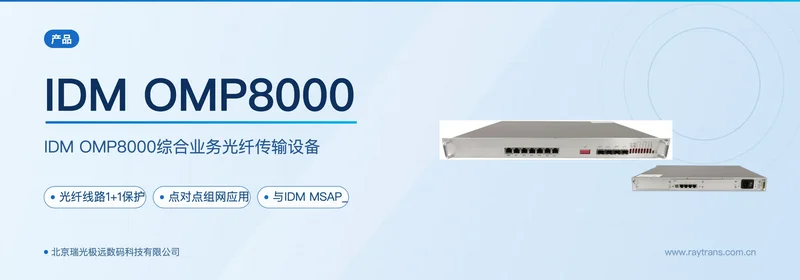
IDM OMP8000 Integrated Service Optical Fiber Transmission Equipment
1+1 Fiber Line Protection, Gigabit Network Telephone and Data Access, Point-to-Point Optical Fiber Networking
Integrated service optical fiber transmission equipment, supporting access for multiple services such as gigabit network, telephone and data, featuring a 1+1 fiber line protection function, and applicable to point-to-point networking and hybrid networking with IDM MSAP_G3CP.
The IDM OMP8000 integrated service optical fiber transmission equipment is a carrier-class optical multiplexing equipment introduced by Beijing Ruiguang Jiyuan Digital Technology Co., Ltd. It can carry gigabit Ethernet (GE), telephone and data services simultaneously over a pair of 2.5Gbps optical fibers and supports 1+1 fiber line protection. It can realize both point-to-point optical fiber networking and hybrid networking with IDM MSAP_G3CP, and is suitable for multi-service access scenarios in private networks such as electric power and transportation.
IDM OMP8000 Device Overview
The IDM OMP8000 integrated service optical fiber transmission equipment multiplexes gigabit Ethernet (GE), telephone and data services into a 2.5G optical channel and demultiplexes and restores them at the opposite end, so that transparent interconnection of broadband, voice and leased-line services is completed over a pair of optical fibers. The optical interface of the device uses pluggable SFP modules, the fiber mode is single-mode (multi-mode optional), the optical port rate is 2.5Gbps, the wavelength covers 1310/1490/1550 nm, the transmit optical power is -1~-10 dB, and the receiver sensitivity is better than -24 dBm, so optical modules can be configured according to the actual fiber distance. The unit adopts a modular design based on functional modules, which facilitates capacity expansion and maintenance. Indicator LEDs and SFP optical ports are arranged together on the front panel, as shown in the figure below.
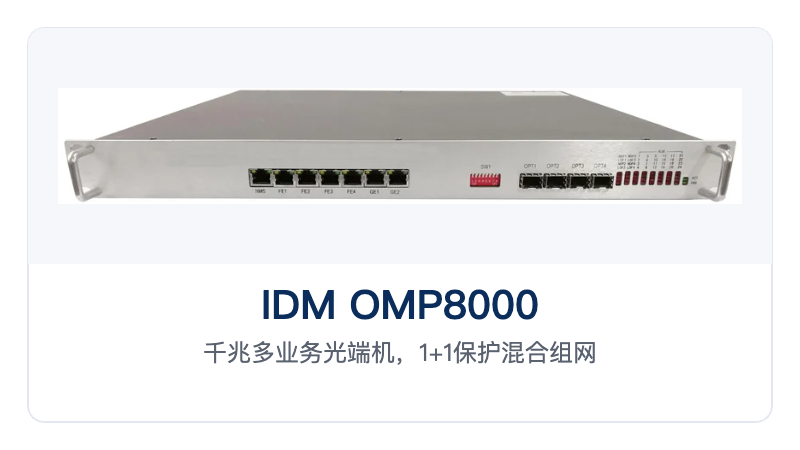
Figure 1: Front Panel of the IDM OMP8000 Integrated Service Optical Fiber Transmission Equipment (Enclosure Indicator LEDs and SFP Optical Port Layout)
As a device at the customer-side access layer, the IDM OMP8000 can either form a point-to-point network independently or work in hybrid networking with IDM MSAP_G3CP, connecting the broadband, voice and data services of dispersed sites to the upper-level network in a unified way. It is typically deployed at the edge of data communication networks.
IDM OMP8000 Core Functions
The IDM OMP8000 completes the multiplexing and transmission of gigabit Ethernet (GE), telephone and data services on the same platform and provides 1+1 fiber line protection. Its core functions are shown in the table below.
Function | Description |
|---|---|
1+1 Fiber Line Protection | Supports 1+1 fiber line protection; when a line abnormality occurs on the active line, automatic switchover to the standby line improves service continuity |
Point-to-Point Networking Application | One device is deployed at each of the two ends and interconnected with a pair of optical fibers, transmitting gigabit Ethernet (GE), telephone and data services at the same time |
Hybrid Networking Application with IDM MSAP_G3CP | Works in hybrid networking with IDM MSAP_G3CP to aggregate the services of dispersed sites into the upper-level network, realizing complex access networking |
Gigabit Ethernet Access | Rate 10M/100M/1000M adaptive, compliant with IEEE802.3, supporting full/half duplex and adaptive mode |
Telephone Service Access | Audio 300 Hz to 3400 Hz, A-law compression in ITU G.711, loop current 25 mA per channel |
Data Service Access | Supports leased-line services such as codirectional 64K, E&M 2/4-wire, magneto, V.24 and V.35 |
Network Management | Can be monitored and managed remotely together with the network management system (NMS); for the specific configuration, the manufacturer's documentation shall prevail |
IDM OMP8000 Technical Specifications
The technical specifications of the IDM OMP8000 are classified by optical interface, Ethernet interface, narrowband service interface, and power supply and environment. The electrical characteristics of each interface comply with standards such as IEEE802.3, ITU-T G.703, ITU G.711, CCITT V.28, ITU-T V.35 and ISO2593. Service interfaces and power supply terminals are arranged together on the rear panel of the device, as shown in the figure below.
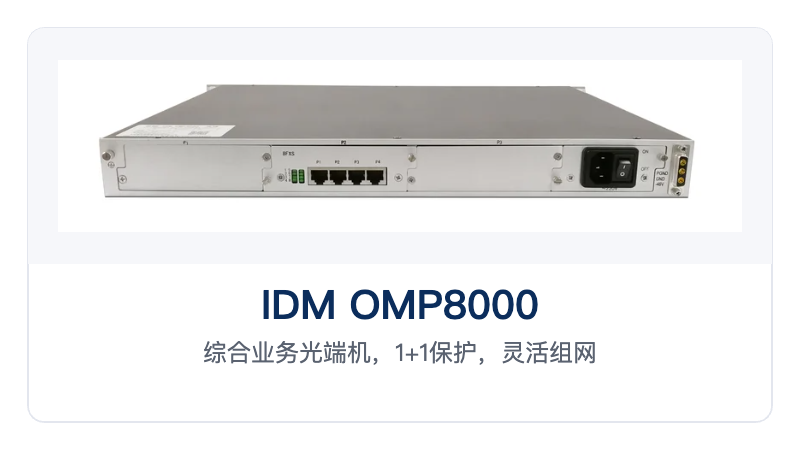
Figure 2: Rear Panel of the IDM OMP8000 Integrated Service Optical Fiber Transmission Equipment (Service Interface and Power Supply Terminal Layout)
Optical Interface Parameters
Item | Parameter/Specification | Description/Applicable Conditions |
|---|---|---|
Interface Type | SFP | Pluggable optical module, easy to replace according to distance |
Fiber Mode | Single-mode (multi-mode optional) | Single-mode is suitable for medium and long-distance transmission |
Optical Port Rate | 2.5Gbps | Rate of the integrated service optical channel |
Wavelength | 1310/1490/1550 nm | Optional according to the optical module and optical fiber type |
Transmit Optical Power | -1~-10 dB | Typical transmit specification of the optical module |
Receiver Sensitivity | Better than -24 dBm | Typical specification on the receive side |
Ethernet Interface Parameters
Item | Parameter/Specification | Description/Applicable Conditions |
|---|---|---|
Transmission Rate | 10M/100M/1000M | Determined through adaptive negotiation |
Standard Protocol | IEEE802.3 | Compliant with the Ethernet standard |
Operating Mode | Full-duplex/half-duplex/adaptive | Negotiated with the peer device |
Narrowband Service Interface Parameters
Interface | Parameter/Specification | Description/Applicable Conditions |
|---|---|---|
Telephone Interface | Audio 300 Hz to 3400 Hz, A-law in ITU G.711 | Impedance 200 Ω + 560 Ω // 0.1 μF, loop current 25 mA per channel |
Codirectional 64K Interface | G.703 standard, bit rate 64Kbps | Balanced impedance 120 Ω |
E&M 2/4-wire Interface | Audio 300 Hz to 3400 Hz, A-law compression | Impedance 600 Ω, return loss ≥18 dB |
Magneto Interface | Audio 300 Hz to 3400 Hz, A-law compression | Impedance 600 Ω, return loss ≥18 dB |
V.24 Interface | Asynchronous ≤9600bps; synchronous 64Kbps | Compliant with CCITT V.28 |
V.35 Interface | RJ-45 interface, n×64Kbps (n=0 to 31) | Compliant with ITU-T V.35, terminal interface ISO2593 |
Power Supply and Operating Environment
Item | Parameter/Specification | Description/Applicable Conditions |
|---|---|---|
Power Supply Mode | AC220V/DC-48V | AC or DC selectable |
Overall Power Consumption | ≤90 W | Typical power consumption at full configuration |
Operating Temperature | -20 °C to +50 °C | Operating environment range of the device |
Relative Humidity | 0 to 95% (non-condensing) | Environment free of condensed water |
Product Dimensions | 480 mm × 308 mm × 131 mm | 19-inch rack-mounted |
1+1 Fiber Line Protection Mechanism
1+1 fiber line protection means that two optical fiber lines, an active line and a standby line, are configured for the same link; when a failure occurs on the active line, services are automatically switched over to the standby line, reducing the risk of single-fiber interruption. The IDM OMP8000 supports 1+1 fiber line protection and, together with the 2.5Gbps SFP optical interfaces, forms a protected transmission link, which is an effective means of improving reliability in private network scenarios such as electric power and transportation. For the specific switchover mechanism, technical confirmation with the manufacturer is recommended.
IDM OMP8000 Typical Application Scenarios
Point-to-Point Optical Fiber Networking Application
Deploying one IDM OMP8000 at each of two sites and interconnecting them with a pair of optical fibers forms point-to-point optical fiber networking; gigabit Ethernet (GE), telephone and data services can be enabled at both ends at the same time, making it suitable for occasions where high bandwidth and multi-service direct transmission between sites are required. Services are multiplexed and transmitted over the 2.5G optical channel, and a single fiber carries broadband, voice and leased-line services at the same time, with no need for equipment stacking, so the networking is clear and maintenance is simple.
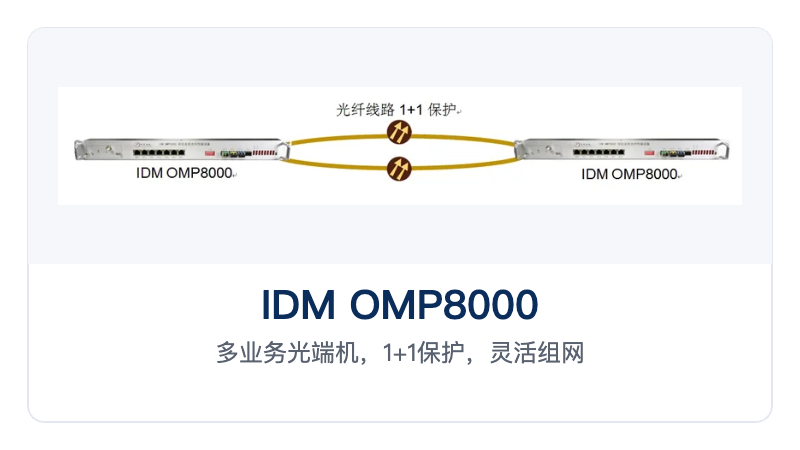
Figure 3: Point-to-Point Optical Fiber Networking Application Diagram of the IDM OMP8000
Hybrid Networking Application with IDM MSAP_G3CP
Hybrid networking between the IDM OMP8000 and IDM MSAP_G3CP is another important application mode. In hybrid networking, the IDM OMP8000 is deployed on the customer-side access and performs optical fiber aggregation of the gigabit Ethernet (GE), telephone and data services of dispersed sites to the IDM MSAP_G3CP side, which then connects them to the backbone network in a unified way; this is suitable for optical fiber transmission for electric power and transportation private networks that involve a large number of sites and complex service types.
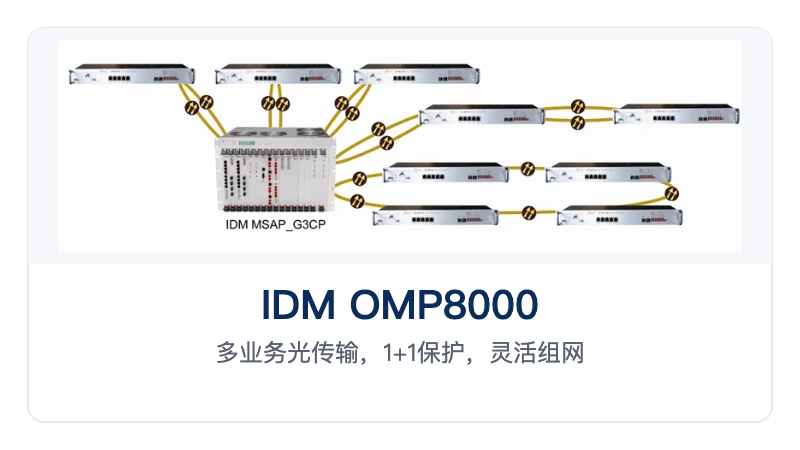
Figure 4: Hybrid Networking Application Diagram of the IDM OMP8000 with IDM MSAP_G3CP
Selection and Configuration Recommendations
When selecting the IDM OMP8000, the service cards can be determined according to the site service type: choose gigabit Ethernet boards for broadband-oriented sites, telephone cards for voice dispatching-oriented sites, and configure leased-line data according to interfaces such as V.24 and V.35. Optical modules are selected according to fiber distance and mode, and single-mode SFP covers 1310/1490/1550 nm; for long-distance lines it is recommended to confirm the link budget with the manufacturer. The power supply mode, AC220V or DC-48V, is selected according to equipment room conditions, and for multi-site deployment it is recommended to connect them to the network management system in a unified way. The differentiated selling points are not yet recorded in the knowledge base, so it is recommended to confirm with the manufacturer according to the project requirements.
Interface | Parameter/Specification | Description/Applicable Conditions |
|---|---|---|
Telephone Interface | Audio 300 Hz to 3400 Hz, A-law in ITU G.711 | Impedance 200 Ω + 560 Ω // 0.1 μF, loop current 25 mA per channel |
Codirectional 64K Interface | G.703 standard, bit rate 64Kbps | Balanced impedance 120 Ω |
E&M 2/4-wire Interface | Audio 300 Hz to 3400 Hz, A-law compression | Impedance 600 Ω, return loss ≥18 dB |
Magneto Interface | Audio 300 Hz to 3400 Hz, A-law compression | Impedance 600 Ω, return loss ≥18 dB |
V.24 Interface | Asynchronous ≤9600bps; synchronous 64Kbps | Compliant with CCITT V.28 |
V.35 Interface | RJ-45 interface, n×64Kbps (n=0 to 31) | Compliant with ITU-T V.35, terminal interface ISO2593 |
Power Supply and Operating Environment
Item | Parameter/Specification | Description/Applicable Conditions |
|---|---|---|
Power Supply Mode | AC220V/DC-48V | AC or DC selectable |
Overall Power Consumption | ≤90 W | Typical power consumption at full configuration |
Operating Temperature | -20 °C to +50 °C | Operating environment range of the device |
Relative Humidity | 0 to 95% (non-condensing) | Environment free of condensed water |
Product Dimensions | 480 mm × 308 mm × 131 mm | 19-inch rack-mounted |
1+1 Fiber Line Protection Mechanism
1+1 fiber line protection means that two optical fiber lines, an active line and a standby line, are configured for the same link; when a failure occurs on the active line, services are automatically switched over to the standby line, reducing the risk of single-fiber interruption. The IDM OMP8000 supports 1+1 fiber line protection and, together with the 2.5Gbps SFP optical interfaces, forms a protected transmission link, which is an effective means of improving reliability in private network scenarios such as electric power and transportation. For the specific switchover mechanism, technical confirmation with the manufacturer is recommended.
IDM OMP8000 Typical Application Scenarios
Point-to-Point Optical Fiber Networking Application
Deploying one IDM OMP8000 at each of two sites and interconnecting them with a pair of optical fibers forms point-to-point optical fiber networking; gigabit Ethernet (GE), telephone and data services can be enabled at both ends at the same time, making it suitable for occasions where high bandwidth and multi-service direct transmission between sites are required. Services are multiplexed and transmitted over the 2.5G optical channel, and a single fiber carries broadband, voice and leased-line services at the same time, with no need for equipment stacking, so the networking is clear and maintenance is simple.
Figure 3: Point-to-Point Optical Fiber Networking Application Diagram of the IDM OMP8000
Hybrid Networking Application with IDM MSAP_G3CP
Hybrid networking between the IDM OMP8000 and IDM MSAP_G3CP is another important application mode. In hybrid networking, the IDM OMP8000 is deployed on the customer-side access and performs optical fiber aggregation of the gigabit Ethernet (GE), telephone and data services of dispersed sites to the IDM MSAP_G3CP side, which then connects them to the backbone network in a unified way; this is suitable for optical fiber transmission for electric power and transportation private networks that involve a large number of sites and complex service types.
Figure 4: Hybrid Networking Application Diagram of the IDM OMP8000 with IDM MSAP_G3CP
Selection and Configuration Recommendations
When selecting the IDM OMP8000, the service cards can be determined according to the site service type: choose gigabit Ethernet boards for broadband-oriented sites, telephone cards for voice dispatching-oriented sites, and configure leased-line data according to interfaces such as V.24 and V.35. Optical modules are selected according to fiber distance and mode, and single-mode SFP covers 1310/1490/1550 nm; for long-distance lines it is recommended to confirm the link budget with the manufacturer. The power supply mode, AC220V or DC-48V, is selected according to equipment room conditions, and for multi-site deployment it is recommended to connect them to the network management system in a unified way. The differentiated selling points are not yet recorded in the knowledge base, so it is recommended to confirm with the manufacturer according to the project requirements.