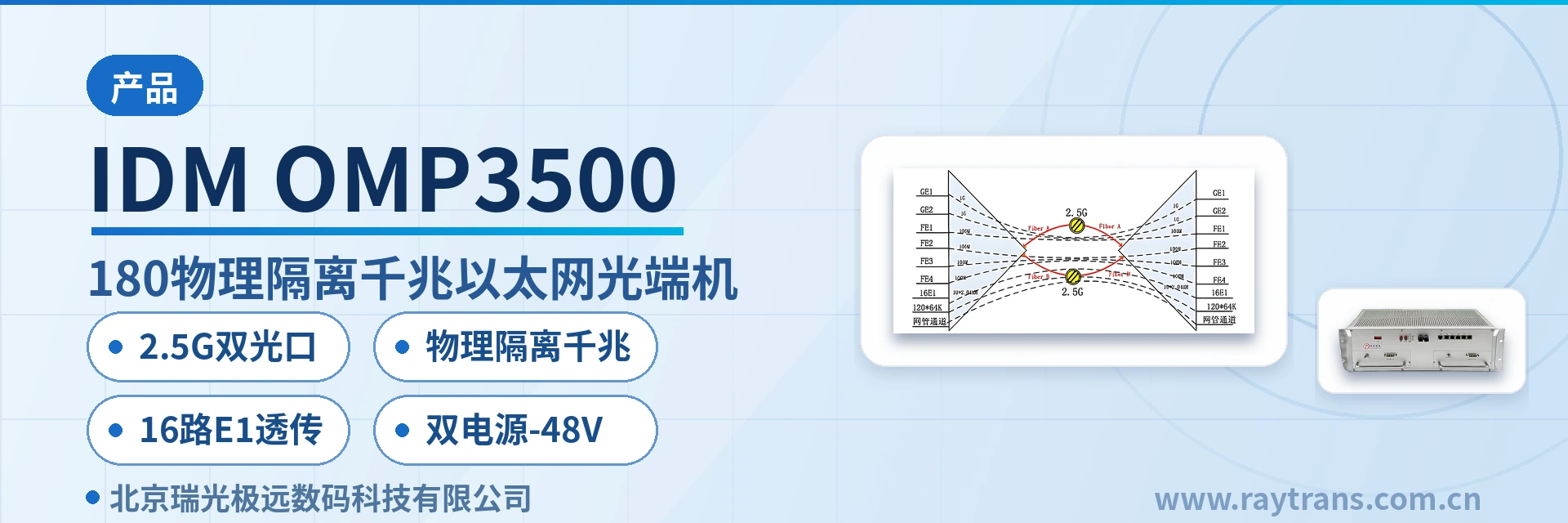
IDM OMP3500-180 Physically Isolated Optical Multiplexer
2.5G dual optical port, ring network self-healing, 6 physically isolated gigabit and Fast Ethernet ports, 16 E1, supports 120 voice channels
Provides two 2.5G optical interfaces (A and B), up to 2 physically isolated wire-speed gigabit Ethernet interfaces, 4 physically isolated wire-speed Fast Ethernet interfaces, and 16 E1 interfaces. It also supports various 64 kbit/s services including FXS/FXO, V.35/V.24, hotline, and magneto, and can access video signals, making it easy to build a video surveillance system.
A 2.5G dual-optical-port ring network self-healing optical multiplexer is a type of multi-service optical fiber transmission equipment that provides physically isolated channels for multiple types of services over the same 2.5G optical fiber and forms a self-healing ring network through optical ports A and B. As a professional optical multiplexer product showcase, the IDM OMP3500-180 2.5G dual-optical-port ring network self-healing optical multiplexer is developed by Raytrans, with PDH, Ethernet and PCM technologies at its core. Its technical performance complies with ITU-T, IEEE and other international standards, and it is used as a service access device at the customer-side access layer of a data communication network.
The IDM OMP3500-180 provides two 2.5G optical interfaces (A and B), up to 2 physically isolated wire-speed gigabit Ethernet interfaces and 4 physically isolated wire-speed Fast Ethernet interfaces, and up to 16 E1 interfaces. It also supports a variety of 64 kbit/s services including FXS/FXO, V.35/V.24, hotline and magneto, and can also access video signals, making it easy to build a video surveillance system. This multi-service optical multiplexer can be used to build point-to-point and point-to-multipoint chain and ring transmission networks, serving sectors such as electric power, transportation and energy. As a capable optical multiplexer manufacturer, Raytrans offers a series of products including telephone optical multiplexers, PDH optical multiplexers and gigabit network optical multiplexers, which are widely used in government private network optical fiber communication solutions and smart mining communication solutions.
Key Specifications at a Glance: 2.5G dual optical ports · Physically isolated gigabit · 16-channel E1 transparent transmission · Dual power supply -48V · Up to 120-channel PCM telephone · 3U card-based 17 slots
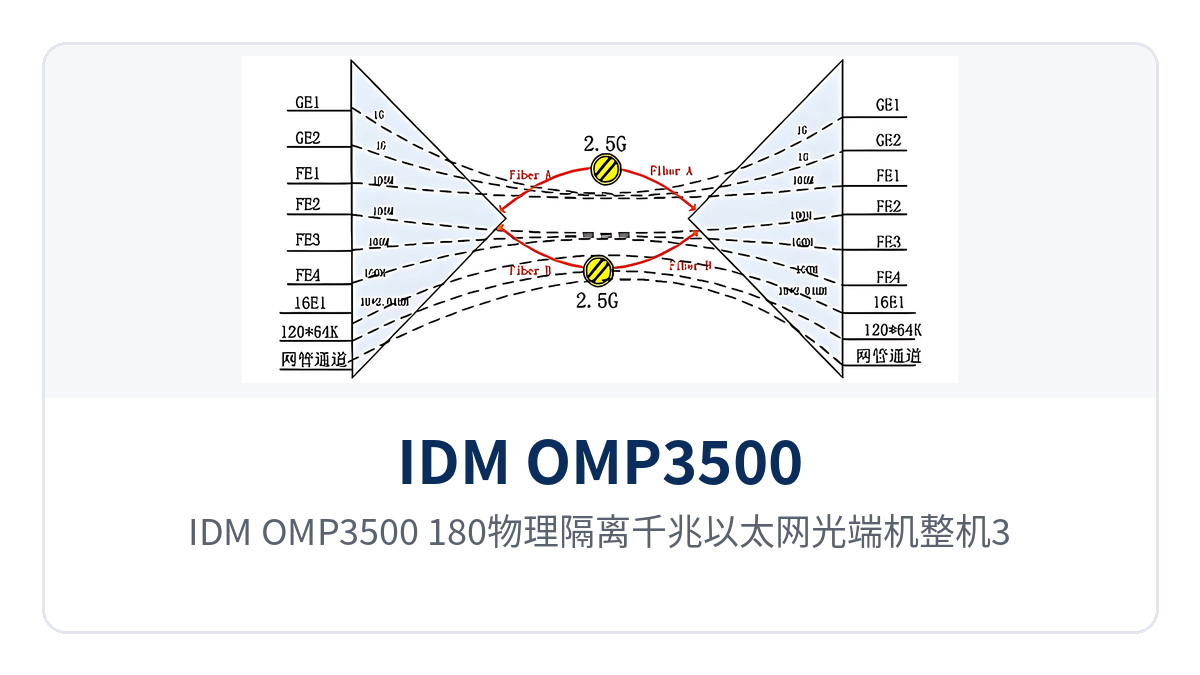
Figure 1: Overall 3U chassis appearance and service slots of the IDM OMP3500-180 physically isolated gigabit Ethernet optical multiplexer
What Kind of Device Is a 2.5G Dual-Optical-Port Ring Network Self-Healing Optical Multiplexer?
A 2.5G dual-optical-port ring network self-healing optical multiplexer refers to multi-service optical fiber transmission equipment that forms a self-healing ring network with two 2.5G SFP optical ports and provides mutually isolated channels for Ethernet, E1 and narrowband telephone services over the same optical fiber. The IDM OMP3500-180 is a specific model in this category, with the official full name IDM OMP3500-180 physically isolated gigabit Ethernet optical multiplexer. It adopts a functional modular design and provides service monitoring, access, protection and network management capabilities. As a typical multi-service optical multiplexer, it integrates multiple service access capabilities such as Ethernet, E1 and narrowband PCM on the same platform, and is also one of the representative products that the optical multiplexer manufacturer Raytrans has launched for the private network market.
The IDM OMP3500-180 adopts a 19-inch standard 3U card-based enclosure and provides 17 service slots. Different quantities and types of service cards and plug-in cards can be configured according to actual needs, which reduces initial investment and facilitates future capacity expansion, upgrade and maintenance. The card-based structure works together with the dual power supply design, so that the equipment room does not need to replace the entire device during capacity expansion or power supply upgrade.
How Optical Ports A and B Form a Self-Healing Ring Network
Optical ports A and B of the IDM OMP3500-180 operate at the same rate and can be connected to the two directions of the ring network respectively. Under normal conditions, services are transmitted to the opposite end along the main direction. When a section of optical fiber or a node in the ring network is interrupted, services are switched over between optical ports A and B and no longer pass through the failed section, thereby maintaining communication without adding extra equipment. The two optical ports can also form 1+1 protection, with one channel working and the other on standby, which is suitable for the private network access layer with clear requirements on link reliability, such as the backbone access links in government private network optical fiber communication solutions and smart mining communication solutions.
Core Functions and Key Parameters
The main functions of the IDM OMP3500-180 cover seven aspects: optical fiber transmission, Ethernet access, E1 transparent transmission, narrowband PCM access, video expansion, network management and power supply, as shown in the table below.
Function | Description |
|---|---|
2.5G optical fiber transmission | Provides two SFP 2.5G optical interfaces (A and B) at 2.5Gbps, and can build point-to-point, chain network, ring network or 1+1 protection networks |
Ethernet access | Supports 2 groups of physically isolated wire-speed gigabit Ethernet and 4 groups of physically isolated wire-speed 100M Ethernet |
16 groups of E1 transparent transmission | Provides up to 16 groups of E1 transparent transmission, can connect 480 channels of 64 kbit/s services, and the E1 interface complies with ITU-T G.703 |
Narrowband PCM access | The unit provides up to 120 channels of PCM service access capability, and supports service cards such as FXS/FXO, magneto, E&M and RS232/RS422/RS485 |
Video expansion | Supports HDMI high-definition (HD) video interfaces as well as video surveillance and video conferencing boards |
Network management | Supports SNMP network management and can connect to the Netguard hierarchical network management system |
Power supply mode | Supports DC-48V and AC220V dual power supply, with overall power consumption ≤90W |
On the Ethernet side, the 2 groups of wire-speed Fast Ethernet can be expanded through the rear 8-port Ethernet switching card to increase the number of access ports. On the narrowband side, FXS/FXO and magneto cards each provide 10 or 8 telephone interfaces, E&M 2/4-wire cards provide 4 each, RS232/RS422/RS485 provides 8 each, and the USER universal interface card can be mixed with 4 PCM service modules. PCM services can also be configured for mutual backup between optical fiber transmission and the PCM service on the first E1 channel, giving telephone services an extra layer of protection. For scenarios requiring telephone optical multiplexer functions, the device can directly connect analog telephones through FXS/FXO service cards, achieving unified bearing of voice and data on the same optical multiplexer platform.
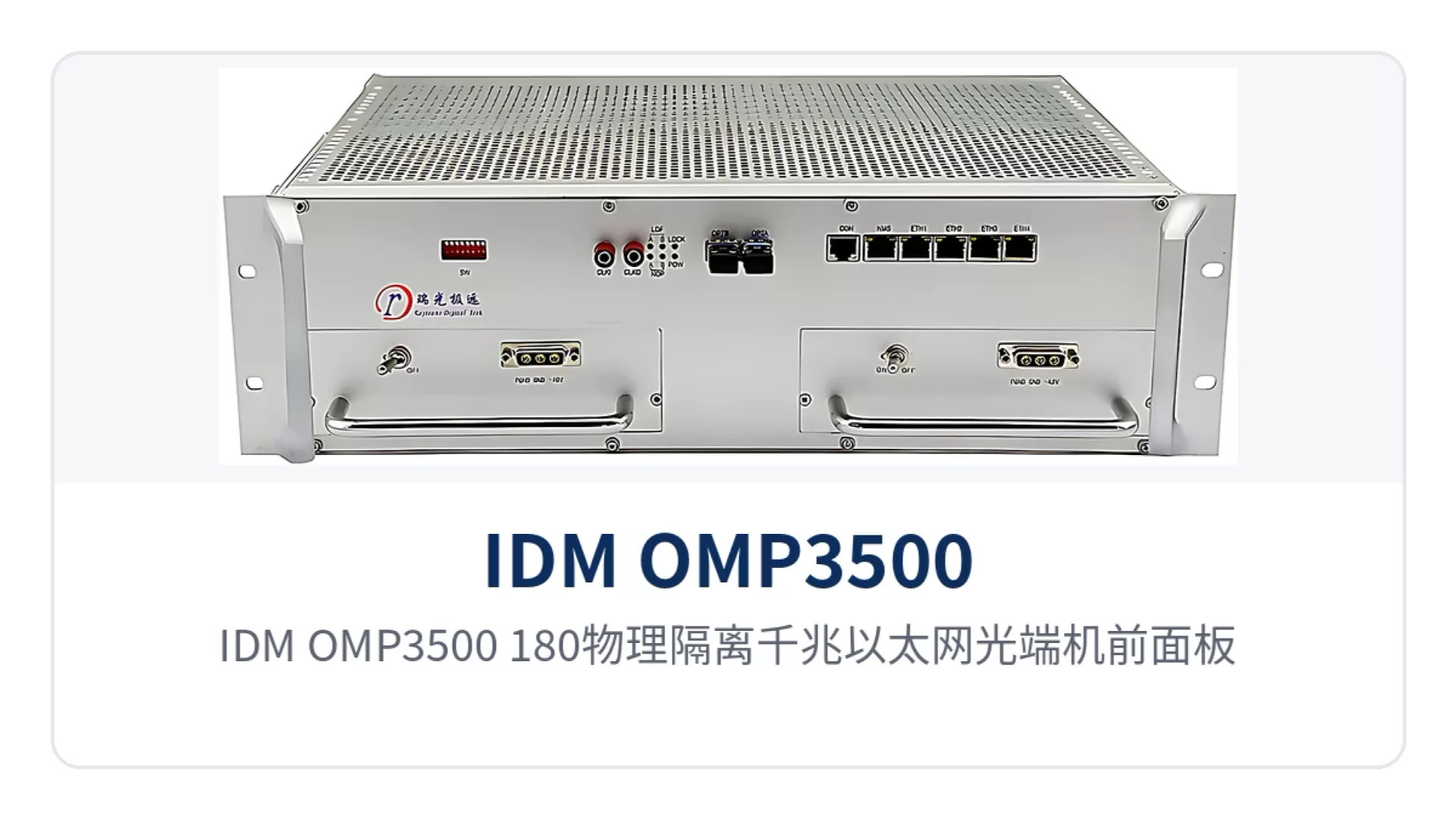
Figure 2: Close-up of the front panel indicator LEDs and dual 2.5G SFP optical ports of the IDM OMP3500-180 physically isolated gigabit Ethernet optical multiplexer
Optical Interface and Ethernet Interface Parameters
Item | Parameter/Specification | Description/Applicable Conditions |
|---|---|---|
Optical interface type | SFP | Pluggable optical module, easy to replace according to transmission distance |
Fiber mode | Single-mode (multi-mode optional) | Single-mode fiber is suitable for medium and long-distance transmission |
Optical port rate | 2.5Gbps | Both optical ports A and B support it |
Wavelength | 1310/1490/1550 | Optional according to optical module and fiber type |
Transmit optical power | -1~-10dB | Typical transmit specification of the optical module |
Receiver sensitivity | Better than -24dBm | Typical specification on the receive side |
Ethernet transmission rate | 10M or 100M or 1000M | Supports IEEE802.3 |
Ethernet operating mode | Full/half duplex/adaptive | Negotiated with the opposite-end equipment |
E1 and Narrowband Service Interface Parameters
Item | Parameter/Specification | Description/Applicable Conditions |
|---|---|---|
E1 bit rate | 2.048Mbps | Line coding HDB3, compliant with ITU-T G.703 |
E1 interface impedance | 75Ω/120Ω | 75 Ω coaxial or 120 Ω balanced, selectable |
E1 frame structure | PCM30/31 | Transparent transmission mode, transparent to upper-layer protocols |
FXO/FXS audio | 300Hz~3400Hz | Compression: ITU G.711 A-law, three-element complex impedance 200Ω+560Ω//0.1μF, loop current 25mA per channel |
Codirectional 64K interface | 64Kbps | Line coding per G.703 standard, balanced 120Ω, compliant with ITU G.703 recommendation |
E&M 2/4-wire interface | 300Hz~3400Hz | Balanced 600 Ω, return loss no less than 18 dB |
Magneto interface | 300Hz~3400Hz | Balanced 600 Ω, compression: ITU G.711 A-law |
Data Interface, Power Supply and Environmental Parameters
Item | Parameter/Specification | Description/Applicable Conditions |
|---|---|---|
V.24 data interface | Asynchronous ≤9600bps; synchronous 64Kbps | Electrical characteristics compliant with CCITT V.28 protocol |
V.35 data interface | n×64Kbps (n=0~31) | Interface type RJ-45, terminal interface compliant with ISO2593 |
Power supply mode | AC220V/DC-48V | Dual power supply, selectable according to on-site conditions |
Overall power consumption | ≤90W | Typical power consumption at full configuration |
Operating temperature | -20℃~+50℃ | Indoor rack environment |
Relative humidity | 0~95% (non-condensing) | Equipment room environment free of condensed water |
Product dimensions | 480mm×308mm×131mm | 19-inch 3U rack-mounted installation |
How Do Ring Network Self-Healing and 1+1 Protection Keep Private Network Services Uninterrupted?
Ring network self-healing and 1+1 protection solve the same problem: when an optical fiber or optical module fails, services must not stop on the failed segment. The IDM OMP3500-180 provides 2.5G dual optical port ring network/1+1 protection capability, and ports A/B can form a self-healing private network—connecting sites along the line into a ring, so that when any site or any fiber segment is interrupted, services are automatically rerouted to the other side; with 1+1 protection, the primary and backup channels exist simultaneously, switchover is performed by the equipment itself, and the impact of link failure on services is controllable. In a government private network optical fiber communication solution, this self-healing capability effectively ensures the continuity of cross-department service channels; in a smart mining communication solution, it ensures that voice, data and video transmission between underground and surface is not interrupted by a single point of failure.
The IDM OMP3500-180 can form point-to-point, chain network, ring network or 1+1 protection networks. Its optical ports use a pluggable SFP design, with wavelengths covering 1310/1490/1550nm, so different transmission distances can be adapted by replacing the optical module. In engineering practice, it is recommended to reserve independent fiber routes on both sides of the ring and avoid the same conduit or the same pole route, so that the reliability of ring network and 1+1 protection can truly be achieved.
How to Build a Ring Network with 1+1 Protection
How to build a ring network with 1+1 protection usually falls into three cases according to site distribution and optical fiber resources. For railways and expressways with sites distributed in a belt, it is suitable to form a ring from end to end and connect sites one by one, with one fiber core going east and one going west; for point-to-point scenarios with few sites and short distances, ports A/B can directly form 1+1 protection, with the two routes each using one core; for scenarios with sites divided into areas and cross-region aggregation, hybrid networking of ring network plus chain network can be used, first forming rings in each area and then tandem-connecting through the central station. All three methods share the same SNMP network management, with a unified O&M interface.
How Are 2 Groups of Gigabit and 4 Groups of Fast Ethernet Physically Isolated in One Device?
Physical isolation means that different Ethernet channels are independent within the device and do not share bandwidth or packets. As a professional optical multiplexer manufacturer, Raytrans offers the IDM OMP3500-180 multi-service optical multiplexer, which uses a channel structure of 2 groups of gigabit plus 4 groups of Fast Ethernet physical isolation, making 2 physically isolated wire-speed gigabit Ethernet (GE) interfaces and 4 physically isolated wire-speed 100M Ethernet interfaces into mutually independent wire-speed channels, each enjoying dedicated bandwidth with no packet forwarding across channels, so that different networks such as the office network, video surveillance network and production control network can be carried on independent channels. In the product showcase, this gigabit network optical multiplexer, with its outstanding physical isolation capability, has become an ideal access device in government private network optical fiber communication solutions and smart mining communication solutions.
Compared with dividing VLANs at the software layer on a switch, physical isolation is performed at the hardware layer, does not depend on VLAN configuration, and reduces the possibility of packet cross-network leakage caused by configuration errors. One optical multiplexer can support access for multiple security domains, reducing the number of devices in the equipment room, while making network boundaries clear and service mutual access restricted, achieving both security and wire-speed.
How Does 16-Channel E1 Transparent Transmission Support Existing Private Network Services?
16-channel E1 transparent transmission supporting 480 channels of 64K is the main way the IDM OMP3500-180, a PDH optical multiplexer, supports existing private network services. The device provides up to 16 E1 transparent transmission channels, each with an E1 bit rate of 2.048Mbps, line coding HDB3, frame structure PCM30/31, and interface impedance of 75Ω/120Ω selectable, compliant with ITU-T G.703; one E1 carries 30 64K time slots per PCM30/31, and 16 channels together can support 480 channels of 64K services.
In transparent transmission mode, the E1 channel is transparent to upper-layer protocols, so existing dispatch telephone, telecontrol data and 2M dedicated line services can be directly connected without replacing the original equipment at either end, and the numbering and signaling configuration of the existing private network remain unchanged. Such channels are often transmitted together with 4 groups of physically isolated wire-speed 100M Ethernet and up to 120 channels of PCM telephone services over a single optical fiber, forming an integrated access solution compatible with existing private network services, fully demonstrating Raytrans's technical accumulation in the field of multi-service optical multiplexers.
Typical Application Scenarios
Electric Power and Energy Private Network
In the power dispatch data network and the private network of energy plants, the IDM OMP3500-180 transmits dispatch data, voice and telecontrol signals over the same pair of optical fibers, and uses physically isolated channels to carry the dispatch data network, the production control network and the management information network separately, with no mutual access between services. The two 2.5G optical ports, A and B, support ring networking or 1+1 protection; when a section of optical fiber is interrupted, services are rerouted or switched over, meeting the power system's requirements for communication isolation and real-time performance. This is a typical application of a government private network optical fiber communication solution.
Rail Transit and Expressway Monitoring
At communication stations and monitoring points along railways and expressways, the IDM OMP3500-180 is connected site by site in a chain network or ring network. One group of gigabit channels backhauls video surveillance, one group of Fast Ethernet channels carries toll or office data, and E1 channels carry dispatch telephone services, so sites along the line do not need to deploy separate equipment for each type of service. Ring network self-healing keeps video and telephone services running when a station or a section of optical cable fails, making it suitable for scenarios with distributed sites that require site-by-site data backhaul.
Military and Government Classified Private Networks
In classified private networks such as those of the military and government, which have explicit requirements for security domains, the IDM OMP3500-180 uses 2 groups of gigabit and 4 groups of Fast Ethernet physically isolated channels to carry networks for different purposes. Isolation is implemented at the hardware level, packets are not forwarded across channels, and network boundaries are clear. The unit supports dual power supply at -48V, with AC220V optional; a failure of one power feed does not affect services. SNMP network management can connect to the Netguard hierarchical network management system, facilitating unified O&M across multiple sites.
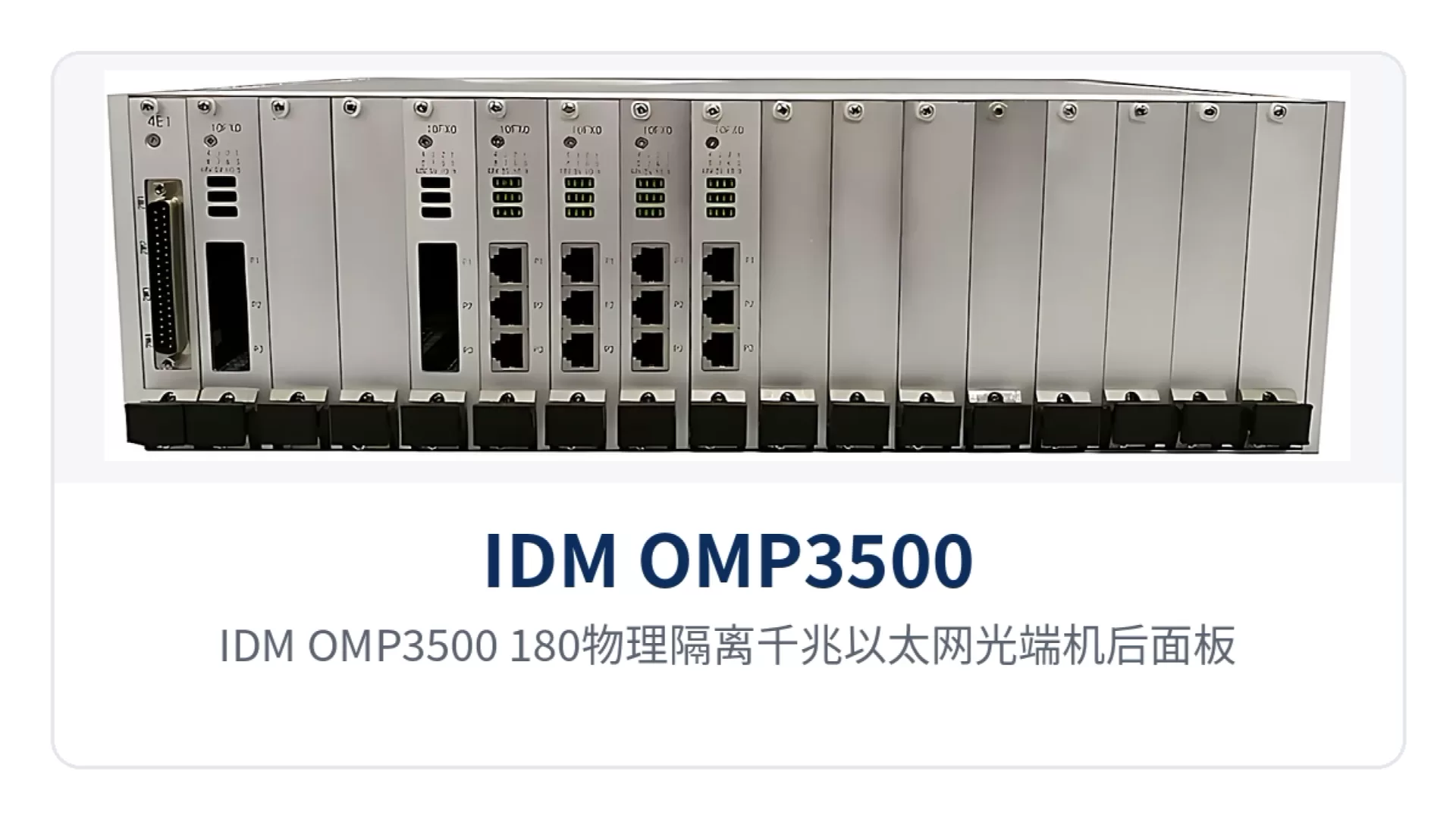
Figure 3: Rear panel of the IDM OMP3500-180 physically isolated gigabit Ethernet optical multiplexer, showing physically isolated Ethernet ports and E1 service interfaces
Selection and Networking Recommendations
During selection, first determine the topology, then the optical modules and service cards, and finally check the power supply and network management:
Topology: for point-to-point, select a pair of devices; for site-by-site backhaul along a line, select a chain network or ring network; for sections with high reliability requirements, use the two optical ports A and B for 1+1 protection.
Optical modules: single-mode is selected by default, and the wavelength among 1310/1490/1550nm is selected according to the fiber core and transmission distance; for lines with many spans, first calculate the transmit optical power and receiver sensitivity margin.
Service cards: configure FXS/FXO, magneto, E&M, RS232/RS422/RS485 and other service cards according to the number of voice channels, serial ports and E1 channels on site. Configure as required initially, and expand by inserting cards later.
Power supply: if the equipment room has -48V direct current, DC-48V can be selected; if it has alternating current, AC220V can be selected. For important sites, it is recommended to connect both feeds at the same time.
Network management: sites that require centralized monitoring are connected to the Netguard network management system to view alarms and operating status in a unified way.
Conclusion
The IDM OMP3500-180 2.5G dual-optical-port ring network self-healing optical multiplexer uses the two 2.5G optical ports A and B to form a ring network or 1+1 protection, and simultaneously carries over a single optical fiber 2 groups of physically isolated wire-speed gigabit Ethernet, 4 groups of physically isolated wire-speed Fast Ethernet, 16 channels of E1 transparent transmission and up to 120 channels of PCM telephone. With dual power supply at -48V and AC220V, it is suited to access-layer networking for electric power and energy private networks, rail transit and expressway monitoring, and military and government classified private networks. As a multi-service optical multiplexer product under Raytrans, the device is widely used in government private network optical fiber communication solutions and smart mining communication solutions. For specific configurations, please refer to the manufacturer's technical documentation and commercial confirmation.