IDM OMP2400
IDM OMP2400
The IDM OMP2400-4E1-30E Ultra-Broadband Integrated Service Optical Fiber Multiplexer utilizes 2.5G optical fiber transmission bandwidth (G.703 standard) and adopts PCM30/31 format. The IDM OMP2400-4E1-30E physically isolated Gigabit Ethernet optical multiplexer is easy to install and can meet the requirements of various application environments.
1. Overview
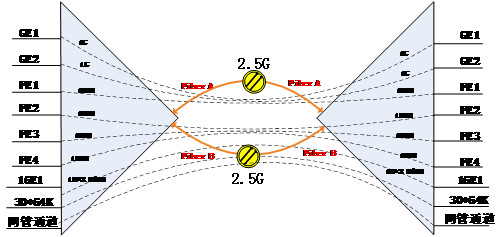
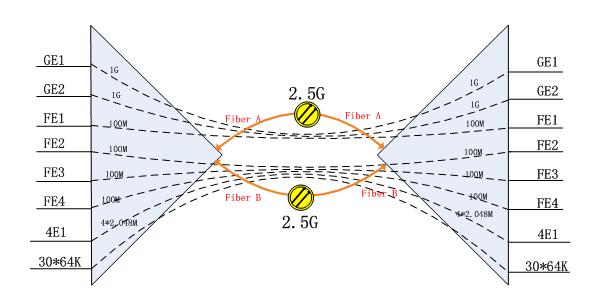
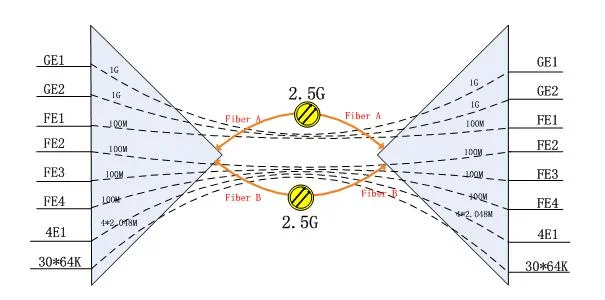
The IDM OMP2400-4E1-30E Ultra-Broadband Integrated Service Optical Multiplexer utilizes 2.5G optical transmission bandwidth (G.703 standard) with PCM30/31 format, providing dual-fiber mutual backup, direct telephone service interfaces (30 channels of FXO, FXS, or Magneto), 4 groups of physically isolated wire-speed 100M Ethernet (400M total), 2 groups of physically isolated wire-speed 1000M Ethernet (2000M total), E1 (1-4 E1 channels), HDMI HD video transmission, and various other user interfaces. Meanwhile, the device features easy installation and is suitable for various application environments.
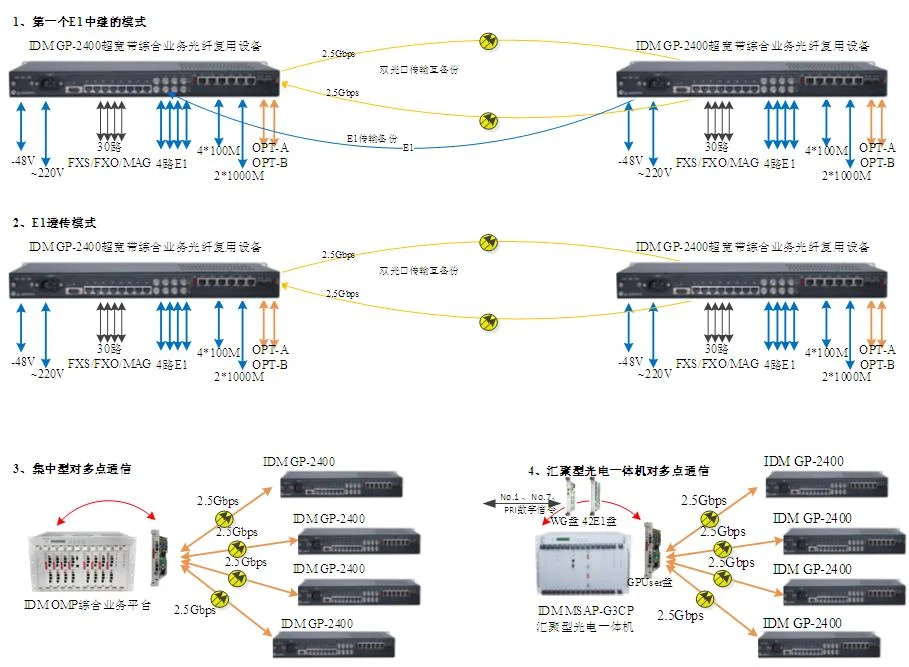
It provides dual-fiber mutual backup and can also be combined with other devices to form multiple physically isolated Ethernet chain telephone optical terminals, ring network telephone optical terminals, and point-to-multipoint star network telephone optical terminals.


2. Product Features
Ø Standard 19-inch 1U chassis design for easy installation;
Ø Provides 2 2.5Gbps SFP optical interfaces with optical port 1+1 protection;
Ø Provides 30 standard-defined telephone interfaces;
Ø Provides 2 independent wire-speed 1000M Ethernet interfaces;
Ø Provides 4 independent wire-speed 100M Ethernet interfaces;
Ø Provides 4 groups of E1 interfaces supporting transparent transmission mode;
Ø Provides standard SNMP network management interface;
Ø Equipped with comprehensive function control switches and alarm indication functions.
3. Technical Specifications
Optical Interface
Interface Type | SFP | Fiber Mode | Single-mode (Multi-mode optional) |
Fiber Rate | 2.5Gbps | Wavelength | 1310nm/1550nm |
Transmit Power | -1~-3dBm | Receiver Sensitivity | Better than -24dBm |
E1 Interface
Line Rate | 2048Kbps | Line Code | HDB3 |
Standard Protocol | ITU-T G.703 | Impedance | 75Ω/120Ω |
Frame Structure | PCM30/31 | Mode | Transparent |
Ethernet
Interface Type | RJ45 | Transmission Rate | 10M/100M/1000M |
Standard Protocol | IEEE802.3 | Operation Mode | Full/Half Duplex/Auto-negotiation |
FXO/FXS Interface
Audio Range | 300Hz~3400Hz | Impedance | Triple complex impedance 200Ω+560Ω//0.1μF |
Compression Rate | A-law per ITU G.711 | Loop Current | 25mA/channel |
Power Supply & Consumption
Power Supply | DC-48V /AC 220V/Dual Power | Power Consumption | ≤100W |
Environmental Conditions
Operating Temperature | 0ºC~40ºC | Humidity | ≤90% (non-condensing) |
4. Application Example
FAQs
What is an E1 line? What are the core knowledge points?
E1 Basics Frame Structure of the E1 Channel In an E1 channel, 8 bits form one timeslot (TS)…
View answerWhat is E1? How to Use E1
What is E1 The European 30-channel pulse code modulation PCM is abbreviated as E1, with a rate of 2.048Mbit/s.
View answerCommunication Transmission Products
PDH Equipment Physically Isolated Gigabit Multi-service Optical Terminal IDM GP2400 Series Optical Terminal IDM…
View answerIntroduction to EoPDH Technology
Ethernet-over-PDH is a set of technologies and standards used to transport local Ethernet frames over established…
View answerPrinciples and Application Scenarios of PDH Optical Terminal Equipment
Optical terminal equipment consists of a transmitter and a receiver. The transmitter amplifies, converts (A/D)…
View answer