
IDM NTD421
IDM NTD421
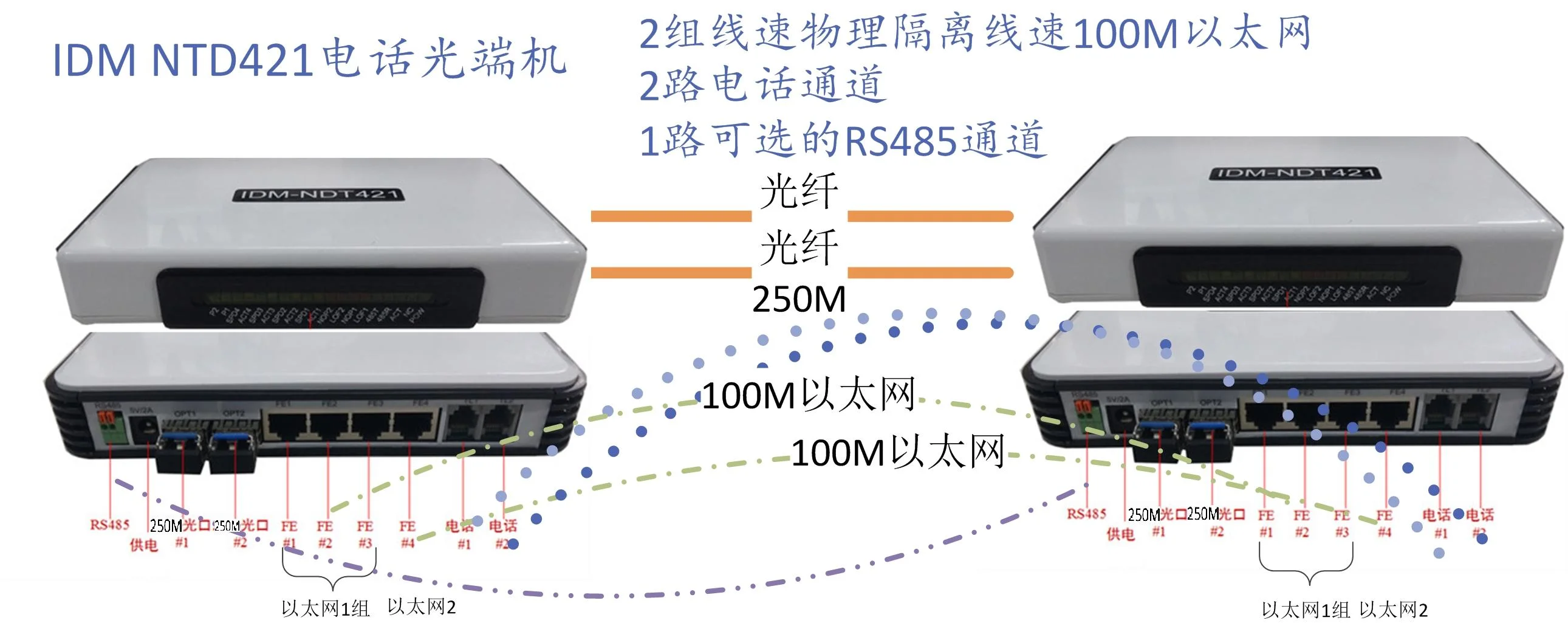
The IDM NTD421 multi-service optical multiplexer provides a 250M optical interface, offering 2 telephone channels and 2 groups of physically isolated 100M Ethernet ports, where ports 1, 2, 3 and the fourth port are physically isolated, with 220V power supply. The IDM NTD421 multi-service optical multiplexer can be used in point-to-point applications, with dual optical ports for mutual backup. It provides a standard SNMP network management interface.
I. Overview
The IDM NTD421 dual-channel Telephone Optical Terminal is a new-generation optoelectronic integrated transmission device developed by our company, based on high-speed fiber optic transmission technology and PCM technology. It integrates Ethernet transmission and PCM multi-service access functions, meeting the demands of users for fiber optic transmission and access of both broadband and narrowband multi-services.
The IDM NTD421 is a fiber access device with multiple configurations. It provides fiber optic multiplexing of Ethernet, telephone, and serial ports, and can interoperate with IDM MP200 series optical interface devices.
The fiber optic interface rate of the IDM NTD421 is 150M, providing 1 wire-speed 100M Ethernet port.
The IDM NTD421-MP200S provides two physically isolated Ethernet channels, where interfaces 1, 2, and 3 share one wire-speed 100M Ethernet port, which can be isolated via VLAN partitioning. The 4th Ethernet group is physically isolated, providing a dedicated 100M bandwidth Ethernet port.
The fiber optic interface rate of the IDM NTD421-MP200 is 250M, providing 2 wire-speed 100M Ethernet channels, and can also provide transmission channels equivalent to 18 E1 bandwidths.
The IDM NTD421 provides up to two groups of fiber optic interfaces on the line transmission interface, forming mutual backup optical ports, or chain networks, ring networks, etc.
On the user interface, it provides 4 groups of Ethernet interfaces, 2 telephone channels (CO-side, RT-side, magneto, 2-wire audio), 2 RS485 channels or 1 RS422 channel. The Ethernet interfaces can be configured in physically isolated or VLAN isolated modes.
It can be widely applied in private networks such as public security, electric power, railway, and mining, as well as public networks of mobile, Unicom, telecom operators, etc.
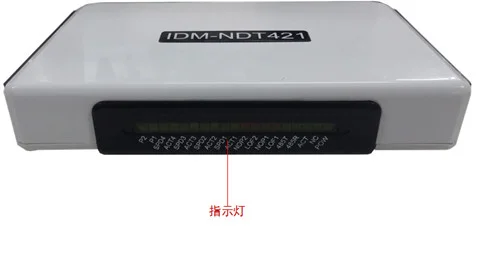
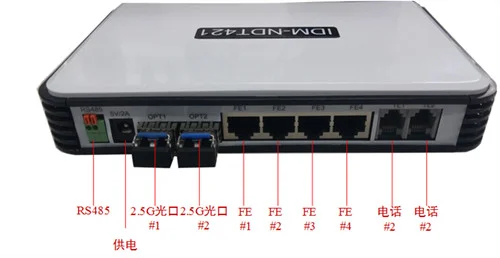
IDM NTD421 Optical Terminal Front Panel IDM NTD421 Optical Terminal Rear Panel
II. Device Operating Principle
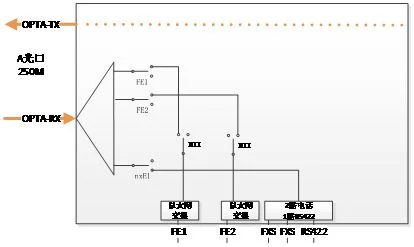
Single Optical Port Device Operating Principle
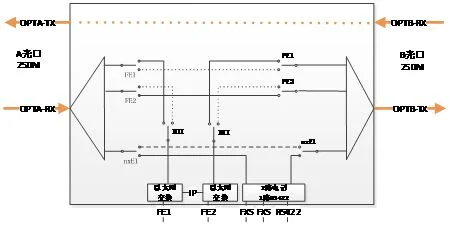
Dual Optical Port Optical Terminal Device Operating Principle
III. Product Features
Ø Dual physically isolated wire-speed 100M Ethernet channels;
Ø The 3 shared 100M Ethernet ports can also be isolated via VLAN partitioning;
Ø Voice interfaces can be FXO CO-side automatic telephone, FXS RT-side automatic telephone, or MAG magneto telephone;
Ø 1 optional RS485 data channel;
Ø Optical ports are SFP interfaces, allowing optical modules to be configured as required;
Ø Can be customized with dual optical ports to form a chain network.
IV. Single Optical Port Device Functions and Applications
Ø Functions
u Point-to-point general-purpose Telephone Optical Terminal diagram
u Point-to-point magneto Telephone Optical Terminal
u Point-to-point elevator five-party intercom Telephone Optical Terminal
u Includes point-to-multipoint central office equipment
Ø Applications:
u Fiber to the office, physical isolation between internal and external networks;
u Public security checkpoint information point construction
u Shielded room communication
u Armed police and public security guard booths
u Community and factory information point construction
V. Dual Optical Port Device Functions and Applications
Ø Functions
u Dual optical port chain network Telephone Optical Terminal interface annotation diagram
u Chain network topology diagram with IDM MP200-30E
Ø Applications
u Tunnel construction applications
u River monitoring and management
VI. Technical Specifications
1) Optical Interface
Interface Type | FC | Fiber Mode | Single-mode(Multi-mode optional) |
Tx/Rx Rate | 250M/250M | Tx/Rx Wavelength | 1310nm/1550nm |
Optical Output Power | -12~-6dBm | Receiver Sensitivity | Better than-18dBm |
Transmission Distance | |||
2) Ethernet
Interface Type | RJ-45 | Transmission Rate | 10M/100M/1000Mauto-negotiation |
Standard Protocol | SupportsIEEE802.3 | Operating Mode | Full/Half Duplex/Auto-Negotiation |
3) FXO, FXS Interfaces
Audio Range | 300Hz~3400Hz | Compression Rate | A-law per ITU G.711 |
Impedance | Three-element compound impedance200Ω+560Ω//0.1μF | Loop Current | 20mA/channel |
4) Power Supply and Power Consumption
Power Supply | AC220V/DC-48V | Total Power Consumption | ≤90W |
5) Environmental Conditions
Operating Temperature | -10oC ~+50oC | Relative Humidity | 0~95%(non-condensing) |
6) Product Dimensions
Length×Depth×Height | ××(mm) |
VII. Application Examples
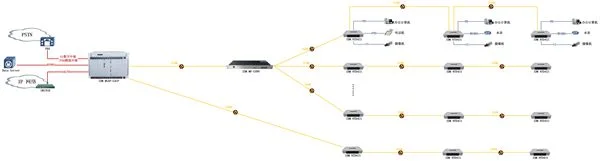
Chain Network Application
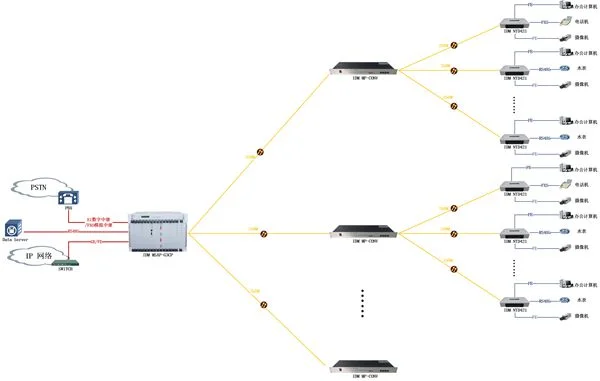
Star Network Application
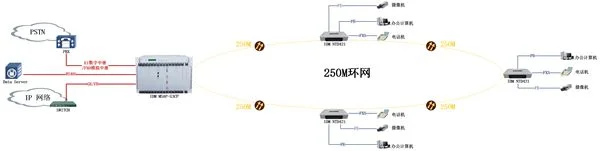
Optical Terminal Ring Network Application
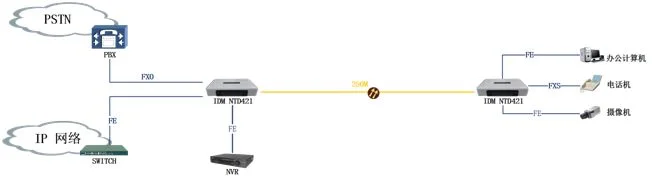
Optical Terminal Point-to-Point Application
FAQs
Top 10 Common Questions About Telephone Optical Terminals
Based on years of experience in the production and R&D of telephone optical terminals…
View answerHow to Troubleshoot Common Faults of Telephone Optical Terminal?
Device cannot be powered on Check whether the power cable is connected correctly.
View answerWhat is the difference between single-fiber and dual-fiber?
The biggest difference between single-fiber and dual-fiber optical terminals lies in the optical modules on their…
View answerWhat is an Optical Terminal?
Many people are unfamiliar with the optical terminal, but in essence, it is a dedicated device for optical-electrical…
View answer