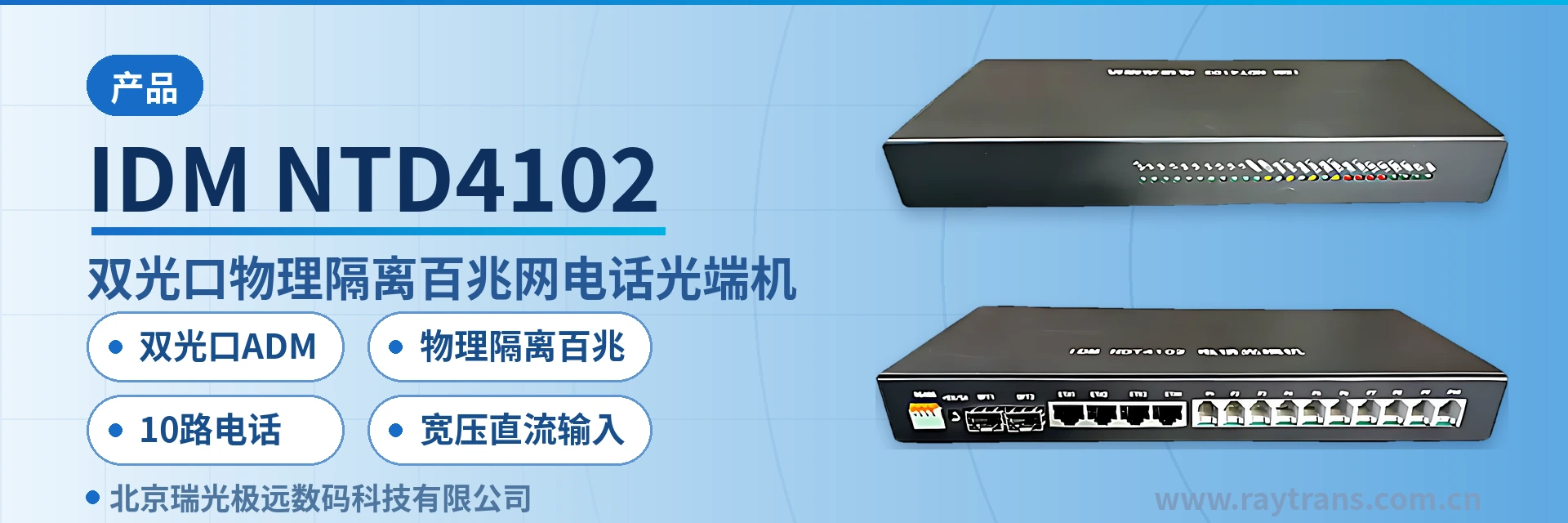
IDM NTD4102 Dual-Port ADM Chain Network Telephone Optical Multiplexer
Fiber break rerouting self-healing, dual-channel physical isolation, 10-channel telephone DIP switch network-management-free provisioning
The IDM NTD4102 multi-service optical multiplexer provides dual optical ports and supports the ADM chain network function; SFP optical modules allow convenient selection of single-mode/multi-mode, single-fiber/dual-fiber, wavelength, transmission distance, and other parameters.
IDM NTD4102 Dual-Optical-Port ADM Chain-Network Telephone Optical Multiplexer is a desktop-type multi-service optical fiber communication device developed by Beijing Ruiguang Jiyuan Digital Technology Co., Ltd. It is used to carry three types of services—telephone, Ethernet, and serial port data—simultaneously over a single optical fiber link, and is a typical multi-service optical multiplexer product. The device is equipped with two SFP optical ports and supports the ADM chain-network function, so multiple optical multiplexers along a line can be cascaded into a chain, and when the optical cable is interrupted at one point, services can be rerouted from the other direction.
The unit is intended for voice and data access in elevator Internet of Things (IoT), rail transit private networks, and remote sites of electric power and energy, and its desktop form factor makes it easy to place in elevator machine rooms, weak-current shafts, and secondary equipment cabinets at stations. Telephone, Ethernet, and serial port services each occupy an independent channel over the same optical fiber, so there is no need to lay separate cables for each service type during cutover.
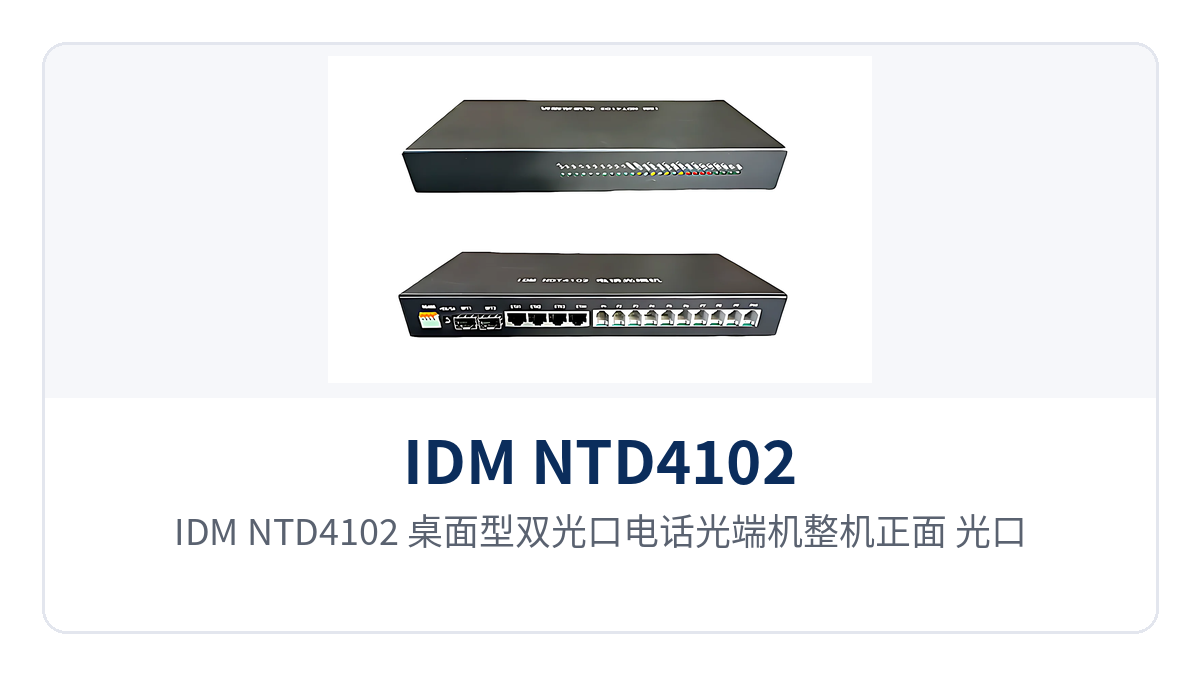
Figure 1: IDM NTD4102 desktop-type dual-optical-port telephone optical multiplexer, front view—layout of optical ports and telephone interfaces
Key Specifications at a Glance: 2× SFP optical ports (ADM chain-network support) · 2 groups of physically isolated Fast Ethernet channels · 10 telephone channels (time slot selectable via DIP switch) · 2 RS485 transparent transmission channels (optional at ordering) · 1–4 serial port server plug-in cards · DC+5V external adapter or customized DC+24V and -48V input
What is a dual-optical-port ADM chain-network telephone optical multiplexer?
A dual-optical-port ADM chain-network telephone optical multiplexer is a transmission device that multiplexes telephone, Ethernet, and serial port services onto an optical fiber. It is used in pairs, with services transparently restored at both ends of the optical link. ADM stands for add/drop multiplexing: each node on the chain only adds and drops its own site services while other services pass through along the optical fiber, so multiple sites can share a single trunk optical fiber without laying a separate pair of fiber cores for each site. As one of the product showcase items from the optical multiplexer manufacturer Raytrans, this device serves both as a telephone optical multiplexer and as a multi-service optical multiplexer in chain-network networking scenarios.
A single IDM NTD4102 provides two SFP optical ports, 2 groups of physically isolated Fast Ethernet channels, 10 telephone channels, and 2 RS485 transparent transmission channels, and can accommodate 1–4 serial port server plug-in cards. Serial port server services are aggregated at the central end via the first network channel, so the site only needs to terminate them centrally in the central equipment room without deploying an additional server at the remote station.
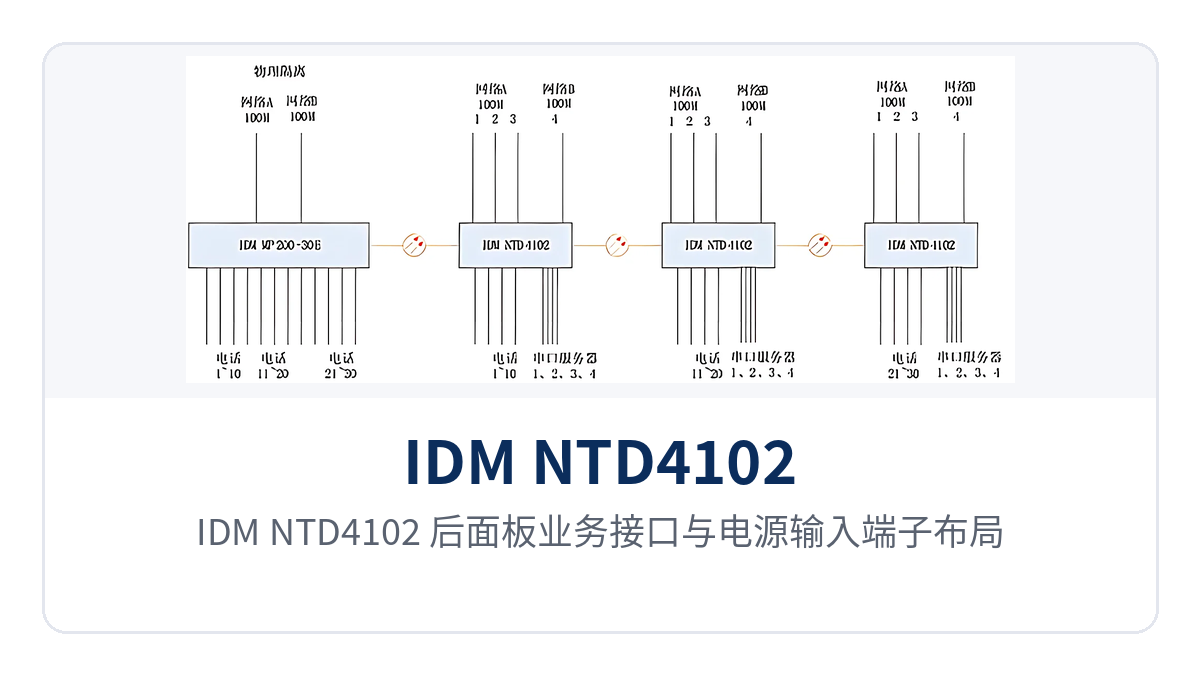
Figure 2: IDM NTD4102 rear panel—layout of service interfaces and power input terminals
Four capability labels: dual-optical-port ADM, physically isolated Fast Ethernet, 10 telephone channels, wide-voltage DC input
The four capability labels correspond to four things: the chain-network networking approach, Ethernet service isolation, voice channel capacity, and power supply access conditions. By checking each item below on site, you can determine the networking topology, number of channels, and ordering content, avoiding the discovery of mismatched optical modules or power supply formats only after the order is placed.
- Dual-optical-port ADM: The two SFP optical ports support the ADM chain-network function, fiber breakpoints can self-heal, making it suitable for chain-shaped industrial private networks; SFP optical modules can be selected by single-mode or multi-mode, single-fiber or dual-fiber, wavelength, and transmission distance.
- Physically isolated Fast Ethernet: The two groups of physically isolated Ethernet channels separately carry different services such as surveillance and office, with service security isolation and no network mixing; by default, Fast Ethernet is shared over the optical fiber, and VLANs can be divided between Ethernet interfaces.
- 10 telephone channels: A single unit provides 10 telephone interfaces, with transmission time slots selected by DIP switch, enabling fast on-site configuration without network management—calls are enabled once the DIP switches at both ends match.
- Wide-voltage DC input: By default, DC+5V is supplied by an external AC220V power adapter; DC+24V and -48V power inputs can also be customized per project to suit elevator machine rooms and in-station DC power distribution conditions.
How does fiber breakpoint self-healing work: operation of the dual-optical-port chain network
In a chain network, each device uses two optical ports—one connects to the upstream site and the other to the downstream site—and services are forwarded site by site. Each site only adds and drops its own voice channels and Ethernet services, while services of other sites passing through are passed through unchanged, so a single trunk optical fiber can string together multiple points along the line.
When a section of optical cable is interrupted, the devices on both sides of the breakpoint maintain local communication through the other optical port direction, and the impact of the failure is confined to adjacent sections, while the remaining sites on the chain continue to make calls and transmit data as usual. If the two ends of the link are closed into a ring, services at the breakpoint can also be restored via the reverse channel—this is exactly the value of the dual-optical-port ADM chain network in industrial private networks, and one of the reasons Raytrans optical multiplexers are selected in government private network optical fiber communication solutions and military emergency communications vehicle solutions.
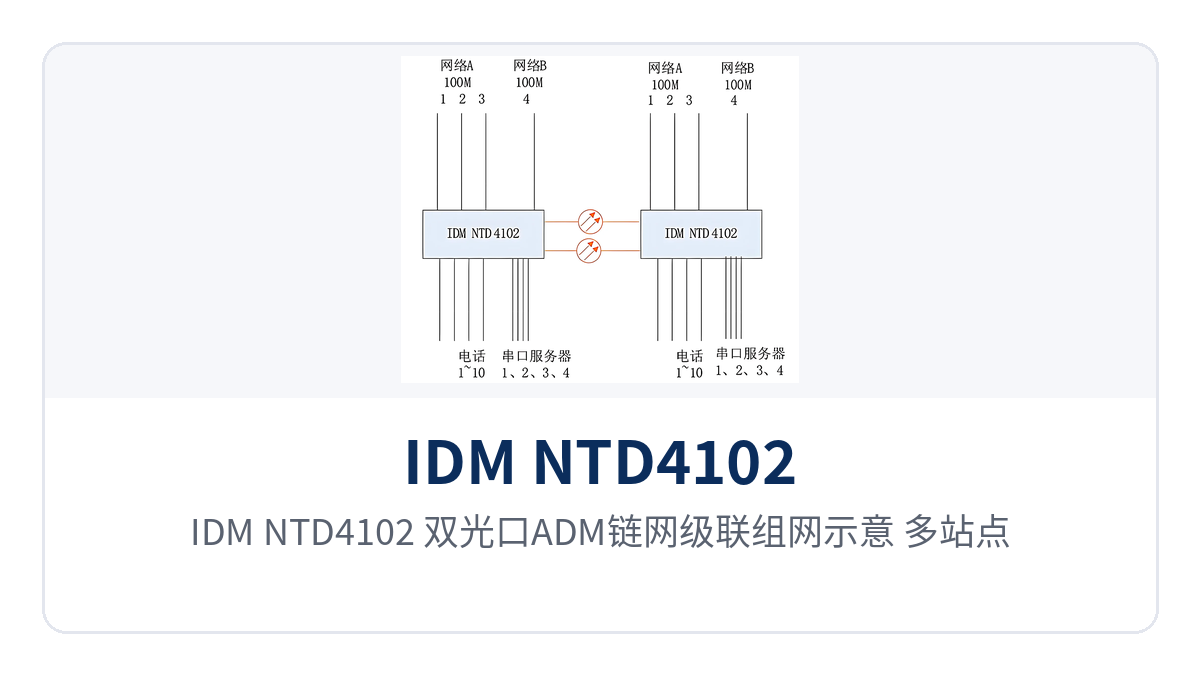
Figure 3: IDM NTD4102 dual-optical-port ADM chain-network cascading diagram—multiple sites sharing a single trunk optical fiber
How are the two groups of physically isolated Fast Ethernet channels used?
The two Ethernet channels each occupy independent transmission resources over the optical fiber and connect services of different security levels without crosstalk. The default factory configuration shares Fast Ethernet over the optical fiber, and VLANs can be divided between Ethernet interfaces; if two fully physically isolated channels are required, state the purpose at ordering, and the optical modules will also be configured separately according to the isolation scheme.
In elevator scenarios, one channel is often reserved for car video surveillance while the other connects access control and operating status acquisition; for electric power and rail transit sites, the practice is to assign production monitoring and the office network to the two channels. In this way, one optical fiber carries two networks, eliminating duplicate cable laying and preventing the internal and external networks from affecting each other within the same broadcast domain. In smart mining communication solutions, the same isolation mechanism can be used to separately carry underground monitoring and dispatch office services.
How are the time slots of the 10 telephone channels configured, and is network management required on site?
When the 10 telephone channels are used point-to-point, the transmission time slots are selected by the DIP switch on the device, and calls are enabled once the DIP switches at both ends match, with no additional network management software required on site. The voice channels support bidirectional dual signaling and telephone polarity reversal, and when interfacing with existing equipment room switching equipment and duty telephones, call, ringing, and on-hook states are presented in the original manner.
The device supports an elevator intercom interface, so intercom voice from the elevator machine room to the duty room can be connected directly without an additional protocol conversion device. When RS485 data needs to be transmitted, the 2 RS485 channels transmit transparently; simply state this at ordering to add the configuration, which is not included by default.
IDM NTD4102 function configuration overview
The device's functions center on chain-network networking, service isolation, and voice channel configuration, and are listed item by item in the table below for easy ordering according to on-site sites and service types. Items marked as optional at ordering in the table must be specified in the technical agreement and cannot be added on site after delivery; interface quantities and function items should also be checked item by item against this table.
| Function | Description |
|---|---|
| Dual SFP optical ports and ADM chain network | Provides two SFP optical ports and supports the ADM chain-network function, with multiple sites along the line cascaded and sharing a single trunk optical fiber |
| SFP optical module options | Optical modules can be selected by single-mode or multi-mode, single-fiber or dual-fiber, wavelength, and transmission distance; replacing the module adapts the device to different lines |
| Two groups of physically isolated Ethernet channels | Two groups of physically isolated Ethernet channels are transmitted over the optical fiber, sharing Fast Ethernet by default, with VLANs dividable between interfaces |
| 10 telephone channel access | A single unit provides 10 telephone interfaces; when used point-to-point, transmission time slots are selected by DIP switch |
| Bidirectional dual signaling and polarity reversal | Supports bidirectional dual signaling and telephone polarity reversal, interfacing with equipment room switching equipment and duty telephones in the original signaling manner |
| Elevator intercom interface | Supports an elevator intercom interface, so intercom voice on the equipment room side can reach the duty room directly over the optical fiber |
| 2 RS485 transparent transmission channels | Provides 2 RS485 channels for transparent transmission; state this at ordering to add the configuration, which is not included by default |
| Serial port server plug-in card | Can accommodate 1–4 serial port server plug-in cards, with services aggregated at the central end via the first network channel |
| Power input | By default, DC+5V is supplied by an external AC220V adapter; DC+24V and -48V power inputs can also be customized |
IDM NTD4102 technical specifications
The table below lists the main specifications by interface, channel, and power supply environment. For items not given, the manufacturer's technical documentation shall prevail; during selection, it is recommended to confirm them together with the optical module model. Wavelength and transmission distance vary with the selected SFP module, and the module models at both ends and the link budget should be written into the technical agreement during ordering to avoid insufficient received optical power margin on site.
| Item | Parameter/Specification | Description/Applicable Conditions |
|---|---|---|
| Equipment form factor | Desktop-type multi-service optical fiber communication device | Can be placed on an equipment room bench, in a weak-current box, or in a secondary equipment cabinet |
| Optical interface | 2 SFP optical ports | Supports ADM chain network and can also be used point-to-point |
| Fiber mode | Single-mode or multi-mode (depending on optical module) | Selected according to line fiber core conditions and interfacing requirements of devices at both ends |
| Single-fiber/dual-fiber | Single-fiber bidirectional or dual-fiber (depending on optical module) | Specify together with the optical module model at ordering |
| Wavelength | Determined by the selected SFP optical module | Specific wavelength values are not yet recorded in the knowledge base; the manufacturer's technical documentation shall prevail |
| Transmission distance | Determined by the optical module and line conditions | Specific kilometer figures are not yet recorded in the knowledge base; calculated according to the on-site link budget |
| Ethernet channels | 2 groups of physically isolated Fast Ethernet channels | Fast Ethernet is shared over the optical fiber by default, with VLANs dividable between interfaces |
| Ethernet interface rate | Fast Ethernet | Interfacing with in-station Fast Ethernet networks such as surveillance and office |
| Telephone channels | 10 | When used point-to-point, transmission time slots are selected by DIP switch |
| Voice channel signaling | Bidirectional dual signaling, with polarity reversal support | Interfacing with equipment room switching equipment and duty telephones in the original signaling manner |
| Elevator intercom | Supports an elevator intercom interface | Used for intercom voice extension from the elevator machine room to the duty room |
| RS485 channels | 2 transparent transmission channels | State this at ordering to add the configuration, which is not included by default |
| Serial port server plug-in card | 1–4 channels | Aggregated at the central end via the first network channel |
| Power supply mode | DC+5V by default, with external AC220V power adapter | DC+24V and -48V power inputs can also be customized |
| Overall power consumption | Not yet recorded in the knowledge base | The manufacturer's technical documentation shall prevail; confirm together at ordering |
| Operating temperature and humidity | Not yet recorded in the knowledge base | The manufacturer's technical documentation shall prevail |
Typical application scenarios
Elevator IoT: intercom and video backhaul from the machine room to the duty room over the same cable
Elevator machine rooms in residential and office buildings are mostly on the top floor or equipment floor, while the duty room is located in the ground-floor lobby or the industrial park surveillance center, and the distance between them often exceeds the transmission range of intercom twisted pair. By installing one IDM NTD4102 telephone optical multiplexer at each end and switching the intermediate link to optical cable, intercom voice and signaling reach the duty room directly over the optical fiber, and after a passenger presses the alarm in the car, the duty operator can connect and reassure them.
One group of Ethernet channels on the same optical cable can carry car video surveillance, while the other connects access control and operating status acquisition, so property management no longer needs to lay separate cables for video. The 10 telephone channel capacity suits grouped access of multiple elevators, and time slots are aligned on site via DIP switch, so maintenance personnel do not need to bring a computer into the machine room to adjust the configuration. As a mature product from the optical multiplexer manufacturer, Raytrans addresses both voice and video service carrying requirements in this scenario.
Rail transit private network: chain-network cascading and service isolation at sites along the line
Stations, depots, and trackside sites are distributed along the line, and inter-station calls, PA control, and monitoring data often each run over a separate set of cables. The IDM NTD4102 multi-service optical multiplexer is chained site by site, with the two optical ports at each station connecting upstream and downstream respectively, so a single trunk optical fiber runs through; when a section of optical cable is interrupted, the impact of the failure is confined to adjacent sections.
The two Ethernet channels at a station separately carry surveillance and office services, with service security isolation and no network mixing; the telephone channels carry inter-station duty calls, and bidirectional dual signaling and polarity reversal adapt to existing switching equipment. The desktop form factor makes it easy to place in the station communications equipment room or integrated equipment cabinet, with no need to modify civil works or cabinet structures during upgrades.
Electric power and energy remote sites: centralized backhaul of in-station voice and data
Substations, switching stations, and new energy stations are distributed on the outskirts of cities and in mountainous areas, and in-station dispatch telephones, environmental monitoring, and video data need to be backhauled to the centralized control station. The IDM NTD4102 optical multiplexer accesses telephone and two groups of Ethernet services at the station and sends them to the centralized control station over a single optical fiber, replacing the previous stacking of multiple devices and multiple line rentals.
Site power supply conditions vary considerably. By default, the device is powered by an external AC220V adapter; DC+24V and -48V DC inputs can also be customized on site to draw power directly from the station's DC power distribution. Chain network networking allows multiple stations along the line to share one trunk optical fiber; when expanding with a new station, only a node needs to be added to the chain, without re-laying the entire line. Raytrans provides corresponding product showcase and selection support for the different industry requirements of government private network optical fiber communication solutions, military emergency communications vehicle solutions, and smart mining communication solutions, and its industrial Ethernet switch manufacturer and video optical multiplexer product lines can also be networked together.
Conclusion
The IDM NTD4102 dual-optical-port ADM chain network telephone optical multiplexer packs two SFP optical ports, two groups of physically isolated Fast Ethernet channels, and 10 telephone lines into one desktop device. Chain network networking allows multiple sites along the line to share one trunk optical fiber, and the impact of a breakpoint is confined to adjacent sections.
The 10 telephone time slots are configured on site with DIP switches and enabled without network management. Together with the elevator intercom interface and customizable DC+24V and -48V power inputs, it suits voice and data access for elevator IoT, rail transit private networks, and remote sites in electric power and energy. As a professional optical multiplexer manufacturer, Raytrans continues to provide multi-service optical multiplexers and video optical multiplexers for scenarios such as government private network optical fiber communication solutions, military emergency communications vehicle solutions, and smart mining communication solutions. More product showcase and technical documentation are available through official channels.